Mary Van Blarcom Art

1913-1953

Painter, printmaker and craftsperson, Mary Van Blarcom was born in Newark, New Jersey and studied at Wellesley College. She was a member of the National Serigraph Society, where she served on the board of trustees from 1945–52 and was first vice-president from 1949–51. Van Blarcom was also a member of the National Association of Women Artists, the Artists Equity Association, the American Color Print Society, the New Jersey Art Association (Director), and the Artists of Today. She exhibited actively throughout the 1940s at many prominent art organizations.

to
2
3
Overall Width
to
Overall Height
to
3
3
3
2
1
2
2
1
1
1
1
1
1
3
3
10,138
2,779
1,375
1,369
3
Artist: Mary Van Blarcom
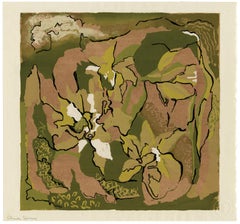
'China Spring' — Mid-Century Floral Abstraction
By Mary Van Blarcom
Located in Myrtle Beach, SC
Mary Van Blarcom, 'China Spring', color serigraph, c. 1945, edition not stated but small. Signed in pencil in the image, lower right. Titled in pencil, bottom left sheet edge. A rich, painterly impression, with fresh colors, on cream laid paper; with full margins (9/16 to 1 5/16 inches), in excellent condition. Matted to museum standards, unframed. Image size 10 3/4 x 10 3/4 inches; sheet size 11 15/16 x 12 5/8 inches. ABOUT THE ARTIST Painter, printmaker, and craftsperson, Mary Van Blarcom was born in Newark, New Jersey, and studied at Wellesley College. She was a member of the National Serigraph Society where she served on the board of trustees from 1945 through 1952 and was 1st vice-president from 1949-51. She was also a member of the National Association of Women Artists, the Artists Equity Association, the American Color Print Society, the New Jersey Artists Association (Director), and Artists of Today. Van Blarcom exhibited actively throughout the 1940s at many prominent art organizations including: Montclair Art Museum, 1941-45 and 1947-51 (prize, 1948); Society of Independent Artists, 1942-44; Artists of Today, 1942-46; Elisabeth Ney Museum, 1943; Northwest Printmakers, 1944, 1946-49; Laguna Beach Art Association, 1945-47, 1949; National Association of Women Artists, 1945-50, (prize, 1946); Library of Congress, 1946-47; Museum of Modern Art Traveling Exhibition, 1945-47; Carnegie Institute, 1947; Serigraph Gallery, 1946, 1951 (solo); American Color Print Society, 1947-52; Newark Museum, 1947-48, 1951; California State Library, 1947, 1949; National Serigraph Society, 1949 (prize), 1950 (prize); University of Chile, 1950; New Jersey State Museum, 1950; Philadelphia Art Alliance, 1951; and the Main Gallery, NY, 1952. Van Blarcom’s work is in the collections of the Newark Public Library, U.S. Library of Congress; the American Association of University Women; New York Public Library; Tel-Aviv Museum, Alabama Polytechnic Institute, Princeton Print Club...
Category

1940s American Modern Mary Van Blarcom Art

Materials

Screen

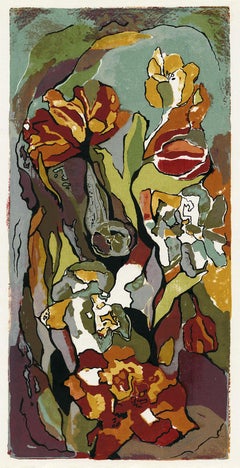
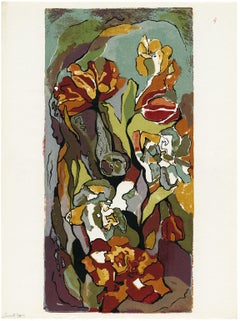
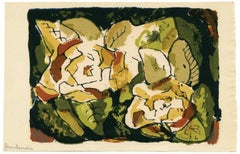
'Gardenias' — Mid-Century Floral Abstraction
By Mary Van Blarcom
Located in Myrtle Beach, SC
Mary Van Blarcom, 'Gardenias', color serigraph, c. 1945, edition small. Signed 'Van B' in pencil in the image, lower right. Titled in pencil, bottom left sheet corner. A rich, painterly impression, with fresh colors, on cream wove paper; the full sheet with margins (5/16 to 1 1/16 inches), in excellent condition. Image size 6 x 8 3/8 inches; sheet size 6 7/8 x 10 1/4 inches. Matted to museum standards, unframed. ABOUT THE ARTIST Painter, printmaker and craftsperson, Mary Van Blarcom was born in Newark, New Jersey and studied at Wellesley College. She was a member of the National Serigraph Society where she served on the board of trustees from 1945 through 1952 and was 1st vice-president from 1949-51. She was also a member of the National Association of Women Artists, the Artists Equity Association, the American Color Print Society, the New Jersey Artists Association (Director), and Artists of Today. Van Blarcom exhibited actively throughout the 1940’s at many prominent art organizations including: Montclair Art Museum, 1941-45 and 1947-51 (prize, 1948); Society of Independent Artists, 1942-44; Artists of Today, 1942-46; Elisabeth Ney Museum, 1943; Northwest Printmakers, 1944, 1946-49; Laguna Beach Art Association, 1945-47, 1949; National Association of Women Artists, 1945-50, (prize, 1946); Library of Congress, 1946-47; Museum of Modern Art travelling exhibition, 1945-47; Carnegie Institute, 1947; Serigraph Gallery, 1946, 1951 (solo); American Color Print Society, 1947-52; Newark Museum, 1947-48, 1951; California State Library, 1947, 1949; National Serigraph Society, 1949 (prize), 1950 (prize); University of Chile, 1950; New Jersey State Museum, 1950; Philadelphia Art Alliance, 1951; and the Main Gallery, NY, 1952. Van Blarcom’s work is in the collections of the Newark Public Library, U.S. Library of Congress; the American Association of University Women; New York Public Library; Tel-Aviv Museum, Alabama Polytechnic Institute, Princeton Print Club...
Category

1940s American Modern Mary Van Blarcom Art

Materials

Screen

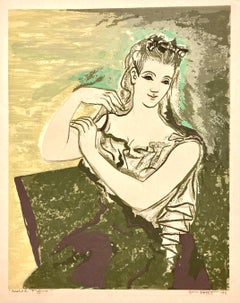
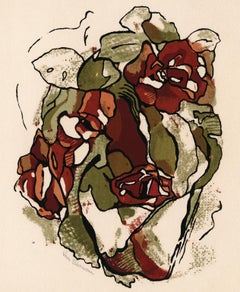
'Crown of Roses' — Mid-century Modernism
By Mary Van Blarcom
Located in Myrtle Beach, SC
Mary Van Blarcom, 'Crown of Roses', color serigraph, c. 1945, edition not stated but small. Signed in pencil beneath the image, lower left. Titled in pencil, bottom left sheet corner. A rich painterly impression, with fresh colors, on cream laid paper, with full margins (3/8 to 7/8 inch), in excellent condition. Matted to museum standards, unframed. Image size 8 13/16 x 12 11/16 inches; sheet size 9 1/2 x 8 5/16 inches. ABOUT THE ARTIST Painter, printmaker, and craftsperson, Mary Van Blarcom was born in Newark, New Jersey, and studied at Wellesley College. She was a member of the National Serigraph Society, where she served on the board of trustees from 1945 through 1952 and was 1st vice-president from 1949-51. She was also a member of the National Association of Women Artists, the Artists Equity Association, the American Color Print Society, the New Jersey Artists Association (Director), and Artists of Today. Van Blarcom exhibited actively throughout the 1940s at many prominent art organizations, including Montclair Art Museum, 1941-45 and 1947-51 (prize, 1948); Society of Independent Artists, 1942-44; Artists of Today, 1942-46; Elisabeth Ney Museum, 1943; Northwest Printmakers, 1944, 1946-49; Laguna Beach Art Association, 1945-47, 1949; National Association of Women Artists, 1945-50, (prize, 1946); Library of Congress, 1946-47; Museum of Modern Art Traveling Exhibition, 1945-47; Carnegie Institute, 1947; Serigraph Gallery, 1946, 1951 (solo); American Color Print Society, 1947-52; Newark Museum, 1947-48, 1951; California State Library, 1947, 1949; National Serigraph Society, 1949 (prize), 1950 (prize); University of Chile, 1950; New Jersey State Museum, 1950; Philadelphia Art Alliance, 1951; and the Main Gallery, NY, 1952. Van Blarcom’s work is represented in the collections of the Newark Public Library, the U.S. Library of Congress; the American Association of University Women; the New York Public Library; Tel-Aviv Museum, Alabama Polytechnic Institute, Princeton Print Club...
Category

1940s American Modern Mary Van Blarcom Art

Materials

Screen

Related Items
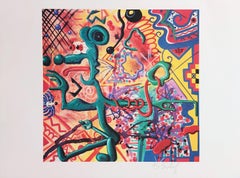
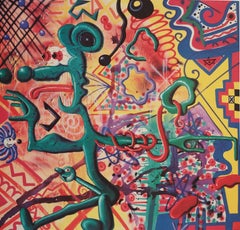
Ratfinkbonerthunk : Surrealist Rat - Original Giclee Print, Handsigned
By Kenny Scharf
Located in Paris, IDF
Kenny Scharf Ratfinkbonerthunk : Surrealist Rat, 1990 Original Giclee Print Handsigned in pencil On Arches vellum 56 x 76 cm (c. 22 x 30 in) Published by Editions Vermorel in 1990 ...
Category

1990s American Modern Mary Van Blarcom Art

Materials

Giclée, Screen

Harry Shokler, Island Harbor
By Harry Shokler
Located in New York, NY
Harry Shokler used serigraphy to great advantage in this landscape. It's colorful and detailed. It is signed in the image at the lower left. When printmakers began making serigraphs...
Category

1940s American Modern Mary Van Blarcom Art

Materials

Screen

"Equal Justice Under Law" Screenprint #99/125 on Wove Paper
By Robert Rauschenberg
Located in Soquel, CA
"Equal Justice Under Law" Screenprint #99/125 on Wove Paper Iconic composition by Robert Rauschenberg (American, 1925-2008). A red envelope and a hand holding sprouted grass the pli...
Category

1970s American Modern Mary Van Blarcom Art

Materials

Laid Paper, Screen

Original Mardi Gras New Orleans 1978 festival serigraph poster
Located in Spokane, WA
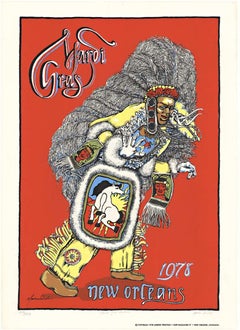
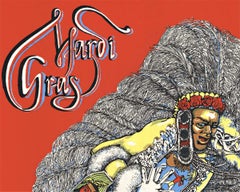
Original Mardi Gras, New Orleans, 1978 linen-backed poster. Dressed up in what would be an American Indian costume with full headgear, he is holding a shield with a horse on it. Indian decoration on the footwear. Signed and numbered. I believe this has to deal with Big Chief leading his Congo Nation Mardi Gras Indian group. Zulu Parade. Many of the original Mardi Gras jazz posters...
Category

1970s American Modern Mary Van Blarcom Art

Materials

Screen

Baden Baden, Casino
By LeRoy Neiman
Located in San Francisco, CA
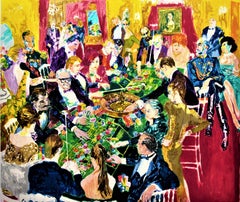
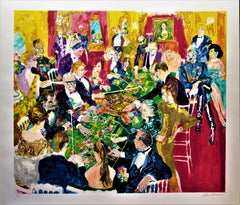
This artwork titled "Baden Baden, Casino" 1988 is an original color serigraph by noted American artist LeRoy Neiman, 1921-2012. It is hand signed and numbered 261/375 in pencil by the artist. The image size is 36 x 42 inches, sheet size is 42 x 48 inches. With the blind stamp of the printer Styria Studio at the lower left corner margin. It is in excellent condition, three small pieces of hanging tape remain on the back. About the artist: Mr. Neiman's kinetic, quickly executed paintings and drawings, many of them published in Playboy, offered his fans gaudily colored visual reports on heavyweight boxing matches, Super Bowl games and Olympic contests, as well as social panoramas like the horse races at Deauville, France, and the Cannes Film Festival. Quite consciously, he cast himself in the mold of French Impressionists like Toulouse-Lautrec, Renoir and Degas, chroniclers of public life who found rich social material at racetracks, dance halls and cafes. Mr. Neiman often painted or sketched on live television. With the camera recording his progress at the sketchpad or easel, he interpreted the drama of Olympic Games and Super Bowls for an audience of millions. When Bobby Fischer and Boris Spassky faced off in Reykjavik, Iceland, to decide the world chess championship, Mr. Neiman was there, sketching. He was on hand to capture Federico Fellini directing "8 ½" and the Kirov Ballet performing in the Soviet Union. In popularity, Mr. Neiman rivaled American favorites like Norman Rockwell, Grandma Moses and Andrew Wyeth. A prolific one-man industry, he generated hundreds of paintings, drawings, watercolors, limited-edition serigraph prints and coffee-table books yearly, earning gross annual revenue in the tens of millions of dollars. Although he exhibited constantly and his work was included in the collections of dozens of museums around the world, critical respect eluded him. Mainstream art critics either ignored him completely or, if forced to consider his work, dismissed it with contempt as garish and superficial — magazine illustration with pretensions. Mr. Neiman professed not to care. Maybe the critics are right," he told American Artist magazine in 1995. "But what am I supposed to do about it — stop painting, change my work completely? I go back into the studio, and there I am at the easel again. I enjoy what I'm doing and feel good working. Other thoughts are just crowded out." His image suggested an artist well beyond the reach of criticism. A dandy and bon vivant, he cut an arresting figure with his luxuriant ear-to-ear mustache, white suits, flashy hats and Cuban cigars. "He quite intentionally invented himself as a flamboyant artist not unlike Salvador Dalí, in much the same way that I became Mr. Playboy in the late '50s," Hugh Hefner told Cigar Aficionado magazine in 1995. LeRoy Runquist was born on June 8, 1921, in St. Paul. His father, a railroad worker, deserted the family when LeRoy was quite young, and the boy took the surname of his stepfather. He showed a flair for art at an early age. While attending a local Roman Catholic school, he impressed schoolmates by drawing ink tattoos on their arms during recess. As a teenager, he earned money doing illustrations for local grocery stores. "I'd sketch a turkey, a cow, a fish, with the prices," he told Cigar Aficionado. "And then I had the good sense to draw the guy who owned the store. This gave me tremendous power as a kid." After being drafted into the Army in 1942, he served as a cook in the European theater but in his spare time painted risqué murals on the walls of kitchens and mess halls. The Army's Special Services Division, recognizing his talent, put him to work painting stage sets for Red Cross shows when he was stationed in Germany after the war. On leaving the military, he studied briefly at the St. Paul School of Art (now the Minnesota Museum of American Art) before enrolling in the School of the Art Institute of Chicago, where, after four years of study, he taught figure drawing and fashion illustration throughout the 1950s. When the janitor of the apartment building next door to his threw out half-empty cans of enamel house paint, Mr. Neiman found his métier. Experimenting with the new medium, he embraced a rapid style of applying paint to canvas imposed by the free-flowing quality of the house paint. While doing freelance fashion illustration for the Carson Pirie Scott department store in Chicago in the early 1950s, he became friendly with Mr. Hefner, a copywriter there who was on the verge of publishing the first issue of a men's magazine. In 1954, after five issues of Playboy had appeared, Mr. Neiman ran into Mr. Hefner and invited him to his apartment to see his paintings of boxers, strip clubs and restaurants. Mr. Hefner, impressed, showed the work to Playboy's art director, Art Paul, who commissioned an illustration for "Black Country," a story by Charles Beaumont about a jazz musician. Thus began a relationship that endured for more than half a century and established Mr. Neiman's reputation. In 1955, when Mr. Hefner decided that the party-jokes page needed visual interest, Mr. Neiman came up with the Femlin, a curvaceous brunette who cavorted across the page in thigh-high stockings, high-heeled shoes, opera gloves and nothing else. She appeared in every issue of the magazine thereafter. Three years later, Mr. Neiman devised a running feature, "Man at His Leisure." For the next 15 years, he went on assignment to glamour spots around the world, sending back visual reports on subjects as varied as the races at Royal Ascot, the dining room of the Tour d'Argent in Paris, the nude beaches of the Dalmatian coast, the running of the bulls at Pamplona and Carnaby Street in swinging London. He later produced more than 100 paintings and 2 murals for 18 of the Playboy clubs that opened around the world. "Playboy made the good life a reality for me and made it the subject matter of my paintings — not affluence and luxury as such, but joie de vivre itself," Mr. Neiman told V.I.P. magazine in 1962. Working in the same copywriting department at Carson Pirie Scott as Mr. Hefner was Janet Byrne, a student at the Art Institute. She and Mr. Neiman married in 1957. She survives him. A prolific artist, he generated dozens of paintings each year that routinely commanded five-figure prices. When Christie's auctioned off the Playboy archives in 2003, his 1969 painting Man at His Leisure: Le Mans sold for $107,550. Sales of the signed, limited-edition print versions of his paintings, published in editions of 250 to 500, became a lucrative business in itself after Knoedler Publishing, a wholesale operation, was created in 1975 to publish and distribute his serigraphs, etchings, books and posters. Mr. Neiman's most famous images came from the world of sports. His long association with the Olympics began with the Winter Games in Squaw Valley in 1960, and he went on to cover the games, on live television, in Munich in 1972, Montreal in 1976, Lake Placid in 1980, and Sarajevo and Los Angeles in 1984, using watercolor, ink or felt-tip marker to produce images with the dispatch of a courtroom sketch artist. At the 1978 and 1979 Super Bowls, he used a computerized electronic pen to portray the action for CBS. Although he was best known for scenes filled with people and incident, he also painted many portraits. Athletes predominated, with Muhammad Ali and Joe Namath among his more famous subjects, but he also painted Leonard Bernstein, the ballet dancer Suzanne Farrell...
Category

21st Century and Contemporary American Modern Mary Van Blarcom Art
Materials

Screen

Baden Baden, Casino
Baden Baden, Casino
$4,000
H 42 in W 48 in D 0.01 in
Modernist Figurative Pop Art Etching and Aquatint "the Artist" Michael Mazur
By Michael Mazur
Located in Surfside, FL
Michael Mazur "The Artist" Hand signed and editioned from the edition of 50 1967 Michael Burton Mazur (1935-August 18, 2009) was an American artist who was described by William Grim...
Category

Early 2000s American Modern Mary Van Blarcom Art

Materials

Lithograph, Screen

"Balcony" 1938 WPA Print Mid 20th Century American Broadway Theatre Modernism
By Leon Bibel
Located in New York, NY
"Balcony" 1938 WPA Print Mid 20th Century American Broadway Theatre Modernism. Silk screen on paper, 15” x 20". Numbered 15/20 lower left. Pencil si...
Category

1930s American Modern Mary Van Blarcom Art

Materials

Paper, Screen

Left Bank Cafe, Paris
By LeRoy Neiman
Located in San Francisco, CA
This artwork titled "Left Bank Cafe, Paris" 1987 is an original color serigraph by noted American artist LeRoy Neiman, 1921-2012. It is hand signed and numbered H.C 166/175 in pencil by the artist. The image size is 26 x 38 inches, sheet size is 32.25 x 44 inches. With the blind stamp of the printer Styria Studio at the lower left corner margin. It is in excellent condition, two small pieces of hanging tape remain on the back. About the artist: Mr. Neiman's kinetic, quickly executed paintings and drawings, many of them published in Playboy, offered his fans gaudily colored visual reports on heavyweight boxing matches, Super Bowl games and Olympic contests, as well as social panoramas like the horse races at Deauville, France, and the Cannes Film Festival. Quite consciously, he cast himself in the mold of French Impressionists like Toulouse-Lautrec, Renoir and Degas, chroniclers of public life who found rich social material at racetracks, dance halls and cafes. Mr. Neiman often painted or sketched on live television. With the camera recording his progress at the sketchpad or easel, he interpreted the drama of Olympic Games and Super Bowls for an audience of millions. When Bobby Fischer and Boris Spassky faced off in Reykjavik, Iceland, to decide the world chess championship, Mr. Neiman was there, sketching. He was on hand to capture Federico Fellini directing "8 ½" and the Kirov Ballet performing in the Soviet Union. In popularity, Mr. Neiman rivaled American favorites like Norman Rockwell, Grandma Moses and Andrew Wyeth. A prolific one-man industry, he generated hundreds of paintings, drawings, watercolors, limited-edition serigraph prints and coffee-table books yearly, earning gross annual revenue in the tens of millions of dollars. Although he exhibited constantly and his work was included in the collections of dozens of museums around the world, critical respect eluded him. Mainstream art critics either ignored him completely or, if forced to consider his work, dismissed it with contempt as garish and superficial — magazine illustration with pretensions. Mr. Neiman professed not to care. Maybe the critics are right," he told American Artist magazine in 1995. "But what am I supposed to do about it — stop painting, change my work completely? I go back into the studio, and there I am at the easel again. I enjoy what I'm doing and feel good working. Other thoughts are just crowded out." His image suggested an artist well beyond the reach of criticism. A dandy and bon vivant, he cut an arresting figure with his luxuriant ear-to-ear mustache, white suits, flashy hats and Cuban cigars. "He quite intentionally invented himself as a flamboyant artist not unlike Salvador Dalí, in much the same way that I became Mr. Playboy in the late '50s," Hugh Hefner told Cigar Aficionado magazine in 1995. LeRoy Runquist was born on June 8, 1921, in St. Paul. His father, a railroad worker, deserted the family when LeRoy was quite young, and the boy took the surname of his stepfather. He showed a flair for art at an early age. While attending a local Roman Catholic school, he impressed schoolmates by drawing ink tattoos on their arms during recess. As a teenager, he earned money doing illustrations for local grocery stores. "I'd sketch a turkey, a cow, a fish, with the prices," he told Cigar Aficionado. "And then I had the good sense to draw the guy who owned the store. This gave me tremendous power as a kid." After being drafted into the Army in 1942, he served as a cook in the European theater but in his spare time painted risqué murals on the walls of kitchens and mess halls. The Army's Special Services Division, recognizing his talent, put him to work painting stage sets for Red Cross shows when he was stationed in Germany after the war. On leaving the military, he studied briefly at the St. Paul School of Art (now the Minnesota Museum of American Art) before enrolling in the School of the Art Institute of Chicago, where, after four years of study, he taught figure drawing and fashion illustration throughout the 1950s. When the janitor of the apartment building next door to his threw out half-empty cans of enamel house paint, Mr. Neiman found his métier. Experimenting with the new medium, he embraced a rapid style of applying paint to canvas imposed by the free-flowing quality of the house paint. While doing freelance fashion illustration for the Carson Pirie Scott department store in Chicago in the early 1950s, he became friendly with Mr. Hefner, a copywriter there who was on the verge of publishing the first issue of a men's magazine. In 1954, after five issues of Playboy had appeared, Mr. Neiman ran into Mr. Hefner and invited him to his apartment to see his paintings of boxers, strip clubs and restaurants. Mr. Hefner, impressed, showed the work to Playboy's art director, Art Paul, who commissioned an illustration for "Black Country," a story by Charles Beaumont about a jazz musician. Thus began a relationship that endured for more than half a century and established Mr. Neiman's reputation. In 1955, when Mr. Hefner decided that the party-jokes page needed visual interest, Mr. Neiman came up with the Femlin, a curvaceous brunette who cavorted across the page in thigh-high stockings, high-heeled shoes, opera gloves and nothing else. She appeared in every issue of the magazine thereafter. Three years later, Mr. Neiman devised a running feature, "Man at His Leisure." For the next 15 years, he went on assignment to glamour spots around the world, sending back visual reports on subjects as varied as the races at Royal Ascot, the dining room of the Tour d'Argent in Paris, the nude beaches of the Dalmatian coast, the running of the bulls at Pamplona and Carnaby Street in swinging London. He later produced more than 100 paintings and 2 murals for 18 of the Playboy clubs that opened around the world. "Playboy made the good life a reality for me and made it the subject matter of my paintings — not affluence and luxury as such, but joie de vivre itself," Mr. Neiman told V.I.P. magazine in 1962. Working in the same copywriting department at Carson Pirie Scott as Mr. Hefner was Janet Byrne, a student at the Art Institute. She and Mr. Neiman married in 1957. She survives him. A prolific artist, he generated dozens of paintings each year that routinely commanded five-figure prices. When Christie's auctioned off the Playboy archives in 2003, his 1969 painting Man at His Leisure: Le Mans sold for $107,550. Sales of the signed, limited-edition print versions of his paintings, published in editions of 250 to 500, became a lucrative business in itself after Knoedler Publishing, a wholesale operation, was created in 1975 to publish and distribute his serigraphs, etchings, books and posters. Mr. Neiman's most famous images came from the world of sports. His long association with the Olympics began with the Winter Games in Squaw Valley in 1960, and he went on to cover the games, on live television, in Munich in 1972, Montreal in 1976, Lake Placid in 1980, and Sarajevo and Los Angeles in 1984, using watercolor, ink or felt-tip marker to produce images with the dispatch of a courtroom sketch artist. At the 1978 and 1979 Super Bowls, he used a computerized electronic pen to portray the action for CBS. Although he was best known for scenes filled with people and incident, he also painted many portraits. Athletes predominated, with Muhammad Ali and Joe Namath among his more famous subjects, but he also painted Leonard Bernstein, the ballet dancer Suzanne Farrell...
Category

21st Century and Contemporary American Modern Mary Van Blarcom Art
Materials

Screen

Left Bank Cafe, Paris
$7,000
H 32.25 in W 44 in D 0.01 in
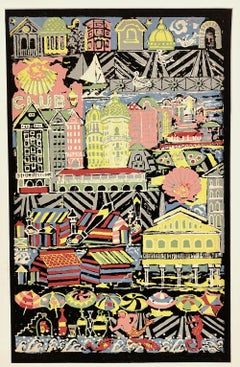
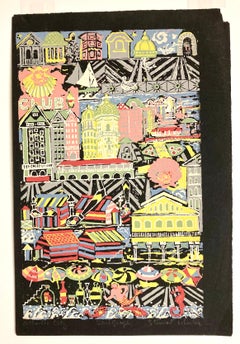
Stewart Wheeler, Atlantic City (New Jersey)
Located in New York, NY
The little that is know about the painter and printmaker Stewart Wheeler indicates that most of his career was spent in Philadelphia, Pennsylvania. And...
Category

Mid-20th Century American Modern Mary Van Blarcom Art
Materials

Screen

Flowers - Original Screen Print - Handsigned and /100 (Schellman II.101)
By Andy Warhol
Located in Paris, IDF
Andy Warhol (1928-1987) Flowers (black and white), 1986 Original silkscreen (Printer Alexander Heinrichi, New York) Signed in pencil with the monogram lower right Countersigned in p...
Category

1980s American Modern Mary Van Blarcom Art
Materials

Screen

Original USSR USA Superman superpowers original vintage poster
By Roman Cieslewicz
Located in Spokane, WA
Original 1968 Cold War Superman Style Poster by Roman Cieslewicz USSR / CCCP USA. Created as the cover of the French left-wing art magazine ‘Opus Internatio...
Category

1960s American Modern Mary Van Blarcom Art
Materials

Screen

Geno Pettit, Seated Figure
Located in New York, NY
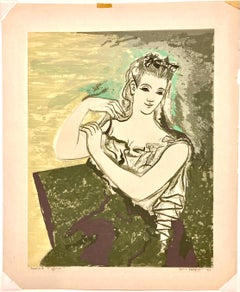
Seated Figure by Geno (sometimes Genoi) Pettit, made in 1945, is a wonderfully 'moderne' image. The woman is wearing a roman-inspired blouse or dress and is shown against a yellow/green, chartreuse background. There is the feeling she is about to lead an ancient procession at any moment! Pettit and her husband, Guy McCoy...
Category

Mid-20th Century American Modern Mary Van Blarcom Art
Materials

Screen

Previously Available Items
'Surgent Spring' — Mid-century Floral Abstraction
By Mary Van Blarcom
Located in Myrtle Beach, SC
Mary Van Blarcom, 'Surgent Spring', color serigraph, c. 1945. Signed in pencil in the image, lower right. Titled in pencil, bottom left sheet corner. A rich, painterly impression, with fresh colors, on cream laid paper; the full sheet with margins (3/8 to 3 1/2 inches); slight water stain in the top left sheet corner, well away from the image, otherwise in excellent condition. Image size 24 1/4 x 11 7/8 inches; sheet size 19 x 25 1/8 inches. Matted to museum standards, unframed. ABOUT THE ARTIST Painter, printmaker, and craftsperson, Mary Van Blarcom was born in Newark, New Jersey, and studied at Wellesley College. She was a member of the National Serigraph Society, where she served on the board of trustees from 1945 through 1952 and was 1st vice-president from 1949-51. She was also a member of the National Association of Women Artists, the Artists Equity Association, the American Color Print Society, the New Jersey Artists Association (Director), and Artists of Today. Van Blarcom exhibited actively throughout the 1940s at many prominent art organizations including Montclair Art Museum, 1941-45 and 1947-51 (prize, 1948); Society of Independent Artists, 1942-44; Artists of Today, 1942-46; Elisabeth Ney Museum, 1943; Northwest Printmakers, 1944, 1946-49; Laguna Beach Art Association, 1945-47, 1949; National Association of Women Artists, 1945-50, (prize, 1946); Library of Congress, 1946-47; Museum of Modern Art traveling exhibition, 1945-47; Carnegie Institute, 1947; Serigraph Gallery, 1946, 1951 (solo); American Color Print Society, 1947-52; Newark Museum, 1947-48, 1951; California State Library, 1947, 1949; National Serigraph Society, 1949 (prize), 1950 (prize); University of Chile, 1950; New Jersey State Museum, 1950; Philadelphia Art Alliance, 1951; and the Main Gallery, NY, 1952. Van Blarcom’s work is in the collections of the Newark Public Library, U.S. Library of Congress, the American Association of University Women, New York Public Library, Tel-Aviv Museum, Alabama Polytechnic Institute, Princeton Print Club...
Category

1940s American Modern Mary Van Blarcom Art
Materials

Screen

Mary Van Blarcom art for sale on 1stDibs.

Find a wide variety of authentic Mary Van Blarcom art available for sale on 1stDibs. You can also browse by medium to find art by Mary Van Blarcom in screen print and more. Much of the original work by this artist or collective was created during the 1940s and is mostly associated with the modern style. Not every interior allows for large Mary Van Blarcom art, so small editions measuring 9 inches across are available. Customers who are interested in this artist might also find the work of Arthur William Heintzelman., Frank Kleinholz, and Jacques La Grange. Mary Van Blarcom art prices can differ depending upon medium, time period and other attributes. On 1stDibs, the price for these items starts at $350 and tops out at $680, while the average work can sell for $475.

Artists Similar to Mary Van Blarcom

Still Thinking About These?

All Recently Viewed