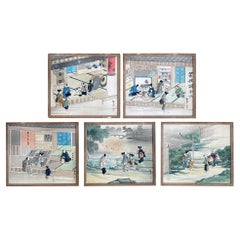
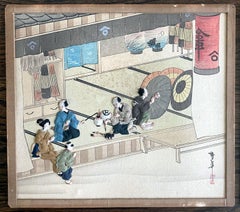
On offer is a set of five Japanese textile art panels called Oshi-E circa Meiji Period (1868-1912). This unusual set of panels depict various aspects of daily life in Edo time with beautiful details. Some of these panels are snapshots of the buzzling commercial activities at the marketplace, providing insight into the signages, architecture, costumes and how people interacted within a historical and pictorial context. Other panels depict daily leisure activities such as lounging in the park or visiting friends. The realistic rendering and attention to details are not short of "photographic" quality. From the signage of the shops to the motions and attires of the individual characters, from the hairstyle, small ornaments, down to the facial expression, were all recorded in great details. Each panel was signed with the artist's name Yukihana in Kanji with a red seal.
These panels are unframed and await your custom touch (framing with inner gilt spacer and mat costs about 250-500 depending on the material chosen, see a framed example in the last picture of a single framed panel we have for sale). We offer them for sale individually, but it will be great for a collector to consider the whole set so that they can stay together.
The Oshi-E (also known as kiritori zaiku) is a type of ornamental textile art dated back to the Muromachi period (1392-1573). It started among the elite aristocratic women in Kyoto before spreading wider in the Japanese society. Throughout Edo and Meiji period, Oshi-E were sometimes used to make offerings to the altars in the temple and in the late 19th century, it was exported to the west along with the other embroidery textile art. Oshi-E was made by using silk wadding to create a relief design. Various silk fabric swaps and sometimes wires and tassels, often recycled from older kimonos...
Category
1890s Japanese Meiji Antique Mira-X Wall Decorations