By Niccolò Stanchi
Located in Sanremo, IT
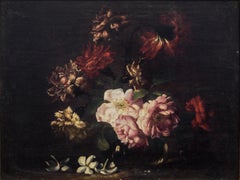
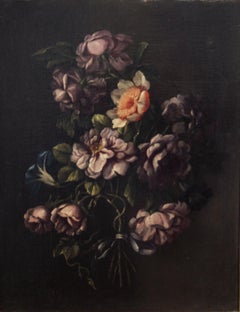
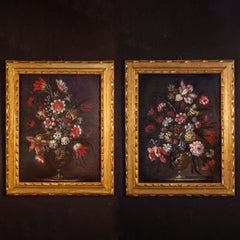
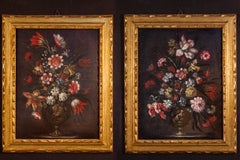
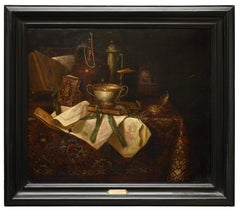
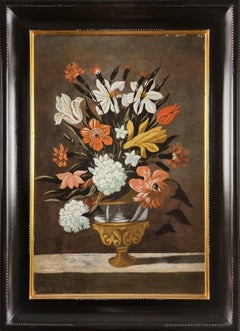
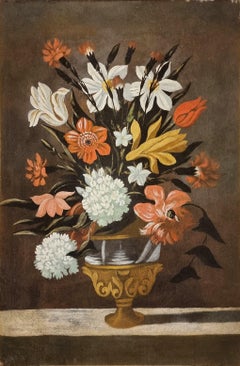
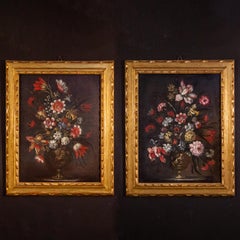
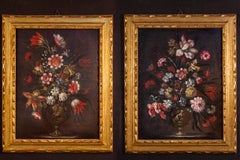
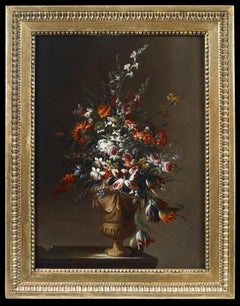
Painting oil on canvas measuring 67 x 45 cm without frame and 82 x 60 depicting a vase of flowers by the painter Niccolò tired (Rome 1626 - 1690).
The Stanchi brothers (Giovanni, Niccolò and Angelo), Roman painters of the seventeenth century, famous and courted by the patrons of the time, they were, subsequently, totally ignored by the historical criticism, which spread over them a silence as absolute as it was incomprehensible.
In reality, their copious and admirable production of flowers and still lifes would have deserved a very different destiny. Given the premise, the reconstruction of a catalog raisonné of the works that have come to light in recent times has proved to be no easy feat.
There is, however, a vast series of works preserved in ancient collections of the Medici, the Borghese, the Colonna and the Chigi, which have been inventoried and attributed to the Stanchi brothers. This allowed, in the light of a rigorous methodology based on comparison, to identify, in many paintings, the hand of Giovanni and Niccolò Stanchi. In particular, the art of Giovanni appears closely linked to the poetics of Verrocchio and, above all, of the Nordic, with singular ancestry to the teaching of Jan van Brueghel (1568-1623) for the composition of garlands of flowers and to that of Daniel Seghers (1590 -1661) for the garlands of flowers inserted inside religious subjects or for the illustration of Christological symbols.
From the very beginning, Giovanni has shown remarkable pictorial skills: the purity of the line, the perfection of the lines, the presence of dazzling colors in which one can recognize sincere adherence to the French culture. Giovanni will remain faithful to this poetic throughout the course of his own artistic life. Next to him, younger than a generation, emerges his brother Niccolò, who grows up in Giovanni's workshop.
He collaborates on many of his brother's still lifes, highlighting a greater freedom of expression than that of Giovanni, more controlled and severe. although he moves in the fraternal groove.
Niccolò introduces in the still lifes, dazzling naturalistic passages, of an amazing compositional effect and such as to enrich the poetics of the still life, at the time dominated by Baroque aesthetics. lesson of painters such as Michelangelo Cerquozzi, Mario dei Fiori, Michelangelo Pace and, above all, Abraham Brueghel.
A splendid example of such influences is the Mirror painted with vases of flowers and five cherubs (the figure is by Carlo Maratta) in the Galleria Grande...
Category
Late 17th Century Italian School Niccolò Stanchi Art