Sir Peter Lely Art

Dutch, 1618-1680
Sir Peter Lely (1618-1680) was born in Germany at Soest in Westphalia in 1618. Though his family name was van der Faes, he assumed the name Lely after the lily that was carved on the gable of his father’s home in The Hague. He moved to England in 1641, the year that Van Dyck died, and succeeded Van Dyck. He was court painter to Kind Charles I and King Charles II. By working for many of the patrons of the late van Dyck, Lely rapidly established himself as one of the country’s most important portrait painters.
to
1
1
1
Overall Width
to
Overall Height
to
3
2
3
1
1
1
1
3
3
2
2
3
10,681
2,826
2,495
1,414
1
3
Artist: Sir Peter Lely
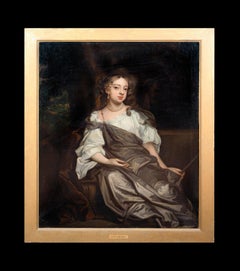
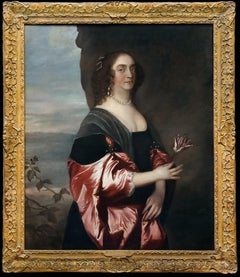
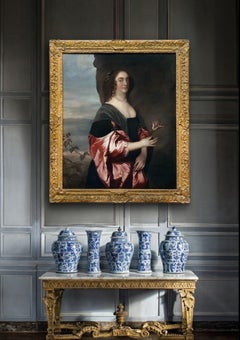
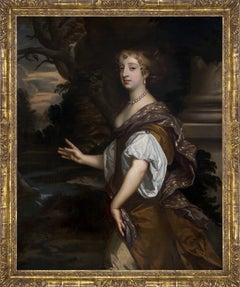
Portrait of a Lady, in Black Dress with Red Satin Sleeves and Pearls c.1660-1680

Portrait of a Lady, in Black Dress with Red Satin Sleeves and Pearls c.1660-1680

By Sir Peter Lely

Located in London, GB

Portrait of a Lady, in a Black Dress with Red Satin Sleeves and Pearls English School c.1660–1680 Circle of Sir Peter Lely (1618-1680) This striking portrait is a compelling exampl...

Category

17th Century Old Masters Sir Peter Lely Art

Materials

Canvas, Oil

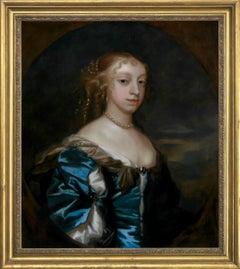
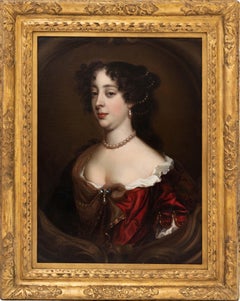
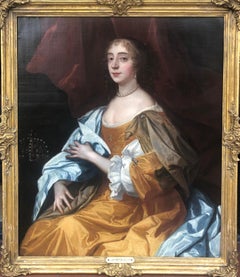
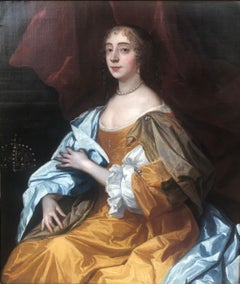
Portrait of Lady Diana Bruce in Blue Dress & Cut Sleeves c.1660-1670, Peter Lely

Portrait of Lady Diana Bruce in Blue Dress & Cut Sleeves c.1660-1670, Peter Lely

By Sir Peter Lely

Located in London, GB

Portrait of Lady Diana Bruce in a Blue Dress with Cut Sleeves c.1660-1670 Circle of Sir Peter Lely (1616-1680) Presented by Titan Fine Art is a captivating portrait of the noble Lad...

Category

17th Century Old Masters Sir Peter Lely Art

Materials

Oil, Canvas

Related Items
18th Century Oil on Canvas Portrait, Major Alexander Brown in Military Uniform.

18th Century Oil on Canvas Portrait, Major Alexander Brown in Military Uniform.

By Sir David Wilkie

Located in Cotignac, FR

18th Century Military portrait of a young officer in Napoleonic period military dress. The painting is not signed but the subject is Major Alexander Brown. The work is oil on canvas later mounted on board and presented in a fine 'Regence style' carved gilt frame. There are labels to the back referring to the subject, 'Major Brown of Trinity' and a framers trade label from Edinburgh. A magnificent and imposing portrait of a young military officer in the prime of his life. His red uniform adorned with fine buttons, fringed epaulettes and high gilt collar. His ruddy complexion offset by his stylish hair, a quiff and swept forward to the sides as was the fashion at the time. Sir David Wilkie RA (18 November 1785 – 1 June 1841) was a Scottish painter, especially known for his portraits, including formal royal ones, and scenes from his travels to Europe and the Middle East. He painted successfully in a wide variety of genres, including historical scenes. His main base was in London, but he died and was buried at sea, off Gibraltar, returning from his first trip to the Middle East. He was sometimes known as the "people's painter". He was Principal Painter in Ordinary to King William IV and Queen Victoria. Apart from royal portraits, his best-known painting today is probably The Chelsea Pensioners Reading the Waterloo Dispatch of 1822 in Apsley House. Sir David Wilkie was actually admitted in 1799 (despite only being 14) through the influence of the Earl of Leven...

Category

Late 18th Century Old Masters Sir Peter Lely Art

Materials

Canvas, Oil, Board

Italian 18th Century Oval Religious Oil on Canvas Painting with Saint Dominic

Italian 18th Century Oval Religious Oil on Canvas Painting with Saint Dominic

By Francesco de Mura

Located in Firenze, IT

This beautiful Italian 18th Century old masters oil painting on oval canvas with giltwood frame is attributed to Solimena and features a religious scene. In this splendid oval-shaped painting are depicted Saint Dominic...

Category

18th Century Old Masters Sir Peter Lely Art

Materials

Canvas, Oil

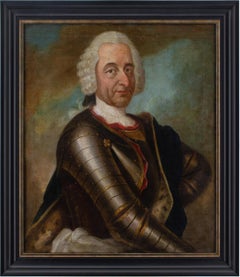
Mid-18th-Century German School, Portrait Of An Aristocrat In Armour, Oil

Mid-18th-Century German School, Portrait Of An Aristocrat In Armour, Oil

Located in Cheltenham, GB

This mid-18th-century half-length German portrait depicts a middle-aged aristocrat wearing armour and a wig. Despite his heavily-clad appearance, it’s likely that this rather noncha...

Category

1750s Old Masters Sir Peter Lely Art

Materials

Oil, Canvas

Oil Portrait of a Victorian Lady, c. 1850

Oil Portrait of a Victorian Lady, c. 1850, c. 1850

$1,480

H 13.75 in W 11.5 in D 1.75 in

Oil Portrait of a Victorian Lady, c. 1850

Located in Chicago, IL

Painted in the 19th century, this exquisite miniature portrait wonderfully exemplifies realism in traditional oil painting. The small artwork is painted in the conventional portraiture style of the Old Masters, and achieves soft realism with fine brushwork and a subdued, neutral palette. The half length portrait depicts a fine Victorian woman dressed in all black with a delicate lace collar and bonnet. She wears a ruby broach...

Category

Mid-19th Century Old Masters Sir Peter Lely Art

Materials

Oil

18th Century portrait oil painting of a lady in an ermine trimmed cloak

18th Century portrait oil painting of a lady in an ermine trimmed cloak

By Sir Godfrey Kneller

Located in Nr Broadway, Worcestershire

Circle of Sir Godfrey Kneller Dutch, (1646-1723) Portrait of a Lady in an Ermine Trimmed Cloak Oil on canvas Image size: 26.5 inches x 22.5 inches Size including frame: 33.5 inches x 29.5 inches A well-executed half-length portrait of a lady painted in a feigned oval, circle of Sir Godfrey Kneller. The use of a feigned oval was a device used in portraiture to give a sense of depth and add an intimacy to the painting, drawing your attention to the sitter. The subject, posed without her wig in the undressed fashion of the day, wears a blue ermine trimmed blue cloak over a white silk robe...

Category

18th Century Old Masters Sir Peter Lely Art

Materials

Canvas, Oil

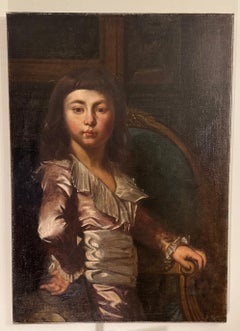
Two royal portraits (the Duc d'Angoulême and the Duc de Berry) by H.P. Danloux

Two royal portraits (the Duc d'Angoulême and the Duc de Berry) by H.P. Danloux

Located in PARIS, FR

These two royal portraits are a major historical testimony to the stay of the Comte d'Artois (the future Charles X) and his family in Edinburgh in 1796-1797. Given by the sitters to Lord Adam Gordon, the Governor of Edinburgh, and kept by family descent to this day, these two portraits provide us with a vivid and spontaneous image of the Duc d’Angoulême and his brother the Duc de Berry. Danloux, who had emigrated to London a few years before, demonstrate his full assimilation of the art of British portrait painters in the brilliant execution of these portraits. 1. Henri-Pierre Danloux, a portraitist in the revolutionary turmoil Born in Paris in 1753, Henri-Pierre Danloux was first a pupil of the painter Nicolas-Bernard Lépicié (1735 - 1784) and then, in 1773, of Joseph-Marie Vien (1716 - 1809), whom he followed to Rome when, at the end of 1775, Vien became Director of the Académie de France. In Rome he became friends with the painter Jacques-Louis David (1748 - 1825). Returning to France around 1782, he settled in Lyon for a few years before returning to Paris in 1785. One of his first portraits was commissioned by the Baroness d'Etigny, the widow of the former Intendant of the Provinces of Gascony, Bearn and Navarre Antoine Mégret d'Etigny (1719 – 1767). He then became close to his two sons, Mégret de Sérilly and Mégret d'Etigny, who in turn became his patrons. In 1787, this close relationship with the d'Etigny family was further strengthened by his marriage to Antoinette de Saint-Redan, a relative of Madame d'Etigny. After his marriage, he left for Rome and did not return to France until 1789. It was during the winter of 1790-1791 that he painted one of his masterpieces, the portrait of Baron de Besenval. Set in a twilight atmosphere, this portrait of an aristocrat who knows that his death is imminent symbolizes the disappearance of an erudite and refined society which would be swept away by the French Revolution. The Jacobin excesses led Danloux to emigrate to England in 1792; many members of his family-in-law who remained in France were guillotined on 10 May 1794. Danloux enjoyed great success as a portrait painter in England before returning to France in 1801. During his stay in England, Danloux was deeply under the influence of English portraitists: his colors became warmer (as shown by the portrait of the Duc d'Angoulême that we are presenting), and his execution broader. 2. Description of the two portraits and biographical details of the sitters The Duc d'Angoulême (1775-1844) was the eldest son of the Comte d'Artois, the younger brother of King Louis XVI (the future King Charles X), and his wife Marie-Thérèse of Savoie. He is shown here, in the freshness of his youth, wearing the uniform of colonel-general of the "Angoulême-Dragons" regiment. He is wearing the blue cordon of the Order of the Holy Spirit, which was awarded to him in 1787, and two decorations: the Cross of Saint-Louis and the Maltese Cross, as he was also Grand Prior of the Order of Malta. Born on 16 August 1775 in Versailles, Louis-Antoine d'Artois followed his parents into emigration on 16 July 1789. In 1792, he joined the émigrés’ army led by the Prince de Condé. After his stay in Edinburgh (which will be further discussed), he went to the court of the future King Louis XVIII, who was in exile at the time, and in 1799 married his first cousin Marie-Thérèse Charlotte of France, the daughter of Louis XVI and the sole survivor of the royal family. The couple had no descendants. He became Dauphin of France in 1824, upon the accession to the throne of his father but played only a minor political role, preferring his military position as Grand Admiral. Enlisted in Spain on the side of Ferdinand VII, he returned home crowned with glory after his victory at Trocadero in 1823. He reigned for a very short time at the abdication of Charles X in 1830, before relinquishing his rights in favor of his nephew Henri d'Artois, the Duc de Bordeaux. He then followed his father into exile and died on 3 June 1844 in Gorizia (now in Italy). His younger brother, the Duc de Berry, is shown in the uniform of the noble cavalry of the émigrés’ Army. He is wearing the blue cordon of the Order of the Holy Spirit, awarded to him in May 1789, and the Cross of Saint-Louis (partly hidden by his blue cordon). Born on 24 January 1778 in Versailles, Charles-Ferdinand d'Artois also followed his parents into emigration and joined the émigrés’ army in 1792. After his stay in Edinburgh, he remained in Great Britain, where he had an affair with Amy Brown...

Category

1790s Old Masters Sir Peter Lely Art

Materials

Canvas, Oil, Wood Panel

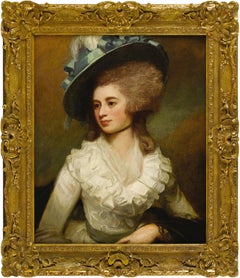
18th Century French Oil Portrait of an Elegant Lady, 68x56 cm

18th Century French Oil Portrait of an Elegant Lady, 68x56 cm

Located in Aartselaar, BE

Elegant 18th-Century French Portrait of a Young Lady This refined and captivating portrait depicts a young lady rendered with remarkable sensitivity and grace, characteristic of th...

Category

18th Century Old Masters Sir Peter Lely Art

Materials

Canvas, Oil

Male and female portrait, both in silk kimono, possibly textile dealers

Male and female portrait, both in silk kimono, possibly textile dealers

By Christoffel Lubieniecki

Located in Amsterdam, NL

CHRISTOFFEL LUBIENIECKI (1659-1729) Pair of portraits of a gentleman and a lady, both in silk kimono, before a country house (circa 1680) Indistinctly signed “C.......” on a box under the man’s left hand Oil on canvas, 79.5 x 67 cm each Both sitters are portrayed wearing a silk “Japanese” coat. During the second half of the seventeenth the Japanese silk coat, an adapted Japanese kimono, became a real vogue in the Dutch elite. The exclusive Dutch trade contacts with Japan can explain the popularity of the kimono-style silk coats in the Netherlands. Everybody who could afford one, dressed in such a fashionable and comfortable coat and, like the present sitters, some proud owners had themselves portrayed in a “Japanese” coat often together with an oriental carpet to underline their standing and international connections. These portraits are the work of the Polish-born portraitist Christoffel Lubieniecki (also known as Lubienitski, Lubinitski or Lubiniecki) Lubieniecki was first trained in Hamburg under Julian Stuhr and after 1675 in Amsterdam under Adriaen Backer and Gerard de Lairesse. He specialized in landscapes, generally of an Italianate character, and in portraits. The loving execution of these contented burghers, enjoying the garden vistas of their country house, places him alongside Amsterdam portraitists such as Constantijn Netscher and Michiel van Musscher...

Category

1680s Old Masters Sir Peter Lely Art

Materials

Canvas, Oil

17th-Century Flemish School, Portrait Of A Gentleman In A Justaucorps, Oil

17th-Century Flemish School, Portrait Of A Gentleman In A Justaucorps, Oil

Located in Cheltenham, GB

This fine late 17th-century Flemish portrait depicts a distinguished gentleman dressed in the elaborate fashions of the 1670s. He wears a long, collarless coat known as a justaucorps...

Category

1670s Old Masters Sir Peter Lely Art

Materials

Canvas, Oil

18th century French Old Master Portrait of a woman in oriental costume

18th century French Old Master Portrait of a woman in oriental costume

Located in Aartselaar, BE

French 18th century old master portrait of a majestic lady dressed "à la Turque" The sitter at the viewer with a kind and enigmatic smile and twinkling eyes. She looks elegant and kind, yet also has an intelligent and determined aura, reflecting the character of someone who is in charge of her own life and destiny. De Silvestre paid great attention to her spectacular outfit, which is striking in its portrayal of the sumptuous fabrics and their decorative richness. She is wearing a luxurious royal blue robe à la...

Category

1740s Old Masters Sir Peter Lely Art

Materials

Canvas, Oil

Young Girl with a Basket of Fruit, Oil on Canvas, French, Circa 1790

Young Girl with a Basket of Fruit, Oil on Canvas, French, Circa 1790

By Jean-Baptiste Greuze

Located in Paris, Île-de-France

French School, late 18th century, circle of Jean-Baptiste Greuze (1725–1805) Young Girl with a Basket of Fruit Oil on canvas, preparatory work, Unsigned 39 x 31 cm Provenance: Pri...

Category

1790s Old Masters Sir Peter Lely Art

Materials

Canvas, Oil

Previously Available Items
Portrait of Lady, Elizabeth Wriothesley, Countess of Northumberland, Peter Lely

Portrait of Lady, Elizabeth Wriothesley, Countess of Northumberland, Peter Lely

By Sir Peter Lely

Located in London, GB

Portrait of Elizabeth Wriothesley, Countess of Northumberland (1646-1690) (later Duchess of Montagu) c.1665-1669 Studio of Peter Lely (1618-1680) This exemplary three-quarter-length...

Category

17th Century Old Masters Sir Peter Lely Art

Materials

Canvas, Oil

Portrait of Bridget Drury Lady Shaw, formerly Viscountess Kilmorey

Portrait of Bridget Drury Lady Shaw, formerly Viscountess Kilmorey

By Sir Peter Lely

Located in London, GB

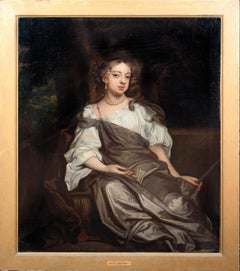
Sir Peter Lely (Soest 1618 – 1680 London) Portrait of lady with a crown, possibly Bridget Drury Lady Shaw, formerly Viscountess Kilmorey, later Lady Baber (d.1696) c.1665 Oil on canvas 46 1/2 x 40 3/4 inches, Framed 42 1/4 x 36 1/4 inches, Unframed Inscribed left [……….]Isabella James Mulraine wrote the following for this piece: This portrait dates to the middle of the 1660s, the decade when Lely’s career took off as successor to Sir Anthony van Dyck. At the Restoration Charles II had appointed him Principal Painter to the King and paid a pension £200 per annum ‘as formerly to Sr. Vandyke...’1 Lely had trained in Haarlem and he was in his early twenties when he came to London in 1643. He was an astute businessman and a wise courtier. In 1650 he painted a portrait of Oliver Cromwell (Birmingham Museum and Art Gallery) while maintaining links with the Royalist exiles through the 1650s. He had arrived in England as a painter of small-scale portraits and lush scenes of nymphs in landscapes in a Dutch style. His experience of Van Dyck in English collections transformed his painting. His lavish and alluring vision of Arcadia exactly captured the spirit of the Court and as Principal Painter he dominated English portraiture for the next twenty years. Lely ran a highly efficient studio along Netherlandish lines, employing a team of specialists like the drapery painter John Baptist Gaspars and young artists-in-training like Nicolas de Largilliere. He had numerous rivals during that period, and by 1670 he had introduced numbered standard poses to speed up production, while collaborating with printmakers for further revenue and advertising. He died in 1680 of a stroke while painting, working to the last. The portrait, painted at a date when Lely’s poses and execution were still individual and inventive shows a lady sitting at three-quarter length facing away from the viewer. She has begun to turn towards the viewer, a pose with a long pedigree in art, first used by Leonardo da Vinci in the Mona Lisa (Louvre). She steadies her blue drapery where it might slip from her arm with the movement, a flash of realism beautifully captured. Like Van Dyck, Lely painted his female sitters in a timeless costume rather than contemporary fashion, showing a loose gown and floating silk draperies. It presented the sitter as a classical ideal. The portrait would not date. The saffron dress may be the work of a drapery painter but the brown scarf must be by Lely himself, and appears unfinished, broadly sketched in behind the shoulder. The delicate blue glaze and nervous highlights suggest shimmering translucence. Lely was a master of painting hands – his hand studies are marvels of drawing – and the lady’s hands are superb, exactly drawn, delicately modelled and expressive. The fidgety gestures, clutching the gown, fiddling with the edge of the scarf, give the portrait psychological bite, suggesting the personality behind the calm courtier’s expression, adding to the sense shown in the look of the eyes and mouth that the lady is about to speak. The portrait’s language is Vandykian. The inspiration comes directly from Van Dyck’s English portraits of women. Lely owned Van Dyck’s Portrait of Lady Elizabeth Thimbleby and Dorothy Viscountess Andover (National Gallery, London) and the sitter’s costume quotes Lady Andover’s saffron dress and brown scarf. But Lely paints a generation who sat nearer to the ground and through a dialogue of expression and gesture he shows sitters who are more flesh and blood than Van Dyck’s. The background with a column and curtain is different to those shown in most of Lely’s portraits of women. They tend to include trees or fountains, with a glimpse of landscape. But there are other examples. A portrait of the King’s reigning mistress, Barbara Villiers Duchess of Cleveland...

Category

1660s Sir Peter Lely Art
Materials

Oil

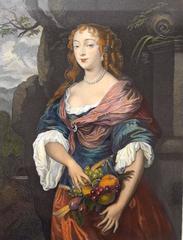
Elizabeth Lady Denham

Elizabeth Lady Denham

By Sir Peter Lely

Located in Saint Augustine, FL

An original hand colored copper plate engraving after Dutch artist Sir Peter Lely (1618-1680) titled "Elizabeth Lady Denham", 1833. Engraved by English artist Thomas Wright (1792-1849) in 1833. Incredibly framed with moulding from Spain, matting from Holland, all archival. Framed size: 21" x 17.75". Image size: 6.5" x 5". Mint condition. Sir Peter Lely (14 September 1618 – 30 November 1680) was a painter of Dutch origin, whose career was nearly all spent in England, where he became the dominant portrait painter to the court. Thomas Wright (1792–1849) was an engraver and portrait-painter. After serving an apprenticeship with Henry Meyer, and worked for four years as assistant to William Thomas Fry, for whom he engraved the popular plate of Princess Charlotte and Prince Leopold in a box at Covent Garden Theatre. About 1817 he began to practise independently as a stipple-engraver, and also found employment in taking portraits in pencil...

Category

1830s Old Masters Sir Peter Lely Art
Materials

Copper

Sir Peter Lely art for sale on 1stDibs.

Find a wide variety of authentic Sir Peter Lely art available for sale on 1stDibs. You can also browse by medium to find art by Sir Peter Lely in oil paint, paint, canvas and more. Not every interior allows for large Sir Peter Lely art, so small editions measuring 21 inches across are available. Customers who are interested in this artist might also find the work of Giovan Battista Viola, and Suzi Fadel Nassif. Sir Peter Lely art prices can differ depending upon medium, time period and other attributes. On 1stDibs, the price for these items starts at $11,379 and tops out at $83,120, while the average work can sell for $30,579.

Artists Similar to Sir Peter Lely

Questions About Sir Peter Lely Art
  • 1stDibs ExpertJanuary 19, 2025
    Sir Peter Blake was famous for his influence on the art world. He is widely regarded as the godfather of British Pop art and the Young British Artists (YBA) movement. Blake created paintings, collages and prints that blended modernity and nostalgia. Though best known for designing the album cover for the Beatles’s Sgt. Pepper’s Lonely Hearts Club Band, he considered painting to be central to his oeuvre. While celebrity figures such as Marilyn Monroe informed Blake's work, folk art, fairground signs and an overall sense of nostalgia also influenced his style. On 1stDibs, explore an assortment of Peter Blake art.