By William L'Engle
Located in Philadelphia, PA
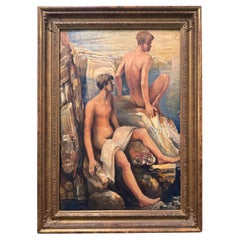
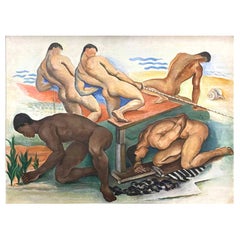
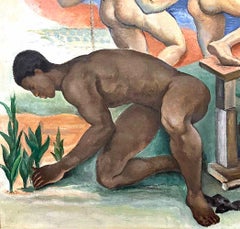
An extraordinary example of Art Deco painting with allegorical meaning -- like so many murals painted in the 1920s and 1930s -- this large work by William L'Engle depicts five nude male figures laboring in the field, symbolizing life in Provincetown, Massachusetts. A Black male figure in the foreground is planting crops, while two other figures in the distance are pulling a rope, perhaps alluding to fishing boats tied up at the dock, while another nude seems to be sinking into sleep beneath a pier -- all with the waters of the Atlantic Ocean in the background. L'Engle called this "The Five Josephs," perhaps referring to Joseph of Arimathea and other figures in the New Testament. William L'Engle was a towering figure in the Provincetown art colony, and was extremely well connected with America's artistic elite, starting with his trip to Europe as a young man with Waldo Pierce and George Biddle. Over time, William and his life Lucy became close to a wide range of important figures in painting, theater and the arts, including Charles Hawthorne, Eugene O'Neill, Gerrit Beneker, John Dos Passos, Edmund Wilson and Mary McCarthy, William and Marguerite Zorach, Edna St. Vincent-Millay, Charles Demuth, Childe Hassam, George Biddle, Edwin Dickinson...
Category
1930s American Art Deco Vintage Pal Fried Art