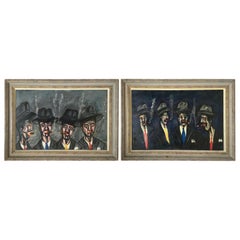
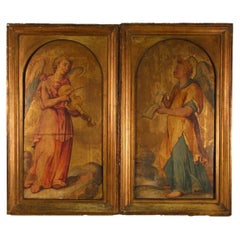
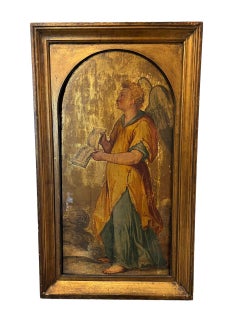
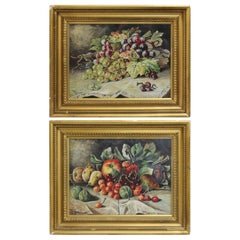
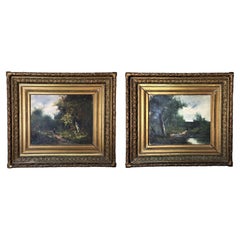
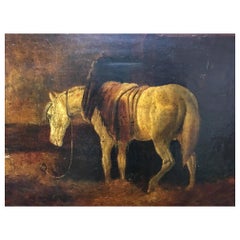
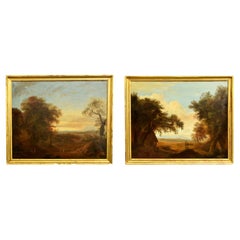
Landscapes, Xalapa, Mexico. Pair of oils on canvas. Spanish school, around 1840.
Provenance: Conde de la Cortina collection, Jalapa, Mexico.
Couple of landscapes framed within the Spanish school of the first half of the 19th century, with a clear romantic affiliation. Both evidence the knowledge of the Dutch classicist landscape, one of the main influences on the Spanish romantic landscape. Thus, we see compositions in "V", closed on the sides and open in the center, very low horizons that allow a wide development of the sky, spaces built in depth based on successive planes subtly differentiated by light and color, and small figures perfectly integrated into the natural setting. In addition, the skies are scenographic and dramatic, with low clouds behind which the golden light characteristic of the classicist landscape filters.
One of the most radical aspects of romantic painting was the attempt to replace large canvases with historical or religious themes with landscapes. They wanted the pure landscape, almost figureless or totally devoid of them, to achieve the heroic significance of history painting. They were based on the idea that human feeling and nature should be complementary, one reflected in the other. In other words, the landscape should arouse emotion and transmit ideas. Thus, landscapers like the author of these canvases tried to express their feelings through the landscape, instead of imitating it. The romantic landscape had two main aspects: the dramatic one, with turbulent and fantastic views, and the naturalistic one, which emphasized images of a peaceful and serene nature. This second conception is what we see embodied in these works; the painter tries to communicate a religious reverence for the landscape, nature in its fullness. In fact, the author's own use of light here conveys a foggy, cloudy, dreamlike atmosphere that invites the viewer to meditate and contemplate himself in the landscape. The romantic landscape is constituted, however, by manifestations of very different types and not comparable to each other; it does not affect all national schools equally, staying more faithful to tradition in schools such as the French or the Dutch. Thus, in this canvas we do not find the grandiose scenery of the British and Germans, the steep mountains or the monumental Gothic ruin...
Category
Mid-19th Century South American Neoclassical Revival Antique Paolo Corvino Furniture