
Florentine singer / - The Renaissance of the Renaissance -
By Paul Dubois
Located in Berlin, DE
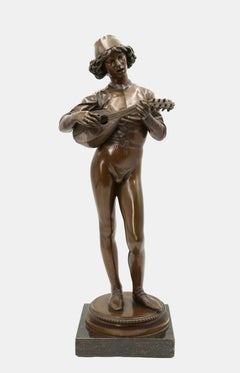
Paul Dubois (1829 Nogent-sur-Seine - 1905 Paris), Florentine singer, 1865. Light brown patinated bronze with cast round plinth mounted on a square marble base (3.5 cm high). Total height 53 cm. Bronze dimensions: 49.5 cm (height) x 20 cm (length) x 10 cm (width), weight 5.6 kg. Inscribed on the plinth "P.[aul] DUBOIS", dated "1865", with the foundry's mark "F. BARBEDIENNE FONDEUR" and the signet "REDUCTION MECANIQUE A. COLLAS". - Patina very occasionally darkened, lute with loss of one tuning peg, otherwise in excellent condition. - The renaissance of the Renaissance - The bronze is a precisely executed and masterfully cast contemporary reduction of Paul Dubois 155 cm tall masterpiece "Florentine Singer", which is exhibited in the Musée d'Orsay and for which the artist was awarded the Medal of Honor at the Paris Salon in 1865. The work acted as a beacon, and was followed by a plethora of depictions of juveniles. Inspired by Donatello and Luca della Robbia, but also by painters such as Piero della Francesca, Benozzo Gozzoli, and Pinturicchio, the "Florentine Singer" is not an epigonal work that pays homage to a vanished era, but a successful attempt to draw vitality from the art of the past and thus give it new life. The effect of vitality is the core of Italian Renaissance art theory. In order to fulfill itself as art, art had to appear like nature. This naturalism also characterizes the "Florentine Singer". The young man appears to have been taken from life, which is reinforced by the momentary nature of his action. He has just struck a now fading chord. In addition, the natural appearance is enhanced by the detailed shaping of the figurative details, such as the laces with the slightly curved leather of the shoes, the belt buckle, or the ornamentation on the body of the lute. Even the fingernails are clearly defined. Unlike the Renaissance, however, the effect of liveliness here is not based on the "discovery" of nature and the human body, but primarily on the rediscovery of the art of the Quattrocento. The liveliness of the artwork is therefore at the same time a revitalization of this art, so that we can speak of a Renaissance of the Renaissance, just as the Pre-Raphaelites in England at the same time transferred the Quattrocento to contemporary art. Dubois takes on the most difficult of all subjects, the depiction of singing through silent sculpture. He was preceded in this by Luca della Robbia and Donatello with their pulpits of singers created in the 1430s in the Museo dell'Opera del Duomo in Florence. Compared to these works, the physiognomy of Dubois singer is far less animated, yet he also depicts singing in a convincing manner. He uses the whole body. He takes the ancient contrapposto, which was essential to Renaissance sculpture, and transforms the standing leg-playing posture into a late medieval S-swing, giving the body an elegant beauty and at the same time setting it in melodic motion. In the equally elegant finger position, the music is expressed in a much more literal way with the beating of the lute. Finally, the musicality of the sculpture culminates in the face with the mouth open to sing. Through the act of singing, which is a great challenge to the artistic will to depict perfect beauty, the gracefulness of the classical face is not diminished, but enhanced. Starting from the face with the singing mouth and the gaze absorbed by the sounds, the inner vitality spreads, giving the bronze sculpture an intense aura, enhanced by the music. Dubois transfers the beauty of the Renaissance to the musical, sublimating the visible sculpture to the invisible of music. He took up the challenge of transcending the Renaissance with the Renaissance, thus responding to the Querelle des Anciens et des Modernes, which arose at the end of the 17th century around the French Academy and remained virulent into the 19th century, in which antiquity was regarded either as an unattainable ideal or as a standard to be surpassed. With his work, Dubois proved that the Renaissance, which had championed the art of the ancients, could lead to a new renaissance of art. About the artist Paul Dubois' great-uncle was the famous French Baroque sculptor Jean-Baptiste Pigalle, in whose footsteps the talented great-nephew followed. When he debuted at the Paris Salon in 1858, he signed his work "Dubois-Pigalle". At his father's request, however, he first studied law before devoting himself to sculpture under the tutelage of François Christophe Armand Toussaint in 1856 and entering the École des Beaux-Arts in 1858. From 1859 to 1863, he lived in Rome and traveled to Naples and Florence. Inspired by Florentine art of the quattrocento, Dubois initiated a school-forming neo-Florentine style that combined the elegantly simple forms of youthful grace with a precise wealth of detail.Two purchases by the French state (“envois de Rome”) were made during his stay in Rome, which brought him recognition in Paris. After his return there, he quickly became an internationally sought-after artist. Dubois was also active as a creator of monuments. His most famous work is the equestrian statue of Joan of Arc (1896) on the forecourt of Reims Cathedral. He was also a sought-after portraitist who produced around 50 busts and - Dubois was also a passionate painter - around 100 portraits in oil. From 1873 to 1878 he was curator of the Museum du Luxembourg, in 1876 he became a member of the Institut de France and from 1878 to 1905 he was director of the École des Beaux-Arts. In 1865, Dubois was awarded the Paris Salon Medal of Honor for his “Florentine Singer”. In 1867 he became Chevalier, in 1874 Officier, in 1886 Commandeur of the Légion d'honneur, which awarded Dubois the Grande Croix in 1896. Selected Bibliography Stole, Elmar: Paul Dubois. In: Saur. Allgemeines Künstlerlexikon, vol. 30, Munich - Leipzig 2001, pp. 677-678. GERMAN VERSION Paul Dubois (1829 Nogent-sur-Seine - 1905 Paris), Florentinischer Sänger, 1865. Hellbraun patinierte Bronze mit gegossener runder Plinthe auf quadratischem Marmorsockel montiert (3,5 cm Höhe). Gesamthöhe 53 cm. Maße der Bronze: 49,5 cm (Höhe) x 20 cm (Länge) x 10 cm (Breite), Gewicht 5,6 kg. Auf der Plinthe mit „P.[aul] DUBOIS“ bezeichnet, auf „1865“ datiert, mit dem Gießereistempel „F. BARBEDIENNE FONDEUR“ und dem Signet „REDUCTION MECANIQUE A. COLLAS“ versehen. - Patina sehr vereinzelt nachgedunkelt, Laute mit Verlust eines Stimmwirbels, ansonsten ausgezeichnet erhalten. - Die Renaissance...
1860s Realist Paul Dubois More Art
Bronze