Paul Soyer Mantel Clocks

to
1
1
1
1
1
1
1
1
Height
to
Width
to
1
1
1
1
42
27
25
21
Creator: Paul Soyer
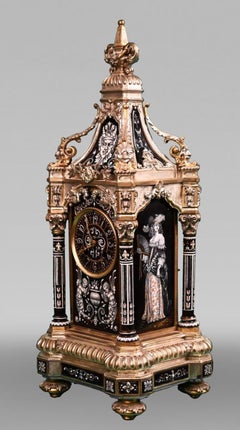
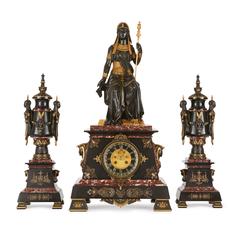
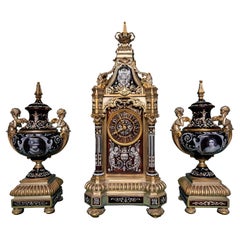
Renaissance Revival Clock Set by Paul Soyer, France, Circa 1875

Renaissance Revival Clock Set by Paul Soyer, France, Circa 1875

By Paul Soyer

Located in SAINT-OUEN-SUR-SEINE, FR

This clock set with a clock and two cassolettes was made by Paul Soyer around 1875. Paul Soyer (1832-1903) worked as a chaser in Paris from the 1850s. Gradually, he learned the technique of enamel to replace ornamental bronzes in furniture decoration. He opened a workshop as an engraver-enameller in 1861 and then collaborated with renowned enamelers and goldsmiths, such as Claudius Popelin, Charles Duron...

Category

Late 19th Century French Renaissance Revival Antique Paul Soyer Mantel Clocks

Materials

Bronze, Enamel

Related Items
Tiffany & Co. Renaissance Revival Architectural Mantel Clock

Tiffany & Co. Renaissance Revival Architectural Mantel Clock

Located in West Palm Beach, FL

Tiffany & Co. Renaissance Revival Architectural Mantel Clock France, circa 1885–1900 Impressive late 19th century Renaissance Revival architectural mantel clock retailed by Tiff...

Category

20th Century Paul Soyer Mantel Clocks

Materials

Wood

French Rococo Revival Carved Wooden Grandfather Clock with Cherubs

French Rococo Revival Carved Wooden Grandfather Clock with Cherubs

Located in BŘECLAV, CZ

Exceptional Italian grandfather clock in the French Rococo Revival style, dating to the early 20th century, masterfully crafted from richly stained wood and adorned with highly elabo...

Category

Early 20th Century Italian Rococo Revival Paul Soyer Mantel Clocks

Materials

Bronze

Antique Egyptian Revival Style Marble and Gilt Bronze Clock Set

Antique Egyptian Revival Style Marble and Gilt Bronze Clock Set

$10,195 / set

H 22.45 in W 16.54 in D 8.27 in

Antique Egyptian Revival Style Marble and Gilt Bronze Clock Set

Located in London, GB

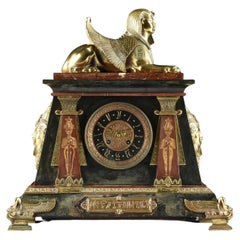
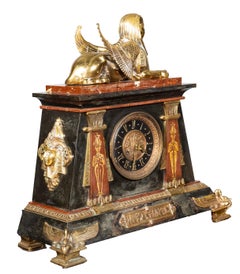
This clock set is designed in the Egyptian Revival style, which was in vogue in Europe and America in the 19th century. The fashion was kick-started by Emperor Napoleon I’s campaign in Egypt in 1798-1799. This led to the publication of ‘Le Description de l’Égypte’ (The Description of Egypt) in 1809 (and a second edition in 1830), which documented various aspects of Egyptian culture, including the pyramids, antiquities, ancient and modern buildings, Egyptian clothing...

Category

19th Century French Egyptian Revival Antique Paul Soyer Mantel Clocks

Materials

Marble, Ormolu, Bronze

Antique Renaissance Revival J.E. Caldwell French Delft Porcelain Mantel Clock

Antique Renaissance Revival J.E. Caldwell French Delft Porcelain Mantel Clock

By J.E. Caldwell & Co.

Located in Dayton, OH

Antique mantel clock was retailed by J.E. Caldwell & Co., an opulent and highly prestigious luxury jeweler and silversmith founded in Philadelphia in 1839. While the dial is sig...

Category

19th Century French Renaissance Revival Antique Paul Soyer Mantel Clocks

Materials

Brass

Egyptian Revival Mantle Clock Retailed By Tiffany & Company

Egyptian Revival Mantle Clock Retailed By Tiffany & Company

By L. Marti et Cie

Located in Essex, MA

A TIFFANY & CO. EGYPTIAN REVIVAL MANTLE CLOCK, AMERICAN, 1880s, a bronze ormolu and marble clock made by L. Marti et Cie for Tiffany & Company, marked on clock face, "Tiffany & Co." ...

Category

1880s French Egyptian Revival Antique Paul Soyer Mantel Clocks

Materials

Marble, Bronze, Ormolu

Egyptian Revival Marble, Gilt and Patinated Bronze Three-Piece Clock Set

Egyptian Revival Marble, Gilt and Patinated Bronze Three-Piece Clock Set

Located in London, GB

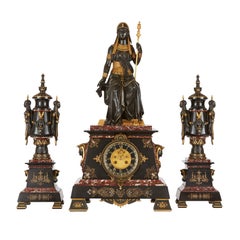
Attributed to Emile Herbert, French, 1828-1893. Comprising a central clock and a pair of flanking lidded vases, the clock on a red and black marble base with Pharaoh busts...

Category

19th Century French Egyptian Revival Antique Paul Soyer Mantel Clocks

Materials

Marble, Bronze

French Egyptian Revival Patinated Bronze and Marble Mantle Clock

French Egyptian Revival Patinated Bronze and Marble Mantle Clock

By Bigelow Kennard & Co.

Located in Bronx, NY

The clock having domed trapezoidal case, dome with bronze relief to front depicting a partial gilt Egyptian goddess, Isis, flanked by cobras and lotus scrolls, red marble ribbed columns to sides, clock face with gilt egg-and-dart border, gilt hands and mounts, clock face engraved BIGELOW KENNARD & CO. BOSTON, double-barrel clock movement by Achille Brocot, down to chained sphinx protruding from lower case, raised on stepped plinth. This vintage mantle clock...

Category

Late 19th Century American Egyptian Revival Antique Paul Soyer Mantel Clocks

Materials

Marble

Elegant Patinated and Gilt Bronze Portico Clock Circa 1875

Elegant Patinated and Gilt Bronze Portico Clock Circa 1875

Located in Lambertville, NJ

An elegant neoclassical bronze portico clock. The patinated bronze with gilt bronze accents with round white porcelain dial. The four columns on each side with a plinth base at the...

Category

1870s French Neoclassical Revival Antique Paul Soyer Mantel Clocks

Materials

Bronze

Large French Renaissance Revival Bronze Mounted Carved Walnut Mantel Clock

Large French Renaissance Revival Bronze Mounted Carved Walnut Mantel Clock

Located in Tarzana, CA

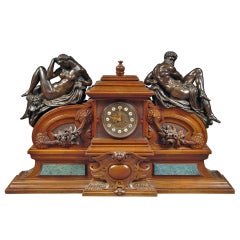
A magnificent 19th century French Renaissance Revival patinated bronze mounted carved walnut "Day and Night" mantel clock.  The dial with Roman numerals flanked by allegorical figures of night and day after Michelangelo. France, circa 1870 Maker: Victor Paillard The movement stamped: Vr. Paillard, Paris. Rodier Paris Stamp & Medaille Dor', 1837 Dimensions: Height 22" (56 cm) Width 37" (94 cm) Depth 9" (22 cm) Victor Paillard (1805-1886) designed and made various bronze decorative and functional objects including chenets, lighting and clocks. He also cast bronzes for some of the most important sculptors of the day including Barye, Carrier-Belleuse and Pradier He opened his first workshop in the 1830s at 105, boulevard Beaumarchais and 6, rue Saint-Claude and by the 1850s was employing around 100 people. His success at numerous international exhibitions including the 1851 Great Exhibition (where he displayed a bronze of the Standing Sappho after Pradier) further enhanced his reputation Day and night by Michelangelo: Though never finished, the tomb of Giuliano de' Medici in the Medici Chapel is the only one of Michelangelo great architectural-sculptural projects to be realized in a form approaching completion. Built between 1520 and 1534, it is widely held to be one of Michelangelo's most stunning achievements. The pose of the central figure on the tomb of Giuliano de' Medici, arms resting at his sides and legs comfortably apart, and its open composition suggest a cheerful Duke, generous in both mind and spirit. In fact, the figure holds in his hand several coins, as if an intended gift. Light plays freely on his beautiful face, yet the figure is lacking in energy and seems to wilt under the burden of the Roman armor...

Category

19th Century French Renaissance Revival Antique Paul Soyer Mantel Clocks

Materials

Marble, Bronze

A Gilded Egyptian Revival Timepiece Desk Clock

A Gilded Egyptian Revival Timepiece Desk Clock

$2,855

H 7.68 in W 5.71 in D 2.76 in

A Gilded Egyptian Revival Timepiece Desk Clock

Located in Amersham, GB

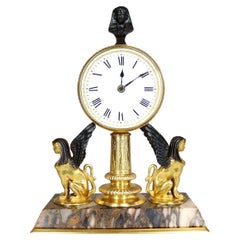
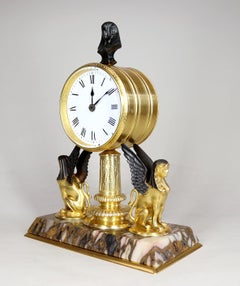
An Egyptian revival timepiece in a gilded and bronzed case. The four pillared eight day movement with a cylinder escapement is housed in a drum case, mounted behind a crisp white ena...

Category

Late 19th Century French Egyptian Revival Antique Paul Soyer Mantel Clocks

Materials

Siena Marble, Brass, Bronze

A Monumental Renaissance Revival Clock Garniture, Attributed to Feuchère

A Monumental Renaissance Revival Clock Garniture, Attributed to Feuchère

Located in Brighton, West Sussex

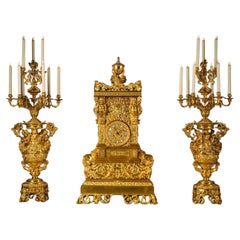
A Large and Important Louis Philippe Period Gilt-Bronze Three-Piece Clock Garniture. Attributed to the Feuchère family. The clock movement by Hémon. In the Renaissance revival style. Comprising a clock and a pair of nine-light candelabra. The clock case of architectural out-shape with cherubic term figures supporting a rectangular pediment centred by an urn. The sides of the clock tower cast in relief with strapwork and foliage. The dial inset with enamel Roman numeral chapters. The twin-barrel clock movement with tic-tac escapement, silk suspension and countwheel strike to bell. Pendulum and winding key. The candelabra as twin-handled vases supporting tiered branches with candle nozzles. Modelled en suite with naturalistic scrolls and foliage. Surmounted by finials modelled as an eagle toying with a serpent. The scrolled handles flanked by cherubic figures and serpents. The bodies fronted by bacchic masks and supported on socles bearing angels. France, Circa 1835. The clock movement signed ‘HEMON A PARIS’. The clockmaker Claude Hémon was established at rue de St. Martin circa 1810-1820. Dimensions, the clock: Height : 106 cm 42 inches Width : 58 cm 23 inches Depth : 38 cm 15 inches Weight : 72 kg Dimensions, the candelabra: Height : 104 cm 41 inches Width : 36 cm 14 inches Depth : 36 cm 14 inches Weight : 28 kg (each) This magnificent clock garniture of palatial size is designed in the Renaissance revival style and dates to the Louis Philippe period. Executed in sculptural gilt-bronze with leaves, scrolls, masks and exotic birds, the naturalistic ornament represents an elaborate system of allegories and mythological iconography which recall the influence of Italian Mannerist art in France. The distinctive design reflects a new style which replaced the neoclassism of the French Empire period. With the fall of Napoleon Bonaparte, artists and designers sought a new decorative vocabulary with which to aggrandise the Bourbon restoration. With the French revolution and Louis XVI’s execution still within living memory, it seemed too soon for a revival of the style of the Grand Siècle. Instead they looked further back to the time of François I, whose patronage of Italian artists had brought the Renaissance to France. The idea of a renaissance revival appealed to the new Bourbon monarchs and their patronage ignited great creativity in the arts. The reigns of Louis XVIII and Charles X, who were brothers of the late King, Louis XVI, and later of Louis Philippe I, nicknamed the Citizen King, coincided with the enlightenment and the dawn of the industrial age. Great technical progress was made in metallurgy and casting which raised the art of bronze making to new heights in the hands of great masters such as Pierre-Philippe Thomire (1751-1843) and Pierre- Jean-François Denière (1774-1866). The renaissance provided a rich and varied source book in architecture, furniture and other decorative arts for designers such as Claude Aimé Chenavard (1798-1838) whose Album de l’ornemaniste (1835) became a reference work. Léon Feuchère (1804-1857) also produced drawings of interiors, silver, bronzes and furniture and was a scion of the prominent family of bronze castors established by his grandfather Pierre-François Feuchère (1737-1823) who had worked as a gilder for the bronze caster Pierre Gouthière before setting up a bronze foundry that would become one of the largest in Paris under the management of his son Lucien-François (d. 1841) and grand-son Armand (1797-1866). A number of drawings by Léon Feuchère have recently been discovered by the Rijksmuseum and probably belonged to the collection of Louis-Philippe-Albert, duc d’Orléans, comte de Paris (1838-1894). Louis-Philippe-Albert was the grandson of the French king, Louis-Philippe I (1773-1850), who granted him the title of comte de Paris, and the son of Ferdinand-Philippe, duc d’Orléans (1810-1842). Ferdinand-Philippe was an important collector and sponsored many young artists to create metalwork objets d’art, notably a celebrated surtout de table made by Claude-Aimé Chenavard and Jean-Jacques Feuchère (1807-1852), a cousin of Armand and Léon. Principally remembered as a sculptor, Jean-Jacques Feuchère trained in the family foundry and designed small objects, cigar boxes...

Category

Early 19th Century French Renaissance Revival Antique Paul Soyer Mantel Clocks
Materials

Bronze

French Faience "Grandfather Clock", circa 1875

French Faience "Grandfather Clock", circa 1875

$7,500

H 16.25 in W 5 in D 3.5 in

French Faience "Grandfather Clock", circa 1875

Located in New York, NY

The central decoration of two lovers in a landscape. The base with a freely painted floral bouquet within a rococo cartouche. The arcuated top with a landscape.

Category

1870s French Antique Paul Soyer Mantel Clocks

Materials

Faience

Paul Soyer mantel clocks for sale on 1stDibs.

Paul Soyer mantel clocks are available for sale on 1stDibs. These distinctive items are frequently made of metal and are designed with extraordinary care. There are many options to choose from in our collection of Paul Soyer mantel clocks, although gold editions of this piece are particularly popular. Prices for Paul Soyer mantel clocks can differ depending upon size, time period and other attributes — on 1stDibs, these items begin at $34,305 and can go as high as $34,305, while a piece like these, on average, fetch $34,305.