By Richard Westall
Located in London, GB
Richard Westall, R.A. (1765-1836)
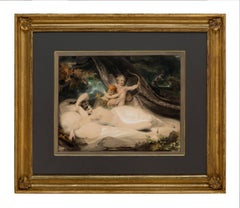
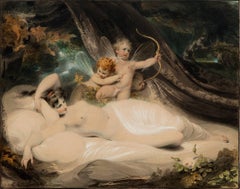
Venus
signed and dated ‘R. Westall 1794’ (lower right)
pencil and watercolour, with white heightening
image 11 ⅞ x 15 ¼ in. (30.2 x 38.7 cm.)
frame 22 ⅛ x 26 in. (56.3 x 66.1 cm.)
Provenance:
Private Collection, UK.
Venus (1794) was produced during a highly creative and defining period of Richard Westall’s career and artistic development, when from 1790-95 the ambitious young artist was sharing a house at 57 Greek Street, Soho, with his friend Sir Thomas Lawrence, the future President of the Royal Academy.
Whilst lodging together, Lawrence became an Associate of the Royal Academy in 1791, Westall the following year, and both were elected full-members in 1794 – the year Lawrence was appointed Painter-in-Ordinary to His Majesty King George III. Westall was to become Queen Victoria’s first Drawing Master, before her ascension to the throne.
It was in this very year, 1794 - as the two young artists became Royal Academicians - that the present watercolour was executed, and it is exciting to speculate that Lawrence would have examined and given his thoughts on the work.
Highly comparable to The Wallace Collection’s Nymph and cupids (c.1793, cat. P757), acquired by Francis Seymour-Conway (1777-1842), 3rd Marquess of Hertford, (who hung it in his bedroom), the mid-1790s saw Westall exhibiting and returning to similar subject-matter on a number of occasions. Two works with titles that could be applied to the present picture were exhibited at the Royal Academy, in 1794 (no. 341 Nymph and Cupids) and 1795 (no. 620, A Wood–nymph and Cupids). However, a print after the watercolour, engraved by F. Screen, entitles the piece Venus.
Westall is regarded as a great virtuoso watercolourist, and Venus is evidence of the young artist’s mastery of the medium. Indeed, it is unusual to find a watercolour of comparable age so well preserved, and retaining such vibrancy - the superb condition providing an insight into his exceptional brushwork and use of colour.
Venus languishes luxuriously on her woodland bed, the trunk of a tree resembling a curtain, while three winged putti play beside her, seeming to gesture to someone in the woods. Cupid draws back his bow and aims an arrow of love, perhaps about to pierce the heart of a hunting nobleman, or unsuspecting woodcutter. The striking contrast between the almost luminescent nymph, with the deep, rich, luxuriant forest, gives the glade an alluring sense of mystery – perhaps an allusion to the mysteries of the heart, a pre-occupation with Romanticism, central to the emerging thought of the time. Westall can be classified as one of the great Romantic artists, and even painted Lord Byron’s portrait...
Category
1790s Romantic Philip Richard Morris Art
MaterialsWatercolor, Pencil