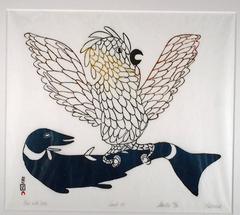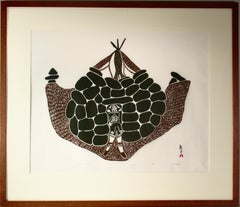
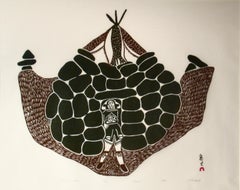
Lunik House
By Pitseolak Ashoona
Located in San Francisco, CA
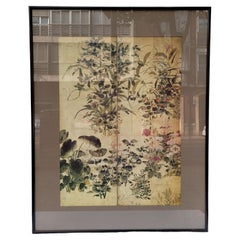
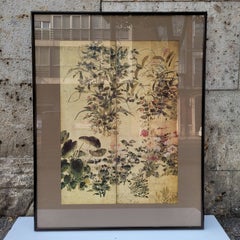
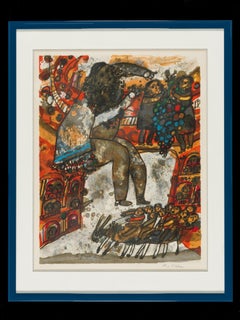
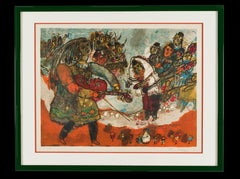
This artwork titled "Lunik Home" 1971, is an original stone cut on thin handmade paper by noted Inuit artist Pitseolak Ashoona, 1904-1983. It is hand signed, dated, titled, numbered 10/50 and inscribed Dorset in pencil by the artist. With the artist blind stamp at the lower right corner. The artwork (image) size is 15 x 17.5 inches, framed size is 25 x 29 inches. Custom framed in original light brown wood frame, with of-white color matting. It is in excellent condition, the frame have some very small minor restoration, barely visible. About the artist: Pitseolak was born to Timungiak and Oootochie on Nottingham Island in the Northwest Territories now Nunavut. Her name means "sea pigeon" in Inuktitut. She grew up in the traditional life of her people, with food dependent on hunting and gathering. Her culture relied on angakuit. In 1922 (or 1923), Pitseolak married Ashoona, a hunter, in the Foxe Peninsula of Baffin Island.[3] They had 17 children, though only six (Namoonie, Qaqaq, Kumwartok, Kiugak, Napachie, and Ottochie) lived with Pitseolak until adulthood. Some died in childhood, and others were adopted out according to custom, and raised by other Inuit families. After her husband died at the age of 40 from a viral sickness, Pitseolak raised four of the children, Kumwartok, Qaqaq, Kiawak or Kiugak, and daughter Napachie Pootoogook, herself. Years of hardship followed the death of Ashoona, which occurred sometime in the early to mid 1940s. He died in the early years of the Second World War, a time of decline in the market for furs. Over time the loss of Ashoona led Pitseolak to become an artist. Making prints eased her loneliness and she described her art as what made her "the happiest since he died". Pitseolak's artwork later enabled her to support her family. Though her art arose from painful circumstances, it expressed mostly positive memories and experiences. As Christine Lalonde notes in Pitseolak Ashoona: Life & Work: "scenes of deprivation and suffering almost never appear in her drawings, though certain images convey sadness and longing" about the passing of Ashoona. Pitseolak is recognized as one of the first Inuit artists to create autobiographical works. Her art contained images of traditional Inuit life and contributed to the establishment of a modern `Inuit art form, one that transmitted traditional knowledge and values while at the same time achieving worldwide popular and commercial success. Pitseolak died on May 28, 1983, in Cape Dorset now Kinngait. She was survived by a large family of artists, including: Pitseolak Ashoona was one of the first artists in the 1960s to make drawings for the print studio in Cape Dorset. She was a self-taught artist, who worked out solutions to artistic problems through what Lalonde described as "a self directed-program of repetitious drawing". Initially Pitseolak worked sewing and embroidering goods for sale as part of the arts and crafts program. It was initiated by the Department of Northern Affairs and National Resources as a way for Inuit to earn money. It was introduced by James Archibald Houston and Alma Houston at Cape Dorset in 1956. Upon seeing the work of her cousin Kiakshuk (1886–1966), who was part of the Cape Dorset graphic studio, Pitseolak decided to take up drawing. Her early work was well received and she soon became one of the most popular artists among those creating images for the Cape Dorset print...
Late 20th Century Modern Pitseolak Ashoona Art
Other Medium