Located in Benington, Herts
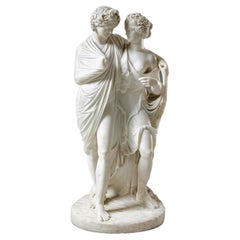
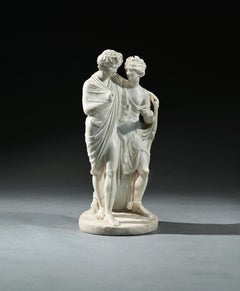
Extremely fine marble group of Bacchus and Ariadne after the antique attributed to Carlo Albacini (1734 – 1813)
Italy Rome circa 1800
Provenance
A French Private Collection
Carved in the round of white marble, the young couple shown walking and apparently exchanging words, his left arm gently wrapped around her shoulder, upholding part of her drapery, a wreath of fruit-bearing vines placed on his head, while hers shows no berries, from her right shoulder suspended a suggestive skin of a goat. In excellent condition having a restoration on Ariadne's left index finger.
This finely carved sculptural group is one of a number of known examples of this subject, all inspired by a Greco-Roman classical original 1st and 2nd centuries A.D which is now in the Museum of Fine Arts in Boston (inv.68.770). Demonstrating the beginning of Bacchus' courtship of Ariadne and illustrates the “Return to Antiquity” which was expressed in numerous archaeological works in Rome at the end of the 18th Century. The subject matter made it perfect for a wide variety of settings and fine copies of the subject which survive in such collections as the Rothschilds at Waddesdon Manor, the Pitti Palace in Florence, the Musée des Beaux-Arts de Nantes, the Musées royaux des Beaux-Arts de Belgique and the National Trust property Erddig in Wales.
This marble is exemplary of neoclassical aesthetics, by its ancient origin and by the creativity of the sculptor who perfectly links these two figures in the manner of Antonio Canova's standing groups (see Daedalus and Icarus or Venus and Adonis). This marble represents a moment of tender complicity illustrating the ability of neoclassical sculptors to detach themselves from ancient rigour in order to introduce an ideal of softness into their works. These two figures are not simply next to each other, but marry through the fusion of their drapes, through the play of glances and through the embracing gesture of Bacchus.
Of the surviving 18th and early 19th century examples of this group, the finest are signed by or attributed to the Italian master Carlo Albacini (1734-1813). Albacini was a restorer of ancient marbles who worked extensively on such aristocratic assemblages as the Charles Townley collection, later to form the basis of the fine sculpture collections at the British Museum, whilst also creating copies of these antique pieces for his elite clientele. Aside from Townley, one of the most interesting and important English collectors of this period was the Earl of Bristol who had a fine house in Naples, a London townhouse and his Suffolk family seat Ickworth which he intended to fill with exceptional examples of art of all kinds. Bristol was a great patron of Italian artists and a chimneypiece from his collection that was supplied for his Italian home and later fitted at Ickworth was sold at Sotheby's on the 26th of November 2003 lot 87. This exceptionally carved chimneypiece...
Category
19th Century Italian Antique Pradier Statues