Reg Butler Art
to
1
1
1
Overall Width
to
Overall Height
to
1
2
1
1
2
1
2
2
1
1
1
1
1
2
1
1
1
1
3
10,222
2,785
2,504
1,384
2
2
1
Artist: Reg Butler
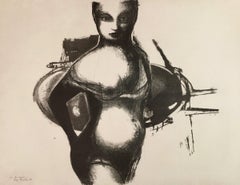
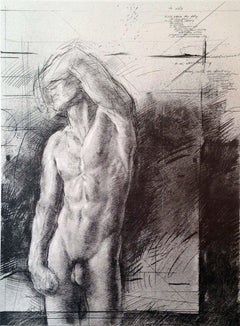
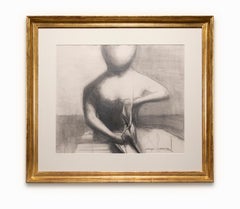
Reg Butler Abstract Figurative Signed "Manipulator"
By Reg Butler
Located in Detroit, MI
SALE ONE WEEK ONLY
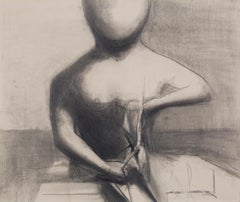
"Manipulator" is an abstracted figurative drawing in charcoal and graphite. The figure seems to be "manipulating" some object it holds without visual clarity as what that object is leaving it up to the viewer to fantasize about its intent. The drawing has a monumentality to it that speaks of Butler’s influence by Henry Moore, for whom he worked at one time, and echoes the style of the sculptures that Butler created. Butler most often used the female figure in his sculptures and drawings and although it is not certain, this drawing may be of a female figure engaged in some hand work with perhaps a mechanical toy that resembles a bird.
Butler trained as an architect and worked as a blacksmith before becoming Henry Moore’s assistant and developing his own talent as a sculptor. His first solo exhibition was held in 1949 at the Hanover Gallery in London. In 1952 he exhibited at the Venice Biennale and in the same year won a much publicized competition for a Monument to the Unknown Political Prisoner which, however, was never made. After winning the 'Unknown Political Prisoner' competition in 1953 he became one of the best known sculptors during the 1950s and 1960s, and also taught at the Slade School of Art.
Reginald Cotterell Butler (28 April 1913 – 23 October 1981) was an English sculptor born at Bridgefoot House, Buntingford, Hertfordshire to Frederick William Butler, formerly a police constable, and Edith Barltrop. His parents were the Master and Matron of the Buntingford Union Workhouse. His father was a relative of the poet William Butler Yeats; Edith was of Anglo-French descent.
Butler studied and lectured at the Architectural Association School of Architecture in London from 1937 to 1939. He was a conscientious objector during the Second World War, being exempted from military service conditional upon setting up a small blacksmith business repairing farm implements. Butler's later work consists of lifelike models of female figures, such as Girl on a Round Base, that have something in common with Hans Bellmer and the sculpture of Allen Jones and prefigure the work of Ron Mueck...
Category
1960s Abstract Reg Butler Art
Materials
Paper, Graphite, Charcoal
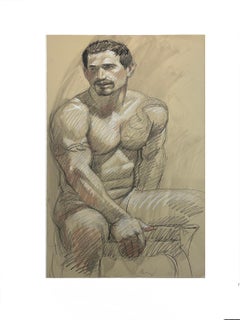
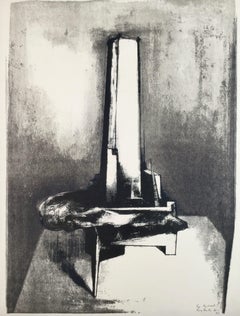
Tower, 5 from Europäische Graphik VI, Black and White Lithograph Print, 1968-9
By Reg Butler
Located in Kingsclere, GB
Tower, 5 from Europäische Graphik VI, Lithograph on Arches Paper (Unframed) Painting by Reg Butler, 1968-9
Additional information:
Medium: Lithograph on Arches paper (unframed)
70 x...
Category
21st Century and Contemporary Reg Butler Art
Materials
Lithograph
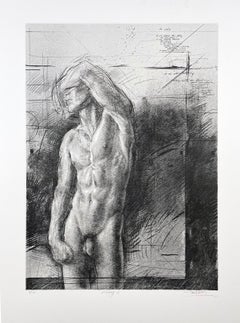
Girl, 4 from Europäische Graphik VI, Black and White Lithograph Print, 1968-9
By Reg Butler
Located in Kingsclere, GB
Girl, 4 from Europäische Graphik VI, Lithograph on Arches Paper (Unframed) Painting by Reg Butler, 1968-9
Additional information:
Medium: Lithograph on Arches paper (unframed)
54 x ...
Category
21st Century and Contemporary Reg Butler Art
Materials
Lithograph
Related Items
MB 702 (Contemporary Life Drawing of Male Nude by Mark Beard)
By Mark Beard
Located in Hudson, NY
MB 702 (Contemporary Life Drawing of Male Nude by Mark Beard)
graphite, Conte crayon and charcoal on Arches paper
30 x 19 inches unframed
Con...
Category
2010s Contemporary Reg Butler Art
Materials
Conté, Charcoal, Archival Paper, Graphite
Marc Chagall - Inspiration - Original Lithograph from "Chagall Lithographe" v. 2
By Marc Chagall
Located in Collonge Bellerive, Geneve, CH
Marc Chagall
Original Lithograph from Chagall Lithographe 1957-1962. VOLUME II.
1963
Dimensions: 32 x 24 cm
From the unsigned edition of 10000 copies without margins
Reference: Mourlot 398
Condition : Excellent
Marc Chagall (born in 1887)
Marc Chagall was born in Belarus in 1887 and developed an early interest in art. After studying painting, in 1907 he left Russia for Paris, where he lived in an artist colony on the city’s outskirts. Fusing his own personal, dreamlike imagery with hints of the fauvism and cubism popular in France at the time, Chagall created his most lasting work—including I and the Village (1911)—some of which would be featured in the Salon des Indépendants exhibitions. After returning to Vitebsk for a visit in 1914, the outbreak of WWI trapped Chagall in Russia. He returned to France in 1923 but was forced to flee the country and Nazi persecution during WWII. Finding asylum in the U.S., Chagall became involved in set and costume design before returning to France in 1948. In his later years, he experimented with new art forms and was commissioned to produce numerous large-scale works. Chagall died in St.-Paul-de-Vence in 1985.
The Village
Marc Chagall was born in a small Hassidic community on the outskirts of Vitebsk, Belarus, on July 7, 1887. His father was a fishmonger, and his mother ran a small sundries shop in the village. As a child, Chagall attended the Jewish elementary school, where he studied Hebrew and the Bible, before later attending the Russian public school. He began to learn the fundamentals of drawing during this time, but perhaps more importantly, he absorbed the world around him, storing away the imagery and themes that would feature largely in most of his later work.
At age 19 Chagall enrolled at a private, all-Jewish art school and began his formal education in painting, studying briefly with portrait artist Yehuda Pen. However, he left the school after several months, moving to St. Petersburg in 1907 to study at the Imperial Society for the Protection of Fine Arts. The following year, he enrolled at the Svanseva School, studying with set designer Léon Bakst, whose work had been featured in Sergei Diaghilev's Ballets Russes. This early experience would prove important to Chagall’s later career as well.
Despite this formal instruction, and the widespread popularity of realism in Russia at the time, Chagall was already establishing his own personal style, which featured a more dreamlike unreality and the people, places and imagery that were close to his heart. Some examples from this period are his Window Vitebsk (1908) and My Fianceé with Black Gloves (1909), which pictured Bella Rosenfeld, to whom he had recently become engaged.
The Beehive
Despite his romance with Bella, in 1911 an allowance from Russian parliament member and art patron Maxim Binaver enabled Chagall to move to Paris, France. After settling briefly in the Montparnasse neighborhood, Chagall moved further afield to an artist colony known as La Ruche (“The Beehive”), where he began to work side by side with abstract painters such as Amedeo Modigliani and Fernand Léger as well as the avant-garde poet Guillaume Apollinaire. At their urging, and under the influence of the wildly popular fauvism and cubism, Chagall lightened his palette and pushed his style ever further from reality. I and the Village (1911) and Homage to Apollinaire (1912) are among his early Parisian works, widely considered to be his most successful and representative period.
Though his work stood stylistically apart from his cubist contemporaries, from 1912 to 1914 Chagall exhibited several paintings at the annual Salon des Indépendants exhibition, where works by the likes of Juan Gris, Marcel Duchamp and Robert Delaunay were causing a stir in the Paris art world. Chagall’s popularity began to spread beyond La Ruche, and in May 1914 he traveled to Berlin to help organize his first solo exhibition, at Der Sturm Gallery. Chagall remained in the city until the highly acclaimed show opened that June. He then returned to Vitebsk, unaware of the fateful events to come.
War, Peace and Revolution
In August 1914 the outbreak of World War I precluded Chagall’s plans to return to Paris. The conflict did little to stem the flow of his creative output, however, instead merely giving him direct access to the childhood scenes so essential to his work, as seen in paintings such as Jew in Green (1914) and Over Vitebsk (1914). His paintings from this period also occasionally featured images of the war’s impact on the region, as with Wounded Soldier (1914) and Marching (1915). But despite the hardships of life during wartime, this would also prove to be a joyful period for Chagall. In July 1915 he married Bella, and she gave birth to a daughter, Ida, the following year. Their appearance in works such as Birthday (1915), Bella and Ida by the Window (1917) and several of his “Lovers” paintings give a glimpse of the island of domestic bliss that was Chagall’s amidst the chaos.
To avoid military service and stay with his new family, Chagall took a position as a clerk in the Ministry of War Economy in St. Petersburg. While there he began work on his autobiography and also immersed himself in the local art scene, befriending novelist Boris Pasternak, among others. He also exhibited his work in the city and soon gained considerable recognition. That notoriety would prove important in the aftermath of the 1917 Russian Revolution when he was appointed as the Commissar of Fine Arts in Vitebsk. In his new post, Chagall undertook various projects in the region, including the 1919 founding of the Academy of the Arts. Despite these endeavors, differences among his colleagues eventually disillusioned Chagall. In 1920 he relinquished his position and moved his family to Moscow, the post-revolution capital of Russia.
In Moscow, Chagall was soon commissioned to create sets and costumes for various productions at the Moscow State Yiddish Theater...
Category
1960s Surrealist Reg Butler Art
Materials
Lithograph
$1,487
H 9.45 in W 12.6 in D 0.04 in
"Wanderer 17" Collaged Papers with Pastel, Acrylic and Graphite on Wood
By Seth Clark
Located in Philadelphia, PA
This piece, titled "Wanderer 17" is an original artwork by Seth Clark as part of his newest solo exhibition, "Passing Through". made of collage, charcoal, pastel, acrylic, and graphi...
Category
21st Century and Contemporary Contemporary Reg Butler Art
Materials
Wood, Paper, Charcoal, Pastel, Acrylic, Graphite
$14,000
H 72 in W 42 in
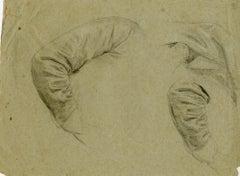
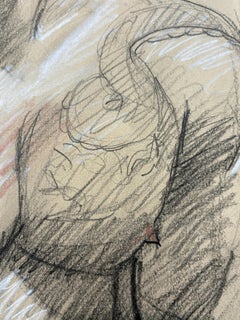
Studies of arms in draped sleeves
Located in Middletown, NY
Charcoal and graphite on grayish laid paper, 10 1/2 x 7 3/4 inches (265 x 195 mm), the full sheet. Scattered light, minor and unobtrusive foxing, several non-archival cellophane tape...
Category
Mid-18th Century Italian School Reg Butler Art
Materials
Handmade Paper, Laid Paper, Graphite, Charcoal
$450
H 10.44 in W 7.68 in
'Eyes for the Night' — Mid-century American Surrealism
By Benton Murdoch Spruance
Located in Myrtle Beach, SC
Benton Spruance, 'Eyes for the Night', lithograph, 1947, edition 35, Fine and Looney 260. Signed, dated, titled, and annotated 'Ed 35' in pencil. A fine impression, on heavy, cream ...
Category
1940s American Modern Reg Butler Art
Materials
Lithograph
$720 Sale Price
20% Off
H 18.88 in W 12.88 in
Marc Chagall - Original Lithograph
By Marc Chagall
Located in Collonge Bellerive, Geneve, CH
Marc Chagall
Original Lithograph
1963
Dimensions: 32 x 24 cm
Reference: Chagall Lithographe 1957-1962. VOLUME II.
Condition : Excellent
Marc Chagall (born in 1887)
Marc Chagall was born in Belarus in 1887 and developed an early interest in art. After studying painting, in 1907 he left Russia for Paris, where he lived in an artist colony on the city’s outskirts. Fusing his own personal, dreamlike imagery with hints of the fauvism and cubism popular in France at the time, Chagall created his most lasting work—including I and the Village (1911)—some of which would be featured in the Salon des Indépendants exhibitions. After returning to Vitebsk for a visit in 1914, the outbreak of WWI trapped Chagall in Russia. He returned to France in 1923 but was forced to flee the country and Nazi persecution during WWII. Finding asylum in the U.S., Chagall became involved in set and costume design before returning to France in 1948. In his later years, he experimented with new art forms and was commissioned to produce numerous large-scale works. Chagall died in St.-Paul-de-Vence in 1985.
The Village
Marc Chagall was born in a small Hassidic community on the outskirts of Vitebsk, Belarus, on July 7, 1887. His father was a fishmonger, and his mother ran a small sundries shop in the village. As a child, Chagall attended the Jewish elementary school, where he studied Hebrew and the Bible, before later attending the Russian public school. He began to learn the fundamentals of drawing during this time, but perhaps more importantly, he absorbed the world around him, storing away the imagery and themes that would feature largely in most of his later work.
At age 19 Chagall enrolled at a private, all-Jewish art school and began his formal education in painting, studying briefly with portrait artist Yehuda Pen. However, he left the school after several months, moving to St. Petersburg in 1907 to study at the Imperial Society for the Protection of Fine Arts. The following year, he enrolled at the Svanseva School, studying with set designer Léon Bakst, whose work had been featured in Sergei Diaghilev's Ballets Russes. This early experience would prove important to Chagall’s later career as well.
Despite this formal instruction, and the widespread popularity of realism in Russia at the time, Chagall was already establishing his own personal style, which featured a more dreamlike unreality and the people, places and imagery that were close to his heart. Some examples from this period are his Window Vitebsk (1908) and My Fianceé with Black Gloves (1909), which pictured Bella Rosenfeld, to whom he had recently become engaged.
The Beehive
Despite his romance with Bella, in 1911 an allowance from Russian parliament member and art patron Maxim Binaver enabled Chagall to move to Paris, France. After settling briefly in the Montparnasse neighborhood, Chagall moved further afield to an artist colony known as La Ruche (“The Beehive”), where he began to work side by side with abstract painters such as Amedeo Modigliani and Fernand Léger as well as the avant-garde poet Guillaume Apollinaire. At their urging, and under the influence of the wildly popular fauvism and cubism, Chagall lightened his palette and pushed his style ever further from reality. I and the Village (1911) and Homage to Apollinaire (1912) are among his early Parisian works, widely considered to be his most successful and representative period.
Though his work stood stylistically apart from his cubist contemporaries, from 1912 to 1914 Chagall exhibited several paintings at the annual Salon des Indépendants exhibition, where works by the likes of Juan Gris, Marcel Duchamp and Robert Delaunay were causing a stir in the Paris art world. Chagall’s popularity began to spread beyond La Ruche, and in May 1914 he traveled to Berlin to help organize his first solo exhibition, at Der Sturm Gallery. Chagall remained in the city until the highly acclaimed show opened that June. He then returned to Vitebsk, unaware of the fateful events to come.
War, Peace and Revolution
In August 1914 the outbreak of World War I precluded Chagall’s plans to return to Paris. The conflict did little to stem the flow of his creative output, however, instead merely giving him direct access to the childhood scenes so essential to his work, as seen in paintings such as Jew in Green (1914) and Over Vitebsk (1914). His paintings from this period also occasionally featured images of the war’s impact on the region, as with Wounded Soldier (1914) and Marching (1915). But despite the hardships of life during wartime, this would also prove to be a joyful period for Chagall. In July 1915 he married Bella, and she gave birth to a daughter, Ida, the following year. Their appearance in works such as Birthday (1915), Bella and Ida by the Window (1917) and several of his “Lovers” paintings give a glimpse of the island of domestic bliss that was Chagall’s amidst the chaos.
To avoid military service and stay with his new family, Chagall took a position as a clerk in the Ministry of War Economy in St. Petersburg. While there he began work on his autobiography and also immersed himself in the local art scene, befriending novelist Boris Pasternak, among others. He also exhibited his work in the city and soon gained considerable recognition. That notoriety would prove important in the aftermath of the 1917 Russian Revolution when he was appointed as the Commissar of Fine Arts in Vitebsk. In his new post, Chagall undertook various projects in the region, including the 1919 founding of the Academy of the Arts. Despite these endeavors, differences among his colleagues eventually disillusioned Chagall. In 1920 he relinquished his position and moved his family to Moscow, the post-revolution capital of Russia.
In Moscow, Chagall was soon commissioned to create sets and costumes for various productions at the Moscow State Yiddish Theater...
Category
1960s Surrealist Reg Butler Art
Materials
Lithograph
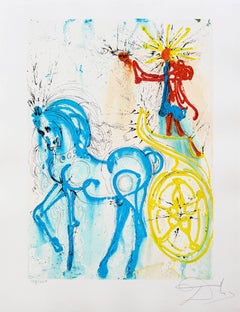
Vitraux in Four Sheets Royal Insect
By Salvador Dalí
Located in Hollywood, FL
ARTIST: Salvador Dali
TITLE: Vitraux in Four Sheets Royal Insect
MEDIUM: 4 Lithographs
SIGNED: 1 Lithograph is Hand Signed by Salvador Dali
EDITION NUMBER: 1 lithograph is numbe...
Category
1970s Surrealist Reg Butler Art
Materials
Lithograph
Nude - Lithograph by Andrè Derain - 1929
By André Derain
Located in Roma, IT
Nude is a modern artwork realized by Andrè Derain in Early 20th century.
Lithograph on simili-Japan paper.
Realized for "Les Travaux et les Jeux" by Vincent Muselli. Published by J...
Category
1920s Modern Reg Butler Art
Materials
Lithograph
Marc Chagall - Original Lithograph
By Marc Chagall
Located in Collonge Bellerive, Geneve, CH
Marc Chagall
Original Lithograph
1963
Dimensions: 32 x 24 cm
Reference: Chagall Lithographe 1957-1962. VOLUME II.
Condition : Excellent
Marc Chagall (born in 1887)
Marc Chagall was born in Belarus in 1887 and developed an early interest in art. After studying painting, in 1907 he left Russia for Paris, where he lived in an artist colony on the city’s outskirts. Fusing his own personal, dreamlike imagery with hints of the fauvism and cubism popular in France at the time, Chagall created his most lasting work—including I and the Village (1911)—some of which would be featured in the Salon des Indépendants exhibitions. After returning to Vitebsk for a visit in 1914, the outbreak of WWI trapped Chagall in Russia. He returned to France in 1923 but was forced to flee the country and Nazi persecution during WWII. Finding asylum in the U.S., Chagall became involved in set and costume design before returning to France in 1948. In his later years, he experimented with new art forms and was commissioned to produce numerous large-scale works. Chagall died in St.-Paul-de-Vence in 1985.
The Village
Marc Chagall was born in a small Hassidic community on the outskirts of Vitebsk, Belarus, on July 7, 1887. His father was a fishmonger, and his mother ran a small sundries shop in the village. As a child, Chagall attended the Jewish elementary school, where he studied Hebrew and the Bible, before later attending the Russian public school. He began to learn the fundamentals of drawing during this time, but perhaps more importantly, he absorbed the world around him, storing away the imagery and themes that would feature largely in most of his later work.
At age 19 Chagall enrolled at a private, all-Jewish art school and began his formal education in painting, studying briefly with portrait artist Yehuda Pen. However, he left the school after several months, moving to St. Petersburg in 1907 to study at the Imperial Society for the Protection of Fine Arts. The following year, he enrolled at the Svanseva School, studying with set designer Léon Bakst, whose work had been featured in Sergei Diaghilev's Ballets Russes. This early experience would prove important to Chagall’s later career as well.
Despite this formal instruction, and the widespread popularity of realism in Russia at the time, Chagall was already establishing his own personal style, which featured a more dreamlike unreality and the people, places and imagery that were close to his heart. Some examples from this period are his Window Vitebsk (1908) and My Fianceé with Black Gloves (1909), which pictured Bella Rosenfeld, to whom he had recently become engaged.
The Beehive
Despite his romance with Bella, in 1911 an allowance from Russian parliament member and art patron Maxim Binaver enabled Chagall to move to Paris, France. After settling briefly in the Montparnasse neighborhood, Chagall moved further afield to an artist colony known as La Ruche (“The Beehive”), where he began to work side by side with abstract painters such as Amedeo Modigliani and Fernand Léger as well as the avant-garde poet Guillaume Apollinaire. At their urging, and under the influence of the wildly popular fauvism and cubism, Chagall lightened his palette and pushed his style ever further from reality. I and the Village (1911) and Homage to Apollinaire (1912) are among his early Parisian works, widely considered to be his most successful and representative period.
Though his work stood stylistically apart from his cubist contemporaries, from 1912 to 1914 Chagall exhibited several paintings at the annual Salon des Indépendants exhibition, where works by the likes of Juan Gris, Marcel Duchamp and Robert Delaunay were causing a stir in the Paris art world. Chagall’s popularity began to spread beyond La Ruche, and in May 1914 he traveled to Berlin to help organize his first solo exhibition, at Der Sturm Gallery. Chagall remained in the city until the highly acclaimed show opened that June. He then returned to Vitebsk, unaware of the fateful events to come.
War, Peace and Revolution
In August 1914 the outbreak of World War I precluded Chagall’s plans to return to Paris. The conflict did little to stem the flow of his creative output, however, instead merely giving him direct access to the childhood scenes so essential to his work, as seen in paintings such as Jew in Green (1914) and Over Vitebsk (1914). His paintings from this period also occasionally featured images of the war’s impact on the region, as with Wounded Soldier (1914) and Marching (1915). But despite the hardships of life during wartime, this would also prove to be a joyful period for Chagall. In July 1915 he married Bella, and she gave birth to a daughter, Ida, the following year. Their appearance in works such as Birthday (1915), Bella and Ida by the Window (1917) and several of his “Lovers” paintings give a glimpse of the island of domestic bliss that was Chagall’s amidst the chaos.
To avoid military service and stay with his new family, Chagall took a position as a clerk in the Ministry of War Economy in St. Petersburg. While there he began work on his autobiography and also immersed himself in the local art scene, befriending novelist Boris Pasternak, among others. He also exhibited his work in the city and soon gained considerable recognition. That notoriety would prove important in the aftermath of the 1917 Russian Revolution when he was appointed as the Commissar of Fine Arts in Vitebsk. In his new post, Chagall undertook various projects in the region, including the 1919 founding of the Academy of the Arts. Despite these endeavors, differences among his colleagues eventually disillusioned Chagall. In 1920 he relinquished his position and moved his family to Moscow, the post-revolution capital of Russia.
In Moscow, Chagall was soon commissioned to create sets and costumes for various productions at the Moscow State Yiddish Theater...
Category
1960s Surrealist Reg Butler Art
Materials
Lithograph
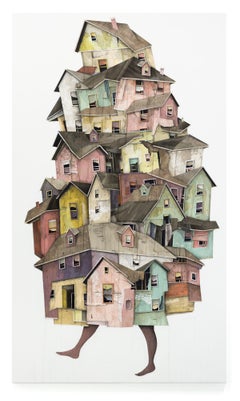
"Wanderer 9" House Composition in Motion in Paint, Paper, and Charcoal
By Seth Clark
Located in Philadelphia, PA
This piece, titled "Wanderer 9" is an original artwork by Seth Clark as part of his newest solo exhibition, "Passing Through" and made of collage, charcoal, pastel, acrylic, and gra...
Category
21st Century and Contemporary Contemporary Reg Butler Art
Materials
Wood, Paper, Charcoal, Pastel, Acrylic, Graphite
"Wanderer 11" Collapsing Houses in Ink Wash, Acrylic, and Collage by Seth Clark
By Seth Clark
Located in Philadelphia, PA
This piece, titled "Wanderer 11" is an original artwork by Seth Clark as part of his newest solo exhibition, "Passing Through" and is made of collage, charcoal, pastel, acrylic, and...
Category
21st Century and Contemporary Contemporary Reg Butler Art
Materials
Wood, Paper, Charcoal, Pastel, Acrylic, Graphite
Sonia Delaunay - Composition - Original Lithograph
By Sonia Delaunay
Located in Collonge Bellerive, Geneve, CH
Sonia Delaunay - Composition
Original Lithograph
1969
Dimensions: 32 x 25 cm
Revue XXe Siècle
Cahiers d'art published under the direction of G. di San Lazzaro.
Sonia Delaunay was known for her vivid use of color and her bold, abstract patterns, breaking down traditional distinctions between the fine and applied arts as an artist, designer and printmaker.
Born Sarah Stern on November 14, 1885 in Gradizhsk, Ukraine, she was adopted in 1890 by her maternal uncle, Henri Terk, a lawyer in St. Petersburg, where she grew up, exposed to music and art, and learning several foreign languages. In 1903, she moved to Germany to study drawing with Ludwig Schmidt-Reutler (1863–1909) at the Karlsruhe academy of fine arts; Arnold Schoenberg (1874–1951), composer-to-be, was among her classmates there. In 1905, she traveled to Paris where she attended art classes at the Académie de la Palette, learned printmaking from Rudolf Grossman (1889–1941), and met Amédée Ozenfant (1886–1966), André Dunoyer de Segonzac (1884–1974), and Jean-Louis Boussingault (1883–1943). Sonia spent much of her time at exhibitions and galleries in Paris, which showed works by Paul Cézanne, Vincent Van Gogh, Pierre Bonnard, and Edouard Vuillard, as well as Les Fauves, Henri Matisse and André Derain. She did, however, maintain contact with Germany, exhibiting at the Galerie Der Sturm, Berlin, in 1913, 1920 and 1921.
During her first year in Paris, Sonia met the German collector and art-dealer, Wilhelm Uhde (1874–1947), whom she married on December 5, 1908, and whose Montparnasse gallery, the Galerie Notre-Dame des Champs, showed her first solo exhibition. Through Uhde, Sonia encountered many painters, including Pablo Picasso, Georges Braque, Maurice de Vlaminck, and Robert Delaunay (1885–1941). In 1910, Sonia divorced Uhde by mutual agreement, married Delaunay that same year, and gave birth to their son, Charles, in January 1911.
Together Sonia and Robert Delaunay pursued the study of color, influenced by theories of Michel-Eugène Chevreul (1786–1889). Sonia’s interest in simultaneous contrast, as evidenced in her early collages, book bindings, small painted boxes, cushions, waistcoats and lampshades, led to one of her first large-scale works, the painting of the Bal Bullier (1912–1913), a popular Parisian dance-hall. Sonia’s first “simultaneous dresses,” a mix of squares and triangles of taffeta, tulle, flannelette, moiré, and corded silk, date from this period.
Friendship with the poet Blaise Cendrars...
Category
1970s Abstract Geometric Reg Butler Art
Materials
Lithograph
$1,546
H 12.6 in W 9.85 in D 0.04 in
Reg Butler art for sale on 1stDibs.
Find a wide variety of authentic Reg Butler art available for sale on 1stDibs. You can also browse by medium to find art by Reg Butler in lithograph, bronze, charcoal and more. Much of the original work by this artist or collective was created during the 20th century and is mostly associated with the abstract style. Not every interior allows for large Reg Butler art, so small editions measuring 10 inches across are available. Customers who are interested in this artist might also find the work of Alexander Archipenko, Anthony Caro, and Sir Eduardo Paolozzi. Reg Butler art prices can differ depending upon medium, time period and other attributes. On 1stDibs, the price for these items starts at $1,083 and tops out at $12,220, while the average work can sell for $1,500.