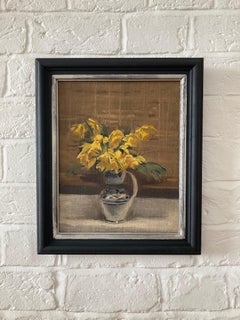
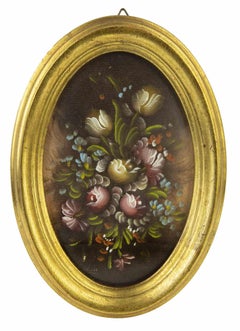
By Regina Mundlak
Located in Surfside, FL
Hand signed upper right
Regina Mundlak was born in a village near Lomza (NE Poland), into a poor Jewish family. In 1901 she went to Berlin to find work, together with her mother and sister, a highly talented violinist. Her extraordinary talent rapidly brought her to the attention of the Jewish artistic milieu. Her work so impressed Max Liebermann (1847–1935) that he decided to finance her education. However, even with his help, she had difficulty in making a living. Efraim Moses Lilien (1874–1925), who did not conceal his fascination with her talent, tried to help by publishing an open letter in Ost und West in 1902, appealing for support for her, but because of financial problems she finally had to give up her studies and return to her homeland.
At the age of fifteen she was already very skilled in drawing. At first she primarily created realistic portrait studies. The works she published in 1902 showed her rare power of observation. Her pen-and-ink drawings were also greatly admired. As her subjects she most often chose characteristic Jewish types from Eastern Europe.
She exhibited her works in Warsaw at the (Society for Promotion of Fine Arts) in 1902 and in 1903 and at the Aleksander Krywult Salon in 1903. In 1906, once again in Berlin, she exhibited her works at the Cassirer Salon. A review of this exhibition by Hermann Struck appeared in Ost und West. Like Lilien before him, he too wrote about her “phenomenal talent.” On the occasion of her exhibition, some of her drawings were reproduced in Ost und West. The development of her creative abilities in the years between Lilien’s letter and Struck’s review is noticeable. Drawings published in 1901 were portraits; compared to later works they evidence a skilful but still somewhat uncertain hand. The works created a few years later were characterized by a stronger and surer line. These works are also more developed: while the subject of her works remained the same, she now extended her interest in portraiture to the shape of the entire human body, presenting the figures in more elaborate environments.
Looking at the reproductions, one might conclude that she was interested in nothing but Jewish life in the Diaspora. There is a propensity to show the faces of older people...
Category
Early 20th Century Modern Regina Mundlak Art
MaterialsCanvas, Oil, Board