Rolf Stoll Art

to
1
1
1
1
Overall Width
to
Overall Height
to
3
1
1
1
1
1
1
1
1
1
1
1
3

Use search to find more

3
11,856
2,888
2,541
1,621

Use search to find more

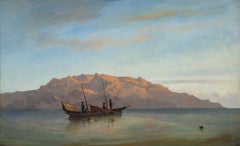
Artist: Rolf Stoll
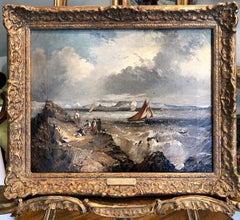
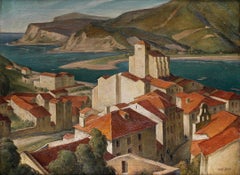
20th Century Spanish Seaside Village (Cadaques Catalonia), Cleveland School

20th Century Spanish Seaside Village (Cadaques Catalonia), Cleveland School

By Rolf Stoll

Located in Beachwood, OH

Rolf Stoll (American, 1892-1978) Spanish Seaside Village (Cadaques Catalonia) Oil on canvas Signed lower right 28 x 38 inches Exhibited: The 11th Annual May Show, Cleveland Museum of Art, 1929 Rolf Stoll, a painter of figure subjects, landscapes and floral still lifes, was an important member of the Cleveland art scene during the second quarter of the century. He was also an influential teacher, as well as one of Ohio’s foremost portrait painters. Rolf Stoll was born in Heidelberg, Germany, in 1892. As a boy, he attended a military academy, during which time he developed an interest in art. He received his early formal training at the Academy of Fine Arts in Karlsruhe and at the Academy of Fine Arts in Stuttgart. He emigrated to the United States in 1912, settling in New York City. A decade later, after studying at the school of the National Academy of Design and supporting himself by working as a commercial artist, Stoll decided to leave New York. Upon the recommendation of Warren Pryor, one of his teachers, he decided to move to Cleveland, Ohio. After arriving in Cleveland, Rolf Stoll continued to work as a commercial artist. However, in 1926, he joined the faculty of the Cleveland School of Art, where he taught drawing. Two years later Stoll was appointed head of the school’s portrait painting department. A talented portraitist, Stoll’s sitters included industrialists, community leaders and many prominent members of Cleveland and Ohio society, as well as over twenty faculty members from Case Western Reserve University. Stoll also gave portrait classes at the John Huntington Polytechnic Institute from 1926 to 1953. In his male portraits especially, he was admired for his ability to convey the dignity of his sitter’s professional position without sacrificing individuality. As noted by one contemporary reviewer, Stoll was a “master of rich color, a searching student of human types, a forceful portrayer of all that the face reveals of the mind and the soul.” In addition to his activity as a portraitist, Rolf Stoll painted figure subjects and floral still lifes. He was also known for his views of the Ohio countryside and Canada. Stoll also painted views of Spain and depictions of Spanish peasants, inspired by an extended trip to that country (1926), during which time he was entertained by the famous Spanish portrait painter, Ignacio Zuloaga. Moving easily between oil and watercolor, Stoll worked in an direct realist style, combining his characteristic firm draftsmanship with the use of simplified forms and decorative color. Rolph Stoll was a member of the Cleveland Society of Artists, the Cleveland Print Club...

Category

1920s Rolf Stoll Art

Materials

Oil

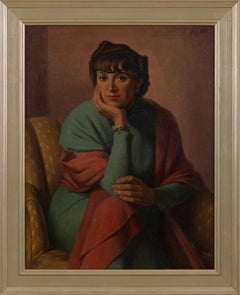
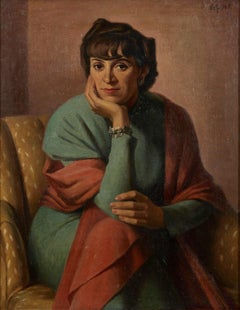
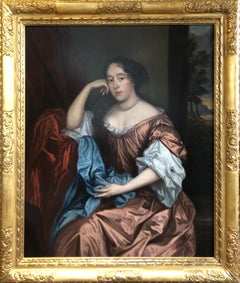
1940 Large Portrait of a Woman, Kae Dorn Cass, by Cleveland School Artist

1940 Large Portrait of a Woman, Kae Dorn Cass, by Cleveland School Artist

By Rolf Stoll

Located in Beachwood, OH

Rolf Stoll (American, 1892-1978) Kae Dorn Cass, 1940 Oil on canvas Signed upper right 32 x 25 inches 38 x 31 inches, framed Exhibited: The 27th Annual May Show, Cleveland Museum of Art, Cleveland, OH, 1940 This work won first prize for oil painting- Portrait category Provenance: Collection of Kae Dorn Cass's niece Kae Dorn Cass Rolf Stoll Rolf Stoll, a painter of figure subjects, landscapes and floral still lifes, was an important member of the Cleveland art scene during the second quarter of the century. He was also an influential teacher, as well as one of Ohio’s foremost portrait painters. Rolf Stoll was born in Heidelberg, Germany, in 1892. As a boy, he attended a military academy, during which time he developed an interest in art. He received his early formal training at the Academy of Fine Arts in Karlsruhe and at the Academy of Fine Arts in Stuttgart. He emigrated to the United States in 1912, settling in New York City. A decade later, after studying at the school of the National Academy of Design and supporting himself by working as a commercial artist, Stoll decided to leave New York. Upon the recommendation of Warren Pryor, one of his teachers, he decided to move to Cleveland, Ohio. After arriving in Cleveland, Rolf Stoll continued to work as a commercial artist. However, in 1926, he joined the faculty of the Cleveland School of Art, where he taught drawing. Two years later Stoll was appointed head of the school’s portrait painting department. A talented portraitist, Stoll’s sitters included industrialists, community leaders and many prominent members of Cleveland and Ohio society, as well as over twenty faculty members from Case Western Reserve University. Stoll also gave portrait classes at the John Huntington Polytechnic Institute from 1926 to 1953. In his male portraits especially, he was admired for his ability to convey the dignity of his sitter’s professional position without sacrificing individuality. As noted by one contemporary reviewer, Stoll was a “master of rich color, a searching student of human types, a forceful portrayer of all that the face reveals of the mind and the soul.” In addition to his activity as a portraitist, Rolf Stoll painted figure subjects and floral still lifes. He was also known for his views of the Ohio countryside...

Category

1940s Rolf Stoll Art

Materials

Oil

After the Symphonic Poem, " Verklarte Nacht ", by Arnold Schoenberg

After the Symphonic Poem, " Verklarte Nacht ", by Arnold Schoenberg

By Rolf Stoll

Located in Grand Rapids, MI

Rolf Stoll, (German/American, 1892-1978) Signed: Rolf Stoll, (lower, left) “ After the Symphonic Poem, " Verklarte Nacht ", by Arnold Schoenberg ", (titled on stretcher verso) Circ...

Category

Mid-20th Century Abstract Geometric Rolf Stoll Art

Materials

Canvas, Oil

Related Items
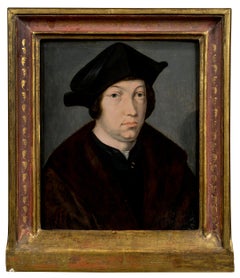
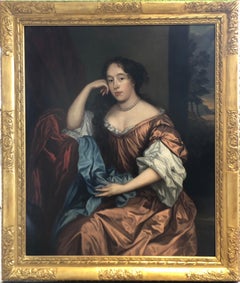
Portrait of a Man
Portrait of a Man

Quentin MassysPortrait of a Man

$52,500

H 11 in W 9 in

Portrait of a Man

Located in New York, NY

Provenance: with Leo Blumenreich and Julius Böhler, Munich, 1924 Dr. Frederic Goldstein Oppenheimer (1881-1963), San Antonio, Texas; by whom given to: Abraham M. Adler, New York, until 1985; thence by descent to the present owners While old inscriptions on the verso of this panel propose its author to be Hans Holbein and the sitter Sir John More—a lawyer, judge, and the father of Sir Thomas More—this fine portrait has long been recognized to be by a Flemish hand. Max Friedländer gave the painting to Bernard van Orley (1487/1491 – 1541) in 1924, but did not include it in the volume dedicated to the artist in his Early Netherlandish Paintings...

Category

16th Century Old Masters Rolf Stoll Art

Materials

Oil, Panel

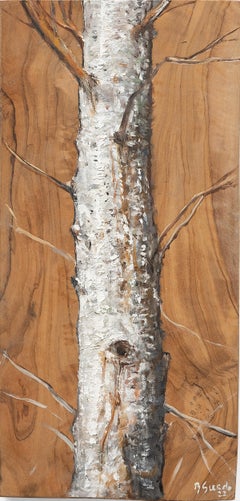
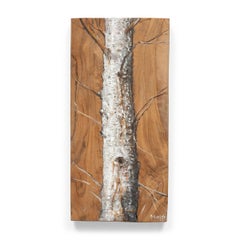
"Birch, " Oil Paint on Olive Board

"Birch, " Oil Paint on Olive Board

By Bruno Surdo

Located in Chicago, IL

Chicago-based fine art painter Bruno A. Surdo is classically trained in drawing and oil painting in the tradition of Renaissance masters. With strong command of the human form, Surdo creates dynamic compositions of people and places that communicate a rich commentary on the world around him. Depicting trees from personal encounters, Surdo’s latest body of work entitled “Tree Spirits” takes us on a foray into the forest, where leaves, branches and burls express something deeply personal. Applying his mastery of figurative realism to the natural world, he experiments with form and texture to uncover the intangible spirits of trees. Entitled “Birch,” this small-scale oil painting depicts a young birch sapling against an olive wood board. Restricting the composition to only a portion of the trunk, Surdo focuses on qualities that make the tree memorable - its narrow trunk...

Category

21st Century and Contemporary Naturalistic Rolf Stoll Art

Materials

Oil, Wood

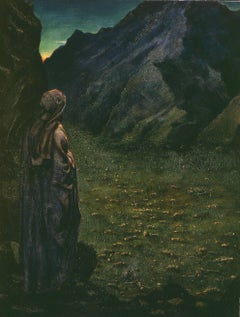
Ezekiel in the Valley of Dry Bones

Ezekiel in the Valley of Dry Bones

By Philip Burne-Jones

Located in New York, NY

Provenance: Christie’s, London, 3 March 1922, lot 46 (with The Tower of Babel); James Nicoll Private Collection Sotheby’s, London, 29 March 1983, lot 157 Private Collection, New Yo...

Category

Late 19th Century Victorian Rolf Stoll Art

Materials

Canvas, Oil

Sand City, Construction Series, Abstract Geometric Painting

Sand City, Construction Series, Abstract Geometric Painting

By Robert Petrick

Located in Los Angeles, CA

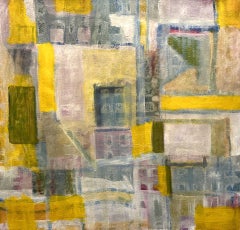
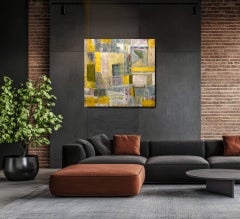
“Sand City” presents a softly structured, abstracted urban grid built from warm ochres, saturated golden yellows, dusty blue-greys, pale blush pinks, and muted olive greens. Block-li...

Category

21st Century and Contemporary Abstract Geometric Rolf Stoll Art

Materials

Canvas, Oil

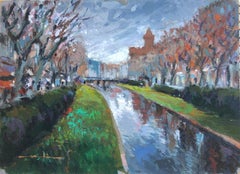
Original European Riverside Cityscape Impressionist Oil Painting Urban Landscape

Original European Riverside Cityscape Impressionist Oil Painting Urban Landscape

By Josep Marfa Guarro

Located in Sitges, Barcelona

European Riverside Cityscape Impressionist Oil Painting Urban Landscape Artist: Josep Marfà Guarro (1928–2014) Date: Circa 1990 Medium: Oil on card Dimensions: 22 × 30 cm / 8.66 × 1...

Category

1980s Impressionist Rolf Stoll Art

Materials

Cardboard, Oil

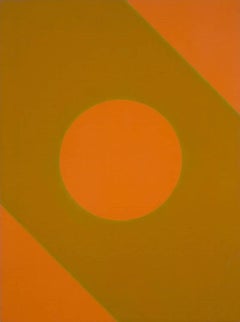
Orange Circle
Orange Circle

Paul ReedOrange Circle, 1965

$15,000

H 54 in W 40 in D 3 in

Orange Circle

By Paul Reed

Located in Saratoga Springs, NY

Signed & dated Verso. 1965 Paul Reed in 1970. He favored “staining” untreated canvas. Paul Reed, the last surviving member of the Washington Color School, who explored the complexities of color and form in vibrant bio-morphic and hard-edge abstract paintings, died on Sept. 26 at his home in Phoenix. He was 96. His death was confirmed by his daughter, Jean Reed Roberts. Mr. Reed acquired his public identity as an artist when he was included, along with Gene Davis, Kenneth Noland, Morris Louis, Thomas Downing and Howard Mehring, in “The Washington Color Painters,” a landmark traveling exhibition that began at the Washington Gallery of Modern Art in 1965. All of the other painters had been shown, the year before, in “Post-Painterly Abstraction,” a 31-artist exhibition at the Los Angeles County Museum of Art organized by the critic Clement Greenberg in an effort to write a new chapter in the historic march of abstract art. Like his fellow Washington artists, Mr. Reed rejected the hot, gestural approach of Abstract Expressionism and explored color and abstract forms in a cooler mode. Working with diluted acrylic paint, in discrete series that methodically explored formal issues, he created luminous fields of color by letting the paint bleed into, or stain, untreated canvas. “I have a saying: Pollock dripped, Frankenthaler poured,” he told The Washington Post in 2011, referring to the artist Helen Frankenthaler. “Morris Louis poured. Howard Mehring sprinkled. I blot.” In his first stained series, “Mandala,” color radiated from a circular central image. The nearly 100 paintings in his “Disk” series, which he called “a matrix for exploiting color,” consisted of a central circle and two triangles positioned at the corners of the canvas. Over the next decade he moved to hard-edge geometric zigzags and stripes in the vertical “Upstart” series, color grids and shaped canvases that allowed for more complex experiments in form and color relations. He also made welded steel sculptures and, in the “Quad” series of the 1980s, collaged photographs. “Reed was, in a sense, the ‘little master’ of that first batch of Washington colorists,” the critic Benjamin Forgey wrote in The Washington Post in 1997. “He was a latecomer — he didn’t turn seriously to painting until he was in his mid-30s — but he never considered becoming anything other than an abstract painter. And when he was ready to show, in his early 40s, he was a very good abstract painter indeed.” Mr. Reed gave himself a more modest assessment in an interview with NPR last year. “I’m sort of low man on the totem pole of that group of six,” he said. Paul Allen...

Category

1960s Abstract Geometric Rolf Stoll Art

Materials

Canvas, Oil

"Orange Colors" by Rehfeld - Large Abstract Geometric in Orange and Yellow

"Orange Colors" by Rehfeld - Large Abstract Geometric in Orange and Yellow

By Steven H. Rehfeld

Located in Carmel, CA

Steven H. Rehfeld (American, born 1954) "Orange Colors" 2018 Oil paint, Paper, Glue, Canvas, Stretcher bars The artist signed the back of the painting. In "Orange Colors," Rehfeld o...

Category

2010s Abstract Geometric Rolf Stoll Art

Materials

Canvas, Oil, Paper, Glue, Stretcher Bars

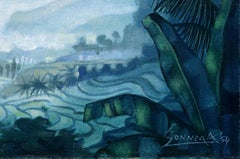
Sawah Landscape
Sawah Landscape

Auke SonnegaSawah Landscape, 1954

$21,082

H 19.89 in W 23.82 in D 1.97 in

Sawah Landscape

Located in Amsterdam, NL

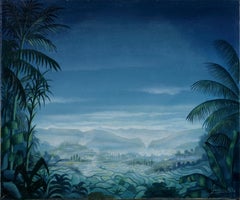
A sawah landscape, Sumatra Signed and dated 'Sonnega '54' (lower right), and annotated 'Voor Jan de Bas 1-1-1970 / R de Bas' (on the reverse) oil on canvas, 50,5x60,5 cm Provenance: - Collection Pieter de Bas (1909-1979) Mr de Bas was head of the MULO school and acting head of the HBS school in Medan. Thence by descent to the present owner. Exhibited: - Hotel de Boer, Medan 1954, where acquired by the first owner. The light I observed everywhere was of a special quality, fluorescent blue, shone from nowhere but radiated from every point, oddly with great depth and intensity. The light in an entirely different dimension came from nowhere and went nowhere shimmering with the glow of a bright blue jewel. The most important thing I discovered was of being omnipresent and able to understand everything at the same time, yes I could fathom creation completely. Auke Sonnega, born March 9, 1910 in Leeuwarden, known as the painter, primarily of young Balinese men and women. Originally raised in the reformed denomination, the parents of Auke apparently practised theosophy and their children, including Auke were taught these principles. The talent for drawing revealed itself at an early stage which in 1926 lead to a 4-year study of textile design at the Academy for Art and Craft in Amsterdam. He completed the academy in 1930 and worked in a carpet factory in Twente until 1934 and then followed in his sister Aafje’s footsteps leaving the Netherlands to go to the Dutch East Indies where in 1935 he started working as a graphic designer with an advertising bureau in Batavia. He was able to travel through Java and Bali on the motorbike that he brought with him from Europe, and was paid for his travelogue, enhanced with his own photo’s which appeared in several Dutch newspapers and magazines. In the 1930’s two Europeans, Walter Spies and Rudolf Bonnet...

Category

Mid-20th Century Expressionist Rolf Stoll Art

Materials

Canvas, Oil

Previously Available Items

Rolf Stoll art for sale on 1stDibs.

Find a wide variety of authentic Rolf Stoll art available for sale on 1stDibs. You can also browse by medium to find art by Rolf Stoll in canvas, fabric, oil paint and more. Much of the original work by this artist or collective was created during the 20th century and is mostly associated with the abstract style. Not every interior allows for large Rolf Stoll art, so small editions measuring 41 inches across are available. Customers who are interested in this artist might also find the work of Erle Loran, Charlie Edmiston, and Mark Zimmermann. Rolf Stoll art prices can differ depending upon medium, time period and other attributes. On 1stDibs, the price for these items starts at $4,000 and tops out at $5,000, while the average work can sell for $4,500.