Theodore Roussel Art
to
2
1
2
2
2
1
1
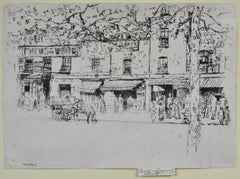
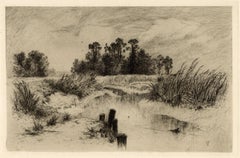
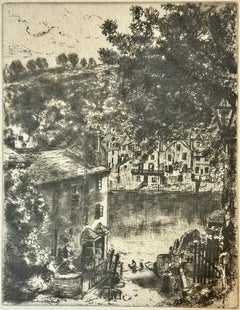
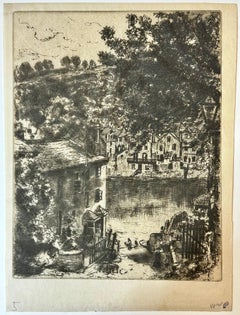
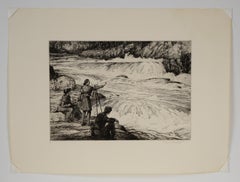
The Ferry Inn, Bodinick, Fowey
By Theodore Roussel
Located in Middletown, NY
Etching in black ink on cream laid Japon paper, 9 1/16 × 7 1/16 inches (229 x 178 mm), full margins. With an ink stamp from the collection of E.A. Scollin, M.D., Springfield, IL, an...
Category
Early 20th Century English School Theodore Roussel Art
Materials
Handmade Paper, Laid Paper, Etching
The Street, Chelsea - 1880s etching by Whistler follower Theodore Roussel
By Theodore Roussel
Located in London, GB
THEODORE CASIMIR ROUSSEL, RBA
(1847-1926)
The Street, Chelsea Embankment
Etching, signed in the plate, signed on the artist’s tab, trimmed to the platemark by the artist, framed
15...
Category
1880s Realist Theodore Roussel Art
Materials
Etching
The Corner of Cheyne Walk, Chelsea - 19th Century British Etching by Roussel
By Theodore Roussel
Located in London, GB
THEODORE CASIMIR ROUSSEL, RBA
(1847-1926)
The Corner of Cheyne Walk, Chelsea
Etching, unsigned, with the artist’s tab, signed in the plate, trimmed to th...
Category
1880s Realist Theodore Roussel Art
Materials
Etching
Related Items
"Enshoku Sanju-roku Kasen" (Thirty-six Enchanting Flowers) Woodblock on paper
By Toyohara Kunichika
Located in Soquel, CA
"Enshoku Sanju-roku Kasen" (Thirty-six Enchanting Flowers) Woodblock on paper
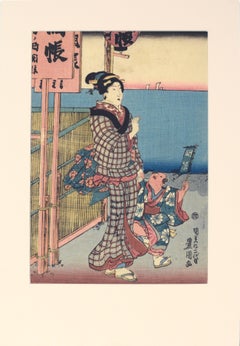
Elegant woodblock print by Toyohara Kunuchika (Japanese, 1835-1900). Three women are in talking with each other inside, while a man waits outside holding a bag of some kind. The colors in this piece are rich and saturated, primarily blues, greens, and purple.
Mat size: 16"H x 20"W
Paper size: 14.75"H x 9.88"W
Born in 1835, Toyohara Kunichika grew up in the Kyobashi district of Edo in the midst of merchants and artisans. In 1848, at age 13, he was accepted as an apprentice into the studio of Utagawa Kunisada I...
Category
1880s Edo Theodore Roussel Art
Materials
Ink, Rice Paper, Woodcut
$380 Sale Price
20% Off
H 20 in W 16 in D 0.25 in
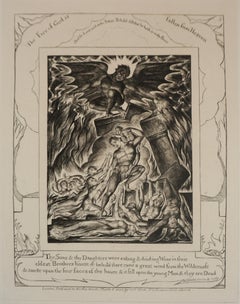
Illustrations From The Book of Job - "The Fire of God is Fallen From Heaven"
By William Blake
Located in Soquel, CA
"Illustrations of the Book of Job" Engraving "The Fire of God is Fallen From Heaven...And the Lord said unto Satan Behold All that he hath is in thy Power"
Engraving, third printing...
Category
1870s Symbolist Theodore Roussel Art
Materials
Handmade Paper, Engraving
$3,720 Sale Price
20% Off
H 20 in W 15 in D 0.2 in
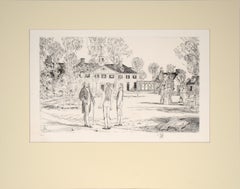
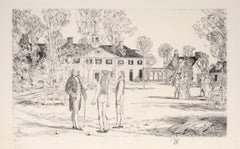
Bowling on the Green (from the Bicentennial Pageant of George Washington)
By Childe Hassam
Located in Soquel, CA
Bowling on the Green (from the Bicentennial Pageant of George Washington)
'Bowling on the Green', by printmaker Frederick Childe Hassam, depicts George Washington and friends lawn b...
Category
1930s American Impressionist Theodore Roussel Art
Materials
Ink, Etching, Laid Paper
$1,680
H 16 in W 20 in D 0.25 in
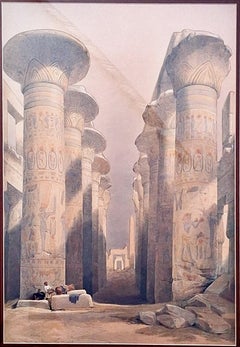
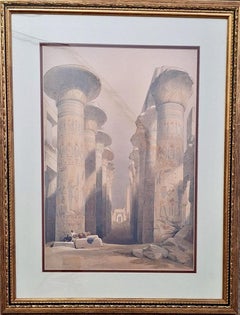
“Thebes, Great Hall at Karnak”
By David Roberts
Located in San Francisco, CA
This lithograph titled "Thebes, Great Hall at Karnak" is a notable work by the Scottish painter David Roberts (1796-1864). This particular scene is part of Roberts' most famous colle...
Category
1840s English School Theodore Roussel Art
Materials
Paper, Lithograph
The British Evacuate Boston - 1932 Etching on Paper
Located in Soquel, CA
The British Evacuate Boston - 1932 Etching on Paper by Allen Lewis. From the portfolio "The Bicentennial Pageant of George Washington."
In this piece George Washington is front and ...
Category
1930s American Realist Theodore Roussel Art
Materials
Laid Paper, Etching
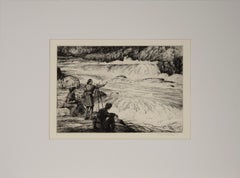
Doorway of the Doges, Venice
By Donald Shaw MacLaughlan
Located in New York, NY
Donald Shaw MacLaughlin (1876-1938), Doorway of the Doges, Venice, etching with plate tone, 1909, signed bottom right [also signed and dated in the plate]. Reference: Marie Bruette 1...
Category
Early 1900s Realist Theodore Roussel Art
Materials
Etching
Griffon With Woodcock original signed etching by Leon Danchin
By Leon Danchin
Located in Paonia, CO
Griffon With Woodcock is an original etching by Leon Danchin showing a Griffon in a field pointing at a Woodcock trying to hide in the brush. This color etching is in good conditi...
Category
20th Century Realist Theodore Roussel Art
Materials
Etching
$950
H 20.5 in W 31.5 in
"Snug Harbor" Etching of a Romantic Harbor Scene 1928
By Armin Hansen
Located in Soquel, CA
"Snug Harbor" Etching of a Romantic Harbor Scene 1928
Tall ships in a "Snug Harbor" by Armin Carl Hansen (American, 1886-1957. On wove paper.
Image, 6"H x 8"W
Sheet, 9.75"H x 12"W
...
Category
1920s American Impressionist Theodore Roussel Art
Materials
Laid Paper, Etching
$2,380
H 12 in W 9.75 in D 0.94 in
"Arch Of Septimius, Rome" Large etching and aquatint.
By Luigi Kasimir
Located in San Francisco, CA
This artwork titled "Arch of Septimius, Rome" 1923, is a color etching and aquatint on wove paper by noted Austrian artist Luigi Kasimir, 1881-1962. It is hand signed in pencil by t...
Category
Early 20th Century Realist Theodore Roussel Art
Materials
Etching, Aquatint
$1,600
H 40 in W 30.25 in D 1.5 in
"Various Himochi" Wagashi Festival Japanese Woodblock Print by Utagawa Toyokuni
By Utagawa Toyokuni
Located in Soquel, CA
"Various Himochi" Wagashi Festival Japanese Woodblock Print by Utagawa Toyokuni
Rare oversized early 19th century 5-tiered woodblock by Utagawa Ichiyosai Toyokuni, (Japan, 1769-1825), a Japanese lord and wife oversee a sekku festival of food, music, and dolls or toys. '"oshi" is the first day of “Mi (Snake)” in the third month of the lunar calendar. This day, known in modern Japan as the Girls' Festival, originated in China as a form of purification ceremony in which water and drinking peach blossom wine were used to drive away evil. Many kinds of hishi-mochi appear in this picture of hina ningyo (dolls associated with Hinamatsuri, or the Girl’s Day) from Omochae.
The custom of eating special dishes at events throughout the year and at milestones in people's lives has existed since ancient times. This paragraph specifically focuses on the annual event called sekku, and life events that involve eating sweets. Joshi is the first day of “Mi (Snake)” in the third month of the lunar calendar. This day, known in modern Japan as the Girls' Festival, originated in China as a form of purification ceremony in which water and drinking peach blossom wine were used to drive away evil. According to the Keiso saijiki, in ancient China, on the third day of the third lunar month, people ate “ryuzetsuhan,” which is the juice of gogyo (Jersey cudweed) mixed with rice flour and nectar. In Japan, there is a record in the Heian period history book Nihon Montoku tenno jitsuroku [839-5] that it was an annual event to make kusamochi using gogyo on the third day of the third month of the lunar calendar, which may have been influenced by Chinese customs.
The tradition of eating kusamochi on the third day of the third month of the lunar calendar continued after that. By the Edo period, however, hishimochi had come to be used as a sweet to serve on the third day of the third month. A picture of a hishimochi is included in the Morisada manko , which we mentioned in Part 1. According to it, hishimochi in the Edo period were often three layers of green-white-green instead of the now common red-white-green. However, it is possible to see from our collection that not all hishimochi were made in this way. Omochae published in 1857, is a good example. Omochae is a type of ukiyoe print...
Category
1820s Edo Theodore Roussel Art
Materials
Ink, Rice Paper, Woodcut
$1,480 Sale Price
20% Off
H 26.75 in W 21.75 in D 0.25 in
"Grave of Santa Anna's Leg" Original Woodblock Print, Signed Artist's Proof
By Carol Summers
Located in Soquel, CA
"Grave of Santa Anna's Leg" Original Woodblock Print, Signed Artist's Proof
Boldly colored woodblock print by Carol Summers (American, 1925-2016). This piece is a segment of a grave, with a headstone that has a skull and cross. There are two bright green plants flanking the headstone. Below the headstone and plants, there is a large arched blue shape, with a crescent moon and stars. A red leg, bent at the knee, cuts across the blue arch.
Signed "Carol Summers" along the right edge of the blue shape.
Numbered and titled "A/P Grave of Sant Anna's Leg" along the left edge of the blue shape.
Presented in a silver colored aluminum frame.
Frame size: 32.245"H x 27.25"W
Paper size: 29.75"H x 24.5"W
Carol Summers (1925-2016) has worked as an artist throughout the second half of the 20th century and into the first years of the next, outliving most of his mid-century modernist peers. Initially trained as a painter, Summers was drawn to color woodcuts around 1950 and it became his specialty thereafter. Over the years he has developed a process and style that is both innovative and readily recognizable. His art is known for it’s large scale, saturated fields of bold color, semi-abstract treatment of landscapes from around the world and a luminescent quality achieved through a printmaking process he invented.
In a career that has extended over half a century, Summers has hand-pulled approximately 245 woodcuts in editions that have typically run from 25 to 100 in number. His talent was both inherited and learned. Born in 1925 in Kingston, a small town in upstate New York, Summers was raised in nearby Woodstock with his older sister, Mary. His parents were both artists who had met in art school in St. Louis. During the Great Depression, when Carol was growing up, his father supported the family as a medical illustrator until he could return to painting. His mother was a watercolorist and also quite knowledgeable about the different kinds of papers used for various kinds of painting. Many years later, Summers would paint or print on thinly textured paper originally collected by his mother.
From 1948 to 1951, Carol Summers trained in the classical fine and studio arts at Bard College and at the Art Students League of New York. He studied painting with Steven Hirsh and printmaking with Louis Schanker. He admired the shapes and colors favored by early modernists Paul Klee (Sw: 1879-1940) and Matt Phillips (Am: b.1927- ). After graduating, Summers quit working as a part-time carpenter and cabinetmaker (which had supported his schooling and living expenses) to focus fulltime on art. That same year, an early abstract, Bridge No. 1 was selected for a Purchase Prize in a competition sponsored by the Brooklyn Museum.
In 1952, his work (Cathedral, Construction and Icarus) was shown the first time at the Museum of Modern Art in New York City in an exhibition of American woodcuts...
Category
1980s Contemporary Theodore Roussel Art
Materials
Ink, Handmade Paper, Woodcut
$2,650
H 32.25 in W 27.25 in D 1 in
Actor as Samurai - 18th Century Japanese Woodblock Print
By Katsukawa Shunshō
Located in Soquel, CA
Actor as Samurai - 18th Century Japanese Woodblock Print
Woodblock print depicting an actor, possibly Nakamura Denkuro II, as a samurai. The actor stands with his sword unsheathed a...
Category
Late 18th Century Edo Theodore Roussel Art
Materials
Woodcut, Rice Paper
$750
H 19 in W 12.5 in D 0.63 in
Previously Available Items
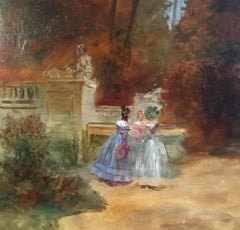
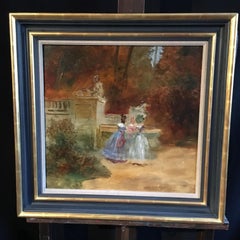
'In the Park' Impressionist Landscape, Fine Antique Oil Painting, Signed
By Theodore Roussel
Located in Cirencester, Gloucestershire
'In the Park' Impressionist Landscape, Fine Antique Oil Painting, Signed
By French artist, Theodore Roussel, 1847-1926
Signed by the artist on the back of the painting
Oil painting o...
Category
Late 19th Century Impressionist Theodore Roussel Art
Materials
Oil
Theodore Roussel art for sale on 1stDibs.
Find a wide variety of authentic Theodore Roussel art available for sale on 1stDibs. You can also browse by medium to find art by Theodore Roussel in etching, handmade paper, laid paper and more. Not every interior allows for large Theodore Roussel art, so small editions measuring 8 inches across are available. Customers who are interested in this artist might also find the work of Leon Danchin, Max Pollak, and Antoine Calbet. Theodore Roussel art prices can differ depending upon medium, time period and other attributes. On 1stDibs, the price for these items starts at $850 and tops out at $1,487, while the average work can sell for $1,274.