Veronique Clamot Art
Belgian, b. 1968
Veronique Clamot (1964, Charleroi, Belgium) is a self-taught artist. Although she has been occupied with making three dimensional works of art ever since her childhood, she is officially established as an independent artist during the previous decade. Since then she has taken part in several group exhibitions at Galerie Tempera (Brussels) and Morren Galleries. Her sculptures are remarkable accounts of observation, created by someone who gives us proof of her thorough knowledge of the human anatomy, also when she accentuates or deforms this anatomy in her work. Daily live is translated in amusing and recognizable anecdotes. . Most of her sculptures present seaside visitors, having an ice-cream, looking onto) sailing boats or reading under the burning heat of the sun.Clamot is well known for her small sculptures of well-formed ladies and the occasional man. Since 2010 she also works on larger scale. Clamot’s round ladies have become monumental in bronze.to
1
Overall Width
to
Overall Height
to
1
1
1
1
1
1
1
1
1
10,579
2,791
2,503
1,387
1
Artist: Veronique Clamot
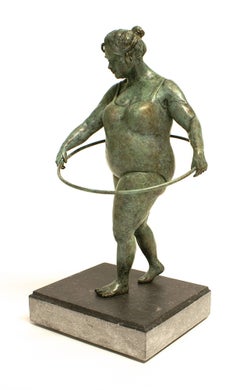
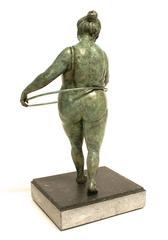
"Cinquieme Essai" Bronze rounded figure with a hula hoop in green patina
By Veronique Clamot
Located in Edgartown, MA
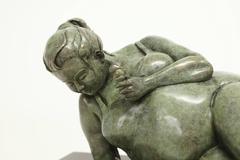
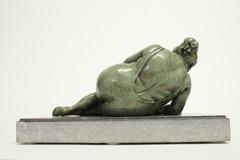
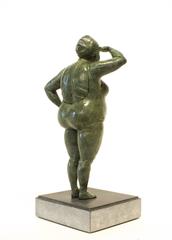
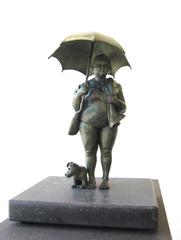
The tiny "baigneuses" or bathers, in bronze by Véronique Clamot are sculpted with loads of appetite and feel absolutely comfortable with their round forms. Chubby women at the seaside, caught off guard, they display a realism drenched in universal truth. Sharp observations, brought to life by the skillful hands of the artist using the traditional lost wax method.
The Eisenhauer Gallery...
Category
2010s Veronique Clamot Art
Materials
Bronze
Related Items
1961 Coty Award Plaque Kenneth Hairdresser Jacqueline Onassis Bronze Fashion
Located in New York, NY
1961 Coty Award Plaque Kenneth Hairdresser Jacqueline Onassis Bronze Fashion
Bronze on wood. The wood plaque measures 12 3/4" by 20 3/4 inches. The bronze plaque itself is 13 3/4 x 8 3/4 inches and the the bronze inscription, which reads "COTY, American Fashion Critics Special Award 1961 to KENNETH of LILY DACHE...
Category
1960s American Modern Veronique Clamot Art
Materials
Bronze
Praying Woman, Modern Bronze and Marble Sculpture by Ruth Gutman
By Ruth Gutman
Located in Long Island City, NY
This bronze patina sculpture is set on a warm toned marble base. The sculptor, Ruth Gutman, has created an expressionist rendering of a woman praying. ...
Category
20th Century Expressionist Veronique Clamot Art
Materials
Marble, Bronze
$1,200
H 16 in W 4 in D 4.5 in
Naked warrior with short sword / - The New Hercules -
Located in Berlin, DE
Hermann Volz (1847 Karlsruhe - 1914 ibid.), Naked warrior with short sword, c. 1935. Partially (?) patinated bronze with cast plinth mounted on a black marble base (6.8 cm high). 32....
Category
1930s Art Deco Veronique Clamot Art
Materials
Bronze
$2,310
H 12.8 in W 4.73 in D 2.76 in
Panther sniffing
By Georges Lucien Guyot
Located in PARIS, FR
Panther sniffing
by Georges GUYOT (1885-1972)
Rare sculpture in bronze with a nuanced dark brown patina
Signed on the base " Guyot "
Cast by " Susse Frères Editeurs Paris " (with the foundry mark)
France
circa 1935
height 33,5 cm
length 49 cm
depth 12 cm
Biography :
Georges Lucien Guyot (1885-1973) known as Georges Guyot was a French animal artist. From an early age, he showed artistic abilities, but the modest conditions of his parents did not allow him to study art. He was doing his apprenticeship with a woodcarver. Guyot then excelled at copying works of the fifteenth, sixteenth and seventeenth centuries, but soon he showed a special attraction for nature. This attraction led him to the Jardin des Plantes in Paris where he could study wild animals and translated his observations into sculpture and painting.
As a famous figure of Montmartre, he was the host of the Bateau-Lavoir from the time of Cubism. In 1931, Georges Guyot joined the group of "The Twelve", created by François Pompon and Jane Poupelet, gathering sculptors like Marcel Lémar, Paul Jouve, André Margat, Jean-Claude de Saint-Marceaux, Georges Hilbert, or even the painter Adrienne Jouclard...
Category
1930s Art Deco Veronique Clamot Art
Materials
Bronze
Crusader with shield and mace / - Ready to strike -
Located in Berlin, DE
Josef Moest (1873 Cologne - 1914 Rath), Crusader with shield and mace, around 1910. Bronze on a black marble pedestal (19 cm high). 57.5 cm (total height) x 21 cm (width) x 12 cm (de...
Category
1910s Realist Veronique Clamot Art
Materials
Bronze
$7,054
H 22.64 in W 8.27 in D 4.73 in
Gladiator ready for battle / - Ready for anything -
By Bruno Zach
Located in Berlin, DE
Bruno Zach (1891 Zhitomir - 1945 Vienna), Gladiator ready for battle, c. 1930. Blackish patinated bronze with silver-plated helmet, shield rim and shield pommel mounted on a fluted m...
Category
1930s Art Deco Veronique Clamot Art
Materials
Bronze
$4,257
H 14.57 in W 5.91 in D 4.73 in
Spear Fighter / - The Fighter's Concentration -
Located in Berlin, DE
Ludwig Eisenberger (active in Berlin between 1895-1920), Spear Fighter, around 1910. Brown patinated bronze with residual gilding on a cast terrain plinth with marble base (8 cm high...
Category
1910s Realist Veronique Clamot Art
Materials
Bronze
$4,621
H 26.78 in W 7.88 in D 5.12 in
Mother Happiness / - The ecstasy of maternal joy -
Located in Berlin, DE
Johannes Boese (1856 Ostrog - 1917 Berlin), Mutterglück, um 1910. Goldbraun patinierte Bronze auf gegossener rechteckiger Plinthe, montiert auf zweifarbigem Marmorsockel (9,5 cm Höhe...
Category
1910s Art Nouveau Veronique Clamot Art
Materials
Bronze
$5,108
H 24.02 in W 7.09 in D 4.53 in
Long Distance Runner III by Yann Guillon - male athlete, bronze sculpture
By Yann Guillon
Located in Paris, FR
Long Distance Runner III is a sculpture by French artist Yann Guillon.
Yann Guillon’s tireless study of the human figure is often reflected in his exploration of specific themes. Th...
Category
2010s Contemporary Veronique Clamot Art
Materials
Bronze
$3,648
H 14.18 in W 5.91 in D 3.94 in
Pecheur / - Full of anticipation -
Located in Berlin, DE
Adolphe Jean Lavergne (1863-1928), Pecheur, c. 1900. Brown patinated bronze with rectangular cast plinth on a green marble base (3 cm high), total height with hinge 37 cm, width 9 cm, depth 8 cm, weight 2.9 kg, signed “Lavergne” on the plinth.
- Base with old drilling and a few oxidized areas, patina occasionally rubbed, somewhat stained in the folds.
- Full of anticipation -
This bronze is the larger, highly detailed version of the fisherman that made Parisian artist Adolphe Jean Lavergne famous. In preparation for fishing, the boy prepares his rod before heading out to sea. The attachment of the iron ring and the rope behind him suggest a quay wall and a boat moored there. However, the depiction is entirely focused on the actual action of the young fisherman: With equal skill and concentration, he bends a hook to connect it to the fishing line. The contrast with his casual clothing, the loose-fitting trousers, the open shirt with its "wild" folds, and, last but not least, the sun hat boldly perched on his neck, reinforces the impression of the attentive care with which he goes about his work. His gaze makes him appear absorbed, as if he has forgotten the world around him and yet he is visibly filled with anticipation of fishing.
GERMAN VERSION
Adolphe Jean Lavergne (1863-1928), Pecheur, um 1890. Braun patinierte Bronze mit rechteckiger gegossener Plinthe auf grünem Marmorsockel (3 cm Höhe), Gesamthöhe mit Angel 37 cm, Breite 9 cm, Tiefe 8 cm, Gewicht 2,9 kg, auf der Plinthe mit „Lavergne“ signiert.
- Sockel mit alter Bohrung und wenigen oxidierten Stellen, Patina mitunter berieben, in den Falten vereinzelt etwas fleckig.
- Voller Vorfreude -
Die Bronzefigur ist die größere äußerst detaillierte Ausführung des Fischers, mit dem der Pariser Künstler Adolphe Jean Lavergne bekannt geworden ist. In Vorbereitung auf das Fischen präpariert der Junge die Angel...
Category
1890s Realist Veronique Clamot Art
Materials
Bronze
Field worker with rake / - The Humility of the Farm Worker -
Located in Berlin, DE
Paul Ludwig Kowalczewski (1865 Mieltschin - 1910 Berlin), Field worker with rake, around 1900. Brown and brown-greenish patinated bronze with ...
Category
Early 1900s Realist Veronique Clamot Art
Materials
Bronze
$1,946
H 19.69 in W 6.3 in D 5.12 in
Forest idyll / - Soulmate -
By Rudolf Kaesbach
Located in Berlin, DE
Rudolf Kaesbach (1873 Gladbach - 1955 Berlin), Forest idyll, around 1915. Bronze, gold and golden brown patina, with cast plinth, mounted on a marble base (5 cm high), total height 36 cm, dimensions of the bronze: 31 cm (height) x 17 cm (length) x 12 cm (width). Weight 4,6 kg, signed on the plinth "R.[udolf] KAESBACH".
- a few rubbed areas, overall in excellent condition for its age
- Soulmate -
The bronze sculpture depicts a young woman in an intimate exchange with a deer that accompanies her. The animal pauses to turn toward her, while the nude beauty slows her pace to look into the deer's eyes and tenderly caress it with her hand. The woman and the deer are in inner harmony. Even though her lips remain motionless, she speaks the language of the animal with which she is deeply connected.
The golden patina, which contrasts with the more naturalistic coloring of the deer, gives the young woman the appearance of a saint, even if she cannot be identified as such. At the same time, she evokes memories of Diana, the goddess of the hunt, or a nymph. But she lacks the ferocity. In her innocent naivety, she is more like a vestal virgin, who is not at home in the solitude of the forest. And yet, the young beauty, moving unclothed in the heart of nature, looks like a priestess with her hair tied up and a carefully carried bowl on her way to a sacred grove.
In order to open up the above-mentioned associations, Kaesbach deliberately designed the female figure in such a way that she cannot be identified as a specific person. He has created an allegory of natural femininity, characteristic of Art Nouveau, in which the deer is far more than a companion animal. It displays the same gracefulness as the young woman, and the inner resemblance between the two makes the deer appear as her other self. In animal terms, it embodies her inner being, which also gives the deer an allegorical character.
About the artist
Rudolf Kaesbach studied sculpture at the Hanau Academy and worked in a bronze foundry in Paris in 1900. In order to work as an independent artist, he opened a workshop in Düsseldorf, where he cast bronzes from models he designed. In 1902 he made his debut at the German National Art Exhibition in Düsseldorf. The following year Kaesbach went to the academy in Brussels. There he was inspired by contemporary Belgian sculpture, especially the work of Constantin Meunier. He moved to Berlin, where he opened a studio in the villa district of Grunewald and devoted himself to life-size marble sculptures and the design of bronzes. From 1911, he regularly presented his works at the major art exhibitions in Berlin, as well as in Düsseldorf and Malmö. Between 1936 and 1939, he also created models for the Rosenthal porcelain factory. From 1939 to 1944, Kaesbach was represented at the major German art exhibitions in Munich.
GERMAN VERSION
Rudolf Kaesbach (1873 Gladbach - 1955 Berlin), Waldidyll, um 1915. Gold und goldbraun patinierte Bronze mit gegossener Plinthe, auf einem Marmorsockel montiert (5 cm Höhe), Gesamthöhe 36 cm, Maße der Bronze: 31 cm (Höhe) x 17 cm (Länge) x 12 cm (Breite). Gewicht 4,6 kg, auf der Plinthe mit „R.[udolf] KAESBACH“ signiert.
- vereinzele beriebene Stellen, insgesamt in einem altersgemäß ausgezeichneten Zustand
- Seelenverwandtschaft -
Die Bronzeplastik veranschaulicht eine junge Frau im innigen Austausch mit einem sie begleitenden Reh. Das Tier hält inne, um sich zu ihr hochzuwenden, während die nackte Schönheit ihren Schritt verlangsamt, um dem Reh ebenfalls in die Augen zu schauen und es zärtlich mit der Hand zu liebkosen. Die Frau und das Reh sind in einem inneren Gleichklang. Auch wenn ihre Lippen unbewegt bleiben, spricht sie die Sprache des Tieres, mit dem sie auf eine tief empfundene Weise verbunden ist.
Die im Kontrast zur naturalistischeren Einfärbung des Rehs aufstrahlende goldfarbene Patina lässt die junge Frau wie eine Heilige erscheinen, auch wenn sich nicht als Heilige identifizierbar ist. Zugleich ruft sie Erinnerungen an die Jagdgöttin Diana oder eine Nymphe hervor. Dafür fehlt ihr allerdings die Wildheit. In ihrer unschuldigen Naivität gemahnt sie vielmehr an eine Vestalin, die freilich nicht in der Waldeinsamkeit zu Hause ist. Und doch wirkt die sich unbekleidet im Herzen der Natur bewegende junge Schönheit wie eine Priesterin, die sich mit hochgebundenem Haar und der vorsichtig getragenen Schale und dem Wege zu einem Heiligen Hain befindet.
Um die gennannten Assoziationen zu eröffnen, hat Kaesbach die Frauenfigur bewusst so gestaltet, dass sie nicht als konkrete Person identifizierbar ist. Damit hat er eine für den Jugendstil charakteristische Allegorie natürlicher Weiblichkeit geschaffen, bei der das Reh weit mehr als ein Begleittier ist. Es weist dieselbe grazile Anmut wie die junge Frau auf und der innere Gleichklag der beiden lässt das Reh als ihr anderen Ich erscheinen. Es verkörpert – ins Animalische übertragen - ihr inneres Wesen, wodurch auch dem Reh ein allegorischer Charakter zukommt.
zum Künstler
Rudolf Kaesbach studierte an der Akademie Hanau Bildhauerei und war im Jahr 1900 in einer Pariser Bronzegießerei tätig. Um sich als eigenständiger Künstler betätigen zu können, eröffnete er in Düsseldorf eine Werkstatt, in der er Bronzen nach selbstentworfenen Modellen goss. 1902 debütierte er auf der Deutschen Nationalen Kunstaustellung in Düsseldorf. Im Folgejahr ging Kaesbach an die Akademie nach Brüssel. Dort wurde er von der zeitgenössischen belgischen Bildhauerei, insbesondere vom Werk Constantin Meuniers, inspiriert. Zurückgekehrt zog er nach Berlin, wo er im Villenviertel Grunewald ein Atelier eröffnete und sich neben dem Entwurf für Bronzen der lebensgroßen Marmorbildhauerei widmete. Ab 1911 präsentierte er seine Werke regelmäßig auf den Großen Berliner Kunstausstellungen, aber auch in Düsseldorf und Malmö. Zwischen 1936 und 1939 fertigte er zudem Modelle für die Porzellan-Manufaktur Rosenthal an. Von 1939 bis 1944 war...
Category
1910s Jugendstil Veronique Clamot Art
Materials
Bronze
Previously Available Items
Une Histoire Passionnate
By Veronique Clamot
Located in Edgartown, MA
The tiny "baigneuses" or bathers, in bronze by Véronique Clamot are sculpted with loads of appetite and feel absolutely comfortable with their round forms. Chubby women at the seasi...
Category
21st Century and Contemporary Veronique Clamot Art
Materials
Bronze
Le Marchand de Glaces
By Veronique Clamot
Located in Edgartown, MA
The tiny "baigneuses" or bathers, in bronze by Véronique Clamot are sculpted with loads of appetite and feel absolutely comfortable with their round forms. Chubby women at the seasi...
Category
21st Century and Contemporary Veronique Clamot Art
Materials
Bronze
L'Ondee
By Veronique Clamot
Located in Edgartown, MA
The tiny "baigneuses" or bathers, in bronze by Véronique Clamot are sculpted with loads of appetite and feel absolutely comfortable with their round forms. Chubby women at the seasi...
Category
21st Century and Contemporary Veronique Clamot Art
Materials
Bronze
Veronique Clamot art for sale on 1stDibs.
Find a wide variety of authentic Veronique Clamot art available for sale on 1stDibs. You can also browse by medium to find art by Veronique Clamot in bronze, metal and more. Much of the original work by this artist or collective was created during the 21st century and contemporary and is mostly associated with the contemporary style. Not every interior allows for large Veronique Clamot art, so small editions measuring 5 inches across are available. Customers who are interested in this artist might also find the work of Pieter Vanden Daele, Beverly Mayeri, and Nichola Theakston. Veronique Clamot art prices can differ depending upon medium, time period and other attributes. On 1stDibs, the price for these items starts at $3,329 and tops out at $13,141, while the average work can sell for $7,066.

