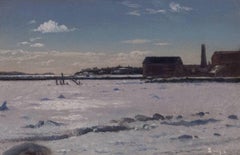
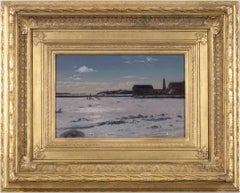
Fairhaven Harbor (Old Tack Works Wharf)
By William Bradford
Located in New York, NY
Signed lower right: Bradford
Category
19th Century Hudson River School William Bradford Art
Materials
Paper, Oil, Board
Fairhaven Harbor (Old Tack Works Wharf)
By William Bradford
Located in New York, NY
Signed lower right: Bradford
Paper, Oil, Board
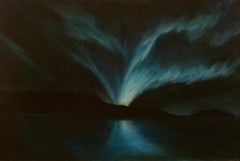
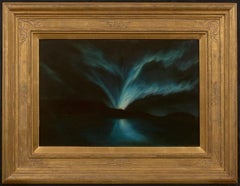
Lights of the Aurora
By William Bradford
Located in New York, NY
Signed lower right: W Bradford
Oil, Board
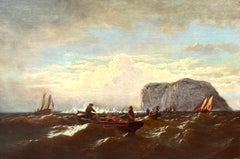
Fishing Boats Off the Coast in Bass Rock, Scotland
By William Bradford
Located in Fredericksburg, VA
This luminous maritime scene by American painter William Bradford captures a fleeting moment of daily life along the rugged coast of Bass Rock, Scotland. Known for his vivid Arctic e...
Canvas, Oil
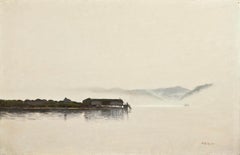
Fishing Camp on the Labrador Coast
By William Bradford
Located in New York, NY
In 1852, twenty-nine year old William Bradford was a failing shopkeeper in Fairhaven, Massachusetts. With a wife and child at home, Bradford, by his own admission, “spent too much time in painting to succeed” in business. Rescued from insolvency by his well-to-do in-laws, this is not the beginning of a narrative that generally leads to a happy ending. Not so with Bradford, who ultimately found international fame and fortune as a painter of arctic seascapes and dramatic marine paintings. William Bradford, the artist, was a lineal descendant of the 17th-century Separatist leader William Bradford, a founder of the Plymouth Plantation, signer of the Mayflower Compact and Governor of the Plymouth Colony. Our Bradford born to a New Bedford ship outfitter in Fairhaven, Massachusetts By the nineteenth century, this line of Bradfords were Quakers, living on the tract purchased nearly two centuries earlier by their pilgrim ancestor. Fairhaven, across the mouth of the Acushnet River from the whaling center of New Bedford was described by a New York journalist in 1857 as “the Brooklyn of New Bedford” (Home Journal, January 3, 1857). Young Bradford displayed an early predilection for the arts, but his Quaker parents were disinclined to support this particular pursuit. After working in his father’s business and then for a dry goods merchant in New Bedford, by 1849 Bradford had set up in New Bedford as a “merchant tailor” offering outfits for “those going to California,” “seamen’s clothing,” custom-tailored “piece goods...
Canvas, Paper, Oil
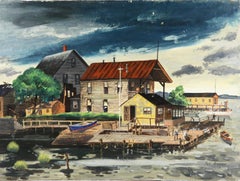
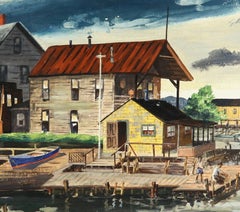
$6,500
H 22 in W 30 in
"Summer Pier Fishing" American Scene Social Realism WPA Mid-20th Century Modern
By Syd Browne
Located in New York, NY
"Summer Pier Fishing" American Scene Social Realism WPA Mid-20th Century Modern Syd J. Browne (1907-1991) "Summer Pier Fishing" 22 x 30 inches Oil on canvas. c. 1930s Signed lower r...
Canvas, Oil
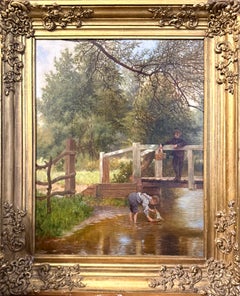
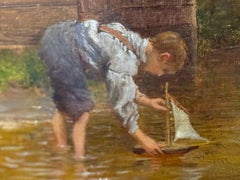
$3,200
H 21 in W 18 in D 3 in
Boy Sailing Toy Boat in Creek, oil on canvas in gilt frame signed and dated 1897
Located in Hillsborough, NC
A boy wades into the creek preparing to set his sailboat on a journey down the creek in this romantic narrative late Victorian oil painting. This painting tells a story, set in an id...
Canvas, Oil
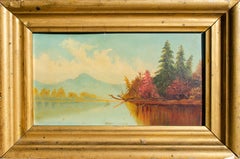
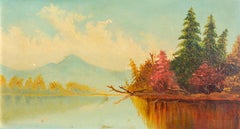
19th Century White Mountain Landscape, Unknown American School
Located in New York, NY
Unknown White Mountain Artist White Mountain Landscape, 19th Century Oil on board 5 x 9 1/4 in. Framed: 7 3/4 x 11 3/4 in.
Oil, Board
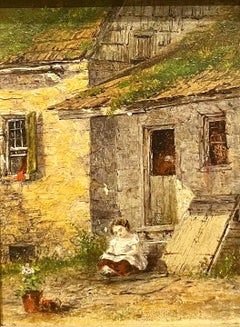
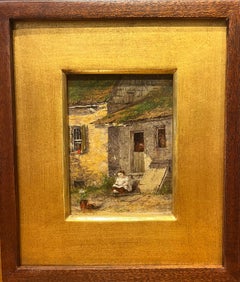
Little Girl Reading by House
By Edward Lamson Henry
Located in Fredericksburg, VA
"Reading After School," attributed to Edward Lamson Henry, offers a glimpse into the everyday moments of 19th-century American life. Known for his meticulous detail and his ability t...
Oil, Board
$9,500
H 9.5 in W 7 in
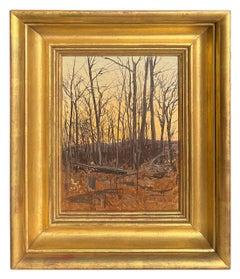
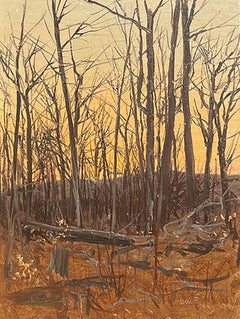
Dusk Forest Scene, Catskills by Lockwood DeForest (American, 1850-1932)
By Lockwood DeForest
Located in New York, NY
"Dusk Forest Scene, Catskills," 1875 by Hudson River School painter Lockwood DeForest (American, 1850-1932) is oil on artists card-stock and measures 9.5 x 7 inches. The work is signed by DeForest, and dated May 13, 1875 at lower right. The work is framed in an elegant, period appropriate frame, and ready to hang. Lockwood DeForest was born in New York in 1850 to a prominent family. He grew up in Greenwich Village and on Long Island at the family summer estate in Cold Spring Harbor. As was customary for a cultivated family in the Gilded Age, the DeForests made frequent trips abroad. Excursions to the great museums, which were prominent on the DeForests agenda, deepened the young Lockwood's familiarity with European painting and sculpture. Though he had begun drawing and painting somewhat earlier, it was during a visit to Rome in 1868 that nineteen-year-old DeForest first began to study art seriously, taking painting lessons from the Italian landscapist Hermann David Salomon Corrodi (1844–1905). More importantly, on the same trip, Lockwood met one of America’s most celebrated painters, (and his maternal great- uncle by marriage) Frederic Edwin Church (1826–1900), who quickly became his mentor. DeForest accompanied Church on sketching trips around Italy and continued this practice when they both returned to America in 1869. Early on in his career, de Forest made a habit of recording the date and often the place of his oil sketches, as to create a visual diary of his travels. Lockwood’s profession as a landscape painter can be primarily attributed to Frederic E. Church and his belief in the young artist’s talent. DeForest often visited Church in the Hudson River community of Catskill where, in addition to sketching trips and afternoons of painting, he assisted with the architectural drawings and planning of Olana. In 1872, DeForest took a studio at the Tenth Street Studio Building in New York. During these formative years DeForest counted among his friend’s artists such as Sanford Robinson Gifford (1823–80), George Henry Yewell (1830–1923), John Frederick Kensett (1816–72), Jervis McEntee (1828–91), and Walter Launt Palmer (1854–1932). Over the next decade DeForest experienced success as a painter. He exhibited for the first time at the National Academy of Design in 1872, and made two more painting trips abroad, in 1875–76 and 1877–78, traveling to the major continental capitals but also the Middle East and North Africa. His trip to the Middle East and the library at Church’s home, Olana, established his interest in design during his mid-twenties. From about 1878 to 1902, landscape painting was overshadowed by his activities and preoccupation with East Indian architecture and décor, a style that became quite fashionable in late nineteenth century America. From 1879-1883, de Forest founded Associated Artists along with Louis Comfort Tiffany, Candace Wheeler...
Oil, Board

$93,668
H 91.74 in W 82.68 in
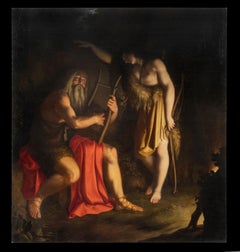
Mythological figurative painting of 19th century Italian Romanticism
Located in Florence, IT
The painting depicts "Ossian tells Malvina about the exploits of his son Oscar" and is dated at lower right "Filippo Bellati did the year 1811" and the unframed measurements are 233 ...
Canvas, Oil
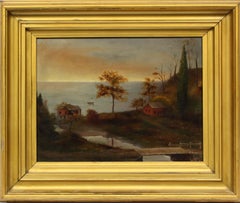
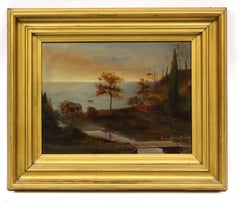
Folk Art American Hudson River School Landscape Figures Homes Rare 19th Century
Located in Buffalo, NY
A 19th century American landscape depicting a quiet coastal or lakeside scene at dusk, where a small cluster of houses rests along the water’s edge beneath a softly glowing sky. A n...
Oil, Board
$1,150
H 12 in W 16 in D 1 in
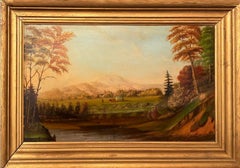
Antique American Pastoral Hudson River Painting Farm Oxen 1890 19th Century Rare
Located in Buffalo, NY
A 19th century American landscape depicting a pastoral valley framed by autumnal trees, with distant mountains rising softly along the horizon. A river winds through the foreground, ...
Oil, Board
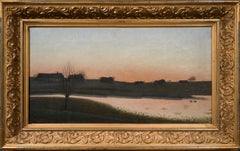
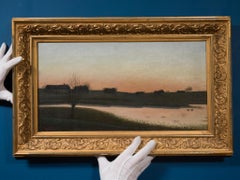
Evening Landscape with River and Farmhouses, 1898
Located in Stockholm, SE
Evening Landscape with River and Farmhouses by August Alvén captures a moment of profound quiet in the Swedish countryside just after sunset. The glowing sky transitions from warm ap...
Canvas, Oil
$2,475
H 18 in W 24 in D 2 in
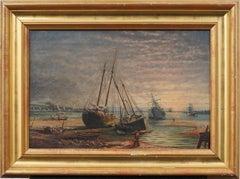
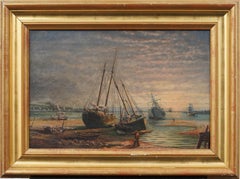
Antique American Sunset Seascape Giltwood Framed New England Harbor Oil Painting
Located in Buffalo, NY
Antique American sunset seascape oil painting. Oil on board. Signed. Framed. Measuring: 18 by 24 inches overall, and 12.25 by 18 painting alone.. In excellent original condition. Ha...
Oil, Board
$1,405
H 13.39 in W 11.23 in D 1.19 in
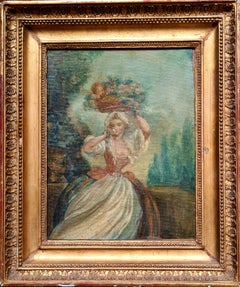
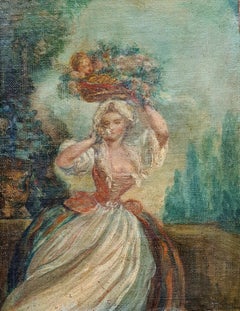
Allegory of Love, Cupid With Beauty in Fine Dress Carrying a Basket of Flowers
Located in Cotignac, FR
A late 18th Century oil on canvas laid on board of a young beauty in period costume carrying a basket of flowers on her head. Presented in a very fine gilt, period 'Directoire' frame...
Canvas, Oil, Board
$11,800Sale Price|20% Off
H 16 in W 22 in D 3 in
Antique American Hudson River School Scalp Level Pennsylvania Landscape Painting
Located in Buffalo, NY
Impressive early American Hudson River School landscape oil painting by Jasper Holman Lawman (1825 - 1906). Framed. Oil on board. Signed. Image size, 10H by 16L.
Oil, Board
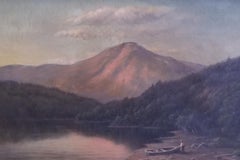
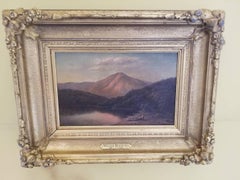
Whiteface Mt, Lake Placid NY
By William Bradford
Located in Saratoga Springs, NY
Signed lower left A 19th-century marine painter, William Bradford is famous for his seascapes that reflect his background of being raised in an area known for whaling and other mar...
Canvas, Oil
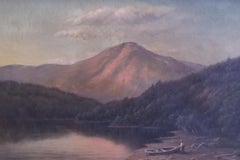
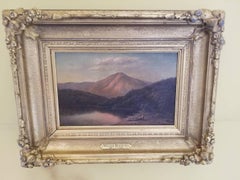
Whiteface Mt, Lake Placid NY
By William Bradford
Located in Saratoga Springs, NY
Signed lower left A 19th-century marine painter, William Bradford is famous for his seascapes that reflect his background of being raised in an area known for whaling and other marine activities. During much of his career, his work focused on the Arctic region, which he depicted with strong color and spectacular lighting. Bradford was born and raised in New Bedford, Massachusetts to Quaker parents who disapproved of his desire for a painting career. He became a clerk in his father's dry goods shop in New Bedford but devoted his spare time to sketching, a diversion that caused him and his wife to lose a farm that had been given to them by his father-in- law. In the early 1850s, living in Fairhaven, he launched his professional career by selling portraits of ships for twenty-five dollars a piece. In 1854, he opened a studio and about this same time attracted the interest of Albert Van Beest, a Dutch painter who had come to America in 1845. He became Bradford's teacher and collaborator, and until his death in 1860, they painted together local scenes including seascapes and whaling pictures. In 1861, Bradford began a series of trips to Nova Scotia, Labrador, and Greenland, and painting and photographing the Arctic region became a consuming interest. He also published a book in London titled The Arctic Region, which he vividly illustrated with photographs pasted onto the page and he gave lectures accompanied by lantern slides...
Canvas, Oil