By William Gear
Located in Hagley, England
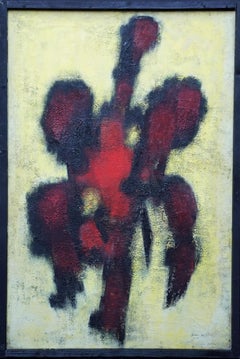
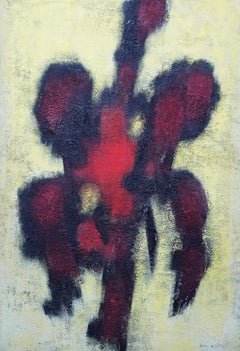
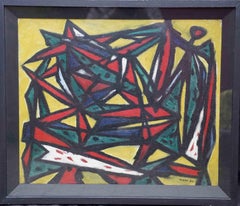
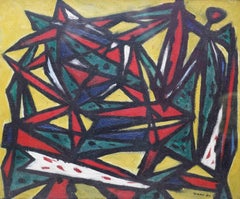
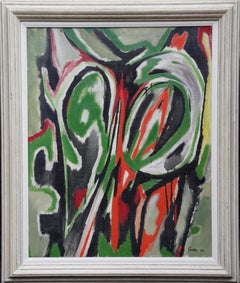
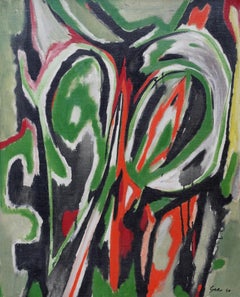
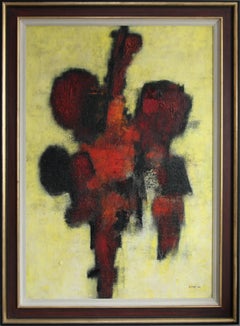
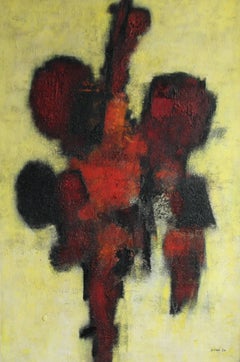
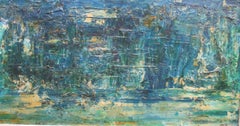
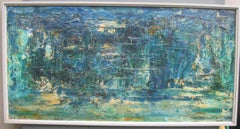
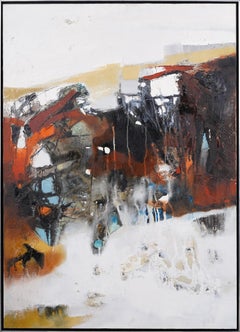
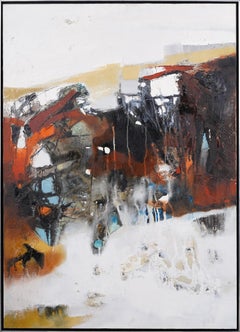
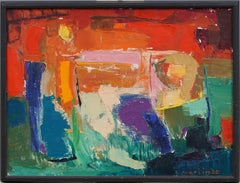
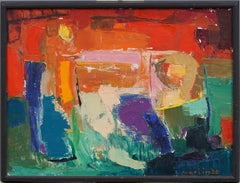
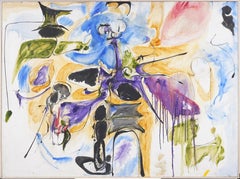
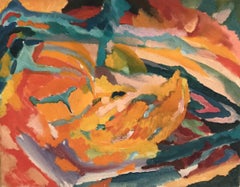
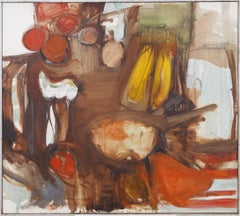
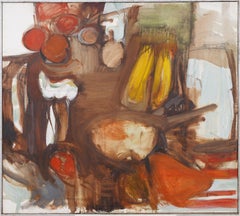
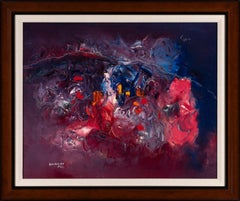
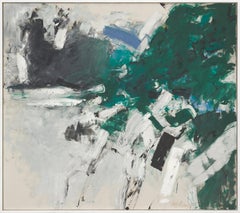
This stunning Scottish Abstract Expressionist oil painting is by noted Scottish artist William Gear. Painted in 1949 it is an early and significant painting which dates to the early part of his career. Entitled Abstract Landscape with Red and Green it was painted during Gear's time in Paris and involvement with COBRA. Mostly red and green shapes are incased in black on a vivid yellow background. A really pleasing composition to the eye and perfectly housed in an ebonised frame, it is an excellent example of Gear's work.
Signed and Dated '49 lower right. Inscribed, titled and dated verso.
Provenance: Cornish collection.
Condition. Acrylic on canvas 25 inches by 20 inches and in good condition.
Frame. Housed in an ebonised frame, 30 inches by 25 inches and in good condition.
Few British painters have played an active role in the modern abstract movement of post-war Europe. William Gear was the most passionate and committed exception. He continued the tradition of the Edinburgh-Paris axis established by J.D. Fergusson, Samuel Peploe and others, spending vital years between 1947 and 1950 living and working in Paris. Significantly, in recent years, he received the greatest acclaim in France, Germany and the Netherlands.
He was born in 1915 in Methil, Fife, into a mining family; the particular landscape of "pitheads, the sea, rocks, castles, trees, storms and poverty" marked his earliest identity with a place and probably remained the most influential to his art. Years later he recalled as a schoolboy visiting the local art gallery in Kirkcaldy and seeing 12 colourful still-lifes by Peploe. Art-history lessons during student years at Edinburgh College of Art, in particular Byzantine classes under David Talbot Rice, also influenced his concern for structure. This had as much to do with the formal language of painting as sheer delight in the medium itself. Gear never missed an opportunity to show people the merits of a well-constructed painting.
On a travelling scholarship in 1937, he chose to study with Fernand Leger, described by Gear as "a keystone for me, seldom abstract, rather a degree of abstraction". The Second World War interrupted these formative years and, by 1940, Gear had joined the Royal Corps of Signals. Dispatched to the Middle East, he still had the discipline to paint - mostly works on paper of damaged landscapes - with exhibitions in Jerusalem, Tel Aviv, Cairo as well as Siena and Florence.
His naturally robust and tenacious temperament was profoundly affected by visiting Bergen-Belsen, and this certainly influenced the later experiments with the black armature. As the British officer in Celle, working for the Monuments, Fine Arts and Archives Section of the Control Commission, he focused on securing the safety of the Berlin Art Collection in Schloss Celle, and organised an important series of modern art exhibitions, including the rejected work of Karl Otto Gotz...
Category
1940s Abstract Expressionist William Gear Art