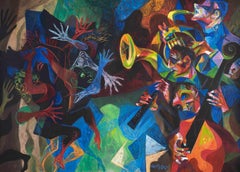
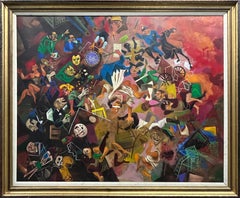
Rhythm in Blues
By William Gropper
Located in London, GB
signed ‘Gropper’ (lower right); with the artist's studio stamp (on the verso)
Category
1940s William Gropper Abstract Paintings
Materials
Canvas, Oil
William Gropper was a painter and cartoonist who, with caricature style, focused on social concerns. Gropper was born on December 3, 1897, in New York. William Gropper was a student of Robert Henri and George Bellows at the Ferrer School from 1912–15. During the 1930s, working as a part of the Federal Arts Project, he produced some of the most gripping social protest works of the Great Depression. His subjects included industrial strikes, especially in coal mining and steel-production centers. Gropper did much illustration-cartoon work for the New York Tribune newspaper, Vanity Fair magazine and the politically left-wing publication, New Masses. Some of his other pieces focused on the hypocrisy of government figures, especially members of the United States Senate. Gropper died on January 6, 1977, in Manhasset.
Rhythm in Blues
By William Gropper
Located in London, GB
signed ‘Gropper’ (lower right); with the artist's studio stamp (on the verso)
Canvas, Oil
$1,996Sale Price|20% Off
H 42 in W 44 in D 2 in
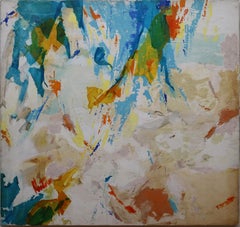
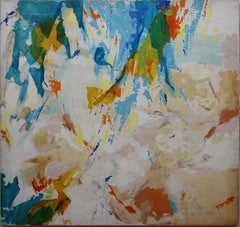
Large Scale Antique American Abstract Expressionist Signed Original Oil Painting
Located in Buffalo, NY
Antique American modernist abstract oil painting. Oil on canvas. Signed.
Canvas, Oil
Sold
H 50 in W 60 in
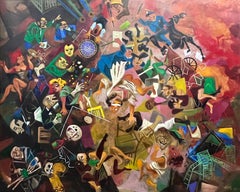
"Doomsday Rhapsody" Contemporary Social Realism Mid 20th Century Political Large
By William Gropper
Located in New York, NY
"Doomsday Rhapsody" Contemporary Social Realism Mid 20th Century Political Large. 42 x 52 inches. Signed lower right Provenance: Estate of the artist. BIO William Gropper (1897- 1977) Throughout his life, William Gropper used his artistic talents to protest social injustice. Born in New York City, he grew up there in poverty and left high school to work as a dishwasher and delivery boy. He eventually began a career in art and was able to study with Robert Henri and George Bellows from 1912 to 1915. He adopted their realistic painting style, and his own work expressed sympathy for common laborers and outrage at society's ills. In 1919 Gropper established a reputation as a political cartoonist working for the New York Tribune. His blunt, forceful style attracted the attention of other publications, and he provided illustrations and cartoons for a variety of magazines, from the left-wing New Masses to mainstream Vanity Fair. Like many social realist artists of the 1930s, Gropper supported liberal political causes, depicting subjects such as the plight of migrant laborers and striking factory workers. In his first gallery exhibition in 1936 at ACA Galleries, Gropper's work was so well received by critics, collectors, and artists that the following year he had two one-man exhibitions at ACA Galleries. In 1937, Gropper traveled west on a Guggenheim Fellowship and visited the Dust Bowl and the Hoover and Grand Coulee Dams, sketching studies for a series of paintings and a mural he painted for the Department of the Interior. That same year he had paintings purchased by both the Metropolitan Museum of Art and the Museum of Modern Art. Gropper exhibited at the 1939 New York World's Fair, Whitney Museum of American Art (1924-55), Art Institute of Chicago (1935-49), Carnegie International (1937-50), Pennsylvania Academy of the Fine Arts (1939-48), and National Academy of Design (1945-48). He was a founder of the Artists Equity Association and member of the National Institute of Arts and Letters. From 1940 to 1945 William Gropper was preoccupied with anti-Nazi cartoons...
Canvas, Oil