William Gropper Prints and Multiples

American, 1897-1977

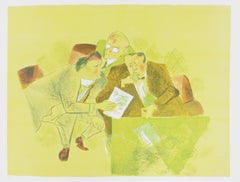
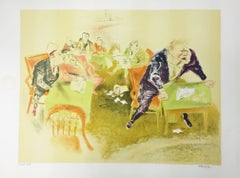
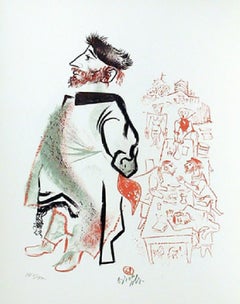
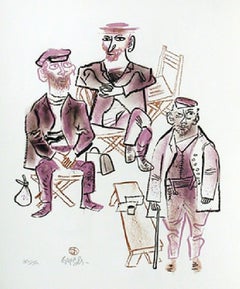
William Gropper was a painter and cartoonist who, with caricature style, focused on social concerns. Gropper was born on December 3, 1897, in New York. William Gropper was a student of Robert Henri and George Bellows at the Ferrer School from 1912–15. During the 1930s, working as a part of the Federal Arts Project, he produced some of the most gripping social protest works of the Great Depression. His subjects included industrial strikes, especially in coal mining and steel-production centers. Gropper did much illustration-cartoon work for the New York Tribune newspaper, Vanity Fair magazine and the politically left-wing publication, New Masses. Some of his other pieces focused on the hypocrisy of government figures, especially members of the United States Senate. Gropper died on January 6, 1977, in Manhasset.

to
9
3
1
Overall Width
to
Overall Height
to
8
25
1,320
1,026
904
901
13
1
1
1
9
4
4
3
2
2
2
1
1
1
1
1
1
12
1
2
13
Artist: William Gropper
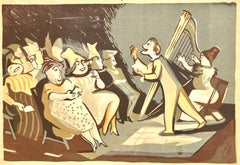
William Gropper, (Choral Group)

William Gropper, (Choral Group)

By William Gropper

Located in New York, NY

An early serigraph (screen print) by William Gropper. There's a harpist to provide the music and a choir master conducting. The seated members of the group are individually drawn as ...

Category

1930s Ashcan School William Gropper Prints and Multiples

Materials

Screen

Jewish Shtetl Klezmer Wedding Tanz Judaica Lithograph WPA Yiddish Social Realist

Jewish Shtetl Klezmer Wedding Tanz Judaica Lithograph WPA Yiddish Social Realist

By William Gropper

Located in Surfside, FL

Hand signed in pencil and numbered with Roman numerals 8/24. A very small edition. Old Lower East Side of New York or East European Shtetl. Jewish Shtetl Klezmer Musicians. humorous...

Category

Mid-20th Century Modern William Gropper Prints and Multiples

Materials

Lithograph

Liberated Village
Liberated Village

Liberated Village

By William Gropper

Located in San Francisco, CA

This artwork titled "Liberated Village" c. 1940, is an original lithograph on paper by noted American artist William Gropper, 1897-1977. It is hans signed and titled in pencil by the artist. The artwork (image) size is 12 x 16.5 inches, framed size is 20.25 x 24.25 inches. Custom framed in a black metal frame, with off white matting. It is in excellent condition. An example of this particular artwork is held at the Metropolitan Museum of Art, New York. About the artist: William Gropper was born in New York City's Lower East Side in 1897. He was the first of six children to parents who earned small wages working in sweatshops. At the age of fourteen, Gropper left school to help support his family. While carrying bolts of cloth for his deliveries, Gropper began to draw on scraps of paper, sidewalks, and walls. A passerby saw some of these drawings and invited Gropper to attend a life-drawing class at the Ferrer School. He studied there for three years from 1912 to 1915, attending classes taught by Robert Henri and George Bellows. From 1915 to 1918 Gropper attended the New York School of Fine and Applied Art part-time on scholarship. Gropper also won a scholarship to the National Academy of Design, but remained as a student for only a short time; the rigid and systematic institution conflicted with Gropper's belief in the personal nature of art. At the New York School of Fine and Applied Art, Gropper earned several prizes. One of these prizes was for his cartoons, which led him to be hired by the New York Tribune in 1917 to sketch for their features. A few years later through freelance work, his cartoons and drawings appeared in other newspapers and magazines, such as The Liberator, The New Masses...

Category

Mid-20th Century American Realist William Gropper Prints and Multiples

Materials

Lithograph

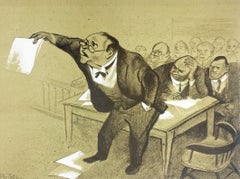
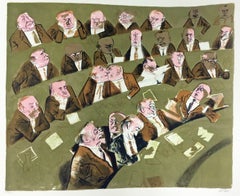
FIVE LITHOGRAPHS OF COURTROOM SCENES

FIVE LITHOGRAPHS OF COURTROOM SCENES

By William Gropper

Located in Portland, ME

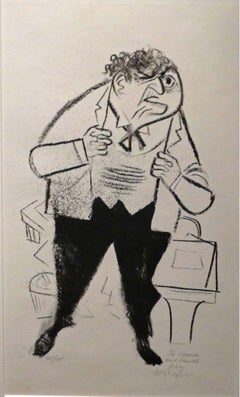
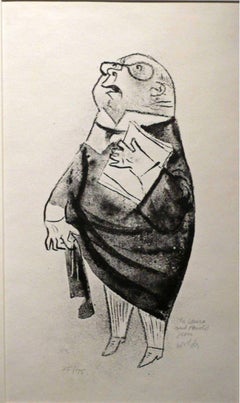
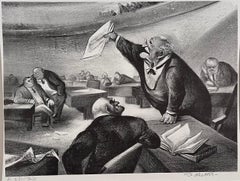
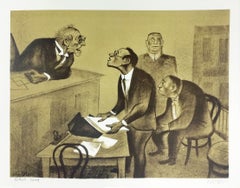
Gropper, William. FIVE LITHOGRAPHS OF COURTROOM SCENES. Lithographs, circa 1950s-60s. Various sizes; each on a 12 3/4 x 20 sheet. Each numbered 25/175, signed and inscribed in pencil...

Category

1950s William Gropper Prints and Multiples

Materials

Lithograph

Women, Dishes, Shtetl Americana Judaica Lithograph WPA Social Realist Artist

Women, Dishes, Shtetl Americana Judaica Lithograph WPA Social Realist Artist

By William Gropper

Located in Surfside, FL

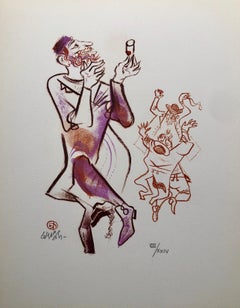
Hand signed in pencil and numbered with Roman numerals 8/24. A very small edition. Old Lower East Side of New York or East European Shtetl. Orthodox Jewish Rabbi having a glass of t...

Category

Mid-20th Century Modern William Gropper Prints and Multiples

Materials

Lithograph

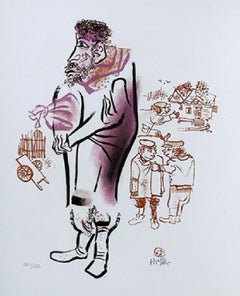
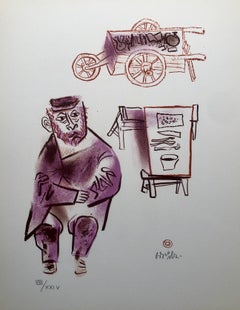
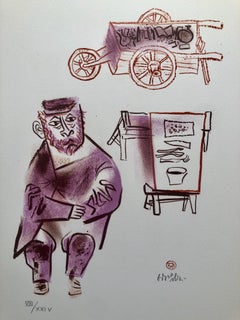
Jewish Shtetl Peddlar Americana Judaica Lithograph WPA Yiddish Social Realist

Jewish Shtetl Peddlar Americana Judaica Lithograph WPA Yiddish Social Realist

By William Gropper

Located in Surfside, FL

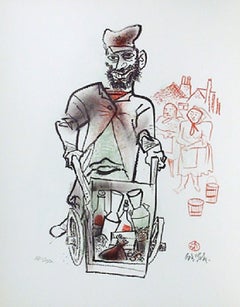
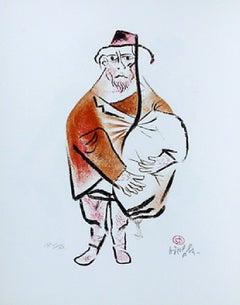
Hand signed in pencil and numbered with Roman numerals 8/24. A very small edition. Old Lower East Side of New York or East European Shtetl. Jewish Shtetl Peddler Merchant. humorous ...

Category

Mid-20th Century Modern William Gropper Prints and Multiples

Materials

Lithograph

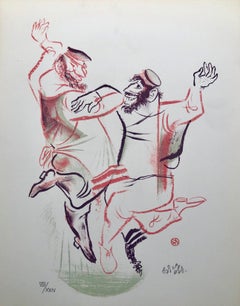
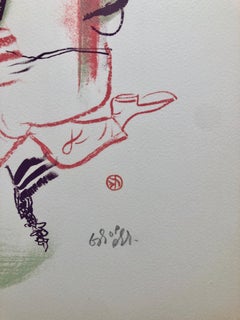
Jewish Shtetl Hasidic Wedding Dance Judaica Lithograph Yiddish Social Realism

Jewish Shtetl Hasidic Wedding Dance Judaica Lithograph Yiddish Social Realism

By William Gropper

Located in Surfside, FL

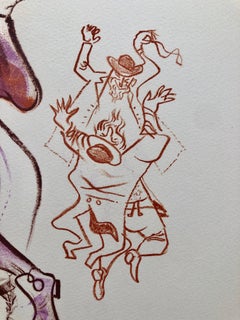
Hand signed in pencil and numbered with Roman numerals 8/24. A very small edition. Old Lower East Side of New York or East European Shtetl. Jewish Shtetl Hasidic Klezmer Musicians. ...

Category

Mid-20th Century Modern William Gropper Prints and Multiples

Materials

Lithograph

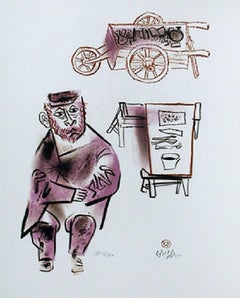
Jewish Shtetl Peddlar Americana Judaica Lithograph WPA Yiddish Social Realist

Jewish Shtetl Peddlar Americana Judaica Lithograph WPA Yiddish Social Realist

By William Gropper

Located in Surfside, FL

Hand signed in pencil and numbered with Roman numerals 8/24. A very small edition. Old Lower East Side of New York or East European Shtetl. Jewish Shtetl Peddler Merchant. humorous ...

Category

Mid-20th Century Modern William Gropper Prints and Multiples

Materials

Lithograph

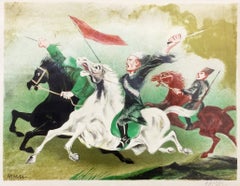
Horsemen
Horsemen

Horsemen

By William Gropper

Located in San Francisco, CA

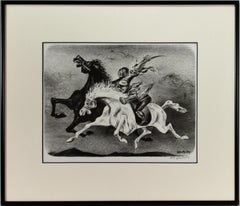
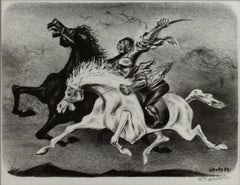
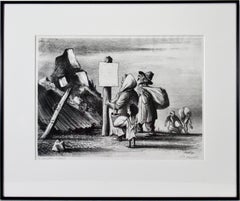
This artwork titled "The Horsemen" 1935, is an original lithograph on paper by noted American artist William Gropper, 1897-1977. It is hand signed in pencil by the artist. The artwork (image) size is 9.5 x 12.75 inches, framed size is 17.5 x 20.40 inches. Published by Associated American Artists, New York, printed by George Miller. Referenced and pictured in the artist catalogue raisonne by Steinberg, page 246 and Windisch and Cole, plate #602. Custom framed in a black metal frame, with off white matting. It is in excellent condition, the frame have very minor scratches. An example of this particular artwork is held at the Metropolitan Museum of Art, New York. and at the Portland Museum, Portland. About the artist: William Gropper was born in New York City's Lower East Side in 1897. He was the first of six children to parents who earned small wages working in sweatshops. At the age of fourteen, Gropper left school to help support his family. While carrying bolts of cloth for his deliveries, Gropper began to draw on scraps of paper, sidewalks, and walls. A passerby saw some of these drawings and invited Gropper to attend a life-drawing class at the Ferrer School. He studied there for three years from 1912 to 1915, attending classes taught by Robert Henri and George Bellows. From 1915 to 1918 Gropper attended the New York School of Fine and Applied Art part-time on scholarship. Gropper also won a scholarship to the National Academy of Design, but remained as a student for only a short time; the rigid and systematic institution conflicted with Gropper's belief in the personal nature of art. At the New York School of Fine and Applied Art, Gropper earned several prizes. One of these prizes was for his cartoons, which led him to be hired by the New York Tribune in 1917 to sketch for their features. A few years later through freelance work, his cartoons and drawings appeared in other newspapers and magazines, such as The Liberator, The New Masses, The New York Post, The New Yorker and Vanity Fair. By the late 1920s Gropper was an established cartoonist and draughtsman. He sympathized with the labor movement and was a champion of peace and personal liberty. Gropper began to paint seriously, but privately, on these themes in 1921. Gropper's first exhibition of monotypes was held in 1921 at the Washington Square Book Shop in New York. At this time, he also began to do illustrations for books. Gropper took his first sketching trip in 1924 to the West with Morris Pass. By 1930 Gropper began to receive recognition as a fine artist. In 1934, he received two mural commissions from the Schenley Corporation in New York City. In 1935, he was commissioned to paint a mural for the Hotel Taft in New York City. In 1936, Gropper received several public mural commissions: one was for the Freeport, Long Island Post Office, which was completed in 1938 and followed by another mural for the Northwestern Postal Station, Detroit, Michigan. In his first gallery exhibition in 1936 at ACA Galleries, Gropper's work was so well received by critics, collectors, and artists that the following year he had two one-man exhibitions at ACA Galleries. In 1937, Gropper traveled west on a Guggenheim Fellowship and visited the Dust Bowl and the Hoover and Grand Coulee Dams, sketching studies for a series of paintings and a mural he painted for the Department of the Interior in Washington, DC. That same year he had paintings purchased by both the Metropolitan Museum of Art and the Museum of Modern Art. Gropper exhibited at the 1939 New York World's Fair, Whitney Museum of American Art (1924-55), Art Institute of Chicago (1935-49), Carnegie International (1937-50), Pennsylvania Academy of the Fine Arts (1939-48), and National Academy of Design (1945-48). He was a founder of the Artists Equity Association and member of the National Institute of Arts and Letters. From 1940 to 1945 William Gropper was preoccupied with anti-Nazi cartoons...

Category

Mid-20th Century American Realist William Gropper Prints and Multiples
Materials

Lithograph

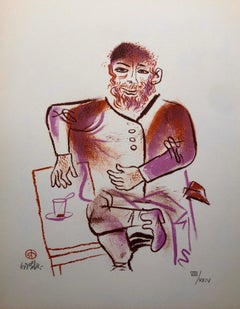
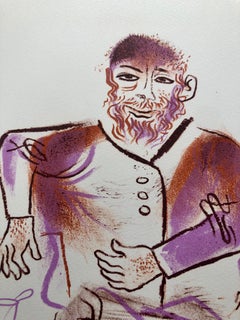
Rabbi, Cup of Tea, Shtetl Americana Judaica Lithograph WPA Social Realist Artist

Rabbi, Cup of Tea, Shtetl Americana Judaica Lithograph WPA Social Realist Artist

By William Gropper

Located in Surfside, FL

Hand signed in pencil and numbered with Roman numerals 8/24. A very small edition. Old Lower East Side of New York or East European Shtetl. Orthodox Jewish Rabbi having a glass of t...

Category

Mid-20th Century Modern William Gropper Prints and Multiples

Materials

Lithograph

Sephardic Jew Fez Hat Jewish Shtetl Americana Judaica Lithograph WPA Yiddish Art

Sephardic Jew Fez Hat Jewish Shtetl Americana Judaica Lithograph WPA Yiddish Art

By William Gropper

Located in Surfside, FL

Hand signed in pencil and numbered with Roman numerals 8/24. A very small edition. Old Lower East Side of New York or East European Shtetl. Yenta gossips in the kitchen peeling. hum...

Category

Mid-20th Century Modern William Gropper Prints and Multiples

Materials

Lithograph

Jewish Shtetl Machers Americana Judaica Lithograph WPA Yiddish Social Realist

Jewish Shtetl Machers Americana Judaica Lithograph WPA Yiddish Social Realist

By William Gropper

Located in Surfside, FL

Hand signed in pencil and numbered with Roman numerals 8/24. A very small edition. Old Lower East Side of New York or East European Shtetl. Jewish Shtetl Peddler Merchant. humorous ...

Category

Mid-20th Century Modern William Gropper Prints and Multiples

Materials

Lithograph

THE NEW BILL

THE NEW BILL

By William Gropper

Located in Portland, ME

Gropper, Will1am (American, 1897-1977). THE NEW BILL. Lithograph, c. 1941. 11 3/4 x 16 inches (image), 14 x 19 inches (sheet).Titled and signed in pencil. In excellent condition.

Category

1940s William Gropper Prints and Multiples

Materials

Lithograph

Related Items
Elegant Lithograph Print, Art Deco Style, Signed, 20th Century, 27.5"

Elegant Lithograph Print, Art Deco Style, Signed, 20th Century, 27.5"

By Erté

Located in Petworth, West Sussex

Erte (Romain de Tirtoff) (Russian, 1892 – 1990) Elegant, 1990 Lithograph Signed ‘Erte’ in pencil (lower right) 27.1/2 x 22.1/4 in. (70 x 56.5 cm.) (sheet size)

Category

20th Century Art Deco William Gropper Prints and Multiples

Materials

Lithograph

Jean Cocteau -  He ! He! Toro - Original Lithograph

Jean Cocteau - He ! He! Toro - Original Lithograph

By Jean Cocteau

Located in Collonge Bellerive, Geneve, CH

Original Lithograph by Jean Cocteau Title: He ! He! Toro 1961 Dimensions: 38 x 28 cm Lithograph made for the portfolio "Gitans et Corridas" published by Société de Diffusion Artistiq...

Category

1960s Modern William Gropper Prints and Multiples

Materials

Lithograph

Jean Cocteau - Europe's Diversity - Original Lithograph

Jean Cocteau - Europe's Diversity - Original Lithograph

By Jean Cocteau

Located in Collonge Bellerive, Geneve, CH

Original Lithograph by Jean Cocteau Title: Europe's Diversity Signed in the plate Dimensions: 33 x 46 cm Edition: 200 Luxury print edition from the portfolio of Sciaky 1961 Jean Coc...

Category

1960s Modern William Gropper Prints and Multiples

Materials

Lithograph

Jean Cocteau - Marine Mountains - Original Lithograph

Jean Cocteau - Marine Mountains - Original Lithograph

By Jean Cocteau

Located in Collonge Bellerive, Geneve, CH

Jean Cocteau - Marine Mountains - Original Lithograph Dimensions: 38 x 28 cm Edition: 200 In Rives From: COCTEAU. — VERDET (André). Montagnes marines. S. l. (Paris), Les Messagers du...

Category

1960s Modern William Gropper Prints and Multiples

Materials

Lithograph

Leonor Fini - Red-Hair - Original Lithograph

Leonor Fini - Red-Hair - Original Lithograph

By Leonor Fini

Located in Collonge Bellerive, Geneve, CH

Leonor Fini - Red-Hair - Original Lithograph The Flowers of Evil 1964 Conditions: excellent Edition: 500 Dimensions: 46 x 34 cm Editions: Le Cercle du Livre Précieux, Paris Unsigne...

Category

1960s Modern William Gropper Prints and Multiples

Materials

Lithograph

Marc Chagall - Inspiration - Original Lithograph from "Chagall Lithographe" v. 2

Marc Chagall - Inspiration - Original Lithograph from "Chagall Lithographe" v. 2

By Marc Chagall

Located in Collonge Bellerive, Geneve, CH

Marc Chagall Original Lithograph from Chagall Lithographe 1957-1962. VOLUME II. 1963 Dimensions: 32 x 24 cm From the unsigned edition of 10000 copies without margins Reference: Mourlot 398 Condition : Excellent Marc Chagall (born in 1887) Marc Chagall was born in Belarus in 1887 and developed an early interest in art. After studying painting, in 1907 he left Russia for Paris, where he lived in an artist colony on the city’s outskirts. Fusing his own personal, dreamlike imagery with hints of the fauvism and cubism popular in France at the time, Chagall created his most lasting work—including I and the Village (1911)—some of which would be featured in the Salon des Indépendants exhibitions. After returning to Vitebsk for a visit in 1914, the outbreak of WWI trapped Chagall in Russia. He returned to France in 1923 but was forced to flee the country and Nazi persecution during WWII. Finding asylum in the U.S., Chagall became involved in set and costume design before returning to France in 1948. In his later years, he experimented with new art forms and was commissioned to produce numerous large-scale works. Chagall died in St.-Paul-de-Vence in 1985. The Village Marc Chagall was born in a small Hassidic community on the outskirts of Vitebsk, Belarus, on July 7, 1887. His father was a fishmonger, and his mother ran a small sundries shop in the village. As a child, Chagall attended the Jewish elementary school, where he studied Hebrew and the Bible, before later attending the Russian public school. He began to learn the fundamentals of drawing during this time, but perhaps more importantly, he absorbed the world around him, storing away the imagery and themes that would feature largely in most of his later work. At age 19 Chagall enrolled at a private, all-Jewish art school and began his formal education in painting, studying briefly with portrait artist Yehuda Pen. However, he left the school after several months, moving to St. Petersburg in 1907 to study at the Imperial Society for the Protection of Fine Arts. The following year, he enrolled at the Svanseva School, studying with set designer Léon Bakst, whose work had been featured in Sergei Diaghilev's Ballets Russes. This early experience would prove important to Chagall’s later career as well. Despite this formal instruction, and the widespread popularity of realism in Russia at the time, Chagall was already establishing his own personal style, which featured a more dreamlike unreality and the people, places and imagery that were close to his heart. Some examples from this period are his Window Vitebsk (1908) and My Fianceé with Black Gloves (1909), which pictured Bella Rosenfeld, to whom he had recently become engaged. The Beehive Despite his romance with Bella, in 1911 an allowance from Russian parliament member and art patron Maxim Binaver enabled Chagall to move to Paris, France. After settling briefly in the Montparnasse neighborhood, Chagall moved further afield to an artist colony known as La Ruche (“The Beehive”), where he began to work side by side with abstract painters such as Amedeo Modigliani and Fernand Léger as well as the avant-garde poet Guillaume Apollinaire. At their urging, and under the influence of the wildly popular fauvism and cubism, Chagall lightened his palette and pushed his style ever further from reality. I and the Village (1911) and Homage to Apollinaire (1912) are among his early Parisian works, widely considered to be his most successful and representative period. Though his work stood stylistically apart from his cubist contemporaries, from 1912 to 1914 Chagall exhibited several paintings at the annual Salon des Indépendants exhibition, where works by the likes of Juan Gris, Marcel Duchamp and Robert Delaunay were causing a stir in the Paris art world. Chagall’s popularity began to spread beyond La Ruche, and in May 1914 he traveled to Berlin to help organize his first solo exhibition, at Der Sturm Gallery. Chagall remained in the city until the highly acclaimed show opened that June. He then returned to Vitebsk, unaware of the fateful events to come. War, Peace and Revolution In August 1914 the outbreak of World War I precluded Chagall’s plans to return to Paris. The conflict did little to stem the flow of his creative output, however, instead merely giving him direct access to the childhood scenes so essential to his work, as seen in paintings such as Jew in Green (1914) and Over Vitebsk (1914). His paintings from this period also occasionally featured images of the war’s impact on the region, as with Wounded Soldier (1914) and Marching (1915). But despite the hardships of life during wartime, this would also prove to be a joyful period for Chagall. In July 1915 he married Bella, and she gave birth to a daughter, Ida, the following year. Their appearance in works such as Birthday (1915), Bella and Ida by the Window (1917) and several of his “Lovers” paintings give a glimpse of the island of domestic bliss that was Chagall’s amidst the chaos. To avoid military service and stay with his new family, Chagall took a position as a clerk in the Ministry of War Economy in St. Petersburg. While there he began work on his autobiography and also immersed himself in the local art scene, befriending novelist Boris Pasternak, among others. He also exhibited his work in the city and soon gained considerable recognition. That notoriety would prove important in the aftermath of the 1917 Russian Revolution when he was appointed as the Commissar of Fine Arts in Vitebsk. In his new post, Chagall undertook various projects in the region, including the 1919 founding of the Academy of the Arts. Despite these endeavors, differences among his colleagues eventually disillusioned Chagall. In 1920 he relinquished his position and moved his family to Moscow, the post-revolution capital of Russia. In Moscow, Chagall was soon commissioned to create sets and costumes for various productions at the Moscow State Yiddish Theater...

Category

1960s Surrealist William Gropper Prints and Multiples
Materials

Lithograph

Jean Dubuffet - original lithograph from XXe Siecle magazine

Jean Dubuffet - original lithograph from XXe Siecle magazine

By Jean Dubuffet

Located in Collonge Bellerive, Geneve, CH

Jean Dubuffet - Original Lithograph from XXe Siecle magazine 1958 Dimensions: 32 x 25 cm Edition: G. di San Lazzaro. Unsigned and unumbered as issued

Category

1960s Modern William Gropper Prints and Multiples
Materials

Lithograph

Tennis Match - Jimmy Connors, Modern Lithograph by Daniel Bennett Schwartz

Tennis Match - Jimmy Connors, Modern Lithograph by Daniel Bennett Schwartz

Located in Long Island City, NY

Daniel Bennett Schwartz, American (1929 - ) - Tennis Match - Jimmy Connors, Year: 1977, Medium: Lithograph, signed and numbered in pencil, Edition: 600, Image Size: 24 x 18 inche...

Category

1970s Expressionist William Gropper Prints and Multiples
Materials

Lithograph

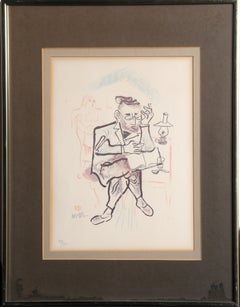
"Postcard from Paris" 1970s Satirical Lithograph

"Postcard from Paris" 1970s Satirical Lithograph

By Charles Bragg

Located in Soquel, CA

"Postcard from Paris" Satirical Lithograph Humorous Screen Print by Charles Bragg (American, 1931-2017). Two nude individuals pose in a room partially covered by a piece of drapery and a flower vase. The woman wears a variety of costume jewelry and a crown and appears posed, while the man stands behind an old-fashioned camera and smiles. The surroundings are highly colorful, with pink wallpaper, blue curtains, and a variety of different plants. Both figures look towards the viewer, potentially nodding to the satirical nature of the piece. Numbered as "Artists Proof IX" in bottom left corner. Signed "Charles Bragg" in bottom right corner. Frame size: 20.88" H x 27" W Image size: 10.25" H x 17" W Charles Bragg (American, 1931-2017) was a painter, sculptor, and illustrator of commentary on human behavior, based out of Los Angeles, California. Bragg often injected his sense of humor and appreciation of satire into his subjects, many of which are cartoonish and seem half human and half animal. He also depicted serious subjects, ones that become poignant commentaries on the human condition. Bragg was born in St. Louis Missouri in 1931. His parents were vaudeville performers, and he spent most of his young life traveling on tour with them. During his teenage years, he went to New York's High School of Music & Art in Harlem. At 18, he ran away with his high school sweetheart, fellow artist Jennie Tomao...

Category

Mid-20th Century American Impressionist William Gropper Prints and Multiples
Materials

Paper, Ink, Screen

Still Life with Hans Maler Pop Art Serigraph Hand Signed

Still Life with Hans Maler Pop Art Serigraph Hand Signed

By Josef Levi

Located in Surfside, FL

On deckle edged watermarked Arches French paper. hand signed in pencil, dated and numbered. the edition size is 175. there are three states of the same image image each with increas...

Category

1970s Pop Art William Gropper Prints and Multiples
Materials

Lithograph, Screen

Still Life with Hans Maler Pop Art Serigraph Hand Signed

Still Life with Hans Maler Pop Art Serigraph Hand Signed

By Josef Levi

Located in Surfside, FL

On deckle edged watermarked Arches French paper. hand signed in pencil, dated and numbered. the edition size is 175. there are three states of the same image image each with increas...

Category

1970s Pop Art William Gropper Prints and Multiples
Materials

Lithograph, Screen

Previously Available Items
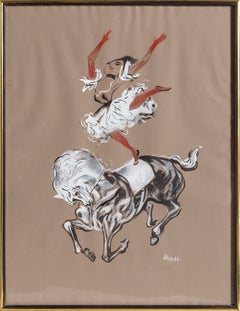
Circus Acrobat on Horse Silkscreen Print William Gropper American WPA Modernist

Circus Acrobat on Horse Silkscreen Print William Gropper American WPA Modernist

By William Gropper

Located in Surfside, FL

William Gropper Silkscreen Print American Modern Art Circus acrobat on horseback, Dancer Frame: 26.5 X 21 Image: 23.5 X 18 Old Lower East Side of New York or East European Shtetl. ...

Category

Mid-20th Century American Modern William Gropper Prints and Multiples
Materials

Screen, Lithograph

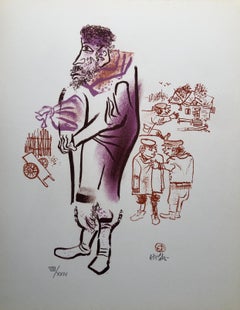
Jewish Shtetl Peddlar Pushcart Judaica Lithograph WPA Yiddish Social Realist

Jewish Shtetl Peddlar Pushcart Judaica Lithograph WPA Yiddish Social Realist

By William Gropper

Located in Surfside, FL

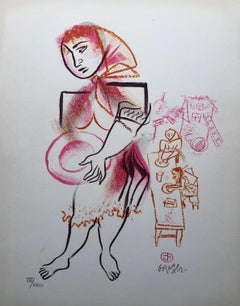
Hand signed in pencil and numbered with Roman numerals 8/24. A very small edition. Old Lower East Side of New York or East European Shtetl. Jewish Shtetl Peddler Merchant. humorous ...

Category

Mid-20th Century Modern William Gropper Prints and Multiples
Materials

Lithograph

Wedding Dancer, Shtetl Series

Wedding Dancer, Shtetl Series

By William Gropper

Located in Surfside, FL

As a politically passionate, unconventional figure in the art world, William Gropper tested the limits of expression through his cartoons, murals, and oil paintings. With a preference for theme over aesthetic, Gropper believed that art should reflect the human condition and experience. Visual art became the means by which Gropper communicated his concern for labor and economic issues, making him an ideal representative of Social-Realism. Throughout his life, he would be called a radical (even being subpoenaed by Congress for communism) and would tirelessly create socially relevant art for the public. Born to Harry and Jenny Gropper in 1897, William was raised in New York City's Lower East Side. His parents were Jewish immigrants from Romania and Ukraine, and young William grew up in relative poverty, watching his family struggle to achieve that sought-after American dream. His father, a bright and college-educated man, was unable to find employment that worthy of his intellect. His mother, meanwhile, worked as a seamstress from home. Coupled with the devastating loss of an aunt to the infamous Triangle Factory fire of 1911, significant childhood factors created the foundation that led to Gropper’s exploration of the American experience. Early on, Gropper displayed an extraordinary, natural skill for art. By 1912, he was already studying under the instruction of George Bellows and Robert Henri at the Ferrer School in Greenwich Village. During his time at school, Gropper was also awarded a prestigious scholarship to study at the National Academy of Design. However, he refused to fit into convention and was swiftly expelled from the Academy. After his expulsion, Gropper returned home to help financially by assisting his mother and taking a shop position. However, he didn't abandon art academia and soon presented a portfolio to the New York School of Fine Art which earned him a scholarship for study. Gropper obtained his first significant job as a cartoonist for the New York Tribune in 1917. While working as a staff cartoonist for the Tribune, he also contributed drawings to publications like Vanity Fair, New Masses, The Nation, and Freiheit. His interest in the welfare of the American worker, class inequality, and social injustice was central in his work. After publishing the graphic novel Alley Oop in 1930, Gropper's illustration career extended well into the decade. However, he was never exempt from controversy, and his 1935 Vanity Fair cartoon; prompted anger from the Japanese government. As an involved labor organizer and activist, Gropper continued to bring attention to his radical reputation with visits to the Soviet Union and Poland. However, his concern with European politics and U.S. social causes didn't slow down his artistic career, and by the late 1930s, he had produced significant murals for American cities like Washington D.C. His 1938 mural Construction of a Dam was commissioned for the Department of the Interior and represents the Social-Realism style that depicts experiences of the worker and everyday societal life. Measuring at a staggering 27ft by 87ft, the piece portrays muscular, robust American laborers scaling rocky hillsides, building infrastructure, and operating heavy machinery. The mural feels undeniably American with golden scenery, denim blues, and steely gray colors. Gropper fits perfectly into Social-Realism because the style exhibits an illustrative flair with strong lines and simple, bold hues. The inspiration for Construction of a Dam sprang from his 1937 travels to the poverty-stricken Dust Bowl area. The trip was sponsored by a Guggenheim Foundation Fellowship, and his drawings of the Grand Coulee and Boulder Dams...

Category

Mid-20th Century Modern William Gropper Prints and Multiples
Materials

Lithograph

Jewish Shtetl Mother-in-law Klezmer Wedding Dance Judaica Lithograph Yiddish WPA

Jewish Shtetl Mother-in-law Klezmer Wedding Dance Judaica Lithograph Yiddish WPA

By William Gropper

Located in Surfside, FL

Hand signed in pencil and numbered. A very small edition. Old Lower East Side of New York or East European Shtetl. Jewish Shtetl Hasidic Klezmer Musicians. humorous Yiddish Chassidic art. The New-York born artist William Gropper was a painter and cartoonist who, with caricature style, focused on social concerns, and was actively engaged in support of the organized labor movement throughout his career. This original color lithograph print is done in the iconic style of the artist's oeuvre. Born to Harry and Jenny Gropper in 1897, William was raised in New York City's Lower East Side. His parents were Jewish immigrants from Romania and Ukraine, and young William grew up in relative poverty, watching his family struggle to achieve that sought-after American dream. His father, a bright and college-educated man, was unable to find employment that worthy of his intellect. His mother, meanwhile, worked as a seamstress from home. Coupled with the devastating loss of an aunt to the infamous Triangle Factory fire of 1911, significant childhood factors created the foundation that led to Gropper’s exploration of the American experience. Early on, Gropper displayed an extraordinary, natural skill for art. By 1912, he was already studying under the instruction of George Bellows and Robert Henri at the Ferrer School in Greenwich Village. During his time at school, Gropper was also awarded a prestigious scholarship to study at the National Academy of Design. However, he refused to fit into convention and was swiftly expelled from the Academy. After his expulsion, Gropper returned home to help financially by assisting his mother and taking a shop position. However, he didn't abandon art academia and soon presented a portfolio to the New York School of Fine Art which earned him a scholarship for study. Gropper obtained his first significant job as a cartoonist for the New York Tribune in 1917. While working as a staff cartoonist for the Tribune, he also contributed drawings to publications like Vanity Fair, New Masses, The Nation, and Freiheit. His interest in the welfare of the American worker, class inequality, and social injustice was central in his work. After publishing the graphic novel Alley Oop in 1930, Gropper's illustration career extended well into the decade. However, he was never exempt from controversy, and his 1935 Vanity Fair cartoon; prompted anger from the Japanese government. As an involved labor organizer and Social Realist activist, Gropper continued to bring attention to his radical reputation with visits to the Soviet Union and Poland. However, his concern with European politics and U.S. social causes didn't slow down his artistic career, and by the late 1930s, he had produced significant murals for American cities like Washington D.C. His 1938 mural Construction of a Dam was commissioned for the Department of the Interior and represents the Social-Realism style that depicts experiences of the worker and everyday societal life. Measuring at a staggering 27ft by 87ft, the piece portrays muscular, robust American laborers scaling rocky hillsides, building infrastructure, and operating heavy machinery. The mural feels undeniably American with golden scenery, denim blues, and steely gray colors. Gropper fits perfectly into Social-Realism because the style exhibits an illustrative flair with strong lines and simple, bold hues. The inspiration for Construction of a Dam sprang from his 1937 travels to the poverty-stricken Dust Bowl area. The trip was sponsored by a Guggenheim Foundation Fellowship, and his drawings of the Grand Coulee and Boulder Dams...

Category

Mid-20th Century Modern William Gropper Prints and Multiples
Materials

Lithograph

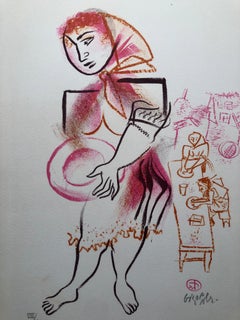
THE SHTETL
THE SHTETL

William GropperTHE SHTETL, 1970

Sold

H 15 in W 12 in D 0.5 in

THE SHTETL

By William Gropper

Located in Portland, ME

Gropper, William. THE SHTETL. Suite of 24 color lithographs, 1970. Portfolio with title page, justification page and 24 color lithographs each signed in pencil and inscribed "Artist'...

Category

1970s William Gropper Prints and Multiples
Materials

Lithograph

Jewish Shtetl Hasidic Wedding Dance Judaica Lithograph Yiddish Social Realism

Jewish Shtetl Hasidic Wedding Dance Judaica Lithograph Yiddish Social Realism

By William Gropper

Located in Surfside, FL

Hand signed in pencil and numbered with Roman numerals 8/24. A very small edition. Old Lower East Side of New York or East European Shtetl. Jewish Shtetl Hasidic Klezmer Musicians. ...

Category

Mid-20th Century Modern William Gropper Prints and Multiples
Materials

Lithograph

Jewish Shtetl Mother-in-law Klezmer Wedding Dance Judaica Lithograph Yiddish WPA

Jewish Shtetl Mother-in-law Klezmer Wedding Dance Judaica Lithograph Yiddish WPA

By William Gropper

Located in Surfside, FL

Hand signed in pencil and numbered with Roman numerals 8/24. A very small edition. Old Lower East Side of New York or East European Shtetl. Jewish Shtetl Hasidic Klezmer Musicians. ...

Category

Mid-20th Century Modern William Gropper Prints and Multiples
Materials

Lithograph

Jewish Shtetl Klezmer Wedding Tanz Judaica Lithograph WPA Yiddish Social Realist

Jewish Shtetl Klezmer Wedding Tanz Judaica Lithograph WPA Yiddish Social Realist

By William Gropper

Located in Surfside, FL

Hand signed in pencil and numbered with Roman numerals 8/24. A very small edition. Old Lower East Side of New York or East European Shtetl. Jewish Shtetl Hasidic Klezmer Musicians. humorous Yiddish Chassidic art. The New-York born artist William Gropper was a painter and cartoonist who, with caricature style, focused on social concerns, and was actively engaged in support of the organized labor movement throughout his career. This original color lithograph print is done in the iconic style of the artist's oeuvre. Born to Harry and Jenny Gropper in 1897, William was raised in New York City's Lower East Side. His parents were Jewish immigrants from Romania and Ukraine, and young William grew up in relative poverty, watching his family struggle to achieve that sought-after American dream. His father, a bright and college-educated man, was unable to find employment that worthy of his intellect. His mother, meanwhile, worked as a seamstress from home. Coupled with the devastating loss of an aunt to the infamous Triangle Factory fire of 1911, significant childhood factors created the foundation that led to Gropper’s exploration of the American experience. Early on, Gropper displayed an extraordinary, natural skill for art. By 1912, he was already studying under the instruction of George Bellows and Robert Henri at the Ferrer School in Greenwich Village. During his time at school, Gropper was also awarded a prestigious scholarship to study at the National Academy of Design. However, he refused to fit into convention and was swiftly expelled from the Academy. After his expulsion, Gropper returned home to help financially by assisting his mother and taking a shop position. However, he didn't abandon art academia and soon presented a portfolio to the New York School of Fine Art which earned him a scholarship for study. Gropper obtained his first significant job as a cartoonist for the New York Tribune in 1917. While working as a staff cartoonist for the Tribune, he also contributed drawings to publications like Vanity Fair, New Masses, The Nation, and Freiheit. His interest in the welfare of the American worker, class inequality, and social injustice was central in his work. After publishing the graphic novel Alley Oop in 1930, Gropper's illustration career extended well into the decade. However, he was never exempt from controversy, and his 1935 Vanity Fair cartoon; prompted anger from the Japanese government. As an involved labor organizer and Social Realist activist, Gropper continued to bring attention to his radical reputation with visits to the Soviet Union and Poland. However, his concern with European politics and U.S. social causes didn't slow down his artistic career, and by the late 1930s, he had produced significant murals for American cities like Washington D.C. His 1938 mural Construction of a Dam was commissioned for the Department of the Interior and represents the Social-Realism style that depicts experiences of the worker and everyday societal life. Measuring at a staggering 27ft by 87ft, the piece portrays muscular, robust American laborers scaling rocky hillsides, building infrastructure, and operating heavy machinery. The mural feels undeniably American with golden scenery, denim blues, and steely gray colors. Gropper fits perfectly into Social-Realism because the style exhibits an illustrative flair with strong lines and simple, bold hues. The inspiration for Construction of a Dam sprang from his 1937 travels to the poverty-stricken Dust Bowl area. The trip was sponsored by a Guggenheim Foundation Fellowship, and his drawings of the Grand Coulee and Boulder Dams...

Category

Mid-20th Century Modern William Gropper Prints and Multiples
Materials

Lithograph

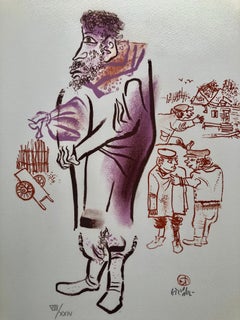
Jewish Shtetl Klezmer Wedding Tanz Judaica Lithograph WPA Yiddish Social Realist

Jewish Shtetl Klezmer Wedding Tanz Judaica Lithograph WPA Yiddish Social Realist

By William Gropper

Located in Surfside, FL

Hand signed in pencil and numbered with Roman numerals 8/24. A very small edition. Old Lower East Side of New York or East European Shtetl. Jewish Shtetl Klezmer Musicians. humorous Yiddish art. The New-York born artist William Gropper was a painter and cartoonist who, with caricature style, focused on social concerns, and was actively engaged in support of the organized labor movement throughout his career. This original color lithograph print is done in the iconic style of the artist's oeuvre. Born to Harry and Jenny Gropper in 1897, William was raised in New York City's Lower East Side. His parents were Jewish immigrants from Romania and Ukraine, and young William grew up in relative poverty, watching his family struggle to achieve that sought-after American dream. His father, a bright and college-educated man, was unable to find employment that worthy of his intellect. His mother, meanwhile, worked as a seamstress from home. Coupled with the devastating loss of an aunt to the infamous Triangle Factory fire of 1911, significant childhood factors created the foundation that led to Gropper’s exploration of the American experience. Early on, Gropper displayed an extraordinary, natural skill for art. By 1912, he was already studying under the instruction of George Bellows and Robert Henri at the Ferrer School in Greenwich Village. During his time at school, Gropper was also awarded a prestigious scholarship to study at the National Academy of Design. However, he refused to fit into convention and was swiftly expelled from the Academy. After his expulsion, Gropper returned home to help financially by assisting his mother and taking a shop position. However, he didn't abandon art academia and soon presented a portfolio to the New York School of Fine Art which earned him a scholarship for study. Gropper obtained his first significant job as a cartoonist for the New York Tribune in 1917. While working as a staff cartoonist for the Tribune, he also contributed drawings to publications like Vanity Fair, New Masses, The Nation, and Freiheit. His interest in the welfare of the American worker, class inequality, and social injustice was central in his work. After publishing the graphic novel Alley Oop in 1930, Gropper's illustration career extended well into the decade. However, he was never exempt from controversy, and his 1935 Vanity Fair cartoon; prompted anger from the Japanese government. As an involved labor organizer and Social Realist activist, Gropper continued to bring attention to his radical reputation with visits to the Soviet Union and Poland. However, his concern with European politics and U.S. social causes didn't slow down his artistic career, and by the late 1930s, he had produced significant murals for American cities like Washington D.C. His 1938 mural Construction of a Dam was commissioned for the Department of the Interior and represents the Social-Realism style that depicts experiences of the worker and everyday societal life. Measuring at a staggering 27ft by 87ft, the piece portrays muscular, robust American laborers scaling rocky hillsides, building infrastructure, and operating heavy machinery. The mural feels undeniably American with golden scenery, denim blues, and steely gray colors. Gropper fits perfectly into Social-Realism because the style exhibits an illustrative flair with strong lines and simple, bold hues. The inspiration for Construction of a Dam sprang from his 1937 travels to the poverty-stricken Dust Bowl area. The trip was sponsored by a Guggenheim Foundation Fellowship, and his drawings of the Grand Coulee and Boulder Dams...

Category

Mid-20th Century Modern William Gropper Prints and Multiples
Materials

Lithograph

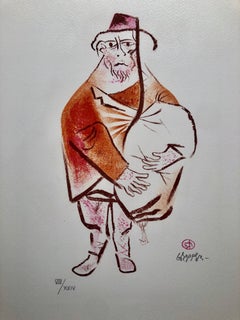
Jewish Shtetl Klezmer Musicians Judaica Lithograph WPA Yiddish Social Realist

Jewish Shtetl Klezmer Musicians Judaica Lithograph WPA Yiddish Social Realist

By William Gropper

Located in Surfside, FL

Hand signed in pencil and numbered with Roman numerals 8/24. A very small edition. Old Lower East Side of New York or East European Shtetl. Jewish Shtetl Klezmer Musicians. humorous...

Category

Mid-20th Century Modern William Gropper Prints and Multiples
Materials

Lithograph

Jewish Shtetl Klezmer Musicians Judaica Lithograph WPA Yiddish Social Realist

Jewish Shtetl Klezmer Musicians Judaica Lithograph WPA Yiddish Social Realist

By William Gropper

Located in Surfside, FL

Hand signed in pencil and numbered with Roman numerals 8/24. A very small edition. Old Lower East Side of New York or East European Shtetl. Jewish Shtetl Klezmer Musicians. humorous...

Category

Mid-20th Century Modern William Gropper Prints and Multiples
Materials

Lithograph

Jewish Shtetl Groise Macher Judaica Lithograph WPA Yiddish Social Realist Print

Jewish Shtetl Groise Macher Judaica Lithograph WPA Yiddish Social Realist Print

By William Gropper

Located in Surfside, FL

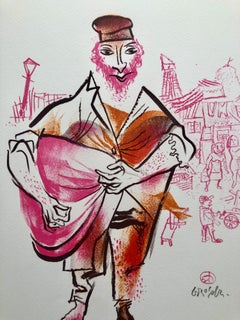
Hand signed in pencil and numbered with Roman numerals 8/24. A very small edition. Old Lower East Side of New York or East European Shtetl. Jewish Shtetl Peddler Merchant. humorous ...

Category

Mid-20th Century Modern William Gropper Prints and Multiples
Materials

Lithograph

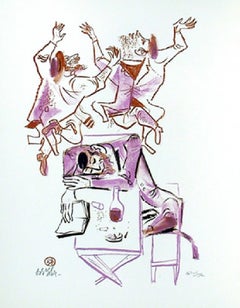
William Gropper prints and multiples for sale on 1stDibs.
Find a wide variety of authentic William Gropper prints and multiples available for sale on 1stDibs. If you’re browsing the collection of prints and multiples to introduce a pop of color in a neutral corner of your living room or bedroom, you can find work that includes elements of yellow and other colors. You can also browse by medium to find art by William Gropper in lithograph, screen print and more. Much of the original work by this artist or collective was created during the 20th century and is mostly associated with the modern style. Not every interior allows for large William Gropper prints and multiples, so small editions measuring 11 inches across are available. Customers who are interested in this artist might also find the work of Knox Martin, Nahum Tschacbasov, and Fritz Eichenberg.. William Gropper prints and multiples prices can differ depending upon medium, time period and other attributes. On 1stDibs, the price for these items starts at $400 and tops out at $1,100, while the average work can sell for $500.