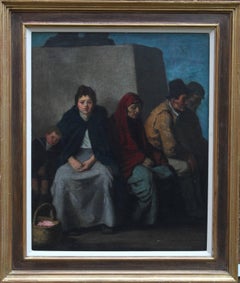
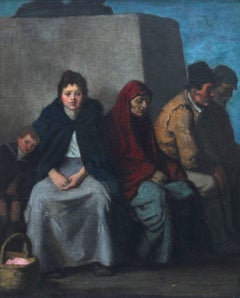
At the Foot of the Statue - Scottish art Impressionist figurative oil painting
By William Strang, R.A., R.E.
Located in Hagley, England
A fine large oil painting by Scottish listed artist William Strang. This is a super evocative oil on canvas which depicts a family at "The Foot of the Statue". It was exhibited in 1904 in Bradford exhibition of fine arts lent by L W Hodson of Wolverhampton who was a patron of his work. This is a fine example of an early 20th century Scottish oil with good subject. It is a good size and signed. This wouldn't be out of place in Kelvingrove Gallery in Glasgow. Signed lower left. Provenance. Bradford Art Gallery 1904. Sotheby 19th June 2002 Guide price £20000-30000GBP. Condition. Oil on canvas. Image size 30 inches by 25 inches and in excellent condition. Housed in a fine period frame, 39 by 34 inches framed and in good condition. William Strang (1859-1921) was born at Dumbarton, the son of Peter Strang, builder, and educated at the Dumbarton Academy. He worked for fifteen months in the counting-house of a firm of shipbuilders before going to London in 1875 when he was sixteen. There he studied art under Alphonse Legros at the Slade School for six years. Strang became assistant master in the etching class, and had great success as an etcher. He was one of the original members of the Royal Society of Painter-Etchers, and his work was a part of their first exhibition in 1881. Some of his early plates were published in The Portfolio and other art magazines. He worked in many manners, etching, dry point, mezzotint, sand-ground mezzotint, and burin engraving. Lithography and wood-cutting were also used by him to create pictures. He cut a large wood engraving of a man ploughing, later published by the Art for Schools Association. A privately produced catalogue of his engraved work contained more than three hundred items. Amongst his earlier works were Tinkers, St. Jerome, A Woman Washing Her Feet, An Old Book-stall with a Man Lighting His Pipe from a Flare, and The Head of a Peasant Woman on sand-ground mezzotint. Later plates such as Hunger, The Bachelor's End and The Salvation Army were also important. Some of his best etchings were done as series—one of the earliest, illustrating poet William Nicholson's Ballad of Aken Drum, is remarkable for clear, delicate workmanship in the shadow tones, showing great skill and power over his materials, and for strong drawing. Another praised series was The Pilgrim's Progress, revealing austere sympathy with John Bunyan's teaching. Samuel Taylor Coleridge's Ancient Mariner and Strang's own Allegory of Death and The Plowman's Wife, have served him with suitable imaginative subjects. Some of Rudyard Kipling's stories were also illustrated by him, and his likeness of Kipling was one of his most successful portrait plates. Other etched portraits included those of Ernest Sichel and of J.B. Clark, with whom Strang collaborated in illustrating Baron Munchausen...
Early 1900s Impressionist William Strang, R.A., R.E. Figurative Paintings
Oil