By Zola Zaugg
Located in Denver, CO
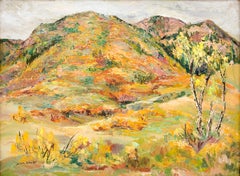
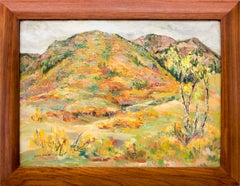
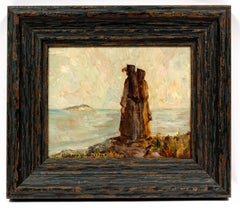
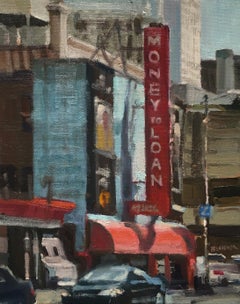
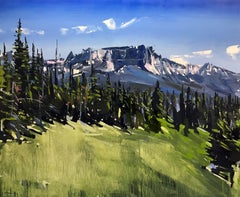
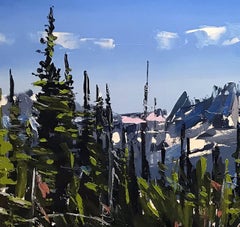
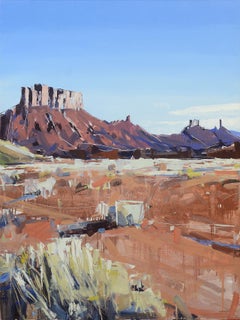
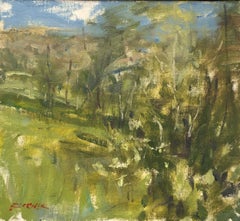
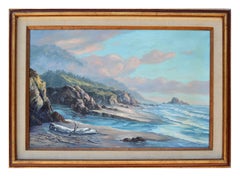
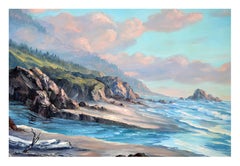
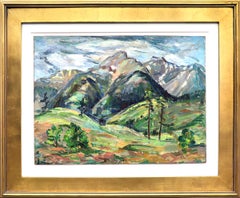
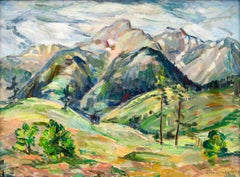
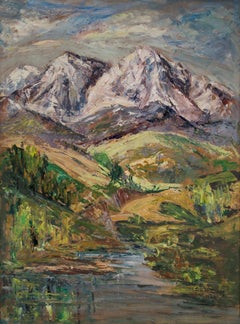
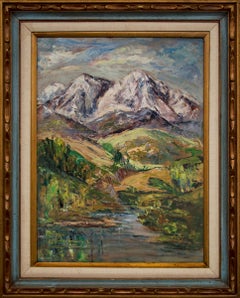
1950s oil on masonite board landscape by Zola Zaugg (1890-1893) of Colorado mountains in spring/summer, likely near Colorado Springs from 1953. Signed and dated by the artist in the lower right corner. Presented in a custom frame with all archival materials, outer dimensions measure 22 ¼ x 28 ½ x ½ inches. Image size is 18 x 24 inches.
Provenance: Estate of the Artist, Zola Zaugg
Painting is clean and in very good vintage condition.
About the Artist:
Born and raised in Missouri, Zola received a Bachelor of Fine Arts degree from Hardin College Conservatory. Yet a photograph of her as an art club member in 1907 shows that she also had an early interest in art, and she speaks later of study with William Hakking of Syracuse University.
In 1916, she married Frederick C. Zaugg, and the two lived and raised a family of two children in Colorado Springs. Her husband was a dentist, and the couple was considered a part of the respectable upper class. Her position in society is also evidenced by her membership in the Daughters of the American Revolution.
Zola became a member of the Colorado Springs Art Guild in the 1940s, the decade of its gradual formation. This period coincides with her emergence onto the local art scene, after her children had grown. Her first showing was at the La Hacienda room at the Antlers Hotel. A reporter wrote at the time: "I believe she has painted every day even though she hasn't touched a brush."
Esteemed by her colleagues, she was given a one-person show at the Colorado Springs Fine Art Center. For this exhibit, Zola provided an artist statement in which we get a glimpse into her view of art. She stressed the importance of an artist expressing their own inner being, and she quotes her favorite line of Walt Whitman: "to sing what belongs to you and none else."
At this time, she was encouraged by artist, Charles Ragland Bunnell, a fellow Missourian connected to the Broadmoor Art Academy. He was beginning to change his style from a stylized regionalism to an increasingly abstract approach to painting. In her statement, Zola suggests, "…one should not censure a public which fails to respond to extreme forms of abstract art which it does not comprehend," and she goes on to assert that the artist should maintain "some semblance to known objects" in order so that a "connection of some thought may be established between observer and artist."
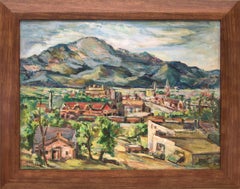
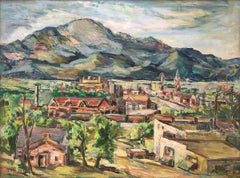
From that point forward, Zola became a well-known contributor to the Colorado Springs art community. She began to exhibit beyond Colorado Springs, including venues in Denver - often grouped with other artists - and in her hometown of Mexico, Missouri. Zola also taught free-hand drawing and sketching in addition to oil painting. Known primarily for her portraits and landscapes, she garnered attention for her paintings of old Colorado City landmarks. In later life, she moved to Northglenn, Colorado. © David Cook...
Category
Mid-20th Century American Impressionist Zola Zaugg Art