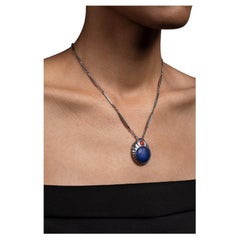
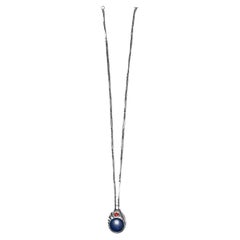
Extremely RareHarry Bertoia Necklace Sterling Silver Lapis Coral ca. 1940
By Harry Bertoia
Located in Bloomfield Hills, MI
Extremely rare combination pendant attached to custom-made chain by Harry Bertoia in sterling silver, containing one Lapis Lazuli and one Coral. This piece comes from a private collection. Provenance will accompany the piece. The work has been added to the Harry Bertoia Catalogue Raisonné and assigned the following catalogue raisonné number: D.JE.78. Although associated with Mid-Century Modern furniture, Harry Bertoia was originally a jewelry designer who used both sterling silver, precious stones and gem stones. The pendant measures: 1.25" long x 1" wide. The necklace measures: 11" length with a measurement of 22" overall length. The chain and closure are all handcrafted and in his unique design. Lapis Lazuli measures 20mm round supported by one 6 mm red coral. Total weight is 33 grams. The following is from Beverly H. Twitchell, PhD, author of Bertoia: The Metalworker, London: Phaidon, 2019. She provides a very informative critique of Bertoia and his jewelry. Wearable Art an Important Design for a Necklace “Before Harry Bertoia enrolled at the Cranbrook Academy of Art in 1937 he had already mastered traditional jewelers’ techniques, but his engagement with Modernism led him to invent and use more direct methods. Instead of precious metals and gems, Bertoia made jewelry that appealed through its design, craftsmanship and the nature of its materials. That approach would make Bertoia a direct predecessor of the American Studio Crafts movement. So complex and cumulative are human perception and memory that we often do not know from where our own ideas come and without firm evidence, it is impossible to think we can establish the origins of an artist’s ideas. While his jewelry is entirely modern, chokers with multiple small pendants had come from ancient Mediterranean cultures: Mesopotamia, Egypt, Greece and Italy, even from Europe and America at the turn of the last century. Did Bertoia see works in books, journals or at the Detroit Institute of Arts that resonated with him or did he invent this on his own, as he would so many other forms? Bertoia found inspiration in nature from an early age on a small farm in Italy and later in Cranbrook’s woods, on the beaches of southern California and in the fields near his home in eastern Pennsylvania where he lived after 1950. The fluidity and motion of the his jewelry characterize much of his art. In that spirit, too, he made jewelry that suited human anatomy and was animated by its wearer’s movement. Bertoia had the instincts of an engineer, as the intricacy of the present lot’s clasp and overall construction of the jewelry demonstrates. Large jewelry by Bertoia is very rare. A delight to the eye, and like all of Bertoia’s work it is timeless.” Harry Bertoia (1915 – 1978) was an Italian-born American artist, jewelry creator and modern furniture designer. He was born in San Lorenzo d-Arzene, Pordenone, Italy. At age 15 he moved to Detroit, Michigan to live with his older brother, Oreste. He quickly learned English and the bus schedule and enrolled in Cass Tech High School in Detroit (1930-1936) where he studied art and design and learned the skill of handmade jewelry making. At that time, there were three jewelry and metals teachers Louise Green...
Mid-20th Century American Mid-Century Modern Abstract Sculptures
Coral, Lapis Lazuli, Sterling Silver