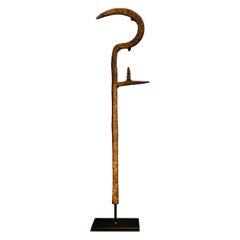
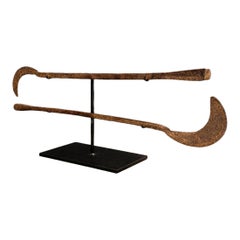
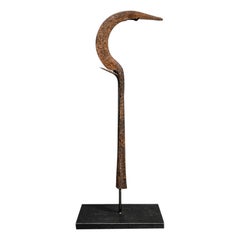
A striking example of West African material culture, this Igbo iron currency knife from Nigeria embodies the intersection of economy, artistry, and ritual within traditional African societies. Before the widespread adoption of coinage and paper money, many regions across Africa used forms of metal currency—objects whose intrinsic material value, craftsmanship, and symbolic form made them widely accepted as units of exchange. Among the Igbo people of southeastern Nigeria, iron currency objects such as knives, rods, and bracelets circulated not only as mediums of trade but also as markers of wealth, social status, and ceremonial exchange.
This particular form—often referred to as a currency knife—features an elegantly curved profile with a tapering blade-like extension and finely incised surface decoration. Forged and hand-carved from iron, the piece demonstrates the remarkable skill of traditional blacksmiths, whose work held both practical and spiritual significance in Igbo culture. The etched geometric motifs along the surface speak to a visual language of craftsmanship passed through generations, transforming what was once a utilitarian object into a sculptural artifact rich with cultural meaning.
Mounted on a custom-made platform for display, the piece now reads as a refined sculptural object. Its weathered iron patina, subtle textural variations, and dynamic crescent silhouette give it a commanding presence—equally compelling as a collectible ethnographic artifact or as a distinctive decorative accent in a contemporary interior.
Today, objects like this Igbo currency...
Category
Antique 1890s Nigerian Tribal Mounted Objects