By Jaeger-LeCoultre
Located in VALLADOLID, ES
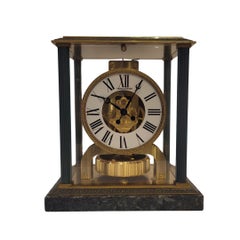
Outstanding ATMOS VENDOME watch.
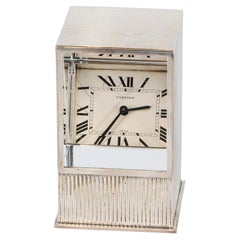
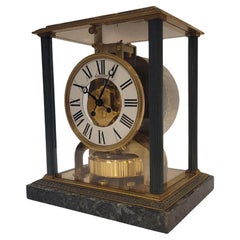
The 1962 Atmos Vendome watch from renowned Swiss watchmaker Jaeger LeCoultre is one of the most iconic and fascinating watches in the history of high-end watchmaking, with a rich connection both in terms of engineering and artistic design. It is an extraordinary timepiece, renowned for its near-perpetual movement, powered by minimal fluctuations in temperature. Its mechanism is housed within a square, transparent glass case, offering an unobstructed view of its intricate inner workings. The base and structural elements are made of green marble and bronze, following a neoclassical aesthetic: an architecture of geometric lines and subtle ornamentation. The dial is white, featuring simple Roman numerals and Breguet hands. Known as “the President’s watch”, the Atmos was for a long time the official gift of the Swiss Confederation and this watch graced the desk of the greatest personalities and numerous presidents of republics.
Origin and history of the complex mechanism
The origin of this clock is due to the Swiss engineer Jean-Léon Reutter (1899-1971), who dedicated his entire life to the search for the so-called perpetual movement. Jean-Léon Reutter surely studied the inventions of Charles Victor Hour, a Frenchman living in Paris who registered several patents, including that of a winding mechanism based on the expansion of gases depending on temperature variations.
It is not a recent invention, since the first clocks that used changes in temperature or atmospheric pressure as a source of energy date back to the 17th century. However, for various reasons, this type of clock did not continue, and it was necessary to wait until 1928, when the Swiss engineer Jean-Léon Reutter developed the Atmos clock mechanism as we know it today.
In 1928 he presented the first prototype, called Atmos 0, of his clock that obtains its energy from variations in temperature and the environment. This invention quickly had a great impact on the international scientific community and was the subject of numerous articles around the world. However, Reutter faced difficulties related to the mass production of his invention. The method of implementation in the 1926 patent was too delicate to be built, so Reutter invented another system in 1928 that enclosed a mixture of mercury and ammonia in a “U”-shaped glass tube. One end of the tube was thermally insulated, while the other was not. So, when the ambient temperature changed, the expansion of the gas and the weight of the mercury caused the tube to rotate to wind the clock.
In 1929, he addressed the problems related to the pendulum’s torsion wire. He further improved his clock and a new version was launched in 1930, two years after the previous one, and was thus the first to be marketed. The watches were not as successful as expected, and it was some time later that Jacques-David LeCoultre, grandson of the founder of the Jaeger-LeCoultre company, discovered this watch by chance in the window of a Parisian watchmaker. Intrigued by this invention that he had heard about but was wary of, he bought a copy and began to study it. This is how he got in touch with the inventor to discuss improvements to be made and to begin a collaboration in 1932 on an in-depth study of the Atmos watch between Jean-Léon Reutter and the watchmakers of Jaeger-LeCoultre.
This collaboration led to the creation of the new LeCoultre calibre 30A. On 22 May 1936, the Jaeger-LeCoultre manufacture bought the patents from Reutter and registered the production of the Atmos watch in its statutes. From 1939, the Atmos was fitted with a more water-resistant membrane. But it took ten years to produce, in 1946, the bellows perfectly sealed against the gas mixture: ethyl chloride C2H5CN. The new system uses a hermetically sealed vacuum capsule containing ethyl chloride. This gas expands in a membrane when the temperature rises, which has the effect of compressing the helical spring. When the temperature drops, the gas condenses and the spring relaxes. An Atmos can operate for years without human intervention. A simple variation of one degree (for a temperature between 15°C and 30°C) or a pressure variation of 3 mm Hg is enough to power the clock for more than a day.
To operate the clock with this modest source of energy, the mechanism is designed with the minimum possible friction, so it does not contain oil in its gears. Time is measured by a balance that consumes less energy than an ordinary pendulum. In fact, it makes only one oscillation per minute, which is sixty times less than a classic clock...
Category
Vintage 1960s Swiss Art Deco Desk Accessories