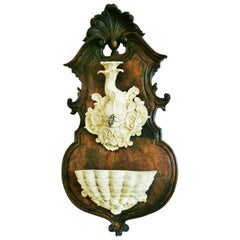
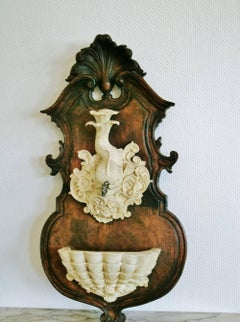
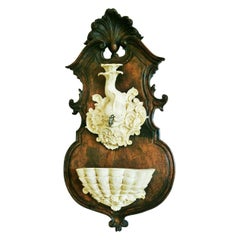
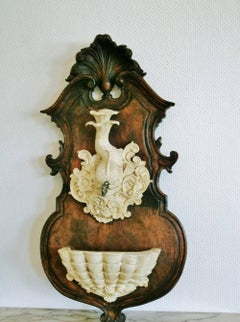
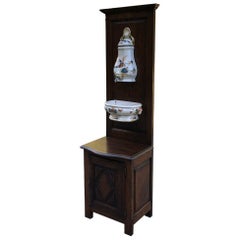
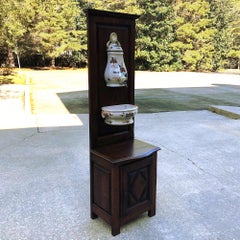
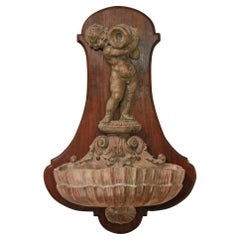
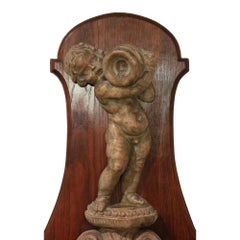
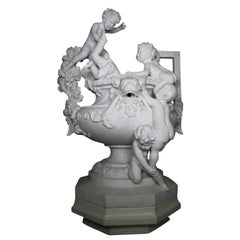
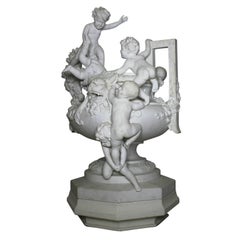
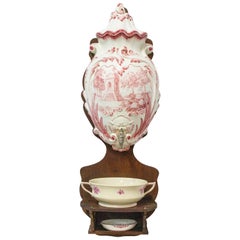
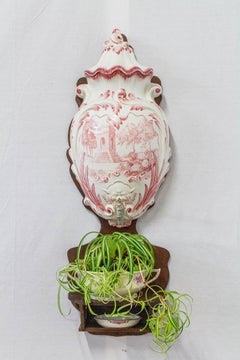
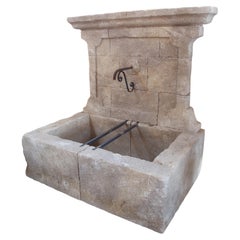
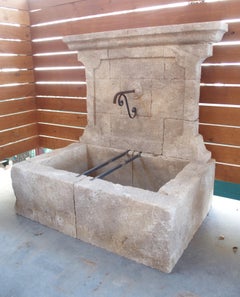
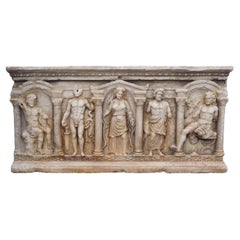
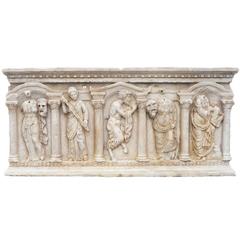
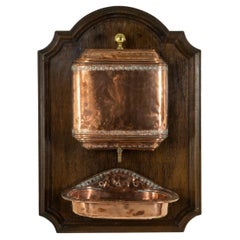
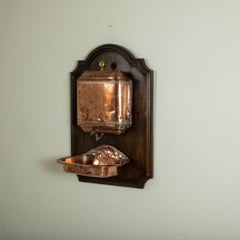
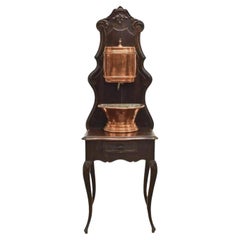
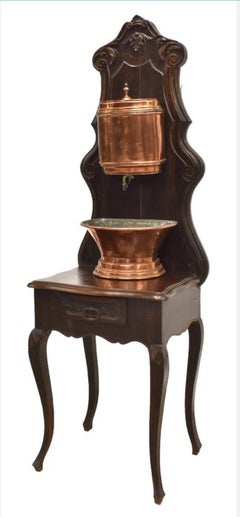
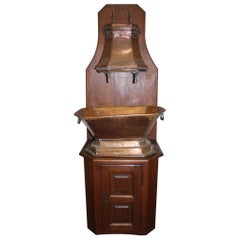
A wonderful and rare, almost 200 year old antique French Provincial Lavabo (water fountain) with beautifully aged patina. Handcrafted in Louis XV taste, dating to around the second quarter of the 19th century, having a hand carved oak stand with outstanding scrollwork, foliate and shell motif carvings, mounted to the tall shaped wooden backboard is a stunning heavily patinated copper Lavabo, all hand hammered copper, there's a water resevior tank, surmounted by the removeable lid with bronze finial, below a spigot controls the flow of water out of the reservoir and into the sink basin, which can also be used to fill the tank. The sink basin (bowl) rests atop the cabinet tabletop, over a single drawer with hand carved dovetail joinery, all rising on elegant cabriole legs. This Lavabo is in excellent shape, fully operable and ready for use or display. We love the warm, rustic vibe from all the character and patina, so we have not heavily cleaned or restored it.
Circa 1830s-1840s, France, Provinces.
Dimensions (approx):
65.25" H, 21.25" W, 16.25" D
A Lavabo is a device used to provide water for the washing of hands. It consists normally of an ewer or container of some kind to pour water, and a bowl to catch the water as it falls off the hands. Considered the forerunner of the modern sink. In several European languages (French, Italian, Serbo-Croatian, Spanish, Turkish), Lavabo is the modern word for sink or washbasin.
Originally the Lavabo was created for use in the church during religious ceremonies, particularly Christianity. In ecclesiastical usage it refers to all of: the basin in which the priest washes his/her/their hands; the ritual that surrounds this action in the Catholic Mass; and the architectural feature or fitting where a basin or place for one is recessed into the side wall of the sanctuary, or projects from it.
In most liturgical traditions, the priest washes their hands after vesting, before the beginning of the liturgy. This washing may be accompanied by prayers. Many Christian rites also have the priest wash his/her/their hands before beginning the Eucharistic prayer. The washing of hands during the recitation of psalm verses is of very ancient usage in the Catholic Church. In eastern Orthodox and Catholic churches, after vesting, the priest goes to the piscina to wash his hands before approaching the altar, where he will prepare the bread and wine for the Divine Liturgy. This lavabo takes place quietly, outside of the view of the congregationtarting.
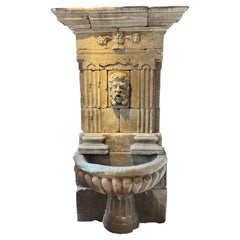
Secular usage: Starting around the early 20th century the Lavabo found its way into the gardens of the European wealthy upper class. Today they can still be found in gardens and backyards, sometimes used for washing, watering or as a interesting planter but more commonly used as a display piece or garden decor. Rare, museum quality pieces such as this one are generally found indoors as they are investment pieces and make stunning, highly decorative, unique decorations, complementing many of today's interior styles, including Rustic, French Country, Shabby Chic, Old World Tuscan, Traditional Cottage, Farm or Farmhouse, Vintage Boho, Mediterranean and Lodge to name just a few
True antique Lavabos...
Category
Early 19th Century French French Provincial Antique Oak Fountains