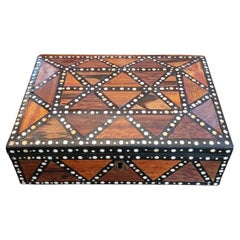
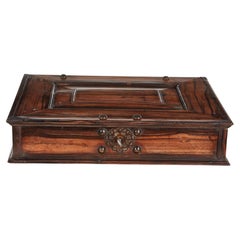
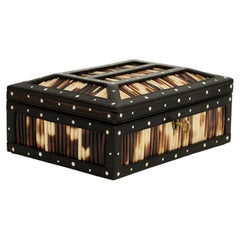
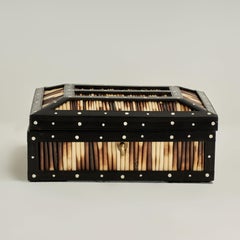
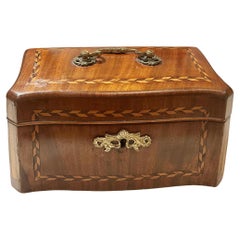
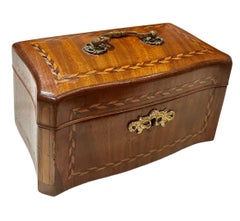
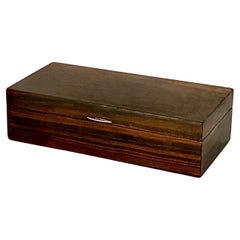
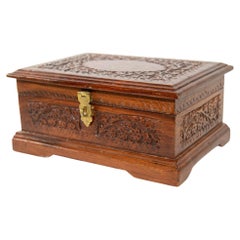
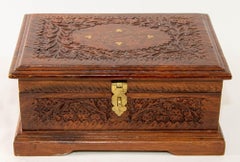
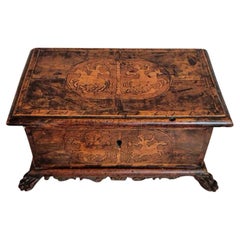
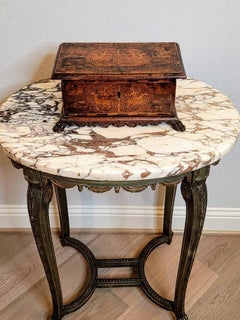
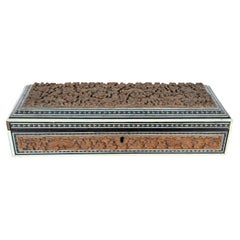
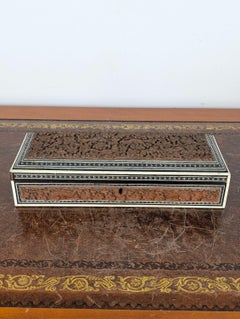
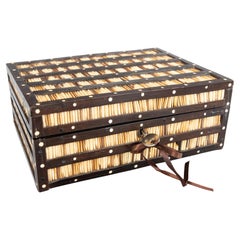
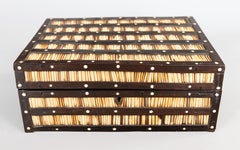
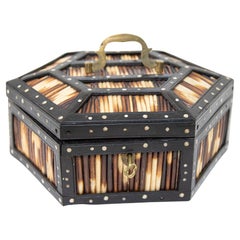
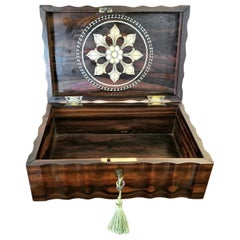
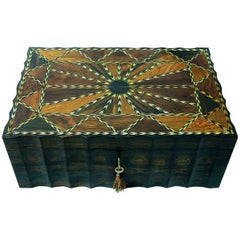
Absolutely stunning 19th century Anglo-Indian (or more accurately, Anglo-Ceylonese) box.
Made of rare and expensive Coromandel wood and inlaid on top with specimen exotic Asian woods, pewter, silver and bone.
The interior of the lid is likewise profusely inlaid with specimen woods in a hexagonal pattern, bone, ebony and pewter chevrons, over an ebony background with bone floral designs surrounding in the Galle style.
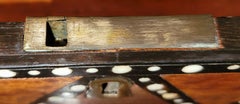
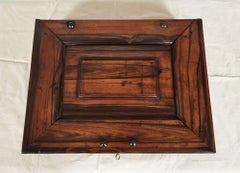
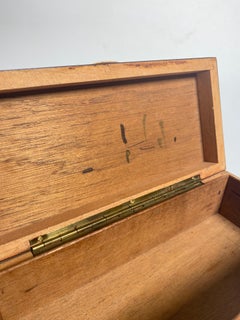
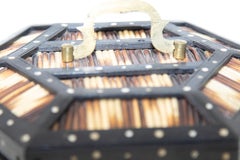
Box opens to reveal two trays on the interior, one on top of the other. The top tray is highly ornate with bone overlay which has been hand-painted using red and black lac (indelible) inks. The second tray is more plain (for obvious reasons) and made from sandalwood. It has its working key and all the brass fittings are of the highest quality and original. It has a crack on the lid but this does not detract from its beauty or importance!
Made circa 1880 in Ceylon (modern day Sri Lanka) in the time of the Raj, for export and sale to wealthy British visitors, Diplomats and Army officers. This would have been a highly expensive piece even when made.
The box is a companion style box, suitable for holding jewelry etc.
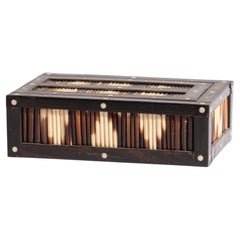
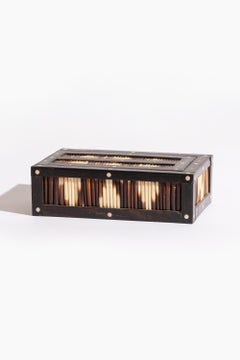
We have a matching Desk Companion Tray in our inventory and for auction.
ANGLO-INDIAN AND CEYLONESE BOXES: Anglo Indian boxes were made in India for the English residents from the early part of the 18th century. They were brought back or sent back to England usually by the people who had commissioned them. From the beginning of the nineteenth century they were imported more commercially, although not in any significant numbers until the middle decades. They were very highly valued, especially the early ones, to the extent that the designs were copied on late 19th and early 20th century tins.
Anglo-Indian Boxes normally consist of 3 main types:-
(1) Most of the best and highest quality Anglo-Indian boxes in the 18th and 19th Centuries were made in Vizigapatam, India………renowned for its exquisite craftsmanship in using ivory and tortoiseshell and lac decoration. These are referred to as ‘Vizigapatam Boxes’.
(2) The Bombay area became famous in the 19th Century for its carving of sandalwood boxes and use of Sadeli Mosaic. These are often referred to ‘Sadeli Boxes...
Category
19th Century British Colonial Antique Sri Lankan Jewelry Boxes
MaterialsBone, Hardwood, Ebony