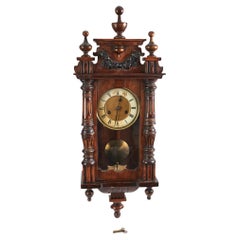
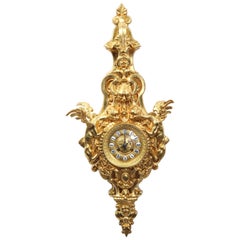
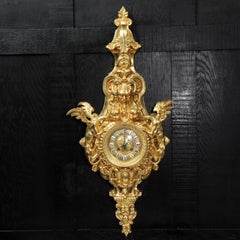
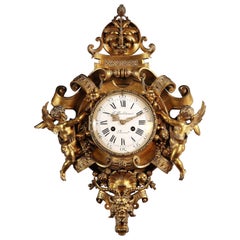
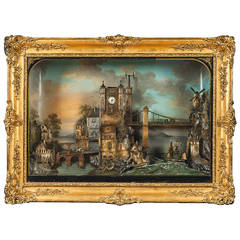
Signed on the dial F. Barbedienne à Paris
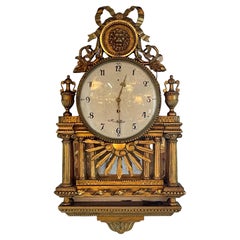
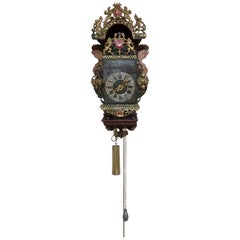
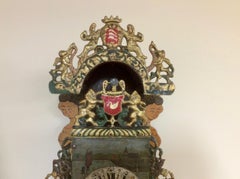
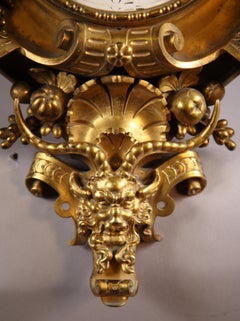
A gilt bronze wall-clock decorated with Renaissance style motifs, such as scalloped scrolls, pomegranates, a faun head and putti framing the dial.
In decorative arts, the "cuir découpé" motif (cut leather) recalls a cut leather or metal piece, wound like stylized volutes. This decorative motif is characteristic of the French Renaissance as showed in the inner decoration of the Galerie François I (1535) at the Château de Fontainebleau. Used by artists on tapestry and engravings, this motif was back into fashion in the 19th century.
Louis-Constant Sévin (1821-1888) designed as soon as 1839 silver-smith’s objects for famous firms like Denière, Froment-Meurice, Morel and Duponchel. During the Revolution in 1848, he joined Morel in London, as workshop manager and designed pieces that Morel exhibited in 1851. Back in France, he worked in 1855 for Ferdinand Barbedienne as sculptor-ornemanist until the end of his life. Sévin’s works are considerable, he designed furniture bronzes for the “hôtel de La Païva.” At the London Exhibition in 1862, he was awarded a medal for the artistic excellence of the furniture he designed and which was exhibited by F. Barbedienne. He won a second class medal at the Union centrale des Arts décoratifs Exhibition...
Category
French Renaissance Revival Antique 1870s Wall Clocks