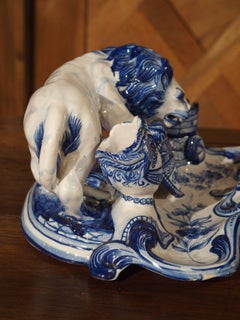
Earthenware Inkwells

to
2
16
4
9
3
3
2
1
1
1
1
1
1
1
7,604
842
352
219
217
11
5
14
8
2
1
1
Height
to
Width
to
16
16
16
1
1
1
Material: Earthenware
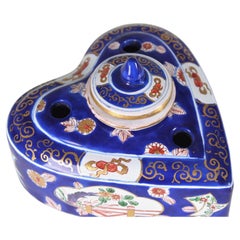
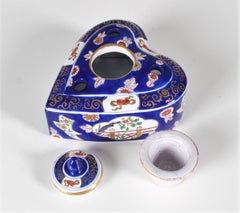
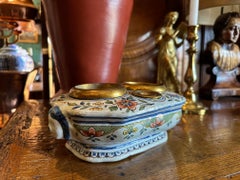
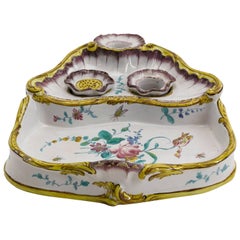
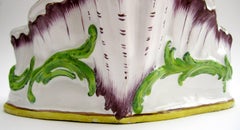
Antique Fayence Inkwell By Henri Delcourt, 1925s, France, Monogram HDV
Located in Greven, DE
Beautiful heart shaped faience inkwell by the french artist Henri Delcourt. Monogrammed at the bottom " HDV". One tint cup and three holes for feather pens. Faiences are open-pored ...
Category

1920s Arts and Crafts Vintage Earthenware Inkwells

Materials

Faience

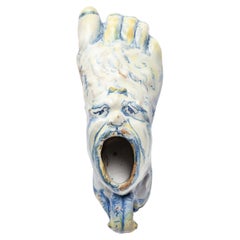
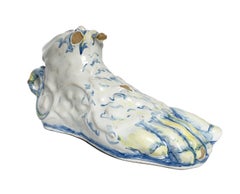
Renaissance Inkwell Calamelli workshop, Italy, Faenza, second half of the 16th
By Virgiliotto Calamelli
Located in Milano, IT
Inkwell Calamelli workshop (attr.). Faenza, second half of the 16th century Height 4.33 in; length 8.07 in; depth 2.95 in (11 cm; 20.5 cm; 7.5 cm) Weight: 0.800 lb (363 g) State of conservation: some chipping to the top of the mask around the mouth. Handle glued, without any restorations; minor chips in some raised areas. This object has the shape of a foot wearing Greek-style footwear, as can be seen in some raised areas. The foot is anatomically modeled with bare toes, while the ankle is partially covered by the footwear. On the heel, there is a small circular handle to support the object. The mouth of the container is shaped like a mask. The interior, completely enameled, suggests that the piece was intended to be used as an inkwell or to contain some other liquid. The base, however, is not enamelled. The painted decoration, scant and brief, consists of rapid cobalt blue shading between the toes of the foot, with more precise emphasis on the nails. It is accompanied by yellow citrine accents to enhance the forms. The mask is painted with the tip of the brush, to accentuate the tense nature of the eyes and to accentuate their outline. Thin strokes of yellow-orange line the interior of the mouth. Since the Renaissance, this decoration has been referred to as "compendiaria" and it characterizes the period of production extending from the mid-16th century to approximately the middle of the following century. It significantly influenced tastes at the time. It evolved from the polychrome style "istoriato" and transformed into a new style that "summarized" (compendia), or condensed, the ornamentation of the works into a few colors, placing greater prominence on the shapes. It was often inspired by metal specimens. Since the Renaissance, this decoration has been referred to as "compendiaria" and it characterizes the period of production extending from the mid-16th century to approximately the middle of the following century. It significantly influenced tastes at the time. It evolved from the polychrome style "istoriato" and transformed into a new style that "summarized" (compendia), or condensed, the ornamentation of the works into a few colors, placing greater prominence on the shapes. It was often inspired by metal specimens. This artwork finds parallels in similar objects all characterized by this refined style and produced in the city of Faenza and other Italian centers starting from the mid-16th century. The closest comparable example in majolica is a foot acquired by the British Museum in 2011 (inv. 2011, 8008.1). This was previously published by Carmen Ravanelli Guidotti in 1996 and later by Dora Thornton in 2016 during the conference on Renaissance ceramics...
Category

16th Century Italian Renaissance Antique Earthenware Inkwells

Materials

Maiolica

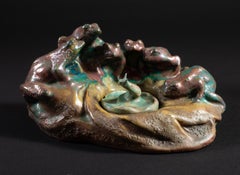
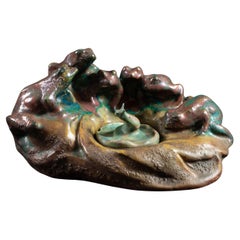
Art Nouveau Frog Inkwell by Émile Müller
Located in Palm Beach, FL
Note: We highly recommend shipping through 1stDibs for its cost effectiveness, full insurance coverage, and reliable handling. While standard parcel services are an option, the defau...
Category

1880s French Art Nouveau Antique Earthenware Inkwells

Materials

Earthenware

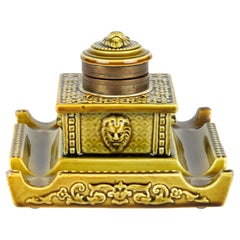
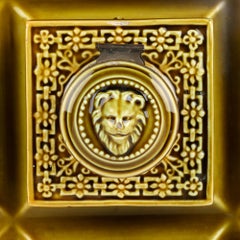
Mühlen & Leendertz Issum Majolica Glazed Lion Mask Inkwell and Desk Stand
Located in Bishop's Stortford, Hertfordshire
A stylish antique German majolica glazed ceramic inkwell and desk stand by Mühlen & Leendertz Issum dating from around 1880. The porcelain desk stand is of square shape standing rais...
Category

1880s German Victorian Antique Earthenware Inkwells

Materials

Brass

Antique French Faience Quimper Inkwell Pen Tray, circa 1900
Located in Pearland, TX
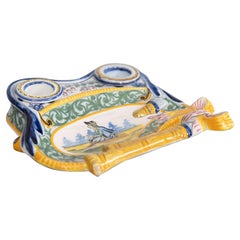
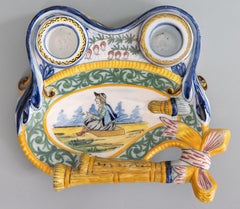
A charming antique French faience Quimper double inkwell and pen tray desk set, circa 1900. This gorgeous inkwell is hand painted with a traditional Breton man surrounded by bagpipes...
Category

Early 1900s French Antique Earthenware Inkwells

Materials

Faience

Rare Antique Mid-19th C Veuve Perrin French France Pottery Inkwell
Located in LOS ANGELES, CA
Rare Antique Mid-19th C Veuve Perrin French France Pottery Inkwell
Category

Mid-19th Century French Provincial Antique Earthenware Inkwells

Materials

Faience

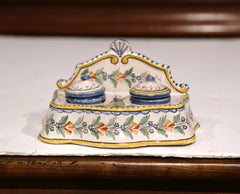
Antique French Faience Quimper Style Inkwell, circa 1900
Located in Pearland, TX
A charming antique French provincial faience Quimper style inkwell from the French province of Saint-Quay-Portrieux, circa 1900. Signed on reverse. Thi...
Category

Early 1900s French French Provincial Antique Earthenware Inkwells

Materials

Ceramic, Faience

Circa 1870 Delft Pottery Inkwell
Located in Charlottesville, VA
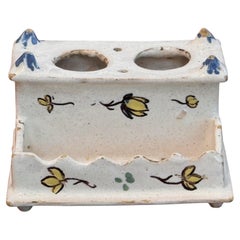
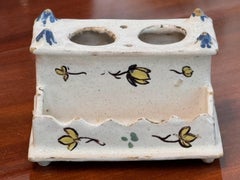
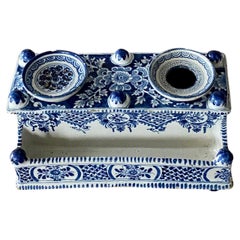
Charming 19th century Delft inkwell, hand-painted with stylized yellow blossoms and delicate green accents on a creamy glazed surface. The stepped design features two inkwell opening...
Category

19th Century Dutch Antique Earthenware Inkwells

Materials

Delft

Danish 18th Century Blue Faience Inkwell by Store Kongensgade
Located in Haddonfield, NJ
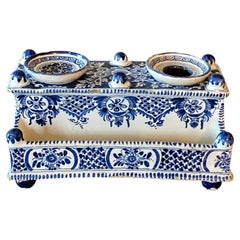
Rare Danish blue and white faience ink stand by Johan Ernst Pfau for Store Kongensgade Faience Manufactory, Copenhagen Denmark circa 1740. This inkwell retain with its original ink a...
Category

Early 18th Century Danish Baroque Antique Earthenware Inkwells

Materials

Faience

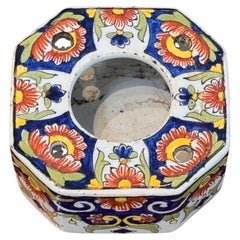
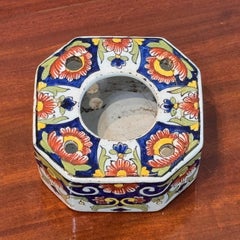
Octagonal Faience Inkwell With Polychrome Floral Motif
Located in Charlottesville, VA
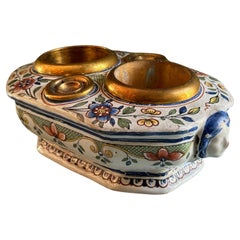
Hand-painted faience inkwell with an octagonal form, featuring vivid red, blue, yellow, and green floral decoration over a white ground. The central opening is surrounded by four pen...
Category

19th Century French Antique Earthenware Inkwells

Materials

Faience

Painted Faience Inkwell With Brass Lids
Located in Charlottesville, VA
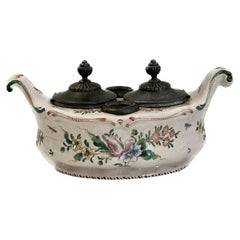
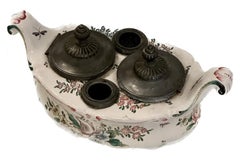
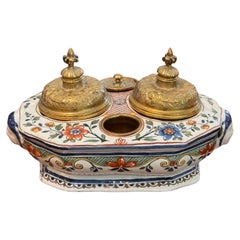
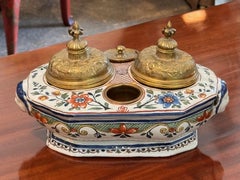
Colorful faience inkwell featuring hand-painted floral motifs in red, green, and blue, with finely detailed gilt brass lids topped by fleur-de-lis finials. The inkwell includes remov...
Category

Early 19th Century French Antique Earthenware Inkwells

Materials

Faience

19th C. French Faience Blue and White Hand Painted Inkwell with Harbor Scene
Located in Dallas, TX
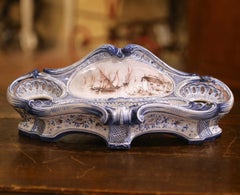
Add a touch of classic French charm to your writing desk with this elegant ceramic inkwell. Crafted in France circa 1880, the cartouche-shaped faience piece features intricate hand p...
Category

Late 19th Century French Louis XV Antique Earthenware Inkwells

Materials

Ceramic, Faience

Strasbourg Faience Chinoiserie Inkwell
Located in New York, NY
Strasbourg chinoiserie inkwell. Antique double-pot faience handled encrier with quill pot and removeable ink pot and cover and sand pot, both wi...
Category

Late 18th Century French Chinoiserie Antique Earthenware Inkwells

Materials

Faience

Group of Two French Faience Ink Wells, 19th Century
Located in Savannah, GA
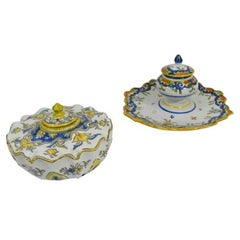
19th century group of two faience ink wells, circa 1875 Desvres with Fourmentraux Frères Mark, circular, decorated in the Rouen style, faience inkwell (5" diameter), circa 1898. Henr...
Category

19th Century French Antique Earthenware Inkwells

Materials

Faience

19th C. Antique Writing Stand Desk office Inkwell Center Piece Faience Porcelain
Located in West Hollywood, CA
19th C. Antique Writing Stand Desk office Inkwell Center Piece Faience Porcelain . This beautiful garniture on a desk a table or a console will a...
Category

Early 19th Century European Antique Earthenware Inkwells

Materials

Brass, Bronze

Rare 18th Century German Faience Rococo Encrier Inkstand Stockelsdorf
Located in Worpswede / Bremen, DE
The form of this rare encrier is based on the model of the known faience master Johann Georg Buchwald, who produced it first in the manufacture of Marieberg, later also in Eckernförd...
Category

Late 18th Century German Rococo Antique Earthenware Inkwells

Materials

Faience

Related Items
Liberty Tudric Pewter Inkwell by Archibald Knox
Located in Tunbridge Wells, GB
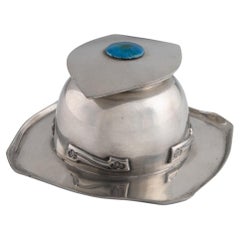
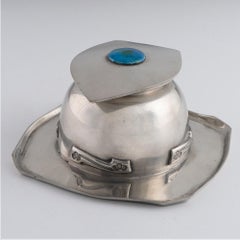
Heading : Liberty Tudric pewter inkwell Archibald Knox c1905 Period : Edward VII Origin : England Decoration : Typical arts and crafts naturalistic lines throughout. Central blue-gre...
Category

Early 1900s English Arts and Crafts Antique Earthenware Inkwells

Materials

Pewter

Liberty Tudric Pewter Inkwell by Archibald Knox
$907
H 2.92 in W 5.12 in D 5.12 in
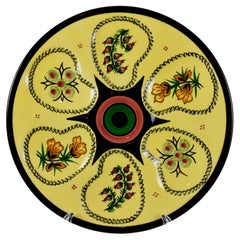
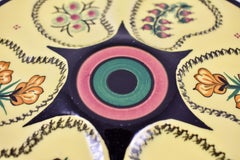
Henriot Quimper Mid-Century French Faïence Sunny Yellow Floral Oyster Plate
Located in Philadelphia, PA
Always charming, French Quimper Faïence oyster plates, circa 1950–1960. Glazed with a bright sun yellow ground, six wells surround a raised center condiment well. The wells are hand...
Category

Mid-20th Century French French Provincial Earthenware Inkwells

Materials

Earthenware

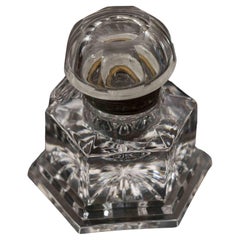
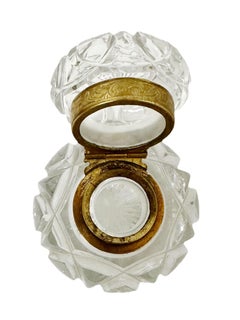
Crystal Inkwell, Italy, 20th Century
Located in Roma, IT
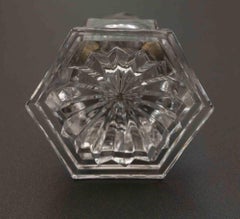
Crystal Inkwell with stopper is a beautiful decorative object. The Inkwell is hexagonal and it is in good condition. Light oxidation at the base of the stopper.
Category

20th Century Italian Earthenware Inkwells

Materials

Crystal

Crystal Inkwell, Italy, 20th Century
$423
H 4.34 in Dm 3.94 in
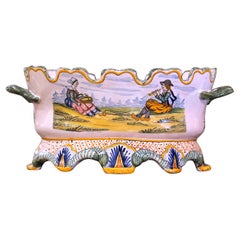
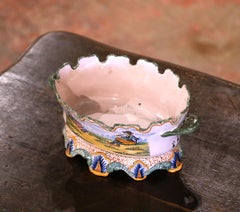
19th Century French Hand Painted Faience Jardiniere Signed Henriot Quimper
Located in Dallas, TX
Decorate a buffet or table with this colorful antique faience jardiniere. Crafted in Brittany, France, circa 1880, the oval planter features crown shaped scalloped edges and is dress...
Category

Late 19th Century French Antique Earthenware Inkwells

Materials

Ceramic, Faience

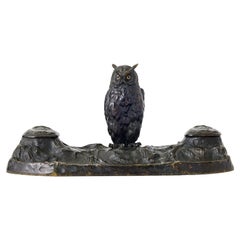
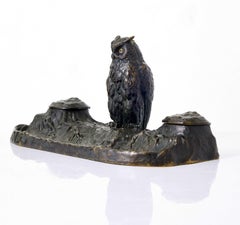
Art Nouveau Bronze Inkwell with an Owl
Located in Stockholm, SE
An Art Noveau or Jugend patinated bronze pen and inkwell with an owl sitting in the center. The owl have inset glass eyes. Made ca.1900. Possibly Swedish. Symbolism of the owl: The...
Category

Early 1900s European Art Nouveau Antique Earthenware Inkwells

Materials

Bronze

Art Nouveau Bronze Inkwell with an Owl
$907
H 7.09 in W 14.97 in D 6.3 in
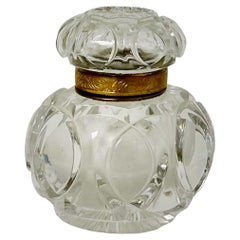
19th Century Baccarat Inkwell
Located in Tampa, FL
A Baccarat crystal inkwell with decorated bronze. Circa 19th century, France. The interior is two inches deep and the opening is one inch wide.
Category

1890s French Antique Earthenware Inkwells

Materials

Crystal

19th Century Baccarat Inkwell
$575
H 4.5 in W 4 in D 4 in
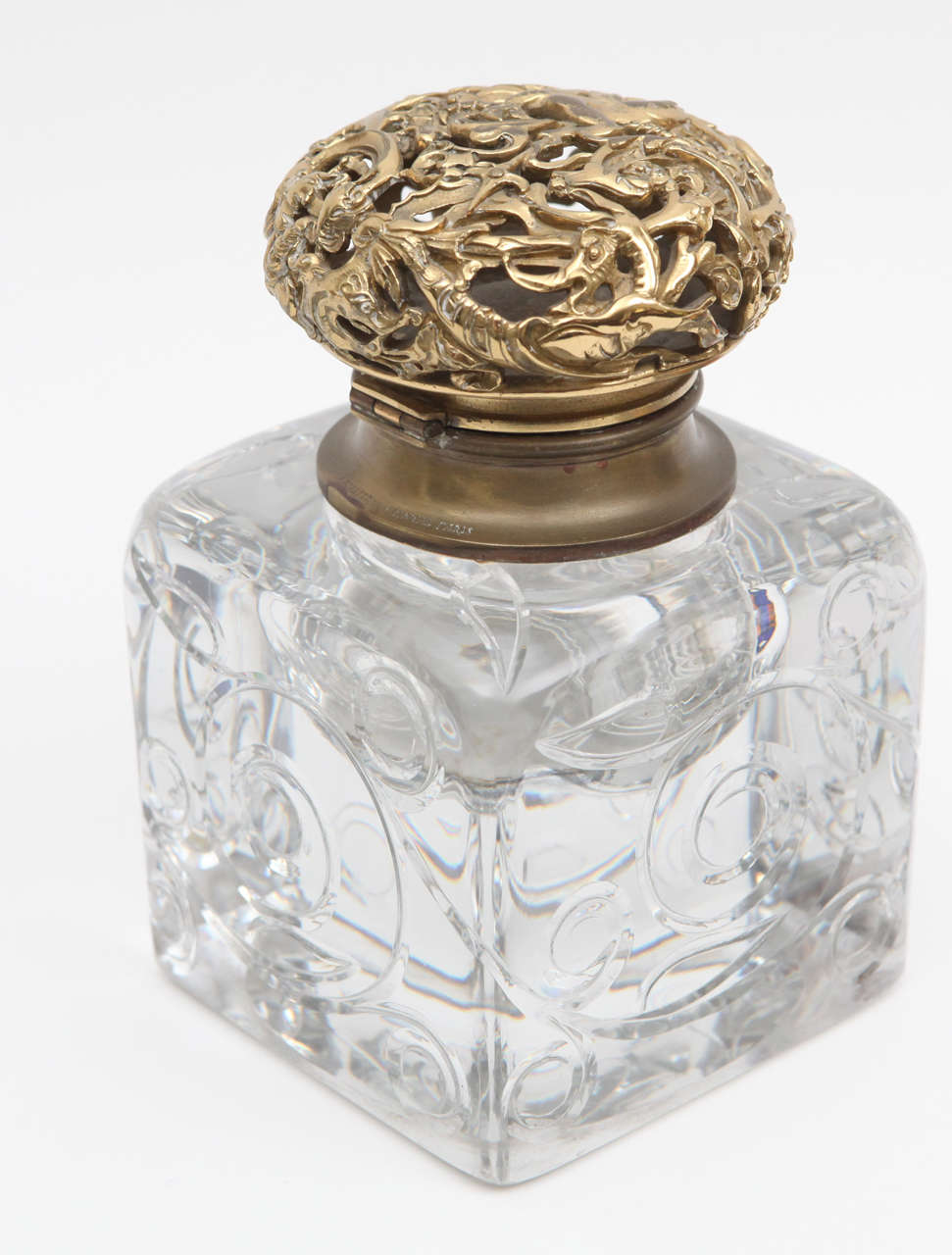
19th Century French Crystal and Bronze Inkwell
Located in Los Angeles, CA
19th century French Crystal and Bronze Mounumental Inkwell. Signed. Escalier de Cristal Paris.
Category

19th Century French Antique Earthenware Inkwells

Materials

Crystal, Bronze

19th Century French Crystal and Bronze Inkwell
$6,500
H 6.75 in W 4.25 in D 4.25 in
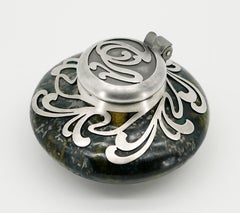
Pierre-Adrien DALPAYRAT French Art Nouveau Stoneware Inkwell, 1890
Located in Saint-Amans-des-Cots, FR
French Art Nouveau Inkwell by Pierre-Adrien Dalpayrat, France, circa 1890. A rare and exquisite Art Nouveau inkwell by renowned French ceramist Pierre-Adrien Dalpayrat (1844–1910). This finely crafted piece showcases Dalpayrat’s signature red copper-glazed stoneware, especially rich and luminous near the base. Elegantly mounted in pewter, the design exemplifies the organic flow and refined detail of the Art Nouveau period. Dimensions: Height: 3.54 in. (9 cm) Diameter: 5.12 in. (13 cm) Materials: Stoneware with pewter mount Condition: Excellent+++++, museum-quality preservation Markings: Incised signature "Dalpayrat 1500" under the base (see photo) This inkwell is a collectible example of French ceramic art at the turn of the century—perfect for collectors of Art Nouveau, 19th-century French ceramics, or the works of Dalpayrat. Adrien Dalpayrat (1844–1910): A Pioneer of French Ceramic Innovation Adrien Dalpayrat was a French ceramicist and researcher who played a key role in the revival of stoneware at the end of the 19th century. Born in 1844 in Limoges, Dalpayrat studied drawing and porcelain painting in his hometown before beginning his professional career at the Jules Vieillard faience factory in Bordeaux. There, he met his wife, Marie Tallerie, with whom he had two sons—Albert and Adolphe—who would later become his primary collaborators. Throughout his early career, Dalpayrat worked for several major ceramic manufacturers, including Ashwin (Valentine), Fouquet (Toulouse), François Blanc (Monaco), and Léon Sazerat (Limoges). In 1889, seeking greater independence, he moved to the Paris region and established his own studio in Bourg-la-Reine. Collaborations and Artistic Evolution Dalpayrat’s creative vision expanded through his collaboration with sculptor Alphonse Voisin-Delacroix. Together, they explored neo-Gothic and Palissy-inspired motifs, creating a remarkable ceramic bestiary. Following Voisin-Delacroix’s death in 1893, Dalpayrat partnered with Adèle Lesbros, which marked a shift in his work toward simpler, more refined vase forms influenced by Japonism. Japanese art had been introduced to France during the 1867 Universal Exhibition, but it wasn’t until the 1878 Exhibition, particularly through the ceremonial stoneware used in the Japanese tea ceremony, that Japonism truly captivated French artists. This influence led Dalpayrat to create vessels with organic, vegetal, and animal-inspired forms. Technical Mastery: The Secrets of Copper Red Among all the ceramists of his time who sought to replicate the elusive Chinese “sang de boeuf” (oxblood) glaze, Adrien Dalpayrat was arguably the most successful. He didn’t simply reproduce the legendary copper red—he transformed it. By manipulating glaze thickness, firing temperature, atmosphere, and copper oxide content, he developed a unique palette of flamed and mottled red glazes that became his signature: the renowned Dalpayrat red. He further enriched his pieces by introducing streaks and inclusions of turquoise, blue, green, and yellow—freeing the red glaze from monochromy and turning it into an expressive, living surface. His work pushed stoneware beyond function into expressive art, merging form and glaze in bold, sculptural harmony. Beyond Ceramics: Bronze Mounts and Architectural Works Dalpayrat also collaborated with renowned jewelers such as Ernest Cardeilhac and Keller to produce pieces mounted in gilt bronze, blending ceramics with decorative arts at the highest level. In an effort to make his work more accessible, he opened a second faience workshop focused on simpler, more affordable pieces inspired by Nevers and Rouen ware. However, this venture faced financial difficulties and closed by 1900. The main family studio followed in 1906 as the popularity of Art Nouveau declined. Dalpayrat then returned to Limoges, devoting his final years to painting and drawing until his death in 1910. Legacy and Recognition Despite financial struggles during his lifetime, Dalpayrat’s ceramics were widely acclaimed at major international exhibitions: Bronze medal, World's Columbian Exposition, Chicago (1893) Silver medal, Antwerp International Exhibition (1894) Gold medal, Exposition Universelle, Paris (1900) Today, his work is part of prestigious museum collections. In 2020, the Petit Palais in Paris acquired a large bird motif vase created in collaboration with Voisin-Delacroix, now on view in Room...
Category

1890s French Art Nouveau Antique Earthenware Inkwells
Materials

Pewter

Bronze Hand Inkstand / Inkwell Desk Piece
Located in Buenos Aires, Olivos
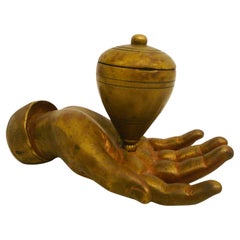
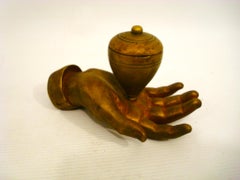
A bronze sculpture of a hand with an open palm. Resting on the palm is a bronze object that resembles a traditional spinning top. The hand appears to be life-sized (Small Children s...
Category

Late 19th Century English Victorian Antique Earthenware Inkwells
Materials

Bronze

Bronze Hand Inkstand / Inkwell Desk Piece
$1,299
H 3.75 in W 5.91 in D 3.15 in
19th century Embossed Bronze Inkwell
Located in Savannah, GA
Bronze inkwell intricately embossed with scroll work. Features include a pen vest and back tray and double inkwells with griffins on the back gallery. A continental piece possibly Au...
Category

Late 19th Century German Victorian Antique Earthenware Inkwells
Materials

Bronze

19th century Embossed Bronze Inkwell
$275 Sale Price
63% Off
H 4.25 in W 14.5 in D 9.5 in
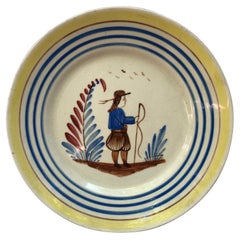
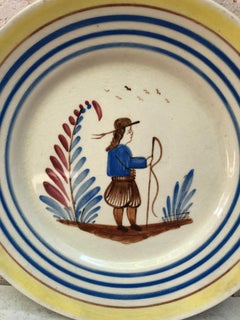
French Faience Plate Henriot Quimper, circa 1930
Located in Austin, TX
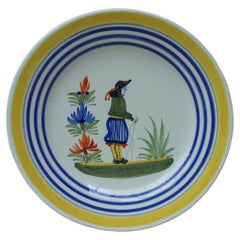
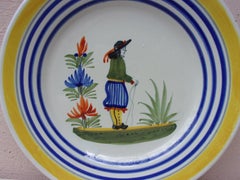
A French large faience plate with a farmer in the costume with flowers signed Henriot Quimper, circa 1950. Colorful yellow border and blue lines. Measure: 9.5 diameter.
Category

1950s French French Provincial Vintage Earthenware Inkwells

Materials

Faience

Beautiful French Angel Face Cast-Iron Inkwell France Antique, 1910s
Located in Nuernberg, DE
Classic early 1900s French metal inkwell. Nice addition to your room or just for use it on your desk. Made of cast iron and glass. Marked with a number and letters. Found at an estat...
Category

Early 20th Century French Black Forest Earthenware Inkwells

Materials

Wood

Previously Available Items
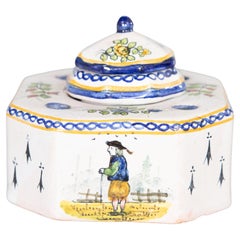
Antique Majolika Inkwell By Georges Dreyfus, 1894s, Hand Painted And Marked
Located in Greven, DE
A beautiful example of a lenticular inkwell with a hinged lid closure made of gilt bronze. Stamped on the bottom by the Manufacture Georges Dreyfus "G.D. Paris - Marque Déposée". Th...
Category

1890s French Late Victorian Antique Earthenware Inkwells
Materials

Ceramic, Majolica

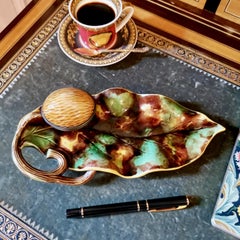
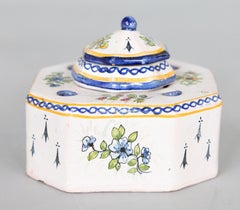
Brown-Westhead & Moore Majolica Ink Stand, Walnut, Victorian ca 1880
Located in London, GB
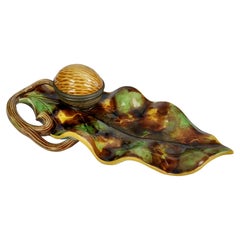
This is a super charming ink stand made in majolica by Brown-Westhead & Moore in about 1880. Brown-Westhead & Moore was a continuation of the famous Ridgway pottery...
Category

1880s English Victorian Antique Earthenware Inkwells
Materials

Majolica

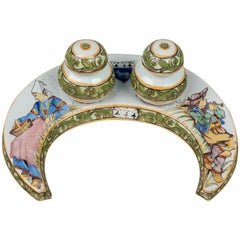
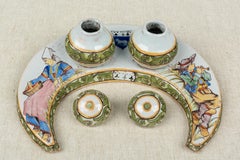
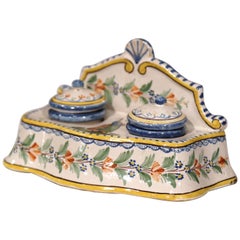
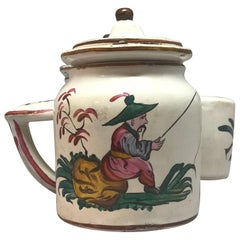
19th Century French Quimper Porquier Beau Faience Ink Well
Located in Winter Park, FL
A 19th century French Quimper faience ink well with crescent moon shape and two small lidded ink pots. Beautifully hand painted depiction of a man and woman in traditional Brittany dress relaxing in the field. Green foliate border decoration and the Quimper sheep crest in the center. Porquier Beau...
Category

19th Century European Antique Earthenware Inkwells
Materials

Faience

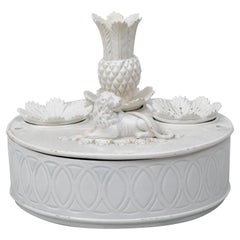
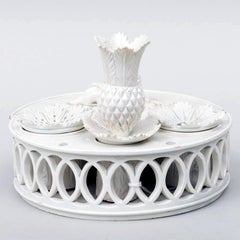
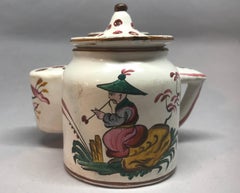
Rare Pearlware Ink Stand with Pineapple-Shaped Candleholder, Sewells, Newcastle
Located in Downingtown, PA
Rare Pearlware Ink Stand with pineapple-shaped candleholder, Sewells, St. Anthonys Pottery, Newcastle, Circa 1804-20. A wonderful pearlware inkstand complete with all its parts. The...
Category

Early 19th Century English Regency Antique Earthenware Inkwells
Materials

Ceramic, Pearlware, Pottery

Early 20th Century French Hand-Painted Faience Inkwell Signed HR Quimper
Located in Dallas, TX
Decorate a lady's writing desk with this colorful antique inkwell from Brittany. Crafted in western France circa 1904-1922, the elegant piece has its original ink containers and matching lids. The porcelain piece is hand painted with a traditional Breton woman figure motif, and is embellished with floral decor around the base and top. The inkwell is in excellent condition with rich colors in the blue and yellow palette and is signed on the back HR Quimper...
Category

Early 20th Century French Earthenware Inkwells
Materials

Faience

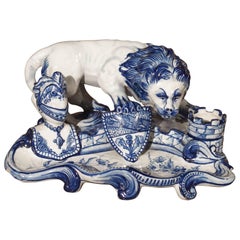
Early 1900s French Faience Inkwell in the Style of Emile Galle
Located in Dallas, TX
This cobalt blue on white ground, French faience heraldic inkwell dates to the early 1900s. It is after Emile Galle and the designer, Gengoult Prouve who had designed similar candle ...
Category

Early 20th Century French Earthenware Inkwells
Materials
Faience