Medieval Paperweights

MEDIEVAL STYLE

The Middle Ages in Europe followed the end of the Roman Empire, and in this time of change, which preceded the Renaissance, furniture was simple and utilitarian, with most homes having only the necessities like chests and benches. Much of medieval furniture, which was often made in oak or walnut, was built for the elite, particularly the emerging merchant class who owned multiple homes.

Life for many in the medieval era was unstable, and furniture was designed to be functional and portable. Peasants worked the fields for affluent landowners and didn’t have access to literature in the way that nobles and people of the church did (women less so than men). The furniture in their modest dwellings was typically limited to cookware and a handful of stools. Foldable chairs, while uncommon in homes of the early Middle Ages and emblematic of wealth, like all other furnishings of the time, allowed for easy transportation of a household. Trestle tables with detachable legs and collapsible beds were designed to be simply moved from place to place.

Medieval blanket chests were among the most important furniture objects and could further serve as tables or even beds. Some ancient traditions were carried forward to build this sturdy furniture, such as turnery. Although the furniture was minimally designed, embellishments like carvings added elegance to the heavy wood pieces. These details sometimes reflected trends in religious art like rose windows.

By the later Middle Ages, storage pieces like chests of drawers were often adorned with high relief carvings, such as geometric and floral motifs. By the 14th and 15th centuries, design had developed to include more involved pieces like cupboards and desks, while benches frequently doubled as chests with hinged seats. Beds also changed in this era from basic boards to four-post designs with large drapes to keep the sleeper warm. These beds and other medieval bedroom furniture were significant status symbols, passed down through families and used as places to conduct business and receive visitors.

Surviving examples of medieval furniture are very rare, yet its distinctive aesthetics influenced later styles like William and Mary and Arts and Crafts.

Find a collection of medieval seating, garden elements, decorative objects and other furniture on 1stDibs.

to
2
1
1
520
145
89
24
22
18
14
10
8
7
5
4
4
3
3
1
1
1
1
1
1
2
2
1
1
1
Height
to
Width
to
2
2
2
Style: Medieval
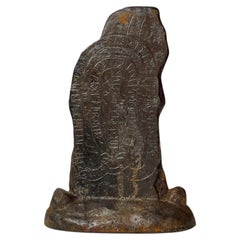
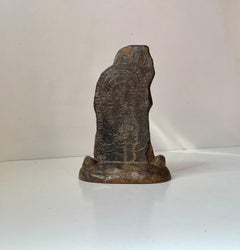
Antique Runestone Desk Ornament - Paperweight in Cast Iron, 1894

Antique Runestone Desk Ornament - Paperweight in Cast Iron, 1894

Located in Esbjerg, DK

A cast model of a Danish Runestone from the Viking era. The so-called Klemensker Stenen on the Island of Bornholm found in 1882. It is one of the tallest/largest Danish Runestones me...

Category

Late 19th Century Danish Antique Medieval Paperweights

Materials

Iron

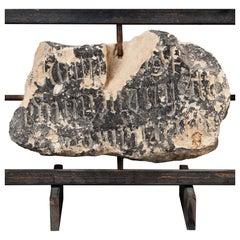
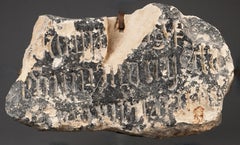
Gothic inscription - France, 15th century

Gothic inscription - France, 15th century

Located in Bruxelles, BE

Fragment of an Inscribed Stone
 France, 15th century
 Limestone
 14 × 24.5 × 5 cm This evocative limestone fragment preserves the refined vestiges of a Gothic inscription carved in ...

Category

15th Century and Earlier French Antique Medieval Paperweights

Materials

Limestone

Related Items
Apache Indian Chief Head Car Mascot, Hood Ornament / Paperweight, France, 1925

Apache Indian Chief Head Car Mascot, Hood Ornament / Paperweight, France, 1925

Located in Buenos Aires, Olivos

Apache indian Chief Head Car Mascot - Hood Ornament / Paperweight. Designed by H. Briand publisher, Paris. Silvered bronze. Mounted over a black marble base. It has a hole at the bac...

Category

Early 20th Century French Medieval Paperweights

Materials

Marble, Bronze

Late 15th Century Polychrome Wood Carving Depicting the Nativity

Late 15th Century Polychrome Wood Carving Depicting the Nativity

Located in Saint-Ouen, FR

While the birth of Christ is briefly told in the Gospel of Luke (2, 7) it is in the apocryphal texts that we find most of the elements and details that have then inspired artists. As of the 14th century and even more of the 15th century the subject of the Adoration of the Child replaces in Western art the scene of the Birth, much favoured in Byzantine art. Instead of being depicted lying with the new-born swathed in the manger, the Virgin is now kneeling, her hands joined in prayer in front of the naked child. This change was probably hastened by the popularity of the visions of Saint Bridget of Sweden to whom the Virgin allegedly appeared to show how she had given birth to Jesus (Visions, VII, chap. 21). Sheltered by a thatch-roofed structure the Virgin is kneeling in front of the Child Jesus. She wears a magnificent red dress under a large gold cloak. Her curled blond hair is partially veiled. The newborn is lying on a straw mat. Joseph is depicted with a parted beard and stands opposite from the Virgin. He wears a tunic and a coat with a purse hanging from the belt. His costume reminds us of the long journey him and Mary have accomplished to reach Bethlehem. Two other women are present. One is looking through the stable’s window to observe the Holy Family while another one kneels in prayer in front of the divine child. The rich costume of the lady might indicate she is a donator. However they could also both represent the women who took part in the birth of Christ, Zelemi and Salome. Salome, incredulous did not believe in the virginal conception of Mary and she is represented far from the scene. The artist has depicted her with an expression of doubt on her face. Zelemi, on the contrary, is a believer. She is rewarded by a place of honour at the heart of the scene, close to Mary. To the left the donkey and ox that have accompanied Mary and Joseph to Bethlehem observe quietly the scene. On the foreground two angels hold a scroll reading an excerpt from the Gloria : “/Gloria/ in excelsis /Deo/.” One of the angels wears a blue cape while the other’s is red Those two colours are very significant as during Middle-Ages blue symbolises hope and red charity. Together they express the hope in redemption thanks to the advent of Christ and his sacrifice to come. Above the main scene, up a cliff, a small shepherd lets his herd of sheep graze amidst the trees. He is framed by two walled cities. This wood carving is the work of a very skilled and inventive artist. The piece bears witness to his exceptional talent. The realism of the scene is emphasised by the amount of details depicted. The refinement of the carving itself is highlighted by the well preserved polychromy. This key moment of the New Testament is set in a contemporary context thanks to the clothes of the characters and the scenes of rural life. The universal dimension of the scene is intensified while allowing contemporary viewers to grasp its meaning more easily. This care for details, the picturesque realism as well as the extraordinary rendition of the cloths suggest it was made by a Flemish artist during the late 15th century. This relief can be compared with the panel of the Nativity from the Saint-Vaast altarpiece made by Jacques Daret between 1433 and 1435, today in Madrid’s Thyssen-Bronemisza Museum. Literature Louis Réau, Iconographie de l’Art chrétien...

Category

15th Century and Earlier Dutch Antique Medieval Paperweights

Materials

Wood

19th Century Bronze Letter Rack - Gothic Revival

19th Century Bronze Letter Rack - Gothic Revival

$598

H 9.06 in W 12.6 in D 7.49 in

19th Century Bronze Letter Rack - Gothic Revival

Located in Casteren, Noord-Brabant

Elegant French bronze letter rack, late 19th century. The openwork design features intricate Gothic Revival motifs with stylized foliage, quatrefoils, and decorative details, complem...

Category

1890s French Antique Medieval Paperweights

Materials

Bronze

Large English Antique Brass Desk Magnifying Glass / Paperweight c.1910

Large English Antique Brass Desk Magnifying Glass / Paperweight c.1910

Located in Bath, GB

Always very popular and a very useful desk-top accessory. These large circular magnifiers actually are the condenser or magnifier from a Magic Lantern dating to around 1910; they are...

Category

1910s British Vintage Medieval Paperweights

Materials

Brass

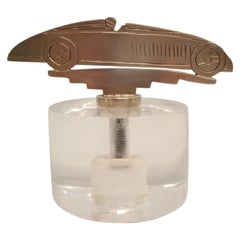
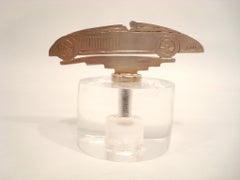
Bugatti Tank Car Mascot / Hood Ornament / Paperweight. France 1930

Bugatti Tank Car Mascot / Hood Ornament / Paperweight. France 1930

Located in Buenos Aires, Olivos

Bugatti Tank Car Mascot / Hood Ornament / Paperweight. France 1930. Silvered Bronze Sculpture depicting a Bugatti Type 32 ¨Tank¨ Car. Mounted over an acylic base. Signed CAD. Lovely ...

Category

Mid-20th Century French Medieval Paperweights

Materials

Bronze

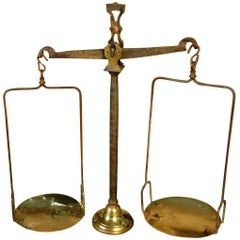
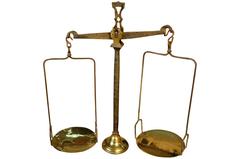
French 18th Century Balance Scale

French 18th Century Balance Scale

$1,950

H 24.5 in W 24.5 in D 8 in

French 18th Century Balance Scale

Located in Round Top, TX

A handsome French 18th century balance scale in iron and brass. The balance mechanism is in iron. The foot and the plates are in brass. The...

Category

18th Century French Antique Medieval Paperweights

Materials

Brass, Iron

Polychrome carved wood Virgin and Child from the 15th Century

Polychrome carved wood Virgin and Child from the 15th Century

Located in Saint-Ouen, FR

POLYCHROME CARVED WOOD VIRGIN AND CHILD FROM THE 15TH CENTURY   ORIGIN: SOUTH GERMANY, SWABIA, NUREMBERG REGION PERIOD: 15th CENTURY   Height: 94,6cm Width : 28 cm Depth : 18 cm   Lime wood Original Polychromy Good state of conservation     From 1430 onwards, sculpture underwent a profound stylistic renewal which continued until 1530, the so-called late Gothic period. In the Germanic countries, original sculptures flourished in an expressive and sensitive vein.
This renewal was inspired by the art of Nicholas of Leiden, who was active in Strasbourg in the 1460's. His style broke with the refined and delicate art of the international Gothic style in force throughout Europe around 1400. The figures became more authentic and realistic. The bodies became denser. Clothes are animated by deep, broken folds, the fabrics are heavy and have a great decorative value. In addition, the polychromy is intended to be illusionistic. The painting makes it possible to restore the texture of the materials, the richness of the textiles and the natural skin tone of the characters.   The dissemination of images through engraving and the great mobility of the artists led to the success of this style, which conquered the Upper Rhine, Swabian, Tyrolean and Franconian regions, contributing to the formation of a common stylistic identity in these regions. The economic boom in the flourishing German cities was conducive to the development of original production. Attracted by this prosperity, numerous workshops were set up in order to meet the orders of religious communities, the Church and the laity, including a clientele of middle-class rockers.      This precious Virgin and Child is depicted standing on a crescent moon, her head encircled by a crown of tall flowers. Her long wavy hair spreads over her shoulders, framing her beautiful oval face. Under fine eyebrows drawn with a brushstroke, her almond-shaped, slightly drooping eyes look at the Child with infinite softness. She is dressed in a long red dress with a rounded neckline, belted under the chest. The heavy fabric of her dress spreads out in broken folds at her feet. On her shoulders she wears a golden cloak. The drapery has deep folds. She holds out her right hand while she holds the Christ Child with her left.   Christ, with his well-defined hair, is naked. His cheeks are highlighted with red, he holds an apple in his left hand and with the other hand makes a sign of blessing towards the faithful.   Virgins with Child on a crescent moon were very popular in the second half of the 15th century, especially as the central subject of altarpieces in southern Germany and Austria. The crescent moon on which Mary is standing is reminiscent of the Woman of the Apocalypse. Often equated with the Virgin Mary.    This episode is taken from the Book of Revelation (12:1-6)   1 Then a great sign appeared in heaven: a woman clothed with the sun, with the moon under her feet and a crown of twelve stars on her head. ; 2 She was pregnant, and she cried out because she was in labor, in pain from giving birth. ; 3 Then another sign appeared in heaven: it was a great fiery red dragon, with seven heads and ten horns, and seven royal crowns on his heads. ; 4 His tail swept down a third of heaven's stars and threw them to the earth. The dragon stood in front of the woman who was about to give birth so that when she gave birth, he might devour her child. ; 5 She gave birth to a son, a male child who is to rule all the nations with an iron rod. Her child was snatched up to God and his throne. ; 6 Then the woman fled into the desert, where God has prepared a place for her. There she will be taken care of for one thousand two hundred sixty days.   Some theologians see in this woman a reference to the Virgin Mary and in the child, Jesus.    
This remarkable work is a very fine example of sculpture from Swabian workshops in the last decades of the 15th century. It presents all the characteristic stylistic elements: a highly girdled silhouette, an abundant drapery with angular folds, but also a great physical presence accentuated by the polychromy that restores the anatomical details. This group is made of a wooden log. The deep folds of the drapery highlight the movement of the Virgin holding the child.       Bibliography :   Sophie Guillot de Suduiraut, Dévotion et Séduction, Sculptures souabes des musées de France, vers 1460-1530, Paris musée du Louvre-Éditions somogy, 2015   “Revelation 12 -   Common English Bible...

Category

15th Century and Earlier German Antique Medieval Paperweights

Materials

Wood

Art Deco Wrought Iron Paperweight

Art Deco Wrought Iron Paperweight

$813

H 15.75 in W 3.55 in D 3.55 in

Art Deco Wrought Iron Paperweight

By Henri Fournier

Located in NANTES, FR

Paperweight, decorative wrought iron office object circa 1925. Executed in Lyon by Henri Fournier establishment "le fer forgé". Stamped "le fer forgé". This is probably a unique pie...

Category

1920s French Vintage Medieval Paperweights

Materials

Wrought Iron

Previously Available Items
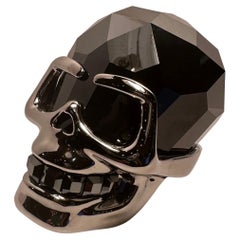
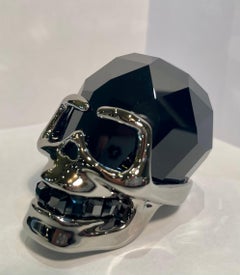
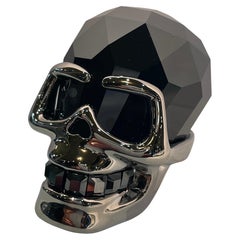
Fine Quality Retired Swarovski Crystal Faceted Jet Hematite Skull Figurine

Fine Quality Retired Swarovski Crystal Faceted Jet Hematite Skull Figurine

By Swarovski

Located in Tustin, CA

Beautifully and expertly hand made in Austria, finest quality Swarovski Crystal Jet Hematite faceted crystal skull with ruthenium finish metal accents on the face and base. Skull fea...

Category

21st Century and Contemporary Austrian Medieval Paperweights

Materials

Crystal

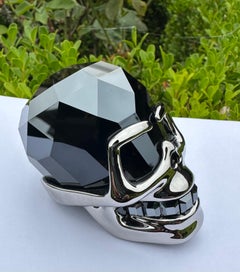
Fine Quality Retired Swarovski Crystal Faceted Jet Hematite Skull Figurine

Fine Quality Retired Swarovski Crystal Faceted Jet Hematite Skull Figurine

By Swarovski

Located in Tustin, CA

Beautifully and expertly hand made in Austria, finest quality Swarovski Crystal Jet Hematite faceted crystal skull with ruthenium finish metal accents on the face and base. Skull features square faceted hand cut matching faceted crystal teeth. Circa 2011 and retired in 2013, the Swarovski Crystal skull is part of the Soulmates group. Signed with the Swarovski Swan logo on the bottom of the metal base. In excellent condition. Comes with its' original box and packaging. Measures approximately 2.5" tall x 3.00" deep x 2.00' wide. Weighs approximately 3/4 pound. Swarovski is an award winning Austrian producer of fine crystal and is headquartered in Wattens, Austria. It is a family owned business founded by Daniel Swarovski in 1895. Swarovski produces some of the finest crystal pieces in the world including the 9 foot diameter, 550 pound crystal star or snowflake that tops the famous Rockefeller Center Christmas Tree in New York City...

Category

21st Century and Contemporary Austrian Medieval Paperweights

Materials

Crystal

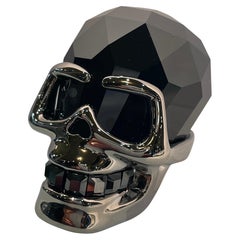
Fine Quality Retired Swarovski Crystal Faceted Jet Hematite Skull Figurine

Fine Quality Retired Swarovski Crystal Faceted Jet Hematite Skull Figurine

By Swarovski

Located in Tustin, CA

Beautifully and expertly hand made in Austria, finest quality Swarovski Crystal Jet Hematite faceted crystal skull with ruthenium finish metal accents on the face and base. Skull features square faceted hand cut matching faceted crystal teeth. Circa 2011 and retired in 2013, the Swarovski Crystal skull is part of the Soulmates group. Signed with the Swarovski Swan logo on the bottom of the metal base. In excellent condition. Comes with its' original box and packaging. Measures approximately 2.5" tall x 3.00" deep x 2.00' wide. Weighs approximately 3/4 pound. Swarovski is an award winning Austrian producer of fine crystal and is headquartered in Wattens, Austria. It is a family owned business founded by Daniel Swarovski in 1895. Swarovski produces some of the finest crystal pieces in the world including the 9 foot diameter, 550 pound crystal star or snowflake that tops the famous Rockefeller Center Christmas Tree in New York City...

Category

21st Century and Contemporary Austrian Medieval Paperweights

Materials

Crystal

Medieval paperweights for sale on 1stDibs.

Find a broad range of unique Medieval paperweights for sale on 1stDibs. Many of these items were first offered in the 21st Century and Contemporary, but contemporary artisans have continued to produce works inspired by this style. If you’re looking to add vintage paperweights created in this style to your space, the works available on 1stDibs include decorative objects and other home furnishings, frequently crafted with crystal, stone and other materials. If you’re shopping for used Medieval paperweights made in a specific country, there are Austria, and Europe pieces for sale on 1stDibs. While there are many designers and brands associated with original paperweights, popular names associated with this style include and Swarovski. It’s true that these talented designers have at times inspired knockoffs, but our experienced specialists have partnered with only top vetted sellers to offer authentic pieces that come with a buyer protection guarantee. Prices for paperweights differ depending upon multiple factors, including designer, materials, construction methods, condition and provenance. On 1stDibs, the price for these items starts at $495 and tops out at $495 while the average work can sell for $495.