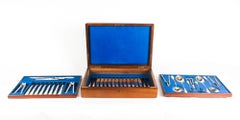
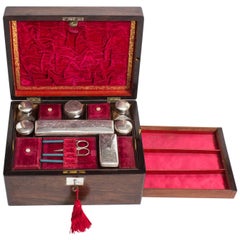
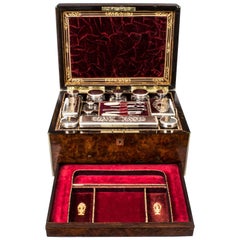
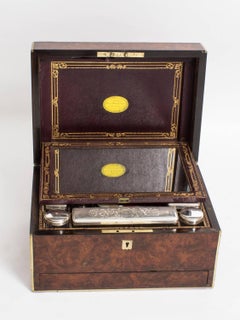
This is a stunning antique Victorian burr walnut and ormolu-mounted rectangular lady's travelling case, retailed by T. Forgie: 93 Buchman St, Glasgow, Scotland, circa 1860 in date.
The spectacular burr walnut case is outlined with brass stringing and has a vacant shield shaped cartouche ready to be engraved with your initials. The interior is well fitted with twelve silver plate topped jars, bottles and wells. There are also a mother-of-pearl mounted button hook, a nail file and two pairs of scissors.
There is a sprung concealed drawer to the front which opens to reveal a gold tooled velvet lined interior for jewellery. The case has also a fitted mirror that is concealed in the lid, which can be removed to reveal a secret gold tooled leather hiding place for letter and documents.
Complete with working lock and original key.
It is a beautiful piece which will look stunning on your dressing table.
Condition:
In excellent condition, please see photos for confirmation.
Dimensions in cm:
Height 18 x Width 32 x Depth 23
Dimensions in inches:
Height 7 inches x Width 1 foot, 1 inch x Depth 9 inches
J. & T. Forgie,
Extract from an index of firms written in 1888.
The business successfully founded by Thomas Forgie in the year 1854, bears witness to the doctrine of the survival of the fittest. Thirty-four years ago Messrs. J. and T. Forgie, the sole proprietors, launched their successful venture in Buchanan Street, and continued it at one address for twenty-two years. Twelve years ago the firm decided to remove their trade to premises better adapted to modem requirements and their rapidly growing trade, and finding what they required at the above address, they removed there.
By energy and industry they have succeeded in making a business of which any firm might be justly proud. Messrs. Forgie’s shop has a handsome exterior, and has double windows with workrooms beneath. The goods as displayed in the windows show to much advantage, and evidence the taste of the proprietors in their arrangements.
Their specialities are dressing-bags and writing-cases, of kinds and values varying as widely as the tastes and requirements of their widely distributed clientele. Dressing-bags fitted with the most costly fittings in gold, gilt, or solid silver, and cut-glass, to suit the most luxurious taste, and the deepest purse. On the other hand, less showy but perhaps as useful, articles to suit the workman, tourist, or commercial man. In writing-desks there is an endless, bewildering choice, from the simplest to the most perfectly furnished and appointed.
Messrs. Forgie, however, do not confine themselves to the dressing-bag and case trade, but are general importers of foreign fancy goods of all kinds. Athletic requirements are also a leading line with them. Tennis bats, balls, nets, &c.; cricketing bats, stumps, pads, gloves, &c., are here in variety and of all makes.
It may be interesting to note that the premises at present occupied by Messrs. Forgie were formerly known as the original “Western Club”, and the dining-hall of the club is what is now used as the shop by Messrs. Forgie. Birmingham, London, and Sheffield goods are not neglected, but are in evidence on the shelves and counters. Messrs. J. & T. Forgie’s name and trade is not confined to Glasgow, but is widely known throughout the West of Scotland, and the firm’s business reputation is highly appreciated wherever known. Their goods are sound, well finished, and marketable, and the firm deserve well the rewards their business capacity has won.
Travelling cases became very popular towards the end of the 18th century. They were manufactured specifically to accompany upper class gentleman during travel. Dressing cases were originally rather utilitarian but they spoke volumes about their owners’s wealth and place in society, as at that time, traveling was only done by the elite.
Gentleman’s dressing cases would contain bottles and jars for colognes, aftershaves and creams as well as essential shaving and manicure tools. As these boxes became more popular, many further traveling item options were offered for inclusion.
By the early Victorian era, ladies also began to travel and suddenly their requirements were anything but utilitarian! Ladies dressing cases could feature a wide range of decorative bottles and jars as well as a vast array of beautifcation tools, all designed with pure luxury in mind. The exterior of the box became almost as important as the interior and these boxes started being veneered with beautiful exotic woods from all-over the world.
As demand for gentleman’s boxes...
Category
1860s British Victorian Antique Velvet Sheffield and Silverplate
MaterialsSilver Plate, Ormolu