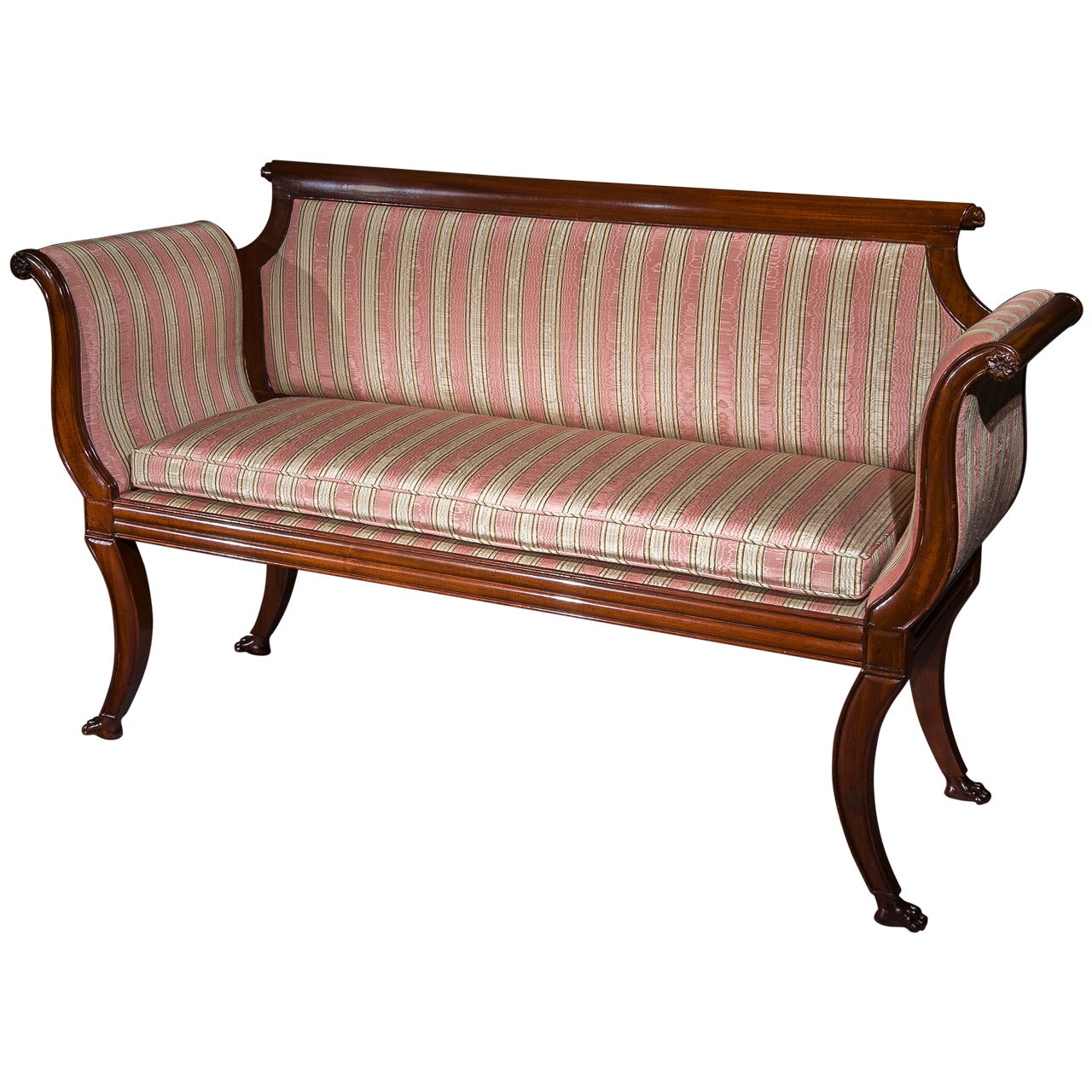
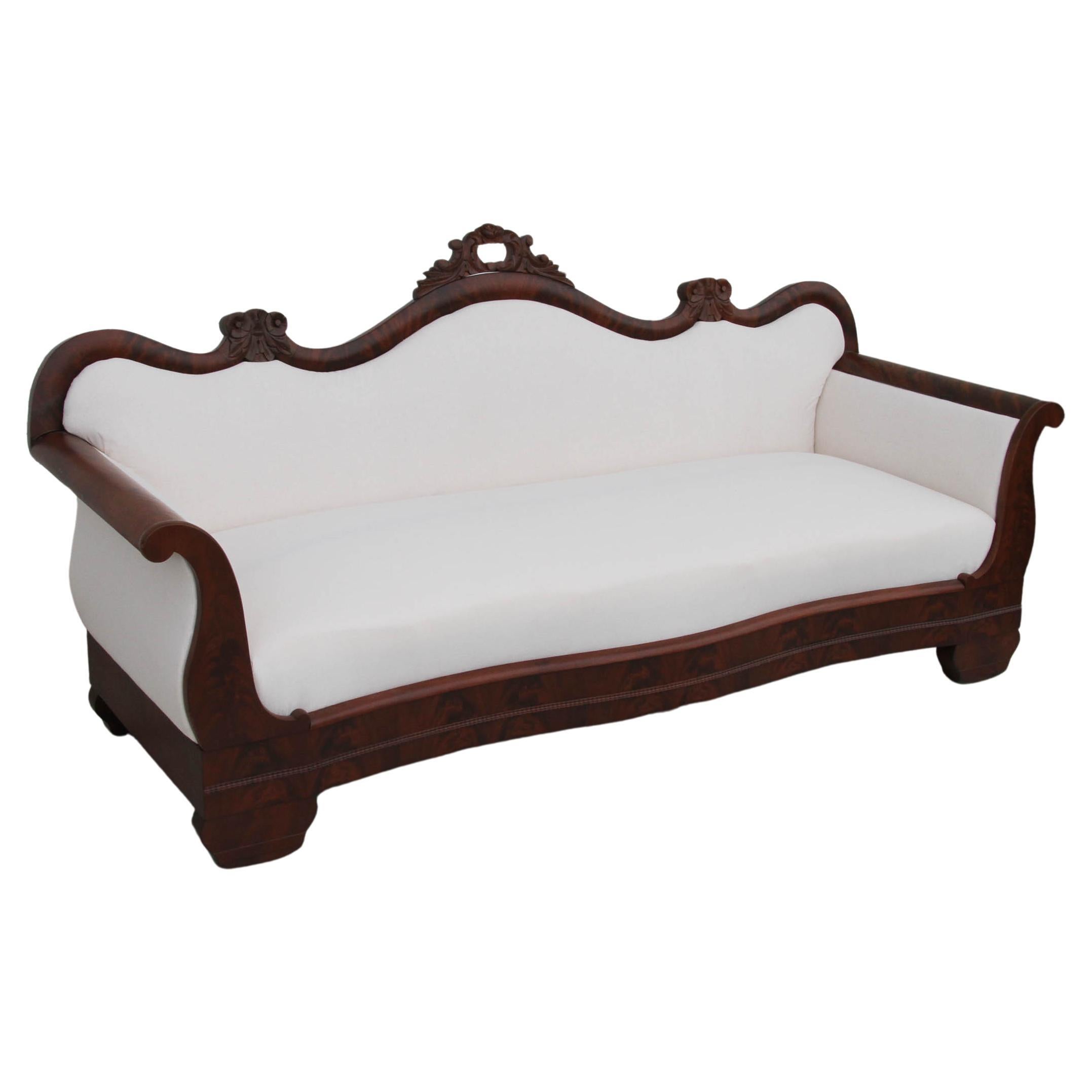
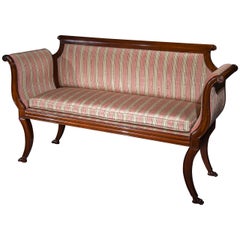
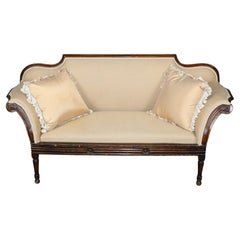
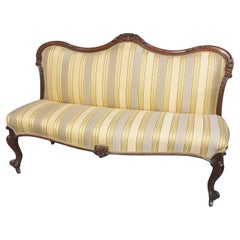
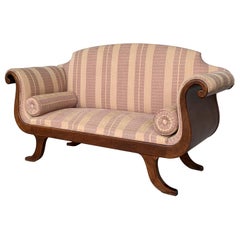
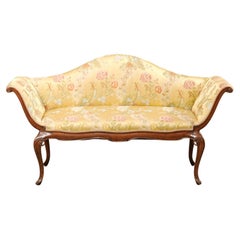
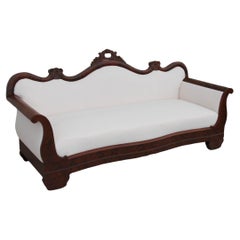
Small Settee in the neoclassical taste
Boston, Massachusetts (active 1804–17), about 1810
Mahogany (secondary woods: ash)
Measures: 35 1/8 in. high, 59 3/4 in. long, 19 1/8 in. deep
Although the diminutive scale of this settee places it in a unique category, the piece itself partakes of a vocabulary that is common in Boston furniture of the Late Federal period. Its sabre legs, for example, as seen straight on from the left and right ends, are closely related to the legs, as seen from the front, on a group of chairs of undisputed Boston origin, including a spectacular armchair with scrolled arms (see Stuart P. Feld, Boston in the Age of Neo-Classicism, 1810–1840, exhib. cat. [New York: Hirschl & Adler Galleries, 1999], p. 37 no. 6 illus. in color), as well as a number of side chairs, including a set made for Nathan Appleton (see Page Talbott, “Boston Empire Furniture, Part I,” The Magazine Antiques, CVII [May 1975], p. 887 fig. 12). In all, the legs are ornamented with two bold, somewhat flattened reeds set between corner beads, a pattern which is repeated here on the front and end seat rails as well. The superb quality of the piece is further demonstrated in the finely drawn profile of the arms, as well as the delicately bulbous surface of the fronts of the arms and legs. As in the best of the related chairs, the sabre legs end in delicately carved paw feet. The added refinement of the beautifully carved rosettes at both the fronts and backs of the arms suggests that the piece may have been designed to be used in the round.
Stylistically harmonious with these pieces is also a group of larger sofas with frontally set sabre legs and scrolled arms (see Page Talbott, “Seating Furniture in Boston, 1810–1835,” The Magazine Antiques, CXXXIX [May 1991], p. 963 pl. 11) that represent an indigenously Boston form. Although none of the furniture in this group has been effectively attributed, they can certainly be related to various Boston card tables...
Category
Antique Early 19th Century American Neoclassical Settees