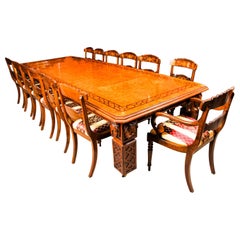
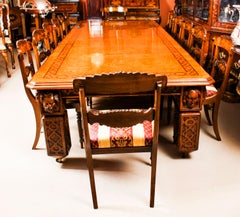
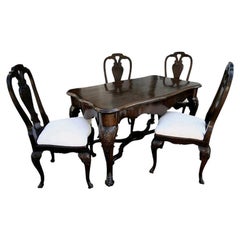
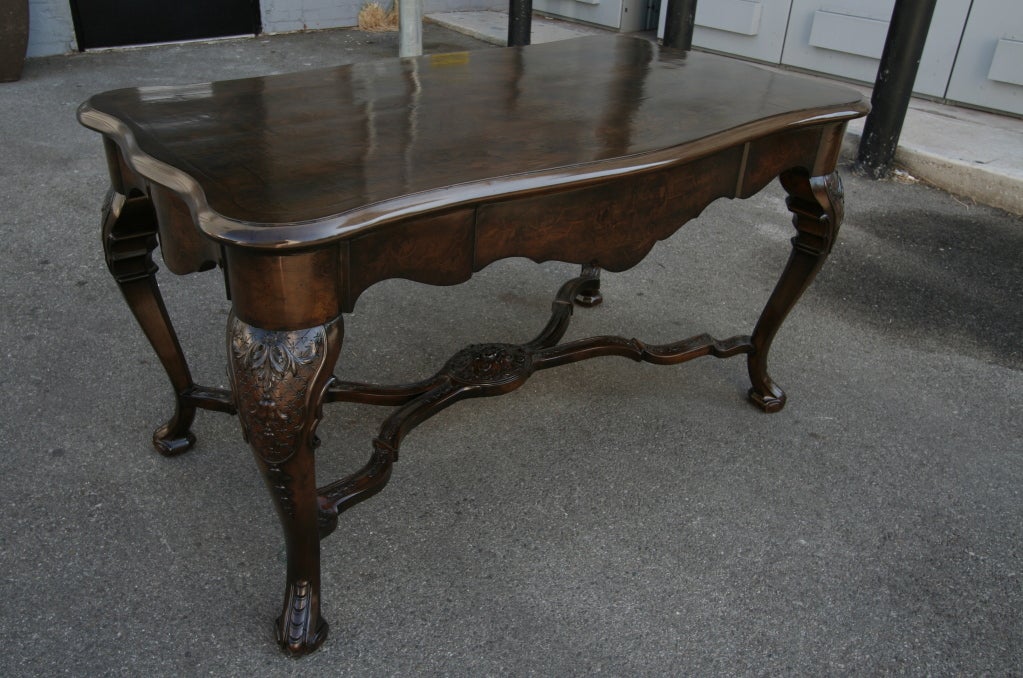
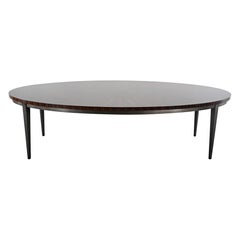
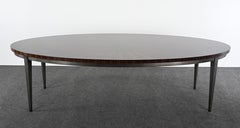
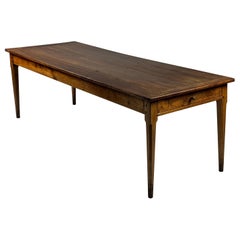
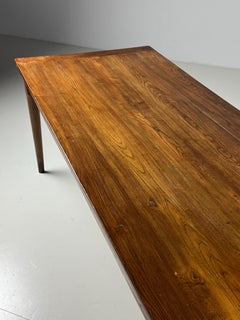
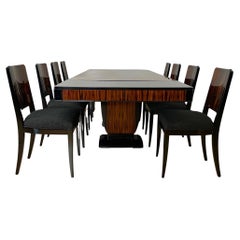
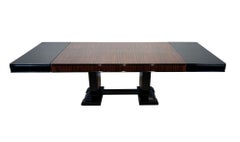
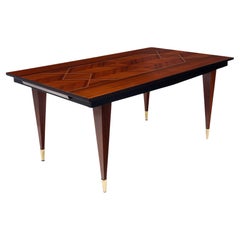
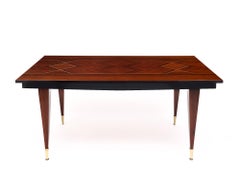
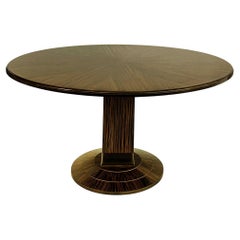
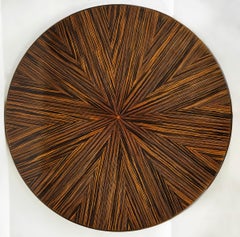
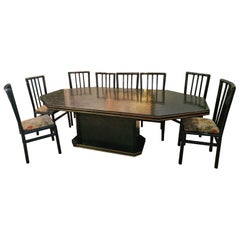
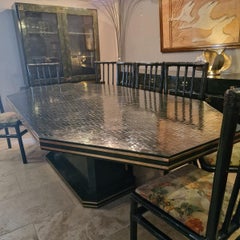
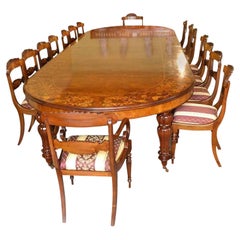
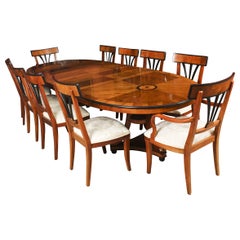
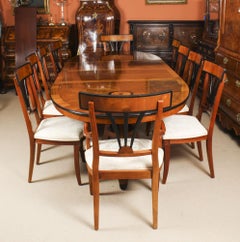
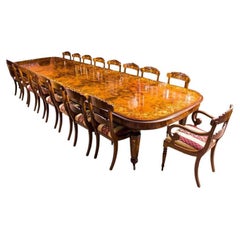
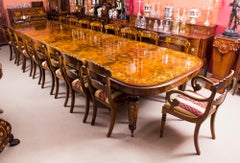
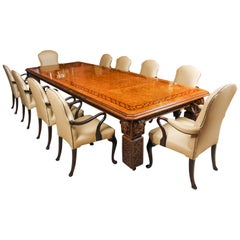
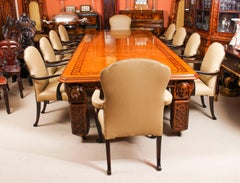
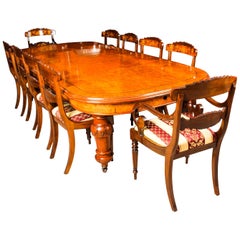
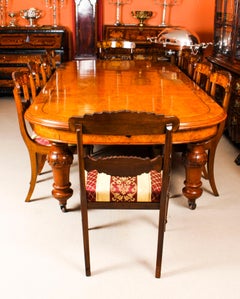
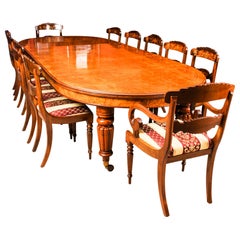
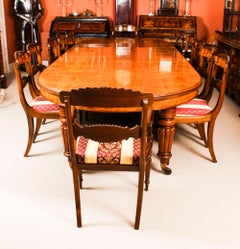
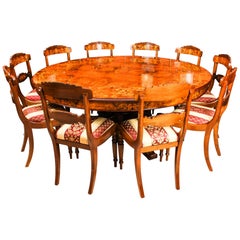
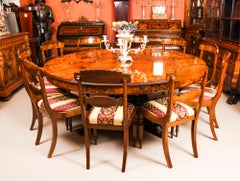
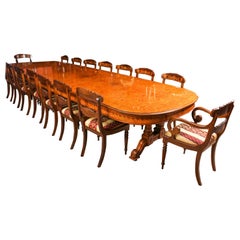
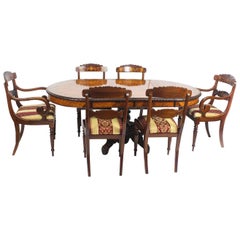
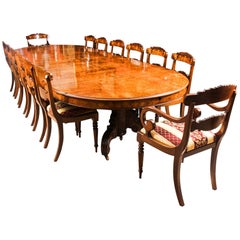
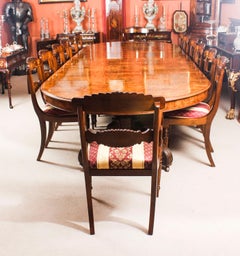
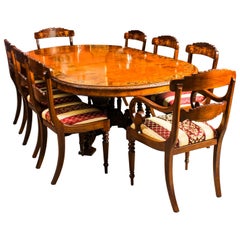
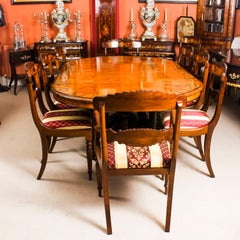
This is a fabulous high quality Biedermeier dining set comprising a satin birch twin pillar oval dining table and matching set of ten dining chairs, purchased at great expense from Harrods, Knightsbridge, London in the 1980s.
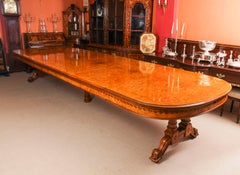
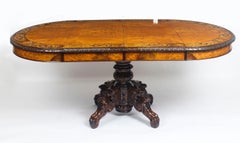
The oval satin birch top with inlaid circular satinwood and ebonized marquetry decoration at each end, with two additional leaves, that can be added or removed a required to suit the occasion.
It is raised on a pair of incurved triform bases with scroll supports on ball feet.
The matching set of ten chairs comprise two armchairs and eight side chairs that each feature curved backs with three ebonized curved splats, with upholstered seats on sabre legs. The seats are upholstered in a stunning cream damask fabric.
There is no mistaking the fine craftsmanship of this handsome dining set which is certain to become a treasured addition to your furniture collection, and a talking point with guests at meal times.
Condition:
In excellent condition having been beautifully cleaned and waxed and the chairs reupholstered in our workshops, please see photos for confirmation.
Dimensions in cm:
Height 75 x Width 317 x Depth 122 - Fully extended
Height 75 x Width 204 x Depth 122 - With both leaves removed
Height 95 x Width 56 x Depth 61 - Armchairs
Height 95 x Width 49 x Depth 57 - Chairs
Height 47.5 - Seat height
Dimensions in inches:
Height 2 foot, 5 inches x Width 10 foot, 5 inches x Depth 4 foot - Fully extended
Height 2 foot, 5 inches x Width 6 foot, 8 inches x Depth 4 foot - With both leaves removed
Height 3 feet, 1 inch x Width 1 foot, 10 inches x Depth 2 foot - Armchairs
Height 3 feet, 1 inch x Width 1 foot, 7 inches x Depth 1 foot, 10 inches - Chairs
Height 1 foot, 7 inches - Seat height
Harrods founder Charles Henry Harrod first established his business in 1824, aged 25. The business was located south of the River Thames in Southwark. The premises were located at 228 Borough High Street.
He ran this business, variously listed as a draper, mercer and a haberdasher, certainly until 1831. During 1825 the business was listed as 'Harrod and Wicking, Linen Drapers, Retail', but this partnership was dissolved at the end of that year. His first grocery business appears to be as ‘Harrod & Co.Grocers’ at 163 Upper Whitecross Street, Clerkenwell, E.C.1., in 1832. In 1834 in London's East End, he established a wholesale grocery in Stepney, at 4, Cable Street, with a special interest in tea.
In 1849, to escape the vice of the inner city and to capitalise on trade to the Great Exhibition of 1851 in nearby Hyde Park, Harrod took over a small shop in the district of Brompton, on the site of the current store. Beginning in a single room employing two assistants and a messenger boy, Harrod's son Charles Digby Harrod built the business into a thriving retail operation selling medicines, perfumes, stationery, fruit and vegetables. Harrods rapidly expanded, acquired the adjoining buildings, and employed one hundred people by 1880.
However, the store's booming fortunes were reversed in early December 1883, when it burnt to the ground. Remarkably, in view of this calamity, Charles Harrod fulfilled all of his commitments to his customers to make Christmas deliveries that year—and made a record profit in the process. In short order, a new building was built on the same site, and soon Harrods extended credit for the first time to its best customers, among them Oscar Wilde,Lillie Langtry, Ellen Terry, Charlie Chaplin, Noël Coward, Gertrude Lawrence...
Category
1980s Vintage Marquetry Dining Room Sets