Title: The Battle of Trafalgar, Admiral Nelson & British Fleet, 1805
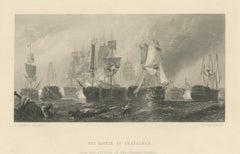
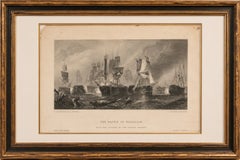
Original antique 19th-century steel engraving depicting the Battle of Trafalgar, the decisive British naval victory of 21 October 1805 during the Napoleonic Wars.
This dramatic maritime scene is after the painting by celebrated British marine artist Clarkson Frederick Stanfield, R.A. (1793–1867), and was engraved by John Cousen (1804–1880).
The inscriptions beneath the image read:
“C. STANFIELD, R.A. PAINTER.”
“J. COUSEN, ENGRAVER.”
“THE BATTLE OF TRAFALGAR.”
“FROM THE PICTURE IN THE VERNON GALLERY.”
The Battle of Trafalgar
Fought on 21 October 1805 off Cape Trafalgar on the southwestern coast of Spain, the Battle of Trafalgar was one of the most important naval engagements of the Napoleonic Wars.
The British Royal Navy, commanded by Vice-Admiral Horatio Nelson, confronted the combined French and Spanish fleet under Admiral Pierre-Charles Villeneuve.
Nelson employed an unconventional attack, dividing his fleet into columns that sailed directly into the Franco-Spanish battle line. The resulting close-range engagement ended in a decisive British victory and confirmed Britain’s command of the seas.
The battle became one of the defining events of British maritime history.
Admiral Horatio Nelson & HMS Victory
Vice-Admiral Horatio Nelson (1758–1805) commanded the British fleet from his famous flagship HMS Victory.
Shortly before the battle commenced, Nelson ordered the celebrated signal:
“England expects that every man will do his duty.”
During the fighting, Nelson was struck by a musket ball fired from the French ship Redoutable and was mortally wounded. He died aboard HMS Victory during the battle, having lived long enough to learn that victory was assured.
His death at the moment of triumph made Nelson a national hero and permanently linked his name with Trafalgar.
The Scene
Stanfield’s composition conveys the enormous scale, violence and confusion of a major naval engagement in the age of sail.
Ships-of-the-line crowd the horizon, their towering masts and rigging emerging through smoke, spray and the dramatic sky.
Several vessels are depicted fighting at extremely close quarters, recalling the devastating exchanges of cannon fire that characterized the battle.
In the foreground, broken spars, wreckage and sailors struggling in the turbulent sea emphasize the human consequences of the engagement.
The exceptionally wide composition gives the engraving an almost panoramic character and makes it particularly effective as a decorative maritime print.
Clarkson Frederick Stanfield, R.A. (1793–1867)
Clarkson Frederick Stanfield was one of the leading British marine painters of the 19th century.
Stanfield had first-hand experience of life at sea before establishing himself as an artist. His knowledge of ships, rigging, changing weather and the movement of the ocean contributed to the convincing maritime atmosphere for which his work became celebrated.
He was elected a Royal Academician and became particularly admired for his dramatic marine and historical paintings.
John Cousen (1804–1880)
The painting was translated into engraving by John Cousen, an accomplished English engraver known particularly for his landscape, architectural and marine subjects after important contemporary British artists.
His finely worked engraving preserves the dramatic tonal effects of Stanfield’s original painting, from the dark turbulent foreground water to the distant ships disappearing into smoke and atmospheric haze.
The Vernon Gallery
The original painting was part of the important collection assembled by British businessman and philanthropist Robert Vernon (1774–1849).
Vernon built an extensive collection devoted primarily to contemporary British art and presented his collection to the British nation in 1847.
The inscription “From the Picture in the Vernon Gallery” records the important provenance of Stanfield’s original composition.
Technique: Original antique steel engraving
Artist: Clarkson Frederick Stanfield, R.A. (1793–1867)
Engraver: John Cousen (1804–1880)
Title: The Battle of Trafalgar
Subject: Battle of Trafalgar
Date depicted: 21 October 1805
Historical figure: Vice-Admiral Horatio Nelson
British flagship: HMS Victory
Historical period: Napoleonic Wars
Origin: England
Publication date: 19th century
Style / Period: Victorian / 19th-century British maritime art
Condition:
Good antique condition with overall age-related toning, scattered spotting and foxing and minor staining. There is visible wear and some paper loss and irregularity to the outer edges and corners, particularly at the upper corners. Some minor handling marks and creasing are present, consistent with the age of the sheet.
The engraved image itself remains strong, detailed and visually impressive.
Please study the photographs carefully as they form part of the condition description.
Please note: This is an original antique 19th-century steel engraving, not a modern reproduction.
The print is sold unframed. Framed images or interior views, if shown, are for presentation and inspiration only.
Keywords: Battle of Trafalgar, Trafalgar 1805, Admiral Nelson, Horatio Nelson, Lord Nelson, HMS Victory, Royal Navy, British Navy, Napoleonic Wars, Napoleon, naval battle, naval warfare, British naval history, maritime history, military history, sailing ships, ships of the line, antique maritime print, antique naval engraving, Clarkson Stanfield, Clarkson Frederick Stanfield, John Cousen, Vernon Gallery, British marine art, Victorian engraving, steel engraving, original antique print, 19th century maritime art
Category
Mid-19th Century Victorian Antique European Prints