By John Opie
Located in Vancouver, British Columbia
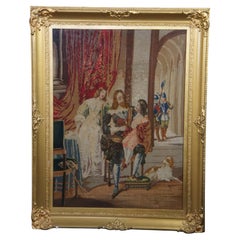
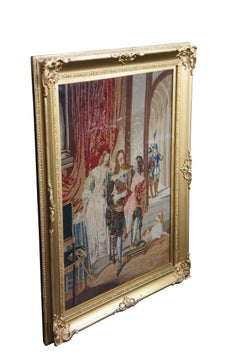
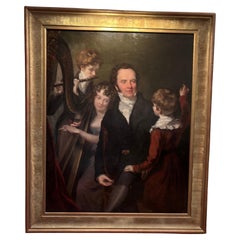
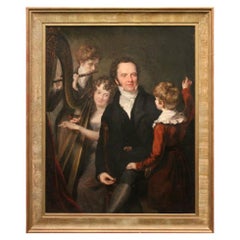
A large oil on canvas depicting a youthful father with his three children, two of which are behind him playing musical instruments, the daughter with her harp and son playing the flute. A third child with his back to the painter faces his father. The painting is presented in a carved and gilded wood frame. Like the great majority of Opie's work, this painting is not signed or stamped.
Opie lived at No 8 Berners Street where he moved in 1791, the street famous for artists, composers and instrument makers. Jacob Erat the famous harp maker lived in the neighbourhood and moved to 23 Berners Street before his death in 1821. This painting could be the painting referenced in John Jope Rogers, "Opie and his Work" Truro 1878, Page 220, entitled 'Musical Party'.
Provenance: Charles St. George Quechee, Vermont; New England Private Institution; Sotheby's New York April 7, 1989, Lot 1, as John Opie, Portrait of a Gentleman and his three children; Private collection Connecticut.
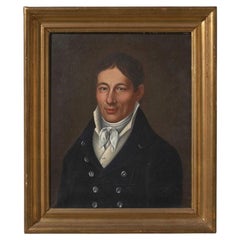
John Opie RA, (May 1761 – 1807), was a Cornish historical and portrait painter. He painted many great men and women of his day, including members of the British Royal Family, and others who were most notable in the artistic and literary professions. Opie's artistic abilities eventually came to the attention of a local physician and satirist, Dr John Wolcot (Peter Pindar). Recognising a great talent, Wolcot became Opie's mentor, buying him out of his apprenticeship and insisting that he come to live at his home in Truro. Wolcot provided invaluable encouragement, advice, tuition and practical help in the advancement of his early career, including obtaining many commissions for work.
In 1781, Opie moved to London with Wolcot, having entered into a formal profit-sharing agreement with him. Although Opie had received a considerable artistic education from Wolcot, the doctor chose to present him as a self-taught prodigy. A portrait of a boy shown at the Society of Artists the previous year had been described in the catalogue as "an instance of Genius, not having ever seen a picture." Wolcot introduced the "Cornish wonder" to leading artists, including Sir Joshua Reynolds, who was to compare him to Caravaggio and Velazquez, and to prospective patrons. The business arrangement with Wolcot lasted for a year after which Opie informed the doctor that he now wished to go it alone, leading to the estrangement of the two former partners.
Through the influence of a Mrs Boscawen, Wolcot managed to have Opie introduced at the court of King George III. The king purchased one of his pictures and commissioned him to produce a portrait of Mary Delany...
Category
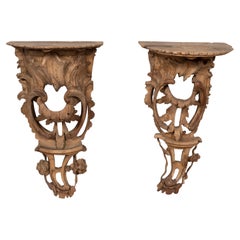
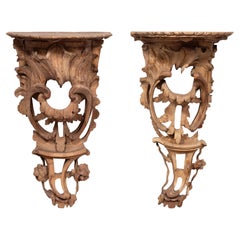
Late 18th Century British Antique George III Wall Decorations