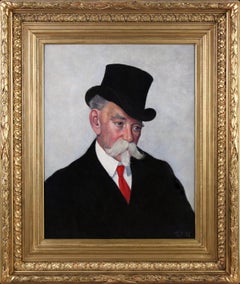
Walter Shirlaw
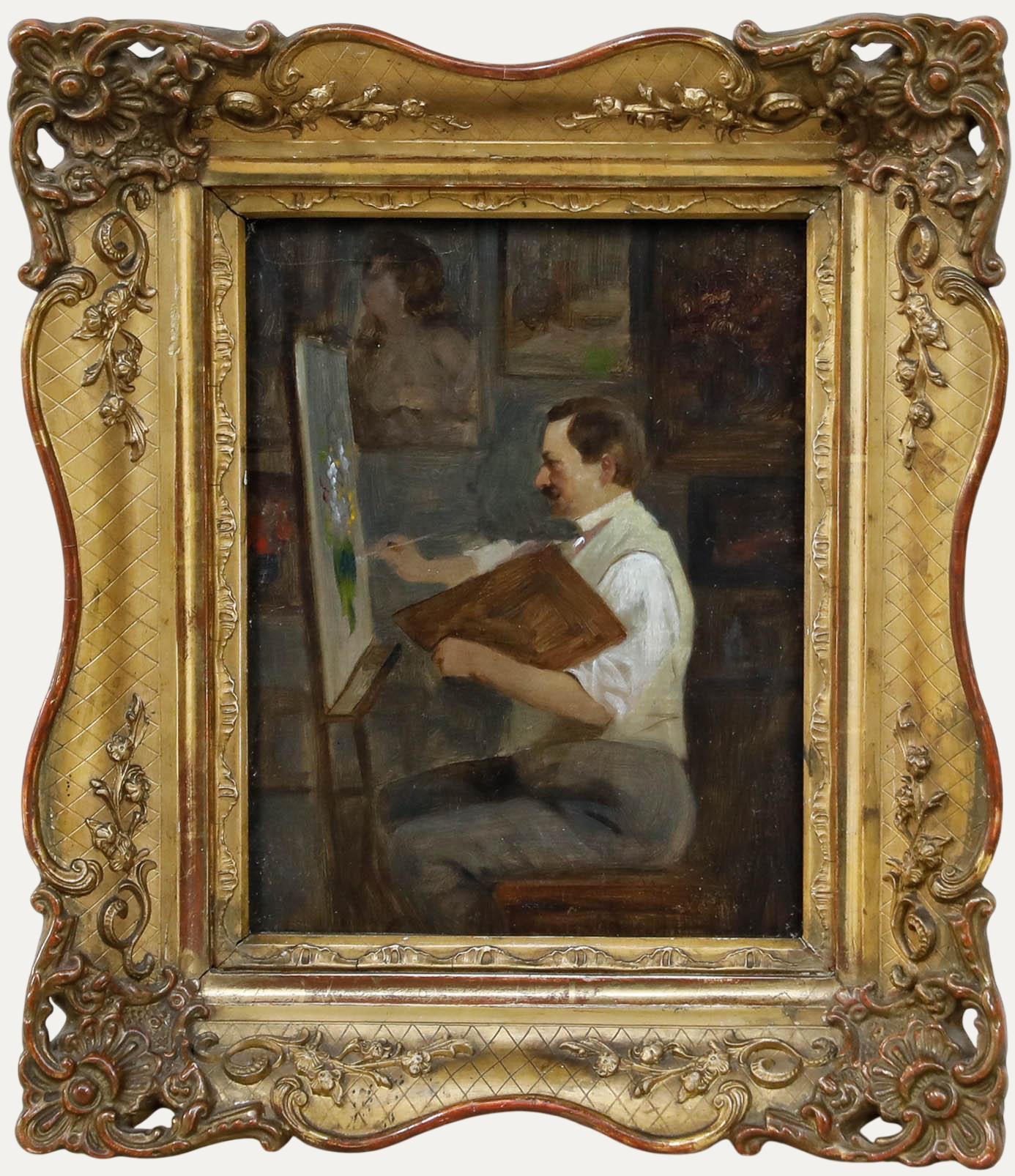
Walter Shirlaw, born in 1838, was only three when he came to Hoboken, New Jersey from Paisley, Scotland. As a young man, he found work as a bank note engraver, a profession that he continued in Chicago, where he lived between 1865 and 1870. But already in 1861 he was exhibiting genre paintings at the National Academy of Design. In 1868, Shirlaw was a member of the Chicago Academy of Design, which would become the Art Institute of Chicago, after changing its name from the Chicago Academy of Fine Arts. Shirlaw spent the years 1870-77 in Munich, at the height of the movement led by Wilhelm Leibl in which a low-keyed, dark palette, combined with bold, virtuoso brushwork, were applied to realist subject matter. Michael Quick defined the time of Shirlaw's arrival as an especially experimental period in progressive German painting. Shirlaw's teachers, however, sided with tradition. The genre painter Arthur Ramberg and Wilhelm von Lindenschmidt, his successor at the Munich Academy, taught Shirlaw composition. The painter of genre scenes and landscapes, Alexander von Wagner was Shirlaw's teacher in painting. T. H. Bartlett mentioned that Shirlaw regarded Leibl as too realistic. In 1877, the second school year of the Art Students League, Lemuel E. Wilmarth announced that he would be returning to teach at the NAD. Frank Waller took over as president of the ASL, and Shirlaw was hired to teach painting and drawing. The appointment was endorsed by Waller. The hiring of Shirlaw and William Merritt Chase seemed to signify a preference of Munich over Paris among the members of the Art Students League, however, while Chase was under Leibl's spell, Shirlaw was strictly academic. During the fourth season at the ASL, Shirlaw taught composition. Thomas Wilmer Dewing replaced Shirlaw in this position in 1880. Although an Associate of the National Academy of Design, Shirlaw resigned, explaining that the Academy was too much focused on exhibitions, at the expense of teaching. He turned to the Society of American Artists, a more liberal group founded in June of 1877. Shirlaw himself, Augustus Saint-Gaudens, and Wyatt Eaton were the artists-founders of the SAA. Within a year, there were twenty-two members. This new, mostly younger group of painters collectively expressed more liberal aesthetic tastes, compared to the less progressive members of the National Academy. Doll and Richards Gallery in Boston was the setting for Shirlaw's one-man exhibition in 1880. Meanwhile, he was active as an illustrator. The artist published drawings in Scribner's Monthly and Harper's Magazine, and did illustrations for various books. In 1889, Shirlaw visited Crow and Cheyenne reservations to illustrate scenes from the life of these tribes. He was also a muralist and a designer of stained-glass windows. He executed Sciences, a mural for the Library of Congress. Walter Shirlaw was an American artist who helped the younger painters promote French impressionism, by founding the Society of American Artists.