Want more images or videos?
Request additional images or videos from the seller.

St. Michaels Church , Workington

1896

$4,023.75
£2,975
€3,632.28
CA$5,737.85
A$5,883.20
CHF 3,352.03
MX$74,888.09
NOK 38,503.12
SEK 40,172.64
DKK 27,152.05

About the Item

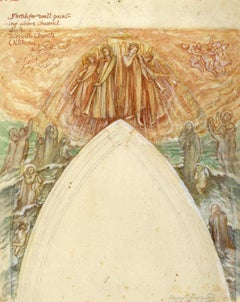
Saint Michaels Church, Workington, Cumbria , England. This picture is the design for a window which was dedicated to a long serving and much loved choirmaster by the name of George Suart who upon his death in 1896 the congregation generously donated funds for the design and production of this window. Saint Michaels Church, which the earliest part of dates from 1150 AD, is almost certainly built on the earlier site of a 7th Century Monastery. There is a competent history of the church and it's earlier buildings on the same site including interesting confirmations of evidence of a nearby Viking settlement and the Monks from Lindisfarne present on the site from the 11th Century, all available on Wikipedia and local research informants. A large section of the church was destroyed by fire in 1887 and this window was designed and installed thereafter. However another fire in 1994 resulted in the window being lost in the further incident, the design had been lost and now resurrected which will enable the parishioners to reconstruct the window as it was first designed. A happy ending for the church warden and congregation. A good number of people have been engaged in following up the biography of this watercolor, including the great great granddaughter of the choirmaster, and professional researchers engaged by us, Unfortunately the drawing which is very accomplished still has not had the artist identified as yet, however should we discover as such the buyer will most certainly be informed. This picture is in the manner of R.A.Bell it is unsigned and consequently the artist is unknown. I have included a short history of the church for your interest. St Michael's Church in Workington, Cumbria, stands on a site with Christian roots dating back to a 7th-century monastery. The first stone church was erected around 1150. It featured a fortified Norman tower built for both worship and protection during border skirmishes. Aside from this original medieval tower base, the building was largely rebuilt in 1770. Fire Damages & Disaster struck in January 1887 when a massive fire destroyed most of the Georgian structure. The community rebuilt the church within three years. However, the most devastating blow occurred on the night of 28 September 1994. A fire started during a burglary completely gutted the church. The catastrophic blaze left only the outer Victorian walls and the ancient tower standing. The entire interior was destroyed. This included irreplaceable historic artifacts, all but one stained-glass window, and the church's handbells. The disaster forced the church to close for seven years. During this time, the Carlisle Archaeological Unit excavated the site, uncovering the original medieval ground plan. Townsfolk and local organizations rallied together to fund an extensive £2.5 million restoration project. Architects preserved the surviving 1880s exterior shell while completely reimagining the inside. The interior was transformed into a bright, flexible space for the 21st century. It was outfitted with contemporary stained glass, modern furnishings, and new community facilities. St Michael's officially reopened and was rededicated in February 2001, standing today as a symbol of community resilience. Finding this original watercolour / drawing for the main window is a profound discovery. When the devastating 1994 fire gutted St Michael’s Church, the loss of the historic stained glass was probably one of the most heartbreaking consequences. For decades, the exact, intricate layout of what has been lost lived only in the hazy memories of old photographs. Discovering the original architectural window plans completely changes that. It provides an authentic, line-by-line look into the craftsmanship of the pre-1994 church. This bridges the gap between the lost 19th-century Neo-Gothic restoration and the modern, light-filled space that exists today. This discovery offers immense emotional and practical value. If the church ever wishes to physically recreate a historical element or feature a precise replica layout within the modern building, this drawing / watercolour provides the literal blueprint to do so accurately. For a town that rallied so fiercely to raise £2.5 million to rebuild from the ashes, finding this feels like reclaiming a piece of the church’s soul that was thought to be lost forever.
  • Creation Year:
    1896
  • Dimensions:
    Height: 17.25 in (43.82 cm)Width: 12 in (30.48 cm)Depth: 1 in (2.54 cm)
  • Medium:
  • Circle Of:
    Robert Anning Bell (1863 - 1933, British)
  • Period:
  • Condition:
  • Gallery Location:
    Douglas, GB
  • Reference Number:
    Seller: No. 3161stDibs: LU2373215884712

More From This Seller

View All
St. John's Church Wapping

St. John's Church Wapping

Located in Douglas, Isle of Man

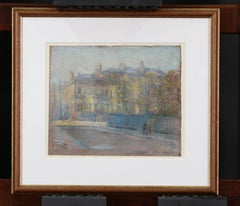
Rose Louise Henriques, Lady Henriques C.B.E. 1889-1972, was an English born artist , social and charity worker in the East End of London where she lived and worked for her entire life. She was posthumously recognised as a British hero of the Holocaust. She drew and painted scenes from the WWII bombing in London's East End, during WWI she worked as a nurse again in London. This painting shows the remains of the bombed building of St. John's church in Wapping which is opposite the park, the picture is representative of the area in the East End which suffered huge damage during the Blitz and the calm manner in which the local population carried on about their daily toil without fuss and distress, typical of the stiff upper lip known throughout the British Isles. The picture is signed and also inscribed on the reverse. I have included an alternative biography of the artist for your information. Lady Rose Louise Henriques (née Loewe; 17 August 1889 – 1972) was a prolific British artist, social activist, and philanthropist who dedicated her life to the communities of London’s Jewish East End. Alongside her prominent charitable projects, she produced an expansive visual record documenting the area’s street life, cultural transitions, and wartime trauma. Posthumously, her courageous welfare work during World War II and at the liberation of Bergen-Belsen earned her recognition as a British Hero of the Holocaust. Born in Stoke Newington, London, to an Orthodox Jewish family. Her father, James Henry Loewe, was a scholar and communal worker. At age 16, she moved to Breslau (now Wrocław) to study as a classical pianist. She returned home at the outbreak of World War I, shifting her life's direction toward communal service. In 1916, she married Jewish reformist Basil Henriques, forming a lifelong partnership in social welfare. Together with her husband, Rose became a pillars of East End social reform, earning her the affectionate nickname "The Missus" among local youth. In 1915, Rose founded a Jewish girls' club in Stepney to parallel the boys' club her husband had established. In 1919, they founded the St George's Jewish Settlement in Betts Street. It expanded into Berner Street in 1929, funded by Bernhard Baron. The settlement offered youth clubs, washrooms, and community services. It crucially served both Jewish and non-Jewish residents alike. In 1954, Rose founded the Workrooms for the Elderly in East London to support aging residents. Rose demonstrated immense bravery during periods of major global conflict, balancing direct emergency response with her community work. She served as a Red Cross nurse stationed...

Category

1940s Landscape Paintings

Materials

Oil, Board

collection of 8 pencil signed etchings of various locations.

collection of 8 pencil signed etchings of various locations.

By William Walcot R. E. Hon. R. I. B. A.

Located in Douglas, Isle of Man

William Walcot 1874 - 1943, was one of the most celebrated architectural draughtsmen and printmakers working in England between the two World Wars. Known as "the architects' etcher,"...

Category

Early 20th Century Landscape Prints

Materials

Paper, Printer's Ink, Pencil, Etching

Eltham, London

Eltham, London

By Francis Dodd

Located in Douglas, Isle of Man

Francis Dodd R.A. 1874-1949, was an English landscape and portrait painter, draftsman and etcher. He attended the Glasgow School of Art and travelled through Europe, France, Italy an...

Category

1930s Landscape Paintings

Materials

Paper, Watercolor

Manchester

Manchester

By Francis Dodd

Located in Douglas, Isle of Man

Francis Dodd R.A. 1874-1949, was an English landscape and portrait painter, draughtsman and etcher. He attended the Glasgow School of Art and travelled throughout Europe, France, Ita...

Category

1890s Landscape Paintings

Materials

Paper, Pastel

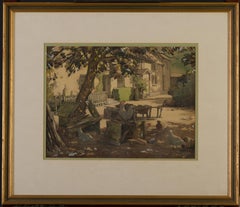
Summer shade, 1935. Muriel Cooke, pioneer for the Guide Dogs for the Blind

Summer shade, 1935. Muriel Cooke, pioneer for the Guide Dogs for the Blind

Located in Douglas, Isle of Man

Muriel Elise Cooke, ( Crooke ) 1901 - 1975, was an English artist who painted in watercolour and oil, she was also an engraver Cooke studied in Paris, France and in her twenties exh...

Category

1930s Landscape Drawings and Watercolors

Materials

Paper, Watercolor

You May Also Like

St. Alban's Abbey Church, High Altar screen /// Robert Clutterbuck Hertford Art

St. Alban's Abbey Church, High Altar screen /// Robert Clutterbuck Hertford Art

Located in Saint Augustine, FL

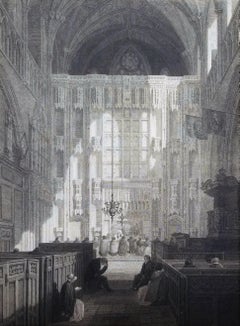
Artist: Robert Clutterbuck (English, 1772-1831) Title: "St. Alban's Abbey Church, High Altar screen" (Vol. 1, Plate 65) Portfolio: The History and Antiquities of the County of Hertford Year: 1815-1827 (First edition) Medium: Original Engraving on wove paper Limited edition: Unknown Printer: Nichols, Son, and Bentley, London, UK Publisher: Nichols, Son, and Bentley, London, UK Sheet size: 17.63" x 11.38" Image size: 11.57" x 8.57" Reference: Brunet II, No. 112; Lowndes No. 483; BAL RIBA No. 666; Upcott I, page 623 Condition: Scattered foxing throughout sheet; it doesn't show much within the image. Creasing to upper left and right corners. Has been professionally stored away for decades. It is otherwise a strong impression in good condition Notes: Provenance: private collection - Aspen, CO. Engraved by English artist John Henry Le Keux (1812-1896) after a drawing by English artist Frederick Nash (1782-1856). Comes from Clutterbuck's three volume "The History and Antiquities of the County of Hertford", (1815-1827) (First edition), which consists of 54 engravings. Printed from one copper plate on one color: black. "Vol. I. p. 65" printed upper right in margin. "Proof" printed lower right in margin. St Albans Cathedral, officially the Cathedral and Abbey Church of St Alban, also known as "the Abbey", is a Church of England cathedral...

Category

1810s Old Masters Interior Prints

Materials

Engraving, Intaglio

Church interior sketch

Church interior sketch

By Guglielmo Innocenti

Located in Genève, GE

Work on paper Support size 20 x 15 x 0.4 cm

Category

20th Century Italian School Still-life Drawings and Watercolors

Materials

Crayon, Paper

St Mary’s Church, Penwortham, Watercolour Stained Glass Window Design, Jane Gray

St Mary’s Church, Penwortham, Watercolour Stained Glass Window Design, Jane Gray

By Jane Gray

Located in London, GB

We acquired a series of watercolour stained glass designs from Jane Gray's studio. To find more scroll down to "More from this Seller" and below it click on "See all from this seller...

Category

Late 20th Century Modern Drawings and Watercolor Paintings

Materials

Watercolor

Early 20th Century English Oil Painting of a Chapel by Frank Moss Bennett

Early 20th Century English Oil Painting of a Chapel by Frank Moss Bennett

By Frank Moss Bennett

Located in London, GB

Early 20th century English oil painting of a chapel by Frank Moss Bennett English, 1918 Canvas: Height 35cm, width 25cm Frame: Height 57cm, width 47cm, depth 6cm This atmospheric oil on canvas by noted English painter Frank Moss Bennett (1874–1952) captures the quiet beauty of the Martyn Chapel within St Mary’s Church, Puddletown, Dorset. Known for his affinity for architectural subjects and historical scenes, Bennett presents here a masterful interpretation of medieval ecclesiastical design. Executed in November 1918, the painting demonstrates Bennett’s refined technique and keen eye for architectural accuracy. His skill in manipulating colour and light is evident throughout the work, particularly in the vivid portrayal of the chapel’s stained-glass window. Multicoloured light dances across the aged stonework, adding warmth and depth to the sacred interior. St Mary’s Church, originally built during the Norman period, retains many 12th century features alongside elements from later restorations. Bennett was deeply inspired by Dorset’s heritage buildings and natural scenery, and this location featured frequently in his body of work. The canvas is presented in a richly carved giltwood frame. It is signed and dated ‘FMB / Nov 1918’ at the lower right and inscribed on the reverse with the title ‘The Martyn Chapel, St. Mary’s, Puddletown’. An artist’s biography is also affixed to the back. This fine example of early 20th century British painting...

Category

Early 20th Century Interior Paintings

Materials

Canvas, Oil