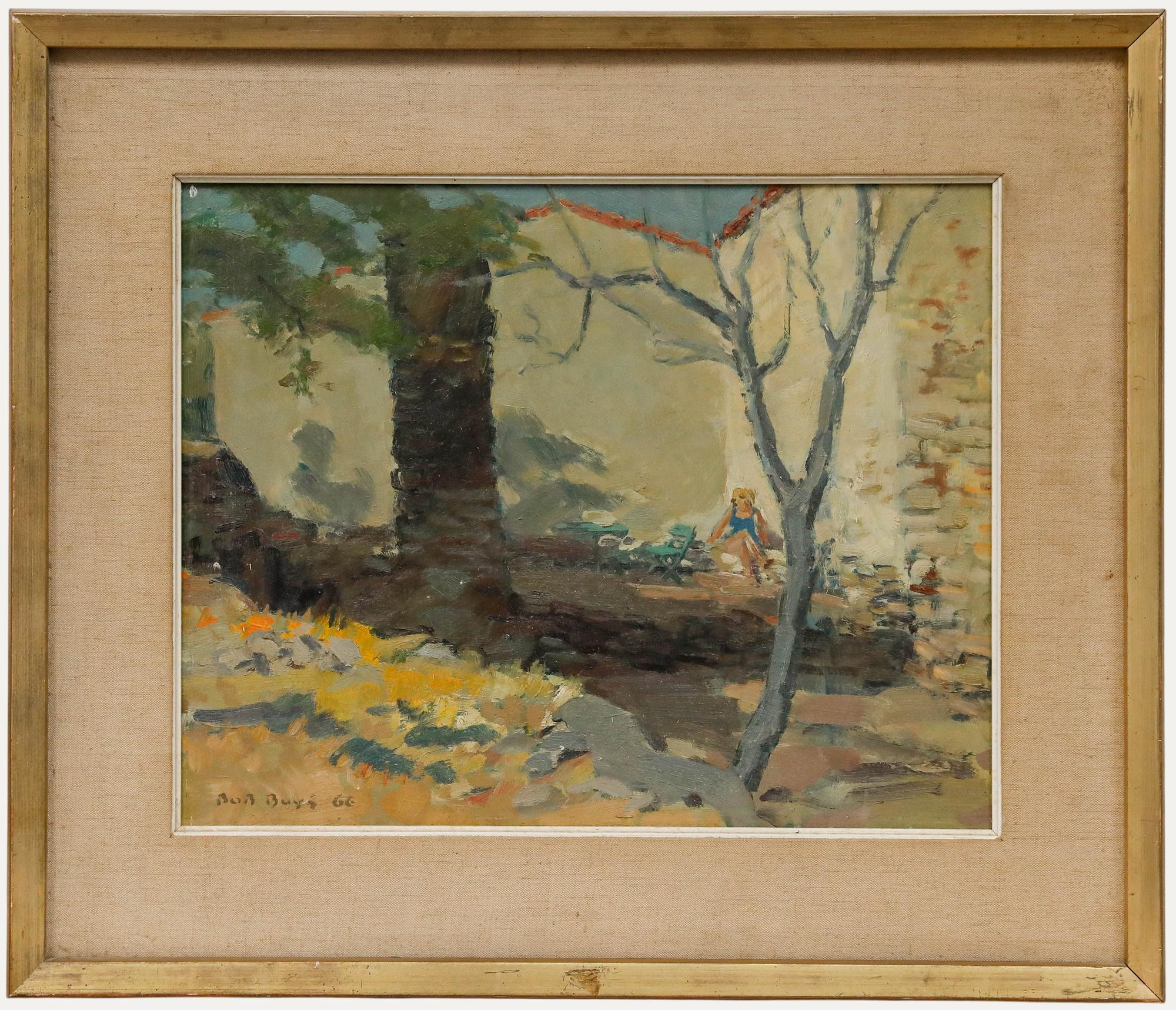
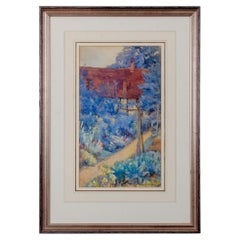
Muriel Elise Cooke, ( Crooke ) 1901 - 1975, was an English artist who painted in watercolour and oil, she was also an engraver Cooke studied in Paris, France and in her twenties exhibited at the Royall Academy, the Royal Scottish Academy, the Royal Society of Art, the Royal Hibernian Association, the Royal West of England Academy and also in Paris at the Salon des Artistes. She was an animalier and landscape painter as seen in this depiction of a farmyard at the height of summer, her application of light and shade shows a competence of the gradation of light which to some artists is a mystery and remains undeveloped in some cases throughout their career, but not in the case of Muriel Cooke. There is a mastery light and shade which makes the whole picture a pleasure and reinstates Cooke's ability above that of some of her contemporaries. A somewhat underrated artist during her career but this picture displays a command of her talent. She was also the pioneer founder of The Guide Dogs for the Blind.
Here is an alternative biography for your interest :-
Muriel Elise Crooke (frequently catalogued as Muriel Cooke) was an accomplished 20th-century British painter, engraver, and animalier. While highly regarded for her mastery of light, landscapes, and animal portraiture, she achieved her greatest historical legacy outside the canvas as the co-founder of the UK's very first guide dog training program. Muriel Elise Crooke was born in 1901 in Egremont, Merseyside. By 1911, her family was residing at Warren Drive in Wallasey, Cheshire. Gifted with early artistic talent, Crooke traveled abroad to study fine art in Paris, France. She worked primarily in watercolours and oils, but was also a skilled engraver. Crooke was a highly competent landscape and animal painter (animalier). Art critics have noted her sophisticated mastery of light and shade—specifically her command over the soft gradation of natural sunlight, which separated her work from many of her contemporaries. During her twenties and thirties, she actively exhibited her work at premier European and British art institutions, The Royal Academy (London)The Royal Scottish Academy, The Royal Hibernian Association, The Royal West of England Academy, The Salon des Artistes (Paris) . Her works today often appear at auction under both her birth name (Crooke) and the alternate spelling (Cooke). A collection of her oil paintings and sketches—largely focusing on animals such as dogs, bulls, and horses—is permanently preserved in the Williamson Art Gallery & Museum on the Wirral. Though she was a dedicated artist, Crooke's life took a monumental turn in the early 1930s due to her passion for breeding German Shepherds. Crooke became fascinated by overseas experiments training dogs to assist veterans blinded by poison gas in World War I. In 1931, Crooke teamed up with fellow dog breeder Rosamund Bond. Together, they operated out of a modest, lock-up garage in Wallasey, Merseyside. They successfully trained the UK’s first four guide dogs: Flash, Folly, Meta, and Judy. These German Shepherds were officially paired with blind veterans in 1931. The immense success of Crooke and Bond's volunteer operation led directly to the official founding of The Guide Dogs for the Blind Association in 1934—an organization that still transforms thousands of lives today. Muriel Crooke lived a quiet later life, blending her twin passions of animal welfare and fine art. She passed away in 1975 at the age of 74. Her historical impact is immortalized on the Wirral peninsula, where she is celebrated both in museum galleries and via large public street art murals honoring her and Rosamund Bond as national pioneers.