Want more images or videos?
Request additional images or videos from the seller.

Urban Village Landscape with trees and figures.

1929

$6,424.47
£4,750
€5,799.44
CA$9,161.27
A$9,393.34
CHF 5,351.99
MX$119,569.23
NOK 61,475.58
SEK 64,141.19
DKK 43,352.02

About the Item

This picture is sold as ' circle of ' Xul Solar. This captivating, whimsical work presents a densely clustered hillside town executed in the artist’s signature avant-garde, neo-primitive style. The upper two-thirds of the composition features a labyrinthine village of tightly overlapping, geometric houses. The structures are rendered in an earthly yet varied palette of muted browns, ochres, greens, and soft pinks, punctuated by tiny windows, pitched roofs, and chimney stacks. The buildings are outlined with delicate, expressive ink lines that lend the structures an organic, almost breathing quality. In the foreground, a expansive grassy meadow or public square slopes toward the viewer. Scattered across the field are stylized, simplified human figures wearing dark coats and brimmed hats, walking in small groups or pairs. The fluid, transparent watercolor washes and gestural pencil markings capture a sense of quiet community life, while a few minimalist birds soar in the sky above. This picture is signed and dated 1929. I have included a biography of the artist Xul Solar. Alejandro Xul Solar (born Oscar Agustín Alejandro Schulz Solari) was an Argentine painter, sculptor, writer, and inventor. He was one of the most enigmatic figures of the 20th-century Latin American avant-garde. His close friend, the legendary author Jorge Luis Borges, famously called him "a man capable of spaces" and "one of the most singular events of our era". Xul Solar did not just paint worlds; he spent his entire life inventing them. He combined a unique vocabulary of spiritualism, linguistics, and mathematical architecture into a highly idiosyncratic visual style. Born on December 14, 1887, in San Fernando, Buenos Aires Province. His father was a Baltic German immigrant from Latvia, and his mother was Italian. He initially studied music and spent two years studying architecture at the University of Buenos Aires. He dropped out to pursue broader intellectual interests. In 1912, he boarded a freight ship to work his way to Europe, where he stayed for twelve years traveling through England, France, Germany, and Italy. In 1916, he officially adopted the pseudonym Xul Solar. "Solar" honored his mother’s surname, while "Xul" reversed the Latin word lux (light)—meaning "Light of the Sun". While traveling Europe during World War I, he was heavily influenced by German Expressionism, Paul Klee, and the Italian Futurists. He also grew deeply connected to esoteric thought, mysticism, and astrology. Xul Solar returned to Buenos Aires in 1924. He quickly integrated into the radical Martín Fierro group (also known as the Florida group), an intellectual movement looking to throw out conservative academicism. His paintings from the 1920s to the 1940s became iconic. Rather than working on massive canvases, Solar preferred painting detailed, jewel-like watercolors and tempera on small cardboards. His artwork from this period frequently depicts pre-Columbian step pyramids mixed with floating geometric cities, mechanical flying vessels, and celestial staircases (Vuel Villa, 1936). Flag-waving structures, numeric codes, astrological glyphs, and religious references spanning Kabbalah, Buddhism, and Egyptian mythology. Xul Solar rejected the label of just being a painter; he viewed himself as a multi-disciplinary cosmic thinker. He invented Neo-Criollo, a poetic fusion of Spanish and Portuguese designed to unite Latin America. He also built Pan-Lingua, a universal language based entirely on mathematics, astrology, and musical tones. He fundamentally modified traditional chess into a three-dimensional game played on a modified board. Moves did not just serve a strategic role; they also corresponded to vowels, consonants, and astrological elements, allowing players to compose poetry while playing. He re-engineered traditional acoustic pianos, altering the keys and adding rows of color-coded keys to bridge the gap between sound and visual palette. In his twilight years, Xul Solar moved away from bright, crowded utopias. His work shifted to a series of monochrome drawings and calligraphic landscapes called Grafías (scriptures). He moved to a peaceful house in the riverside town of Tigre, Argentina, where he spent his time calculating astrological charts and translating texts. In 1962, a year before his death, he enjoyed a major triumphant retrospective exhibition at the Musée National d'Art Moderne in Paris. He passed away on April 9, 1963, at the age of 75. Today, his home studio in Buenos Aires serves as the Fundación Pan Klub (Museo Xul Solar), which preserves his artwork, personal library, custom chessboards, and modified pianos. His work continues to be celebrated globally as a unique, fantastical bridge between European modernism and Latin American magical realism.
  • Creation Year:
    1929
  • Dimensions:
    Height: 16 in (40.64 cm)Width: 15 in (38.1 cm)Depth: 1 in (2.54 cm)
  • Medium:
  • Circle Of:
    Xul Solar (1887 - 1963, Argentinian)
  • Period:
  • Condition:
  • Gallery Location:
    Douglas, GB
  • Reference Number:
    Seller: No. 2731stDibs: LU2373218226282

More From This Seller

View All
Pond Farm

Pond Farm

Located in Douglas, Isle of Man

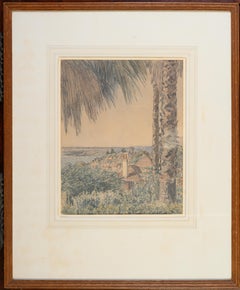
Bernard Sleigh 1872-1954, was an English mural and stained glass painter, illustrator, and landscape painter. He was best known for his fairyland pictures and was inspired by Willi...

Category

Early 20th Century Landscape Drawings and Watercolors

Materials

Paper, Watercolor

Potts Point Sydney Australia

Potts Point Sydney Australia

Located in Douglas, Isle of Man

Sydney Ure Smith O.B.E. 1887-1949, was an English born Australian Arts publisher and part time painter, but did not exhibit his own works. He studied pencil and ink drawing at the A...

Category

1930s Landscape Drawings and Watercolors

Materials

Paper, Watercolor

Mountainous Landscape

Mountainous Landscape

Located in Douglas, Isle of Man

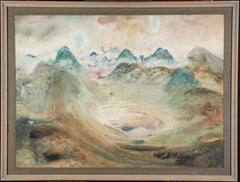
Raymond James Coxon 1896-1997, was an English landscape and portrait painter, he was a war artist during the second World war after which his works became more abstract. He studied a...

Category

Mid-20th Century Landscape Drawings and Watercolors

Materials

Paper, Watercolor

View of a Dutch Harbour, possibly imaginary

View of a Dutch Harbour, possibly imaginary

Located in Douglas, Isle of Man

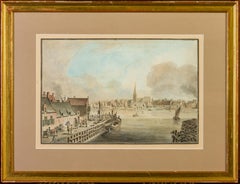
19th Century watercolour, Dutch view, unsigned. The picture is in ink and watercolour and displays the view of a Harbour with a distant town in the background which at this point i...

Category

Mid-19th Century Landscape Drawings and Watercolors

Materials

Paper, Watercolor, Ink

Idyllic Landscape

Idyllic Landscape

Located in Douglas, Isle of Man

In the manner of Jean-Francoise Milet, 1814-1875, who was a French artist, and one of the founders of the Barbizon School of painters. Milet influenced a great many painters through...

Category

Late 20th Century Landscape Paintings

Materials

Canvas, Oil

Garden

Garden

By David Gentleman

Located in Douglas, Isle of Man

David Gentleman 1930- R.D.I. , is an English artist born in London, attended Royal College of Art. His works frequently compose of London urban landscapes and this picture seems...

Category

1960s Landscape Paintings

Materials

Watercolor, Paper

You May Also Like

Urban Landscape - Original Drawing - Mid 20th Century

Urban Landscape - Original Drawing - Mid 20th Century

Located in Roma, IT

Urban Landscape is an original drawing in Black Marker realized in the mid-20th Century by an unknown artist. Good Conditions. The artwork is depicted through soft strokes in a wel...

Category

Mid-20th Century Modern Figurative Drawings and Watercolors

Materials

Permanent Marker

Landscape - Original Drawing - Mid 20th Century

Landscape - Original Drawing - Mid 20th Century

Located in Roma, IT

Composition is an original drawing in pen realized in the mid-20th Century by an anonymous Artist. Good Conditions. The artwork is depicted through soft strokes in a well-balanced ...

Category

Mid-20th Century Modern Figurative Drawings and Watercolors

Materials

Pen

Landscape - Original Drawing - Mid 20th Century

Landscape - Original Drawing - Mid 20th Century

Located in Roma, IT

Landscape is an original drawing in Black Marker realized in the mid-20th Century by an unknown artist. Good Conditions except for fo some folding and cut-away. The artwork is depi...

Category

Mid-20th Century Modern Figurative Drawings and Watercolors

Materials

Permanent Marker

Landscape with Trees - Original Drawing - 1950s

Landscape with Trees - Original Drawing - 1950s

Located in Roma, IT

Landscape with trees is an original china ink drawing realized by Unknown Artist in 1950s. The artwork represent a beautiful landscape. Good condition, so signature, mounted on a w...

Category

1950s Modern Figurative Drawings and Watercolors

Materials

Ink

Village by a Road

Village by a Road

Located in San Francisco, CA

This artwork titled "Village by a Road" c 1940 is a watercolor on paper by noted artist Donald Jeffries Bear 1905-1952. It is signed in pencil at the lower right corner by the artist. The artwork size is 10.65 x 14.5 inches, framed size is 17 x 21 inches. Framed in original frame. The artwork is in good condition, paper is toned by time, the four extreme corners are slightly discolored by hanging tape. The frame is also in good condition with minor dents, the linen is slightly discolored by time. The item is over all in good condition. About the artist. Donald Jeffries Bear, the Santa Barbara Museum of Art's founding director from 1940 to 1952, was born on this day, February 5, 1905, in Terre Haute, Indiana. He previously served as the Director of the Denver Art Museum (1935-1940), regional advisor for the Federal Art Project (1935-38), and as principal of the World's Fair in New York (1938-39). While director of the SBMA, Bear served as president of the Western Association of Art Directors from 1943 to 1946. He was also an art critic and, last but not least, an artist. Bear was well travelled, spoke numerous foreign languages, and as a Renaissance man, he was a singular match for another local polymath, Wright S. Ludington. In addition to his duties as director, Bear was also the curator and was responsible for producing over 600 exhibitions during his tenure. The exhibitions were as remarkable for their quality as well as their quantity, including SBMA's inaugural exhibition, Painting Today and Yesterday in the United States (June 5―September 1, 1941), which featured pieces from George Bellows, Mary Cassatt, Robert Harnett, Childe Hassam, Robert Henri, Winslow Homer, Edward Hopper, Yasuo Kuniyoshi, Georgia O'Keefe, and numerous others. Perhaps most remarkably, the SBMA displayed two of the most influential paintings of the 20th century, Pablo Picasso’s Guernica (1937) and Marcel Duchamp’s revolutionary Nude Descending a Staircase, No. 2 (1912) as part of the “Free France” exhibition in 1942. He was also responsible for producing numerous solo artist exhibitions, many of which were the first of their careers, including: William Dole, Clarence Hinkle...

Category

Mid-20th Century Impressionist Landscape Drawings and Watercolors

Materials

Watercolor

Landscape with Figures in the English Countryside

Landscape with Figures in the English Countryside

Located in Fairlawn, OH

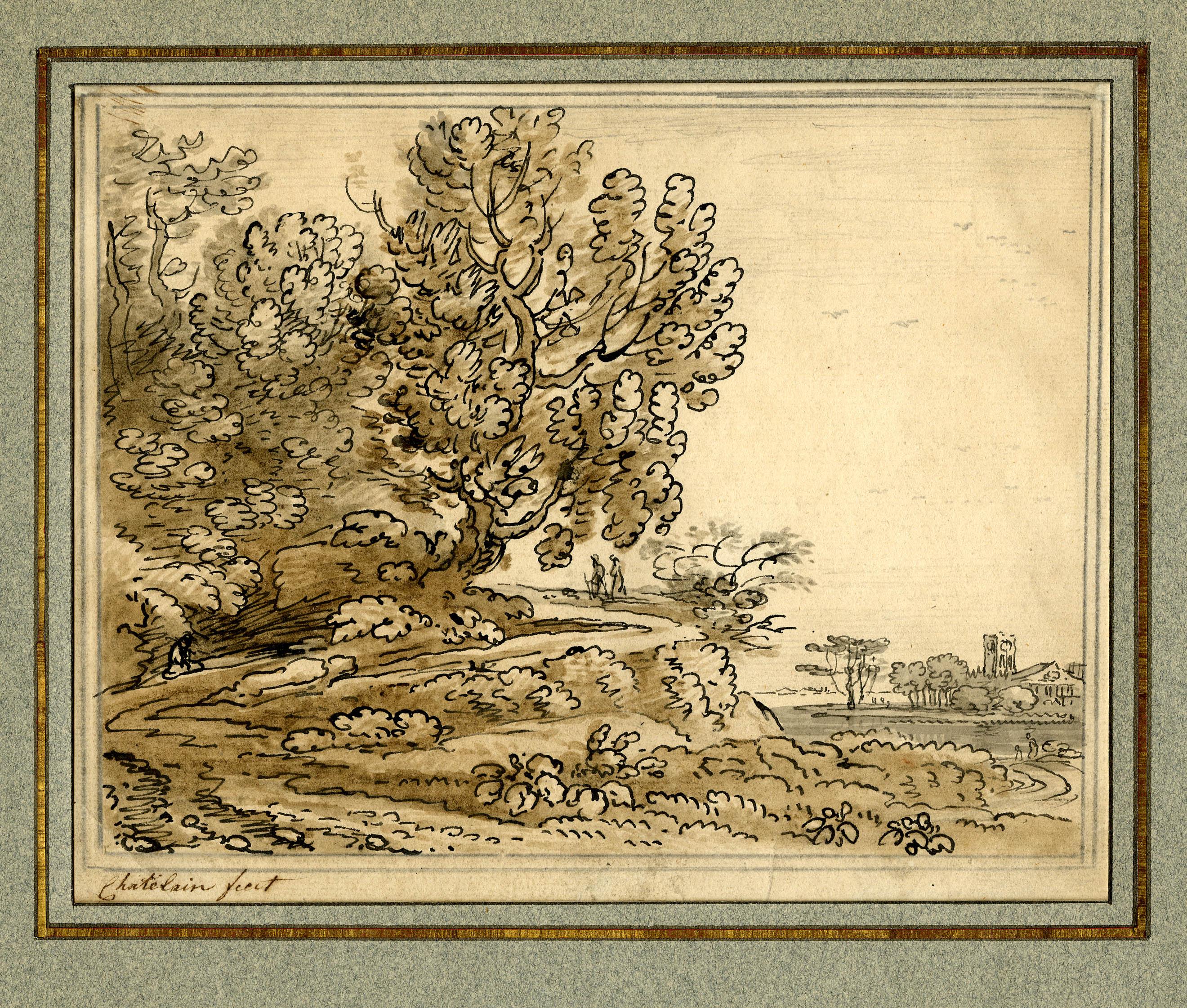
Landscape with Figures in the English Countryside Pen, ink and graphite with gray and brown washes on laid watermarked paper, c. 1740 Signed by the artist lower left of image: "Chate...

Category

1740s Romantic Landscape Drawings and Watercolors

Materials

Ink