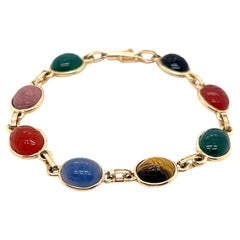
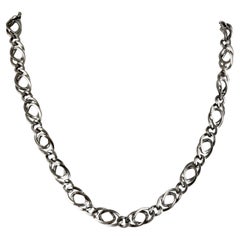
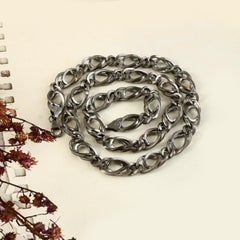
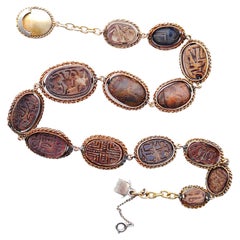
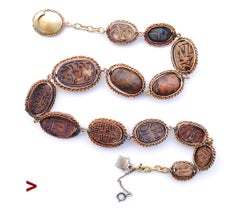
This a unique opportunity to buy an extremely rare and strikingly unusual antique necklace, a fine example of Egyptian Revival jewelry composed of 14 genuine ca.1786 -1567 BC ancient Hyksos Egyptian / Middle Eastern Soapstone or Steatite Scarabs assembled /swivel set into solid 18K Yellow Gold frame between ca. 1800s- 1850s somewhere in Europe. All scarabs can be rotated around the axes. Each golden bezel was individually made to fit the specific dimensions of each beetle. The V-lock part and the security chain are made of Silver.
The length of the necklace is 37.5 cm / it's a chocker. To make it longer you will need to replace or extend the existing 18K Gold chains for longer ones.
Weight of the piece: 51 grams / of which about a half is a weight of 18K Gold metal parts.
Condition is fine used / as found - I didn't try to clean it. It seems that the scarabs are covered with tinted beeswax-like substance. All parts are securely set /attached to each- other. Ready to be used again.
Most of these or likely all of these beetles date approximately to the period called the Second Intermediate Period of Egypt ca.1650 -1550 BC when Ancient Egypt fell into disarray for a second time, between the end of the Middle Kingdom and the start of the New Kingdom. It is best known as the period when the Hyksos made their appearance in Egypt and whose reign comprised the Fifteenth dynasty.
These scarabs are Made of Steatite - a very unusual natural mineral that initially is rather soft ( Mohs hardness 1 ) and easy to carve on but it undergoes transformations when heated to temperatures of 1000–1200 °C turning into Enstatite and Cristobalite; in the Mohs scale, this corresponds to an increase in hardness from initial Mohs hardness 1 > to Mohs hardness level 5.5–6.5 and that makes it a very suitable material for making jewelry like these scarabs. This future of Steatite was known to ancients and they used this material in its initial naturally softer state to carve and shape the way they wanted to and would burn it in the oven when ready making it much harder. The scarabs would often undergo second heating to apply enamels of various colors or were painted with certain long-lasting natural dies - some beetles show reddish glaze or paint still present (note N. 9 and 10) , and two are black colored (N.3 and 11). Once these scarabs were a common form of "charm" which everyone could afford and easily wear strung on a cord on their person. Most scarabs were made for the living, both rich and the poor. The small magical object was believed imbued with particular protective powers that warded off evil and provided good things for the owner for this life and also for the next, particularly when sewn to mummy wrappings.
All scarabs in this set are one-of-a-kind genuine ancient pieces. All bottoms are flat and demonstrate the decorations - cartouches typical for Egyptian iconography that demonstrate the extraordinary skills of ancient carvers.
N1 : 15mm long,top part grinned off and mounted into the golden lock casing, showing great detailed carving of a goat or an antelope - very common Hyksos design.
N2 : 14 mm long, carved design of a hawk and two uraeii /cobras
N3 : 13 mm long, two "ankh" hieroglyphics representing life and swirled decor in the center, very typical Hyksos design
N4 : 16 mm long, carved design of a Goddess, likely Anubis, and a figure of a Dead in front of him.
N5 : 16 mm long, 11 deep-groove concentric circles with remnants of dark-colored enamel still visible, very typical Hyksos design
N6 : 18.5 mm long with the body of the scarab nicely carved and engraved with spiral scrolls, a very typical Hyksos design.
N7 : 22 mm long, three figures, one knelled
N8 : 18 mm long, a figure of a sitting pharaoh
N9 : 18 mm long, two "ankh" hieroglyphics representing life with probably the name of a pharaoh in between.
N10 : 18 mm long, body of the scarab nicely carved, cross-seal design on the other side.
N11 : 16 mm long, black, unknown design
N12 : 15 mm long. Very unusual piece I could not find any reference to any similar - there are three small scarabs in the shape of one (Egyptians divided...
Category
15th Century and Earlier Egyptian Antique Revival Jewelry