532 results for "sol lewitt"

to
34
493
34
195
137
203
189
121
167
74
93
75
123
Overall Height
to
Overall Width
to
218
130
37
16
13
5
2
1
1
1
22
15
14
13
12
11
10
9
7
7
6
6
5
5
5
5
5
5
4
4
242
290
3
4
26
37
83
60
149
53
42
36
12
155
135
134
134
90
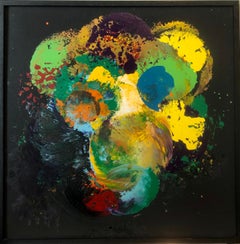
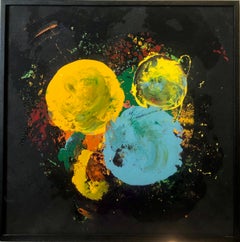
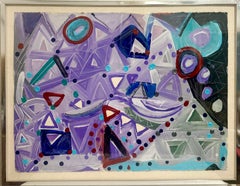
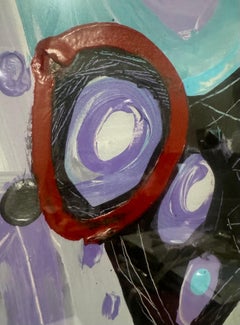
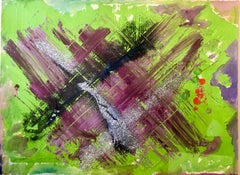
Charles Clough Picture Generation Abstract Expressionist Oil Enamel Painting

Charles Clough Picture Generation Abstract Expressionist Oil Enamel Painting

By Charles Clough

Located in Surfside, FL

This listing is for 1 painting. the last image shows all 4 that I have hung as grouping. Charles Sidney Clough (born February 2, 1951, in Buffalo, New York) is an American painter. H...

Category

1980s Abstract Expressionist Abstract Paintings

Materials

Enamel

Abstract Expressionist 1980s Painting Miami Woman Modernist Lynne Golob Gelfman

Abstract Expressionist 1980s Painting Miami Woman Modernist Lynne Golob Gelfman

By Lynne Golob Gelfman

Located in Surfside, FL

Lynne Golob Gelfman, American (1944-2020) Composition in Blue Acrylic polymer on paper Hand signed and dated recto Sheet: 22.5 x 30 inches Frame dimensions: 26 x 33 frame with glazin...

Category

1980s Contemporary Abstract Paintings

Materials

Mixed Media, Acrylic

Ross Bleckner, Floating Red

Ross Bleckner, Floating Red

By Ross Bleckner

Located in New York, NY

Ross Bleckner FLOATING RED Year: 2019 Medium: Archival pigment print on Innova Etching Cotton Rag 315 gsm fine art paper Size: 42 x 70 inches (107 x 178 cm) Edition: 30 Price: $7,000 Also sold as a set with Floating Red Glowing and contemplative, Ross Bleckner’s work blends abstraction with recognizable symbols to create meditations on perception, transcendence and loss. Ross Bleckner was born in 1949 in New York and grew up in the prosperous town of Hewlett Harbor on Long Island. The first art exhibition he saw—The Responsive Eye, a show of Op art on view at the Museum of Modern Art in New York in 1965—had a strong impact on him. He decided to become an artist when he was in college, studying with Sol LeWitt and Chuck Close at New York University, where he earned a BA in 1971. Two years later, he completed an MFA at the California Institute of the Arts in Valencia, where he met David Salle. After moving back to New York, Bleckner purchased and moved into a Tribeca loft building in 1974. Painter Julian Schnabel rented three floors of the building, and the Mudd Club, a nightclub frequented by musicians and artists, occupied space there from 1977 to 1983. Bleckner sold the building in 2004. His first solo exhibition was held in 1975 at Cunningham Ward Gallery in New York. In 1979 he began his long association with Mary Boone Gallery in New York, which championed several of the so-called art stars of the 1980s. In 1981 Bleckner met Thomas Ammann, an important Swiss art dealer who went on to collect his work. Bleckner’s early 1980s Stripe...

Category

2010s Contemporary Abstract Prints

Materials

Archival Pigment

1980's Mixed Media Painting Glitter Feminist Pop Art Miami Artist Sheila Elias

1980's Mixed Media Painting Glitter Feminist Pop Art Miami Artist Sheila Elias

By Sheila Elias

Located in Surfside, FL

Titled: SIlver Bullet, Hand signed, dated and titled. Sheet measures 22 X 30 From her Pompidou Series (1979-1981) built around the X in the raw, exposed architecture of the Centre Georges Pompidou in the center of Paris designed by Richard Rodgers and Renzo Piano. Sheila Elias (born in Chicago, Illinois) is an American artist. Her work is Neo Expressionist, Feminist Pop Art. Her works have been featured in exhibitions across North America and at the Liberty show at the Louvre Museum in Paris. Elias graduated from the Art Institute of Chicago, lives and works in Miami, Florida and in New York City. As an artist and art historian, Elias works with the layers of life and art history, seeking in it a connection between art aesthetics and social consciousness. She has exhibited with diverse artists, Larry Rivers, Bob Stanley, Ford Crull, Sol LeWitt, Mark Tobey, Walter Darby Bannard, Clyde Butcher. Her work spans the disciplines of painting, digital mixed media, sculpture, installation and performance. Her inspiration to be an artist began with the work that Matisse created (La Cirque) in the library of the Art Institute of Chicago. Paul Wieghardt (from the Bauhaus School in Germany), was her art teacher at SAIC. She was influenced by the Marisol, Claes Oldenburg and Jean Dubuffet. Her sculptures also reveal the influence of Andy Warhol and Robert Rauschenberg. Select Exhibitions: Museo Vault in Wynwood Art District, Miami Coral Springs Museum of Art, Sheila Elias: Somewhere-Anywhere, Coral Springs, Fla. Lila G. Martinez Gallery, Cambridge, Mass. “Painted Pixels” Lowe Art Museum, University of Miami, FL (Solo Exhibition) “Salon Series” The Sagamore Hotel, Miami Beach, FL (Group Exhibition) “The Invisible Woman” Concrete Space, Doral, FL (Group Exhibition) “eye-Pad” Silvana Facchini Gallery, Wynwood, Miami, FL “Jewels” Buccellati, Bal Harbour, FL “Chai Contemporary” Jewish Museum, Miami Beach, FL “Tribute to Africa” Silvana Facchini Gallery, Wynwood, Miami, FL The Bakehouse Art Complex, Wynwood, Miami, FL Apple Store “iPaint on my iPad,” Chicago, IL The Multicultural Arts Center, Cambridge, Mass. The Napoleon Grand Salon at The Deauville Hotel, Miami Beach, Fla. Bass Museum, "I Wanna Be Loved by You: Photographs of Marilyn Monroe," Miami Beach, Fla. Boca Raton Museum of Art Norton Museum of Art Bass Museum, Miami Beach, Fla. Jewish Museum of Florida Kim Foster Gallery, "Beyond the Camera...," New York, NY Silvana Facchini Gallery, "Living in Miami," Miami, Fla. South Florida / Art Center, "Reconnect," Miami Beach, Fla. Maryland Federation of Art, "Art on Paper 2001" Corcoran Gallery, Annapolis, MD, juror David C. Levy Veneto Gallery, Miami, Fla. Margulies Taplin Gallery, Bay Harbour, Fla. "Secret Gardens," Travelling Exhibition, Lowe Art Museum, Miami, Fla. Public Art Program, City of Orlando, Fla. Lowe Museum, University of Miami, Fla. Art and Culture Center of Hollywood, Hollywood, Fla. Bernard Biderman Gallery, New York, NY Metro Dade Cultural Resource Center, Miami, Fla. Huntsville Museum of Art New England Center for Contemporary Art San Diego Art Institute, CA Anne Jaffe Gallery, Bay Harbour, Fla. Ratner Gallery, Chicago, IL Santa Monica Heritage Museum, Los Angeles, Calif. Paula Allan Gallery, New York, NY. Otis Parsons...

Category

1980s Neo-Expressionist Mixed Media

Materials

Acrylic Polymer, Glitter, Mixed Media, Acrylic

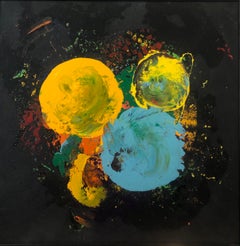
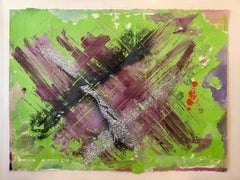
Charles Clough Picture Generation Abstract Expressionist Oil Enamel Painting

Charles Clough Picture Generation Abstract Expressionist Oil Enamel Painting

By Charles Clough

Located in Surfside, FL

This vibrant colorful painting is fully hand signed, dated and titled verso. It might be acrylic but it looks like oil or enamel ad I have seen it described thusly. This listing is...

Category

1980s Abstract Expressionist Abstract Paintings

Materials

Enamel

Frogs and Toad, Signed lithograph (AP), from Conspiracy: The Artist as Witness

Frogs and Toad, Signed lithograph (AP), from Conspiracy: The Artist as Witness

By Jack Beal

Located in New York, NY

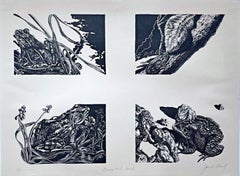
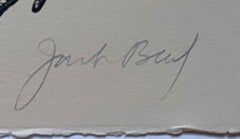
Jack Beal Frogs and Toad, 1971 Hand signed in pencil by Jack Beal, annotated AP One-color lithograph proofed by hand and pulled by machine from a zinc plate on Arches buff paper with deckled edges at the Shorewood Bank Street Atelier Stamped, hand numbered AP, aside from the regular edition of 150 Stamped on reverse: COPYRIGHT © 1971 BY JACK BEAL, bears blind stamp 18 × 24 inches Unframed 18 x 24 inches Stamped on reverse: COPYRIGHT © 1971 BY JACK BEAL, bears distinctive blind stamp of publisher (shown) Publisher: David Godine, Center for Constitutional Rights, Washington, D.C. Jack Beal's "Frogs and Toads" is a classic example of protest art from the early 1970s - the most influential era until today. This historic graphic was created for the legendary portfolio "CONSPIRACY: the Artist as Witness", to raise money for the legal defense of the Chicago 8 - a group of anti-Vietnam War activists indicted by President Nixon's Attorney General John Mitchell for conspiring to riot during the 1968 Democratic National Convention. (1968 was also the year Bobby Kennedy was killed and American casualties in Vietnam exceeded 30,000.) The eight demonstrators included Abbie Hoffman, Jerry Rubin, David Dellinger, Tom Hayden, Rennie Davis, John Froines, Lee Weiner, and Bobby Seale. (The eighth activist, Bobby Seale, was severed from the case and sentenced to four years for contempt after being handcuffed, shackled to a chair and gagged.) Although Abbie Hoffman would later joke that these radicals couldn't even agree on lunch, the jury convicted them of conspiracy, with one juror proclaiming the demonstrators "should have been shot down by the police." All of the convictions were ultimately overturned by the 7th Circuit Court of Appeals. This lithograph has fine provenance: it comes directly from the original Portfolio: "Conspiracy The Artist as Witness" which also featured works by Alexander Calder, Nancy Spero and Leon Golub, Romare Bearden Sol Lewitt, Robert Morris, Claes Oldenburg, Larry Poons, Peter Saul, Raphael Soyer and Frank Stella - as well as this one by Jack Beal. It was originally housed in an elegant cloth case, accompanied by a colophon page. This is the first time since 1971 that this important work has been removed from the original portfolio case for sale. It is becoming increasingly scarce because so many from this edition are in the permanent collections of major museums and institutions worldwide. Jack Beal wrote a special message about this work on the Portfolio's colophon page. It says, "In 1956, shortly after Sondra and I moved to New York, two friends were arrested and jailed for protesting air-raid drills. From them and their friends came our education. This work is dedicated to them and their families. "In Memory of Patricia McClure Daw and AL Uhrie" - This print was made for their children. Jack Beal Biography: Early in his career Walter Henry “Jack” Beal Jr. painted abstract expressionist canvases, because he believed it was “the only valid way to paint.” By the early 1960s he totally altered his approach and fully repudiated abstraction. Turning to representation, he painted narrative and figurative subjects, often enhanced by bright colors and dramatic perspectives. Beal was born in Richmond, Virginia, and from 1950 to 1953 he attended the Norfolk Division of William and Mary College Polytechnic Institute, (now Old Dominion University) where he studied biology and anatomy. Shifting gears, he sought art training at the School of the Art Institute of Chicago where he focused on drawing, and met his wife, artist Sondra Freckelton. His art history instructor encouraged her students to paint in the manner of established artists, and to that end he frequented the Institute’s galleries. For Beal this was significant: “Until I saw pictures of real quality I had tended to think of painting as just so much self-indulgent smearing around, but when I saw masterpieces by Cézanne and Matisse, and other painters of similar stature, I was bowled over; suddenly I realized the force of art.” After spending three years (1953–1956) at the Art Institute, Beal concluded his studies there without getting a terminal degree, thinking it was only useful if he wanted to teach, which, at the time, he did not. He also took courses at the University of Chicago in 1955 and 1956. During this period he married Freckelton, a fellow student and sculptor who began her career working in wood and plastic. Together they moved to New York’s SoHo District before its transformation from a wasteland of sweatshops and small factories into an arts district. They were active with the Artist Tenants Association which was instrumental in getting zoning laws changed so that artists could live and work in the well-lit lofts. Embracing what came to be called “New Realism,” Beal initially painted an occasional landscape as well as earthy-toned still lifes which consisted of jumbled collections filled with personal objects. His signature style started with a series of female nudes—all modeled by Freckelton—based on Greek mythology. These were large canvases with flat paint surfaces, dramatic foreshortening, and unusual perspectives. He further enlivened them with vivid colors, stark lighting, and dynamic patterns derived from textiles and overstuffed furniture. He stopped painting nudes after two episodes. The first came as he was loading a canvas of his naked wife onto a truck in lower Manhattan; several laborers walked by and started to fondle and kiss the painting. On the one hand he felt his wife had been violated, while on the other he was pleased that his realism was so convincing. The second occurred after a solo exhibition in Chicago at which the reception had been sponsored by Playboy magazine. A few days later he was approached by a publicist and asked if Playboy bunnies could be photographed in front of his paintings. He refused. Some portrait commissions came Beal’s way, but he preferred only portraying friends. More significant were four large murals on the History of Labor in America, the 20th Century: Technology (1975), which he undertook for the headquarters of the United States Department of Labor in Washington. Following a historical timeline, the themes were: colonization, settlement, nineteenth century industry, and twentieth century technology. The unveiling ceremony was attended by government officials and Joan Mondale, an arts advocate and wife of the vice-president. The reviewer for the Washington Post wrote enthusiastically: “They’re heartfelt and they’re big (each is 12 feet square). Their many costumed actors (the Indian, the trapper, the scientist, the hardhat, the capitalist in striped pants, the union maid, etc.) strike dramatic poses in dramatic settings (a seaside wood at dawn, an outdoor blacksmith’s forge, a 19th-century mill, a 20th-century lab). The lighting is theatrical. Beal’s compositions, with their swooping curves and bunched diagonals, are as complicated as his interwoven plots.” To accomplish the murals Beal assembled a team of assistants and models, much in the manner of Renaissance masters, which included artist friends and Freckelton. who by then was painting brightly colorful still lifes. A second mural commission ensued from New York City’s Metropolitan Transit Authority for two twenty-foot long installations for the Times Square Interborough Rapid Transit Company subway station. Beal’s designs for The Return of Spring (installed in 2001, three days after the terrorist attacks in New York, Washington, DC and Philadelphia) and The Onset of Winter (installed in 2005), Beal captured the appearance of his models in an oil painting made to the scale of the intended mosaic. A collaboration with Miotto Mosaics, the canvases were shipped to the Travisanutto Workshop, in Spilimbergo, Italy, where craftsmen fabricated the design to glass mosaics. The Return of Spring depicted construction workers and other New Yorkers in front of a subway kiosk and an outdoor produce market and in The Onset of Winter, a crowd watches a film crew recording a woman entering the subway as snow falls against the city’s skyline. Harkening back to some of his early nudes based on Greek myth, Persephone, goddess of fertility and wife of Hades, appears in both. The symbolism is pertinent, since she spent six months each year below ground. Although he disparaged teaching early on, Beal and Freckelton offered four summertime workshops on their farm in Oneonta, New York. He was an instructor at the New York Academy of Art, a graduate art school he helped to establish in 1982. Returning to Virginia, he taught at Hollins College...

Category

1970s Realist Animal Prints

Materials

Lithograph

Comet, Outer Space Dark Series Aquatint Etching Color Abstract Expressionist

Comet, Outer Space Dark Series Aquatint Etching Color Abstract Expressionist

By Pat Steir

Located in Surfside, FL

Pat Steir (born 1940) is an American painter and printmaker. Her early work was loosely associated with Conceptual Art and Minimalism, however, she is best known for her abstract dri...

Category

1990s Abstract Expressionist Abstract Prints

Materials

Etching, Aquatint

Four Quartets Third Quartet

Four Quartets Third Quartet

By Mel Bochner

Located in Missouri, MO

Four Quartets Third Quartet, 1990 Mel Bochner (American, b. 1940) Signed and Numbered Verso Lithograph in Four Panels 42 x 34.5 inches 52.25 x 44 inches with frame Mel Bochner, a po...

Category

1990s American Modern Abstract Prints

Materials

Lithograph

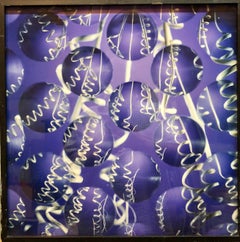
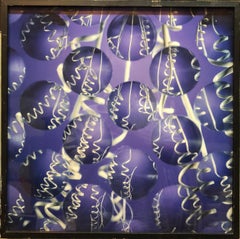
Vintage Large Format Abstract Unique Color Photo Polaroid Photograph Ellen Carey

Vintage Large Format Abstract Unique Color Photo Polaroid Photograph Ellen Carey

By Ellen Carey

Located in Surfside, FL

Untitled, Unique photograph. Center panel from larger scale installation. Shot in the 20X24 format. (this measures about 20X20 inches) Ellen Carey, American artist and photographer. Ellen Carey resides in Hartford, Connecticut, and teaches at the Hartford Art School. She holds a B.F.A. from the Kansas City Art Institute, Missouri, and an M.F.A. from State University of New York at Buffalo. Her photographs have been exhibited at numerous galleries and museums, including the International Center for Photography, New York and the Fogg Art Museum at Harvard University, Cambridge, Massachusetts. She has received many grants from her home state of Connecticut as well as the Massachusetts Council of the Arts, New Works Grant, New York State Federation for Artists Grant; and a National Endowment for the Arts Award. Her photographs are in the permanent collections of The Art Institute of Chicago; the Baltimore Museum of Art; Brooklyn Museum of Arts; Chase Manhattan Bank; Coca Cola Corporation; Fogg Art Museum; George Eastman House; International Center for Photography; and the Los Angeles County Museum of Art, among others. Abstract photography, sometimes called non-objective, experimental, conceptual or concrete photography, is a means of depicting a visual image that does not have an immediate association with the object world and that has been created through the use of photographic equipment, processes or materials. Some photographers pushed the boundaries of conventional imagery by incorporating the visions of surrealism or futurism into their work. Man Ray, Maurice Tabard, André Kertész, Curtis Moffat and Filippo Masoero were some of the best known artists who produced startling imagery that questioned both reality and perspective. Both during and after World War II photographers such as Minor White, Aaron Siskind, Henry Holmes Smith and Lotte Jacobi explored compositions of found objects in ways that demonstrated even our natural world has elements of abstraction embedded in it. Beginning in the late 1970s photographers stretched the limits of both scale and surface in what was then traditional photographic media that had to be developed in a darkroom. Inspired by the work of Moholy-Nagy, Susan Rankaitis first began embedding found images from scientific textbooks into large-scale photograms. By the 1990s a new wave of photographers were exploring the possibilities of using computers to create new ways of creating photographs. Photographers such as Thomas Ruff, Barbara Kasten, Tom Friedman, and Carel Balth were creating works that combined photography, sculpture, printmaking and computer-generated images. Any boundaries that remained between pure artists and pure photographers were eliminated by individuals who worked exclusively in photography but produced only computer-generated images. Among the most well-known of the early 21st century generation were Gaston Bertin...

Category

1980s Abstract Color Photography

Materials

Polaroid

Abstract Aquatint Etching Ross Bleckner Zig Zag lines New York Artist D Loop

Abstract Aquatint Etching Ross Bleckner Zig Zag lines New York Artist D Loop

By Ross Bleckner

Located in Surfside, FL

ROSS BLECKNER (American, b. 1949) "D Loop," 2002 Limited Edition Print : Color Aquatint With Spit Bite Aquatint And Gampi Chine-Collé on Somerset Paper Approximate dimensions - Frame 29.5 X 28,.5 inches, sheet 27 x 26 inches. Edition lower left: 2/20, Hand signed lower right. Publishers blind stamp lower right margin: Paulson Press. Ross Bleckner draws inspiration from science, psychology, and his own personal experience. The title of this print, D Loop, refers to molecular biology and DNA repair abstracted in vivid blue and yellow. Ross Bleckner (born May 12, 1949) is an American artist. He currently lives and works in New York City. His artistic focus is on painting, and he held his first solo exhibition in 1975. Bleckner grew up in Brooklyn, New York and he grew up Jewish. In an interview, Bleckner commented that he was fortunate to have supportive parents. In 1961, Bleckner and his family moved to a more affluent town in Hewlett Harbor, New York, where he attended George W. Hewlett High School. In 1965, Bleckner saw his first art exhibition, The Responsive Eye, at the Museum of Modern Art, which went on to have a huge impact on his artwork. Eventually, this was a time when he realized that he wanted to become an artist. Bleckner went on to study at New York University, where he studied alongside fellow artist Sol LeWitt and Chuck Close. During college, Bleckner worked in an art supply store and drove a taxi. He received his Bachelor of Fine Arts (B.F.A) from New York University (1971), and later received his Master of Fine Arts (M.F.A) at California Institute of the Arts. In 1974, when Bleckner moved back to New York, he moved into a Tribeca loft building. Three of the floors were rented to the painter Julian Schnabel and from 1977 to 1983 the Mudd Club, a nightclub frequented by musicians and artists, was in the same building. In 2004 Bleckner sold the building. He held his first solo exhibition in 1975 at Cunningham Ward Gallery in New York. Then In 1979 he began what was to become a long association with Mary Boone Gallery in New York. In 1981 Bleckner met Thomas Ammann, who was an influential Swiss art dealer who went on to collect Bleckner's work. Early 1990s, Bleckner did his first abstract painting called Cell painting which showed an example of human body cell diseases. Since either the 1980s or 1990s as an openly gay artist, his art has been largely an investigation of change, loss, and memory, often addressing the subject of AIDS. Bleckner uses symbolic modernist imagery rather than direct representation, and his work is visually elusive, with forms that constantly change focus. While much of Bleckner's work can be divided into distinct groups or series with motifs repeated from painting to painting, he is also in the habit of redeploying and combining old motifs. Bleckner has posited that a painting is never finished, provided it is still in his studio, because it can always be improved. In 2009, Bleckner published a book of his theoretical art statements entitled Examined Life: Writings, 1972-2007 that was published by Edgewise Press. In 1995, the Solomon R. Guggenheim Museum had a major retrospective exhibition of his works from the last two decades of exhibitions at acclaimed institutions such as San Francisco Museum of Modern Art, Moderna Museet in Stockholm, and the Carnegie Museum of Art. He was one of the youngest artists to be featured at the Guggenheim. Bleckner's works are held in collections around the world including Museum of Modern Art, New York, (he was included in the show Contemporary Works from the Collection, MoMA along with Carl Andre, Richard Artschwager, Marcel Broodthaers, Jim Dine, Howard Hodgkin, Jasper Johns, Donald Judd, Anish Kapoor, Ellsworth Kelly, Robert Mangold...

Category

Early 2000s Abstract Prints

Materials

Etching, Aquatint

"Geostructure X" Abstract, Colors, Geometric, Primary Shapes, Acrylic

"Geostructure X" Abstract, Colors, Geometric, Primary Shapes, Acrylic

By Franklin Jonas

Located in Detroit, MI

"Geostructure X" is an intensely colorful painting of the primary shapes of the circle, square, and triangle. Though the shapes are repetitive their mixed juxtapositions and the creative use of color moves the eye around the canvas with constant interest. This painting is an extraordinary example of Franklin Jonas...

Category

1990s Abstract Geometric Abstract Paintings

Materials

Linen, Acrylic

"Wounded Fruit, " Color Aquatint sigend by Dan Mitchell Allison

"Wounded Fruit, " Color Aquatint sigend by Dan Mitchell Allison

By Dan Mitchell Allison

Located in Milwaukee, WI

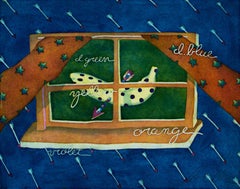
"Wounded Fruit" is an original color aquatint by Dan Mitchell Allison. It depicts a banana behind a window with an arrow through it. There are also color names written on the piece. It recalls Rene Magritte's early surreal explorations of objects and text. The artist signed the piece in the lower right. It is edition 39/40. 15 1/2" x 19 1/2" art 22 1/4" x 26" frame Born in Houston, Texas in 1953, the printmaker and painter continues to live and work there, still remaining an integral part of the lively Houston art scene while garnering attention throughout the United States, as well as overseas. Allison's prints are included in major museum and private collections throughout the world, including the U.S., Europe and Asia. He has gained renown for his innovative painting with the surface subtleties of printmaking and has established an international reputation for printmaking that places him in league with some of the most important late 20th century artists to have worked in the print medium. Achieving worldwide critical acclaim for his printmaking, Allison was the recipient of the prestigious 1987 Grand Prix award for the 17th Biennial of Graphic Art sponsored by the Ljubljana Museum of Modern Art in the former Republic of Yugoslavia. The artist's award winning, three panel collagraphic triptych, "Between Heaven and Earth," was selected from more than 1800 entries submitted from 57 countries. Past recipients of Ljubljana print award honors include Joan Miro, Karl Appel, Jasper Johns, Robert Rauschenberg, Frank Stella, James Rosenquist, David Hockney, Victor Vasarely, Antonio Berni...

Category

1980s Surrealist Still-life Prints

Materials

Aquatint

"St. Sebastian in NY, " Original Aquatint signed by Dan Mitchell Allison

"St. Sebastian in NY, " Original Aquatint signed by Dan Mitchell Allison

By Dan Mitchell Allison

Located in Milwaukee, WI

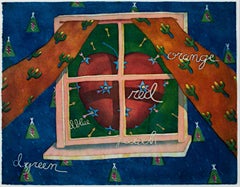
"St. Sebastian in N.Y." is an original color aquating by dan Mitchell Allison. The artist signed the piece in the lower right. This piece depicts a heart/apple behind a window being assaulted by small arrows. Cactus-patterned curtains fly away from the windows and five words float in front of the entire image. This piece resembles Rene Magritte's early experiments with text-based surrealism. This piece is edition 38/40. 15 3/8" x 19 5/8" art 22 1/8" x 26 1/4" frame Born in Houston, Texas in 1953, the printmaker and painter continues to live and work there, still remaining an integral part of the lively Houston art scene while garnering attention throughout the United States, as well as overseas. Allison's prints are included in major museum and private collections throughout the world, including the U.S., Europe and Asia. He has gained renown for his innovative painting with the surface subtleties of printmaking and has established an international reputation for printmaking that places him in league with some of the most important late 20th century artists to have worked in the print medium. Achieving worldwide critical acclaim for his printmaking, Allison was the recipient of the prestigious 1987 Grand Prix award for the 17th Biennial of Graphic Art sponsored by the Ljubljana Museum of Modern Art in the former Republic of Yugoslavia. The artist's award winning, three panel collagraphic triptych, "Between Heaven and Earth," was selected from more than 1800 entries submitted from 57 countries. Past recipients of Ljubljana print award honors include Joan Miro, Karl Appel, Jasper Johns, Robert Rauschenberg, Frank Stella, James Rosenquist, David Hockney, Victor Vasarely, Antonio Berni...

Category

1980s Surrealist Still-life Prints

Materials

Aquatint

Pirate Kitty (Silver Tabby)

Pirate Kitty (Silver Tabby)

By Daniel Handal

Located in New York, NY

Oil on canvas Signed and dated in black ink, verso This artwork is offered by ClampArt, located in New York City. Daniel Handal writes: “With ‘Cats in Costume’ I wanted to work on ...

Category

2010s Other Art Style Animal Paintings

Materials

Canvas, Oil

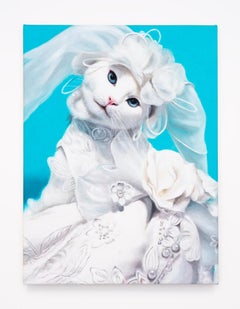
Bridal Kitty (Albino)

Bridal Kitty (Albino)

By Daniel Handal

Located in New York, NY

Oil on canvas Signed and dated in black ink, verso This artwork is offered by ClampArt, located in New York City. Daniel Handal writes: “With ‘Cats in Costume’ I wanted to work on ...

Category

2010s Other Art Style Animal Paintings

Materials

Canvas, Oil

Cowboy Kitty (Cameo Tabby)

Cowboy Kitty (Cameo Tabby)

By Daniel Handal

Located in New York, NY

Oil on canvas Signed and dated in black ink, verso This artwork is offered by ClampArt, located in New York City. Daniel Handal writes: “With ‘Cats in Costume’ I wanted to work on ...

Category

2010s Other Art Style Animal Paintings

Materials

Canvas, Oil

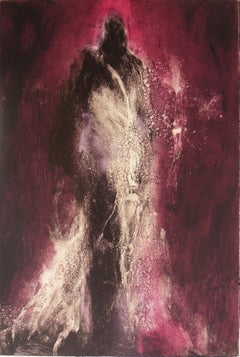
Passing Shaman 17
Passing Shaman 17

Passing Shaman 17

By Lawrence Fodor

Located in San Francisco, CA

Artist: Lawrence Fodor – American (1951- ) Title: Passing Shaman 17 Year: 1989 Medium: Monotype Image size: 18 x 12 inches Sheet size: 30 x 22 inches Framed size: 32.5 x 24.5 inches Signature: Signed, dated lower right by the artist Condition: Excellent Frame: Floating. Framed in modern wood frame. Frame in good condition. This haunting monotype is by the well-known artist Lawrence Fodor (1951-). It is in excellent condition, archivally mounted and floating in a modern wood frame. The maple frame is in good condition with a few very light scratches. Lawrence Fodor began the pursuit of painting when he was 10. He studied at Orange Coast College and received a BFA from Otis Art Institute in Los Angeles, California where he also did graduate work towards his MFA in printmaking and painting. He has studied, traveled and lived in Europe, Asia, Central and South America. His work is exhibited and collected extensively in private and public collections including the Lannan Foundation in Santa Fe, New Mexico and recently by the Modern Art Museum of Forth Worth, Texas, among others. In addition to a studio art career as a painter and printmaker he has done curating and fine art consulting, residential design and construction, graphic design, gallery management, set design and production for live theater. He has worked and had studios in Los Angeles, Long Beach and Santa Barbara, California, Kathmandu, Nepal, Tucson, Arizona and Santa Fe, New Mexico. He currently lives and works in Los Angeles, California and Santa Fe, New Mexico. Maintaining studios in both locations, his work includes painting using oil, alkyd resin and cold wax on canvas, panels, and wood boxes, monotypes, watercolors, other works on paper and photography. Source: Artist's website C UR R I C U L U M V I T A E BORN 1951, Los Angeles, CA. EDUCATION 1974 – 1976 Graduate Work toward MFA, Otis Art Institute • Los Angeles, CA 1973 Bachelor of Fine Arts, Drawing/Printmaking Major • Otis Art Institute • Los Angeles, CA 1971 Associate of Arts Degree, Fine Arts Major • Orange Coast College • Costa Mesa, CA TRAVEL 2015 – 2016 Independent study & research in Baja del Sur, Mexico 2013 Independent study & research in Key West & surrounding Keys & Islands including Dry Tortugas National Park 2009 – 2010 Independent study & research in Costa Rica, Argentina & Patagonia 1985 – 2008 Independent study & research in England, France, Germany, Italy, Spain, Mexico & Costa Rica 1974 – 1975 Independent study in Katmandu, Nepal 1974 Independent study & research in England, France, Germany, Holland, Italy & Switzerland S E L ECTED EXHIBITIONS 2019 “…a tireless hand.” • Friesen Gallery • Sun Valley, ID 2017 Eclipse: obscured memories • Friesen Gallery • Sun Valley, ID Amended Mythologies • Solo Exhibition • SCAPE • Corona del Mar, CA Purple Haze • Group Exhibition • Charlotte Jackson Fine Art • Santa Fe, NM 2016 EMERGENCE • Group Exhibition • Charlotte Jackson Fine Art • Santa Fe, NM 2014 Without Gravity • Solo Exhibition • Chiaroscuro @ Gebert Contemporary • Santa Fe, NM 2013 Friends and Family • Three-Person Exhibition with Florence Pierce & Mala Breuer • Charlotte Jackson Fine Art • Santa Fe, NM Again: Repetition, Obsession and Meditation • Group Exhibition with Agnes Martin, Sol Lewitt, Olafur Eliasson, Uta Barth, Chuck Close, Susan York & others • Lannan Foundation • Santa Fe, NM 2012 Infinite Sequence 2 • Two-Person Exhibition with Chris Richter • Friesen Gallery • Sun Valley, ID Holding Light 4: 315 paintings • Site-specific installation • ALCOVE 12.6: New Mexico Museum of Art • Santa Fe, NM Holding Light 02: 81 paintings • Installation • Laguna Art Museum • Laguna Beach CA Infinite Sequence • Two-Person Exhibition with Chris Richter • SCAPE • Corona del Mar, CA 2010 Ligatures and Kōan Boxes • Solo Exhibition • Friesen Gallery • Seattle, WA Considered • Group Exhibition • Friesen Gallery • Sun Valley, ID Speak for the Trees • Group Exhibition • Friesen Gallery • Sun Valley, ID & Seattle, WA 2009 Kōan Boxes • Solo Exhibition • Lannan Foundation • Santa Fe, NM Ligatures & Kōan Boxes • Solo Exhibition • Friesen Gallery • Sun Valley, ID Ligatures & Kōan Boxes • Solo Exhibition • Linda Durham Contemporary Art • Santa Fe, NM 2008 Ligatures • Solo Exhibition • SCAPE • Corona del Mar, CA Gold • Group Exhibition • Linda Durham Contemporary Art Stochastic II • Solo Exhibition • R Duane Reed Gallery • St. Louis, MO 2007 Stochastic • Solo Exhibition • Linda Durham Contemporary Art • Santa Fe, NM 2006 Summer Moon • Solo Exhibition • SCAPE • Corona del Mar, CA 2005 Moment of Inertia • Solo Exhibition • Linda Durham Contemporary Art • Santa Fe, NM Winter Group Exhibition • Linda Durham Contemporary Art • Santa Fe, NM 2004 Sustained Resonance • Two-Person Exhibition • SCAPE • Corona del Mar, CA Beneath the Surface • Solo Exhibition • Friesen Gallery • Sun Valley, ID Beneath the Surface • Two-Person Exhibition • Friesen Gallery • Seattle, WA Greek Contributions to Mankind • An Exhibition of Contemporary American Art • Group Exhibition, catalog • United States Embassy • Athens, Greece • Curator: Virginia Shore 2003 A Given Moment – Part 2 • Two-Person Exhibition • Peyton Wright Gallery • Santa Fe, NM Group exhibition • Jeannie Denholm • The Shed • Newport Beach, CA Outside Within • Group Exhibition • Friesen Gallery • Seattle, WA 2002 The Art Collection • Embassy of the United States of America • Dar Es Salaam, Tanzania 2002 A Given Moment • Solo Exhibition • Friesen Gallery • Sun Valley, ID Group Exhibition • Peyton Wright Gallery • Santa Fe, NM 2001 Stream from the Clearing • Two-Person Exhibition • Peyton Wright Gallery • Santa Fe, NM Group Exhibition • Friesen Gallery • Seattle, WA 2000 Group exhibition • Peyton Wright Gallery • Santa Fe, NM Group exhibition • Friesen Gallery • Seattle, WA 1999 Vestiges II • Solo Exhibition • Peyton Wright Gallery • Santa Fe, NM 1998 Into the Clearing • Two-Person Exhibition • Peyton Wright Gallery • Santa Fe, NM The Romantic Landscape • Group Exhibition • Turner Carroll Gallery • Santa Fe, NM Vestiges • Solo Exhibition • Friesen Gallery • Seattle, WA 1997 The Dialogue Within • Solo Exhibition • Friesen Gallery • Sun Valley, ID Setting Prayers on Fire • Solo Exhibition • Peyton Wright Gallery • Santa Fe, NM 1996 Solo Exhibition • Peyton Wright Gallery • Santa Fe, NM Two-Person Exhibition with Lucy Brown • Diane Nelson Fine Art • Laguna Beach, CA • Curator: Jeannie Denholm 1995 Setting Prayers on Fire • Solo Exhibition • Zenith • Denver, CO • Curator: Kyle Belding 1994 Two-Person Exhibition with Peter Joseph • Peyton Wright Gallery • Santa Fe, NM Solo Exhibition • Jan Maiden Contemporary Art • Columbus, OH 1993 Two-Person Exhibition with Holly Roberts • Jeannie Denholm Fine Art • Newport Beach, CA Solo Exhibition • Canyon Contemporary Art • Columbus, OH 1992 Perigrinari • Solo Exhibition • Peyton Wright Gallery • Santa Fe, NM 1991 Ex Arcanum Locus • Solo Exhibition • Friesen Gallery • Seattle, WA A Sense of Place • Group Exhibition• Peyton Wright Gallery • Santa Fe, NM 1990 In Lucem Proferre • Solo Exhibition • Friesen Gallery • Sun Valley, ID Monotypes from Black Mesa Workshop • Group Exhibition • Lone Pine Gallery • Irvine, CA Ritual Images/Ritual Objects • Two-Person Exhibition with Ann Mallory • Lone Pine Gallery • Irvine, CA 1989 Solo Exhibition • Friesen Gallery • Sun Valley, ID 1983 Solo Exhibition • Pamela Auchincloss Gallery • Santa Barbara, CA 1981 Solo Exhibition • Pamela Auchincloss Gallery • Santa Barbara, CA PUBL ICATIONS 2017 The Beauty in Painting A Time After Time. Sun Valley Property News, article by Courtney Lauck. 30 July 2017. “Chaco Issue,” Pasatiempo, Santa Fe New Mexican. Multiple photographs illustrating various articles about Chaco Culture National Historical Park. 21 April 2017. 2015 Chaco Canyon: Wandering the Past in the Present. Photographs & essay by the artist of Chaco Culture National Historic Park. Publisher: Andrews Art Books, Santa Fe, NM. 2015 Apparatus: in a Painter’s Studio. Photographs of vignettes in the studio of Lawrence Fodor by the artist, essay by Aline Branduaer. Publisher: Andrews Art Books, Santa Fe, NM. 2012 Holding Light, a catalogue documenting the work for an installation of paintings at the Laguna Art Museum, essay by Cyndi Conn. Publisher: Andrews Art Books, Santa Fe, NM 2009 Speak for the Trees, Composed by Andria Friesen, publisher Marquand Books, Inc., Seattle, WA. Illus.: In Lucem Proferre VIII, 1989-90, oil on canvas. Sarah S. King, Lawrence Fodor – Linda Durham Contemporary Art, Art in America, National Reviews, October 2009. Illus.: Ligature 12 Green/Blue-Green/Violet, oil/wax/alkyd on canvas. Kōan Boxes, catalogue to accompany Lannan Foundation Exhibition, essay Timothy Rodgers Ph. D., Chief Curator, New Mexico Museum of Art. Publisher: Lannan Foundation, Design Twin Palms Press, 2009. 2007 Hollis Walker “Larry Fodor...

Category

1980s Abstract Figurative Prints
Materials

Paper, Monotype

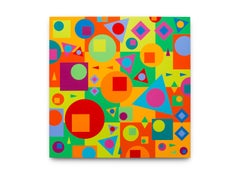
"Geostructure IX" Abstract, Geometric, Colors, Primary Shapes, Acrylic

"Geostructure IX" Abstract, Geometric, Colors, Primary Shapes, Acrylic

By Franklin Jonas

Located in Detroit, MI

"Geostructure IX" is an intensely colorful painting of the primary shapes of the circle, square, and triangle. Though the shapes are repetitive their mixed juxtapositions and the creative use of color moves the eye around the canvas with constant interest. This painting is an extraordinary example of Franklin Jonas...

Category

1990s Abstract Geometric Abstract Paintings

Materials

Linen, Acrylic

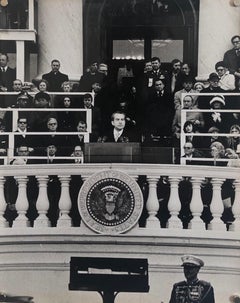
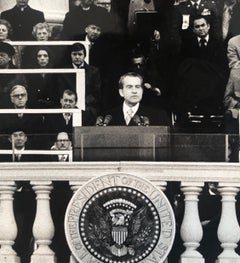
Vintage Print Silver Gelatin Signed Photo President Richard Nixon Innaugural

Vintage Print Silver Gelatin Signed Photo President Richard Nixon Innaugural

By Fred McDarrah

Located in Surfside, FL

Photograph signed in ink and with photographer stamp verso and hand written title. Richard Milhous Nixon (January 9, 1913 – April 22, 1994) was the 37th president of the United Stat...

Category

1990s American Modern Black and White Photography

Materials

Black and White, Silver Gelatin

Op Art Hard Edged Abstract Geometric Mod Painting John Pearson

Op Art Hard Edged Abstract Geometric Mod Painting John Pearson

Located in Surfside, FL

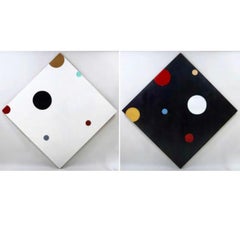
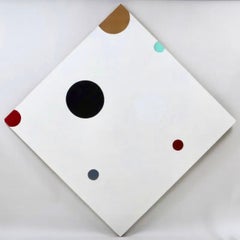
John Pearson (American born 1940) "Study for Circus" 1985 Acrylic on canvas painting Hand signed verso, hangs from corner of canvas. Provenance: The New Gallery of Contemporary Art, Cleveland, Ohio. Bearing label verso: Dimensions: 19 x 19 in (it hangs in diamond shape which measures point to point 26.87 X 26.87 inches) Red, White, Blue, and Yellow abstract geometric painting. Circle and ellipse. John Pearson (British, 1940-was born in Yorkshire, England, and studied at the Harrogate School of Art, Yorkshire (National Diploma of Design, 1960), the Royal Academy Schools, London (Certificate, R.A.S 1963), the Akademie der Bildenden Kunst, Munich (1963–64, research fellow), and Northern Illinois University (M.F.A. 1966). He is known for hard edged, mod abstract oil painting on shaped canvas in geometric, curvilinear forms. For many years, Pearson has made paintings and low-relief sculpture, predominantly wall pieces, which use color, form, and various degrees of abstraction to modify the space of entire rooms. With work exhibited nationally and internationally in both solo and group shows, Pearson has also been sought for many site-specific commissions, both public and private. These are typically highly abstract, simplified, and nuanced; they’re often witty, too. Pearson early on became a devotee of the Dutch artist Piet Mondrian, a chief proponent of De Stijl (The Style), Pearson’s style has evolved from intense system-based abstract compositions to one more attuned to the spiritual influences of the natural environment. Pearson’s early style reflects the European reaction to expressionism and artistic emotionalism in the form of a rational, systematic approach to art (often called the “New Tendency”). An heir to the tenets of Constructivism, he investigated color within a predetermined linear or grid system that eliminated options after the artist’s initial choices. He was drawn to Cleveland in 1970 because of its reputation at the time for having a rich environment for abstract art, as two of the chief proponents of Kinetic art and op art, Julian Stanczak and Richard Anuszkeiwicz, worked there. Students of Josef Albers, the grand master of color theory who taught these two primary practitioners of the “Color Function” school of abstract art at Yale in the 1950s. Pearson’s early style reflects a European reaction to abstract expressionism that manifested itself in a rational, systematic approach to art.Since his emergence in 1960s London, John Pearson has been using mathematical systems and computer programs to generate hard-edged geometric compositions. His work is of the same genre as the artists of the Denise Rene Gallery in Paris, similar to Vasarely, Agam, Cruz Diez and Soto. His most recent work, with its circles and ellipses superimposed on patterns of wavy lines, brings a more easygoing approach to his particular breed of rule-based art. Pearson has received grants from the National Endowment for the Arts and the Canada Council, and has had solo exhibitions at institutions including the Akron Art Museum, the Cleveland Center for Contemporary Art, and the Museum of Modern Art in Rijeka, Croatia. Pearson was born in Yorkshire (Britain) and studied art at the Royal Academy Schools in London, did advanced work in Munich (Germany), and earned the M.F.A. (Master of Fine Arts) degree from Northern Illinois University. Before arriving to teach at Oberlin College in 1972, he taught at the University of New Mexico, the Nova Scotia College of Art and Design, and the Cleveland Institute of Art. At Oberlin, he served as the Young-Hunter Professor of Art. John retired from teaching in 2014 but still occasionally works with students and lives in Oberlin where he educated several generations of appreciative liberal arts students. He also served as department chair and held the Young-Hunter endowed professorship from 1987 onward, until his retirement. Pearson travelled widely to paint, exhibit, and teach and received support from the Ohio Arts Council and the National Endowment for the Arts, among others. His career received recognition via the Cleveland Arts Prize in 1975, while most recently he was recognized as a Special Honoree by the same organization. His paintings and sculptures are held in many public and private collections in the U.S., Canada, Europe, China, and Japan, as well as by museums, such as the Allen Art Museum (Oberlin), the Cleveland Museum of Art, the Museum of Modern Art (New York), and the Art Institute of Chicago. Hard-Edged Select Group Exhibitions Abstract, Constructive, Concrete Mondrian huis, Amersfoort, Holland Chronologic Planet Art...

Category

1980s Abstract Geometric Abstract Paintings

Materials

Acrylic, Canvas

Comet, Outer Space Dark Series Aquatint Etching Color Abstract Expressionist

Comet, Outer Space Dark Series Aquatint Etching Color Abstract Expressionist

By Pat Steir

Located in Surfside, FL

Pat Steir (born 1940) is an American painter and printmaker. Her early work was loosely associated with Conceptual Art and Minimalism, however, she is best known for her abstract dri...

Category

1990s Abstract Expressionist Abstract Prints
Materials

Etching, Aquatint

Vintage Signed  Silver Gelatin Photograph Jasper Johns Exhibit Photo Whitney Mus

Vintage Signed Silver Gelatin Photograph Jasper Johns Exhibit Photo Whitney Mus

By Fred McDarrah

Located in Surfside, FL

Mercedes and Herbert Matter at Jasper Johns Exhibition nov 21 1978 Whitney Museum photographer Fred McDarrah Over a 50-year span, McDarrah documented the rise of the Beat Generatio...

Category

1970s American Modern Black and White Photography

Materials

Silver Gelatin

Stockholm
Stockholm

Stockholm

By Kenneth Noland

Located in Toronto, Ontario

Kenneth Noland (1924 – 2010) is one of the most important artists and contributors to the evolution of American abstraction. He is one of the most beloved figures in the Color-Field ...

Category

1970s Color-Field Abstract Prints
Materials

Screen

Comet, Outer Space Dark Series Aquatint Etching Color Abstract Expressionist

Comet, Outer Space Dark Series Aquatint Etching Color Abstract Expressionist

By Pat Steir

Located in Surfside, FL

Pat Steir (born 1940) is an American painter and printmaker. Her early work was loosely associated with Conceptual Art and Minimalism, however, she is best known for her abstract dri...

Category

1990s Abstract Expressionist Abstract Prints
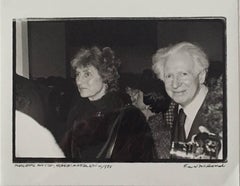
Materials

Etching, Aquatint

"Geostructure VI" Abstract, Graphic, Colors, Geometric, Primary Shapes, Acrylic

"Geostructure VI" Abstract, Graphic, Colors, Geometric, Primary Shapes, Acrylic

By Franklin Jonas

Located in Detroit, MI

"Geostructure VI" is an intensely colorful painting of the primary shapes of the circle, square, and triangle. Though the shapes are repetitive their mixed juxtapositions and the creative use of color moves the eye around the canvas with constant interest. This painting is an extraordinary example of Franklin Jonas...

Category

1990s Abstract Geometric Abstract Paintings

Materials

Linen, Acrylic

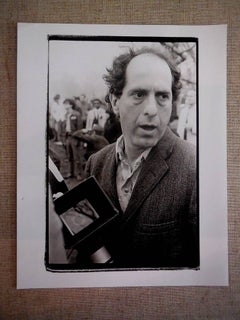
Vintage Silver Gelatin Photograph Robert Frank

Vintage Silver Gelatin Photograph Robert Frank

By Fred McDarrah

Located in Surfside, FL

Robert Frank in Central Park. Shoot A film during Anti-War protests. April !5 1967 Robert Frank (born November 9, 1924) is an important figure in American photography and film. His m...

Category

1960s Portrait Photography

Materials

Silver Gelatin

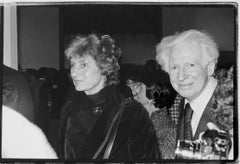
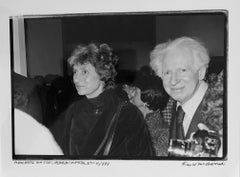
Herbert & Mercedes Matter

Herbert & Mercedes Matter

By Fred McDarrah

Located in Surfside, FL

Mercedes Matter née Carles (1913 – December 2001) was an American painter and draughtswoman. Her father was the American modernist painter Arthur Beecher Carles who had studied with ...

Category

20th Century Black and White Photography

Materials

Silver Gelatin

Vintage Signed Silver Gelatin Photograph Bob Grant Radio Personality Photo

Vintage Signed Silver Gelatin Photograph Bob Grant Radio Personality Photo

By Fred McDarrah

Located in Surfside, FL

Bob Grant - Radio Personality at WOR NYC march 10, 1994 Photographer Fred McDarrah Over a 50-year span, McDarrah documented the rise of the Beat Generation, the city’s postmodern art movement, its off-off-Broadway actors, troubadours, politicians, agitators and social protests. Fred captured Jack Kerouac frolicking with women at a New Year’s bash in 1958, Andy Warhol adjusting a movie-camera lens in his silver-covered factory, and Bob Dylan offering a salute of recognition outside Sheridan Square near the Voice’s old office. Not just a social chronicler, McDarrah was a great photo-journalist. For years, McDarrah was the Voice's only photographer and, for decades, he ran the Voice’s photo department, where he helped train dozens of young photographers, including James Hamilton, Sylvia Plachy, Robin Holland and Marc Asnin. His mailbox was simply marked "McPhoto." An exhibit of McDarrah’s photos of artists presented by the Steven Kasher Gallery in Chelsea was hailed by The New York Times as “a visual encyclopedia of the era’s cultural scene.” artists in their studios, (Alice Neel, Philip Guston, Stuart Davis, Robert Smithson, Jasper Johns, Franz Kline), actors (Dustin Hoffman, Robert De Niro on the set of “Taxi Driver”), musicians (Janis Joplin, Alice Cooper, Bob Dylan) and documentary images of early happenings and performances (Yayoi Kusama, Charlotte Moorman, Al Hansen, Jim Dine, Nam June Paik). The many images of Andy Warhol include the well-known one with his Brillo boxes at the Stable Gallery in 1964. Woody Allen, Diane Arbus, W. H. Auden, Francis Bacon, Joan Baez, Louise Bourgeois, David Bowie, Jimmy Breslin, William Burroughs, John Cage, Leo Castelli, Christo, Leonard Cohen, Merce Cunningham, William de Kooning, Jim Dine, Mark di Suvero, Marcel Duchamp, Bob Dylan, Federico Fellini, Allen Ginsberg, Robert Indiana, Mick Jagger, Jasper Johns, Kusama, John Lennon, Sol Lewitt, Roy Lichtenstein, Nam June Paik, Elvis Presley, Claes Oldenburg, Yoko Ono, Robert Rauschenberg, Lou Reed, James Rosenquist, Mark Rothko, Ed Ruscha, Robert Smithson, Susan Sontag, Andy Warhol, and others. McDarrah’s prints have been collected in depth by the J. Paul Getty Museum and the National Portrait Gallery, Washington. His work is in numerous public and private collections. Robert Ciro Gigante, known as Bob Grant (March 14, 1929 – December 31, 2013), was an American radio host. A veteran of broadcasting in New York City, Grant is considered a pioneer of the conservative talk radio format. Grant was widely termed a political conservative, and personally considered himself to be a conservative with some libertarian leanings. On September 15, 1991, a roast honoring Grant for twenty one years of radio in New York City was held in West Orange, New Jersey. Freddie Roman was the Master of Ceremonies, and Grant was roasted by New York Senator Al D'Amato, comedian Pat Cooper, Soupy Sales, Rush Limbaugh, comedian Joe Piscopo and Lynn Samuels, among others. Over the years, national radio talk personality Howard Stern has made differing remarks on his admiration for Grant as an early influence. Stern said, "I consider him to be the best broadcaster I've ever heard." Radio & Records had planned to issue a Lifetime Achievement Award to Grant during its annual convention in March 2008; however, the nomination was revoked. Sean Hannity, Opie and Anthony, comedian Jim Norton, Lars Larson...
Category

1990s American Modern Black and White Photography

Materials

Silver Gelatin

Vintage Print Silver Gelatin Signed Photograph Sidney Janis, Conrad Janis, NYC

Vintage Print Silver Gelatin Signed Photograph Sidney Janis, Conrad Janis, NYC

By Fred McDarrah

Located in Surfside, FL

signed in ink and with photographer stamp verso and hand written title. Sidney Janis (July 8, 1896 – November 23, 1989) was a wealthy clothing manufacturer and art collector who ope...

Category

1960s American Modern Black and White Photography

Materials

Black and White, Silver Gelatin

Vintage Silver Gelatin Photo of Ibram Lassaw Modernist Sculpture (Photograph)

Vintage Silver Gelatin Photo of Ibram Lassaw Modernist Sculpture (Photograph)

Located in Surfside, FL

This is from the photogrpaher John A. Ferrari he shot work for Eva Hesse, Robert Mangold, Ronald Bladen and Sol Lewitt. It bears his stamp and label from Zabriskie Gallery. This is for the original vintage photograph. I believe the inscription is in the hand of Ibram Lassaw some also bear the photographers stamp. Lassaw was born in Alexandria, Egypt, of Russian Jewish émigré parents, he went to the U.S. in 1921. His family settled in Brooklyn, New York. He became a US citizen in 1928. He first studied sculpture in 1926 at the Clay Club and later at the Beaux-Arts Institute of Design in New York. He made abstract paintings and drawings influenced by Kandinsky, Sophie Tauber Arp...

Category

1960s Abstract Expressionist Abstract Photography

Materials

Silver Gelatin

Vintage Silver Gelatin Photograph Thomas Hoving John Lindsey Costume Party Photo

Vintage Silver Gelatin Photograph Thomas Hoving John Lindsey Costume Party Photo

By Fred McDarrah

Located in Surfside, FL

Thomas Hoving and John Lindsay at a benefit party 1/18/1967 Photographer is Fred McDarrah Over a 50-year span, McDarrah documented the rise of the Beat Generation, the city’s postmodern art movement, its off-off-Broadway actors, troubadours, politicians, agitators and social protests. Fred captured Jack Kerouac frolicking with women at a New Year’s bash in 1958, Andy Warhol adjusting a movie-camera lens in his silver-covered factory, and Bob Dylan offering a salute of recognition outside Sheridan Square near the Voice’s old office. Not just a social chronicler, McDarrah was a great photo-journalist. For years, McDarrah was the Voice's only photographer and, for decades, he ran the Voice’s photo department, where he helped train dozens of young photographers, including James Hamilton, Sylvia Plachy, Robin Holland and Marc Asnin. His mailbox was simply marked "McPhoto." An exhibit of McDarrah’s photos of artists presented by the Steven Kasher Gallery in Chelsea was hailed by The New York Times as “a visual encyclopedia of the era’s cultural scene.” artists in their studios, (Alice Neel, Philip Guston, Stuart Davis, Robert Smithson, Jasper Johns, Franz Kline), actors (Dustin Hoffman, Robert De Niro on the set of “Taxi Driver”), musicians (Janis Joplin, Alice Cooper, Bob Dylan) and documentary images of early happenings and performances (Yayoi Kusama, Charlotte Moorman, Al Hansen, Jim Dine, Nam June Paik). The many images of Andy Warhol include the well-known one with his Brillo boxes at the Stable Gallery in 1964. Woody Allen, Diane Arbus, W. H. Auden, Francis Bacon, Joan Baez, Louise Bourgeois, David Bowie, Jimmy Breslin, William Burroughs, John Cage, Leo Castelli, Christo, Leonard Cohen, Merce Cunningham, William de Kooning, Jim Dine, Mark di Suvero, Marcel Duchamp, Bob Dylan, Federico Fellini, Allen Ginsberg, Robert Indiana, Mick Jagger, Jasper Johns, Kusama, John Lennon, Sol Lewitt, Roy Lichtenstein, Nam June Paik, Elvis Presley, Claes Oldenburg, Yoko Ono, Robert Rauschenberg, Lou Reed, James Rosenquist, Mark Rothko, Ed Ruscha, Robert Smithson, Susan Sontag, Andy Warhol, and others. McDarrah’s prints have been collected in depth by the J. Paul Getty Museum and the National Portrait Gallery, Washington. His work is in numerous public and private collections. Thomas Pearsall Field Hoving was an American museum executive and consultant and the director of the Metropolitan Museum of Art. He was born in New York City to Walter Hoving, the head of Tiffany & Company, and his wife, Mary Osgood Field, a descendant of Samuel Osgood. Hoving grew up surrounded by New York's upper social strata. As recounted in his memoir, Making the Mummies Dance, these early experiences would be invaluable in his later dealings with the Met's donors and trustees. He edited Connoisseur Magazine from 1981 to 1991; along with his memoirs of his time at the Met, he is also the author of books on a number of art-related subjects, including art forgeries, Grant Wood, Andrew Wyeth, Tutankhamun, and the 12th-century walrus ivory crucifix...
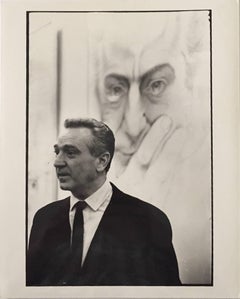
Category

1960s American Modern Black and White Photography

Materials

Silver Gelatin

Vintage Silver Gelatin Signed Photograph Edward Steichen, MoMA Photo

Vintage Silver Gelatin Signed Photograph Edward Steichen, MoMA Photo

By Fred McDarrah

Located in Surfside, FL

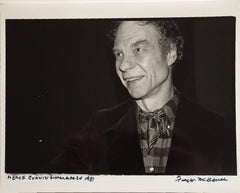
Edward Steichen, John Durniak, Monroe Wheeler and Edward D. Museum of modern art on Feb 10, 1962 Photographer Fred McDarrah Over a 50-year span, McDarrah documented the rise of the Beat Generation, the city’s postmodern art movement, its off-off-Broadway actors, troubadours, politicians, agitators and social protests. Fred captured Jack Kerouac frolicking with women at a New Year’s bash in 1958, Andy Warhol adjusting a movie-camera lens in his silver-covered factory, and Bob Dylan offering a salute of recognition outside Sheridan Square near the Voice’s old office. Not just a social chronicler, McDarrah was a great photo-journalist. For years, McDarrah was the Voice's only photographer and, for decades, he ran the Voice’s photo department, where he helped train dozens of young photographers, including James Hamilton, Sylvia Plachy, Robin Holland and Marc Asnin. His mailbox was simply marked "McPhoto." An exhibit of McDarrah’s photos of artists presented by the Steven Kasher Gallery in Chelsea was hailed by The New York Times as “a visual encyclopedia of the era’s cultural scene.” artists in their studios, (Alice Neel, Philip Guston, Stuart Davis, Robert Smithson, Jasper Johns, Franz Kline), actors (Dustin Hoffman, Robert De Niro on the set of “Taxi Driver”), musicians (Janis Joplin, Alice Cooper, Bob Dylan) and documentary images of early happenings and performances (Yayoi Kusama, Charlotte Moorman, Al Hansen, Jim Dine, Nam June Paik). The many images of Andy Warhol include the well-known one with his Brillo boxes at the Stable Gallery in 1964. Woody Allen, Diane Arbus, W. H. Auden, Francis Bacon, Joan Baez, Louise Bourgeois, David Bowie, Jimmy Breslin, William Burroughs, John Cage, Leo Castelli, Christo, Leonard Cohen, Merce Cunningham, William de Kooning, Jim Dine, Mark di Suvero, Marcel Duchamp, Bob Dylan, Federico Fellini, Allen Ginsberg, Robert Indiana, Mick Jagger, Jasper Johns, Kusama, John Lennon, Sol Lewitt, Roy Lichtenstein, Nam June Paik, Elvis Presley, Claes Oldenburg, Yoko Ono, Robert Rauschenberg, Lou Reed, James Rosenquist, Mark Rothko, Ed Ruscha, Robert Smithson, Susan Sontag, Andy Warhol, and others. McDarrah’s prints have been collected in depth by the J. Paul Getty Museum and the National Portrait Gallery, Washington. His work is in numerous public and private collections. Edward Jean Steichen (March 27, 1879 – March 25, 1973) was a Luxembourgish American photographer, painter, and art gallery and museum curator. Steichen's were the photographs that most frequently appeared in Alfred Stieglitz's groundbreaking magazine Camera Work during its publication from 1903 to 1917. Together Stieglitz and Steichen opened the Little Galleries of the Photo-Secession, which eventually became known as '291', after its address. Steichen laid claim to his photos of gowns for the magazine Art et Décoration in 1911 being the first modern fashion photographs ever published. From 1923 to 1938, Steichen was a photographer for the Condé Nast magazines Vogue and Vanity Fair while also working for many advertising agencies including J. Walter Thompson. During these years, Steichen was regarded as the best known and highest paid photographer in the world. In 1944, he directed the war documentary The Fighting Lady, which won the 1945 Academy Award for Best Documentary. From 1947 to 1961, Steichen served as Director of the Department of Photography at New York's Museum of Modern Art. While at MoMA, he curated and assembled exhibits including The Family of Man, which was seen by nine million people. In 1904, Steichen began experimenting with color photography. He was one of the earliest in the United States to use the Autochrome Lumière process. In 1905, Stieglitz and Steichen created the Little Galleries of the Photo-Secession, which eventually became known as 291 after its address. It presented some of the first American exhibitions of Henri Matisse, Auguste Rodin, Paul Cézanne, Pablo Picasso, and Constantin Brâncuși. He worked with Robert Frank even before his The Americans was published, exhibited the early work of Harry Callahan and Aaron Siskind, and purchased two Rauschenberg prints...
Category

1960s American Modern Black and White Photography

Materials

Silver Gelatin

Richard Klein, Holiday Inn Nocturne, 2020, Found and altered objects assemblage

Richard Klein, Holiday Inn Nocturne, 2020, Found and altered objects assemblage

Located in Darien, CT

In the mid 1990s Richard Klein started working with found glass objects, including bottles, drinking glasses, ashtrays, and eyeglasses. Initially, Klein rejected any object with commercial or advertising content, but in 2015 he became fascinated with the promotional content that was screen printed on ashtrays from the 1950s, 1960s and early 1970s. This period was before smoking was looked at as being primarily a negative habit, and iconic American businesses, including Howard Johnson’s, International House of Pancakes (iHop) and Holiday Inn, all produced promotional ashtrays printed with their graphic identity. By the time Klein became interested in these objects, the businesses had either ceased to exist, or had changed their logos, and many of their signature buildings, which where examples of classic, “Pop” roadside architecture, has been torn down or repurposed. The artist wanted to connect the glass objects with the business’s sites that were still recognizable and spoke of their history, so he began researching where original buildings still stood. Klein then embarked on a series of road trips to photograph these sites with the intention of combining the photographs with the promotional glass objects. This led him to as far south as Maryland and as far north as upstate New York from his home in Connecticut. In the case of Holiday Inn, it wasn’t their buildings, but their iconic illuminated sign that appeared on ashtrays, so he sought out a standing example of the sign he could photograph. As it turned out all had been removed years before from the hotels' properties and the only working example was indoors at the Henry Ford Museum in Dearborn, Michigan. He did, however, find out that there was one still standing, surprisingly, in Beruit, Lebanon. He found an image of it on the web and used it to make Holiday Inn (Beruit). In 1973 Holiday Inn changed their tagline from “The Nations Innkeeper” to “The World’s Innkeeper” as they expanded overseas, including the Mideast. For the hotel chain it was bad timing: the disastrous Lebanese civil war began in 1975. In the war, the different Lebanese militias involved in the conflict, including the Nasserites, Christian Phalangists, and the Lebanese National Movement engaged in what came to be called “The Battle of the Hotels” where they each occupied a major high-rise hotel in central Beruit. The Phalangists commanded the Holiday Inn, which they used to fire with both light arms and heavier weapons at the militias in neighboring hotels. Klein used the photo of the heavily damaged Holiday Inn sign as I thought it spoke in a curious, offhanded way about American cultural imperialism in juxtaposition with an ashtray that proclaimed Holiday Inn to be “The World’s Innkeeper.” In the work Holiday Inn (Nocturne) the artist utilized a found, 35mm slide of a Holiday Inn sign at night at an unknown location as the basis of the photograph in the work. Richard Klein is a Connecticut-based artist, independent curator and writer. As an artist, he has exhibited widely, including the Neuberger Museum of Art at SUNY Purchase; Caren Golden Fine Art, New York; the John Michael Kohler Arts Center, Sheboygan, WI; Hales Gallery, London; Gavlak Gallery, Palm Beach, FL; deCordova Sculpture Park and Museum, Lincoln, MA; James Barron Art, Kent, CT; The Portland Institute of Contemporary Art (PICA), Portland, OR; Schoolhouse Gallery, Provincetown, MA; Stephan Stoyanov Gallery, NY; Katonah Museum of Art, Katonah, NY; Brattleboro Museum and Art Center, Brattleboro, VT; Ortega y Gasset Projects, Brooklyn, NY; Exhibit by Alberson Tulsa, OK; Incident Report/Flow Chart Foundation, Hudson, NY; ICEHOUSE Project Space, Sharon, CT; Kenise Barnes Fine Art in Kent, CT and with ODETTA Gallery at the Equity Gallery in New York City.. Reviews of his work have appeared in Two Coats of Paint, Whitehot Magazine, The New York Times, Sculpture Magazine, Art in America, and The New Yorker. In the summer of 2024 he will be the first Artist-In-Residence at Peck Ledge Light...

Category

2010s Assemblage Still-life Sculptures

Materials

Metal

Richard Klein, McDonalds (El Nino), 2024, Found and altered objects assemblage

Richard Klein, McDonalds (El Nino), 2024, Found and altered objects assemblage

Located in Darien, CT

In the mid 1990s Richard Klein started working with found glass objects, including bottles, drinking glasses, ashtrays, and eyeglasses. Initially, Klein rejected any object with commercial or advertising content, but in 2015 he became fascinated with the promotional content that was screen printed on ashtrays from the 1950s, 1960s and early 1970s. This period was before smoking was looked at as being primarily a negative habit, and iconic American businesses, including Howard Johnson’s, International House of Pancakes (iHop) and Holiday Inn, all produced promotional ashtrays printed with their graphic identity. By the time Klein became interested in these objects, the businesses had either ceased to exist, or had changed their logos, and many of their signature buildings, which where examples of classic, “Pop” roadside architecture, has been torn down or repurposed. The artist wanted to connect the glass objects with the business’s sites that were still recognizable and spoke of their history, so he began researching where original buildings still stood. Klein then embarked on a series of road trips to photograph these sites with the intention of combining the photographs with the promotional glass objects. This led him to as far south as Maryland and as far north as upstate New York from his home in Connecticut. In the case of Holiday Inn, it wasn’t their buildings, but their iconic illuminated sign that appeared on ashtrays, so he sought out a standing example of the sign he could photograph. As it turned out all had been removed years before from the hotels' properties and the only working example was indoors at the Henry Ford Museum in Dearborn, Michigan. He did, however, find out that there was one still standing, surprisingly, in Beruit, Lebanon. He found an image of it on the web and used it to make Holiday Inn (Beruit). In 1973 Holiday Inn changed their tagline from “The Nations Innkeeper” to “The World’s Innkeeper” as they expanded overseas, including the Mideast. For the hotel chain it was bad timing: the disastrous Lebanese civil war began in 1975. In the war, the different Lebanese militias involved in the conflict, including the Nasserites, Christian Phalangists, and the Lebanese National Movement engaged in what came to be called “The Battle of the Hotels” where they each occupied a major high-rise hotel in central Beruit. The Phalangists commanded the Holiday Inn, which they used to fire with both light arms and heavier weapons at the militias in neighboring hotels. Klein used the photo of the heavily damaged Holiday Inn sign as I thought it spoke in a curious, offhanded way about American cultural imperialism in juxtaposition with an ashtray that proclaimed Holiday Inn to be “The World’s Innkeeper.” In the work Holiday Inn (Nocturne) the artist utilized a found, 35mm slide of a Holiday Inn sign at night at an unknown location as the basis of the photograph in the work. Richard Klein is a Connecticut-based artist, independent curator and writer. As an artist, he has exhibited widely, including the Neuberger Museum of Art at SUNY Purchase; Caren Golden Fine Art, New York; the John Michael Kohler Arts Center, Sheboygan, WI; Hales Gallery, London; Gavlak Gallery, Palm Beach, FL; deCordova Sculpture Park and Museum, Lincoln, MA; James Barron Art, Kent, CT; The Portland Institute of Contemporary Art (PICA), Portland, OR; Schoolhouse Gallery, Provincetown, MA; Stephan Stoyanov Gallery, NY; Katonah Museum of Art, Katonah, NY; Brattleboro Museum and Art Center, Brattleboro, VT; Ortega y Gasset Projects, Brooklyn, NY; Exhibit by Alberson Tulsa, OK; Incident Report/Flow Chart Foundation, Hudson, NY; ICEHOUSE Project Space, Sharon, CT; Kenise Barnes Fine Art in Kent, CT and with ODETTA Gallery at the Equity Gallery in New York City.. Reviews of his work have appeared in Two Coats of Paint, Whitehot Magazine, The New York Times, Sculpture Magazine, Art in America, and The New Yorker. In the summer of 2024 he will be the first Artist-In-Residence at Peck Ledge Light...

Category

2010s Assemblage Still-life Sculptures

Materials

Metal

Richard Klein, Expo 67, 2017, Found and altered objects assemblage

Richard Klein, Expo 67, 2017, Found and altered objects assemblage

Located in Darien, CT

In the mid 1990s Richard Klein started working with found glass objects, including bottles, drinking glasses, ashtrays, and eyeglasses. Initially, Klein rejected any object with commercial or advertising content, but in 2015 he became fascinated with the promotional content that was screen printed on ashtrays from the 1950s, 1960s and early 1970s. This period was before smoking was looked at as being primarily a negative habit, and iconic American businesses, including Howard Johnson’s, International House of Pancakes (iHop) and Holiday Inn, all produced promotional ashtrays printed with their graphic identity. By the time Klein became interested in these objects, the businesses had either ceased to exist, or had changed their logos, and many of their signature buildings, which where examples of classic, “Pop” roadside architecture, has been torn down or repurposed. The artist wanted to connect the glass objects with the business’s sites that were still recognizable and spoke of their history, so he began researching where original buildings still stood. Klein then embarked on a series of road trips to photograph these sites with the intention of combining the photographs with the promotional glass objects. This led him to as far south as Maryland and as far north as upstate New York from his home in Connecticut. In the case of Holiday Inn, it wasn’t their buildings, but their iconic illuminated sign that appeared on ashtrays, so he sought out a standing example of the sign he could photograph. As it turned out all had been removed years before from the hotels' properties and the only working example was indoors at the Henry Ford Museum in Dearborn, Michigan. He did, however, find out that there was one still standing, surprisingly, in Beruit, Lebanon. He found an image of it on the web and used it to make Holiday Inn (Beruit). In 1973 Holiday Inn changed their tagline from “The Nations Innkeeper” to “The World’s Innkeeper” as they expanded overseas, including the Mideast. For the hotel chain it was bad timing: the disastrous Lebanese civil war began in 1975. In the war, the different Lebanese militias involved in the conflict, including the Nasserites, Christian Phalangists, and the Lebanese National Movement engaged in what came to be called “The Battle of the Hotels” where they each occupied a major high-rise hotel in central Beruit. The Phalangists commanded the Holiday Inn, which they used to fire with both light arms and heavier weapons at the militias in neighboring hotels. Klein used the photo of the heavily damaged Holiday Inn sign as I thought it spoke in a curious, offhanded way about American cultural imperialism in juxtaposition with an ashtray that proclaimed Holiday Inn to be “The World’s Innkeeper.” In the work Holiday Inn (Nocturne) the artist utilized a found, 35mm slide of a Holiday Inn sign at night at an unknown location as the basis of the photograph in the work. Richard Klein is a Connecticut-based artist, independent curator and writer. As an artist, he has exhibited widely, including the Neuberger Museum of Art at SUNY Purchase; Caren Golden Fine Art, New York; the John Michael Kohler Arts Center, Sheboygan, WI; Hales Gallery, London; Gavlak Gallery, Palm Beach, FL; deCordova Sculpture Park and Museum, Lincoln, MA; James Barron Art, Kent, CT; The Portland Institute of Contemporary Art (PICA), Portland, OR; Schoolhouse Gallery, Provincetown, MA; Stephan Stoyanov Gallery, NY; Katonah Museum of Art, Katonah, NY; Brattleboro Museum and Art Center, Brattleboro, VT; Ortega y Gasset Projects, Brooklyn, NY; Exhibit by Alberson Tulsa, OK; Incident Report/Flow Chart Foundation, Hudson, NY; ICEHOUSE Project Space, Sharon, CT; Kenise Barnes Fine Art in Kent, CT and with ODETTA Gallery at the Equity Gallery in New York City.. Reviews of his work have appeared in Two Coats of Paint, Whitehot Magazine, The New York Times, Sculpture Magazine, Art in America, and The New Yorker. In the summer of 2024 he will be the first Artist-In-Residence at Peck Ledge Light...

Category

2010s Assemblage Still-life Sculptures

Materials

Metal

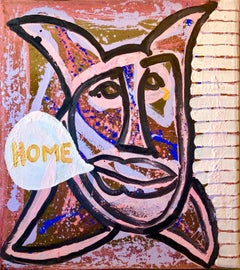
Conceptual Pop Art Color Mixed Media Painting "Home" Brooke Alexander Gallery

Conceptual Pop Art Color Mixed Media Painting "Home" Brooke Alexander Gallery

By Robin Winters

Located in Surfside, FL

Robin Winters (b. 1950) hand signed; 1986. Acrylic, rhoplex and powdered pigment on screenprint Dimensions: 36”h, 32”w Title: "Home" Provenance: Brooke Alexander Gallery, New York, New York. Gallery label verso. Robin Winters is known for his conceptual works in a wide variety of two- and three-dimensional media and performance/durational art. The reliquary and other recurring themes that appear in his works can be seen in the collection of sculptures and paintings offered in this sale (lots 170, 171, 173, 393, 396). Gallery label to reverse: Brooke Alexander Gallery, New York, New York. Provenance: Brooke Alexander Gallery, New York, New York. Robin Winters (born 1950 in Benicia, California) is an American conceptual, multi-disciplinary, artist and teacher based in New York. Winters is known for creating solo exhibitions containing an interactive durational performance component to his installations, sometimes lasting up to two months. Winters first emerged in the burgeoning Soho NYC art scene of the 1970s. An early practitioner of the Relational Aesthetics (social interaction as an art medium) Winters also created in works through sculpture, installation, performance, painting, drawing and prints. His art maintains a whimsical spirit, and he often returns to ongoing themes involving faces, boats, cars, bottles, hats and jesters or fools. Winters has incorporated such devices as blind dates, double dates, dinners, fortune telling, and free consultation in his performances. Throughout his career he has engaged in a wide variety of media, such as performance art, film, video, writing prose and poetry, photography, installation art, printmaking, drawing, painting, ceramic sculpture, bronze sculpture, and glassblowing. Winters was born in Benicia, California in 1950 to lawyer parents. As a child his hobby was collecting glass bottles found on the beach and under old buildings, which would later influence him as an artist. In 1968, Winters had his first durational performance, entitled Norman Thomas Travelling Museum. The artist drove a Volkswagen bus decorated in collage, many of the images relating to current events and politics. Inside was what the artist described as a “reliquary” containing many objects, including a bottle collection. Winters took the van to shopping centers and even as far as Mexico. That same year, Winters opted not to register for the military draft. Although he was deemed fit to serve, Winters refused. In 1975 the resulting legal proceedings finally came to a close after it was proven that the artist had been harassed by the local draft board. In his teens and early twenties, Winters became acquainted with several local artists who helped shape his aesthetic, most notably Manuel Neri and Robert Arneson. By the early 1970s, Winters was studying at the San Francisco Art Institute (SFAI) and had relocated to San Francisco. At this time Winters became friends with the Bay Area conceptual artists Terry Fox and Howard Fried, and participated in several of Fried's performance works. In 1972 Winters was accepted into the Whitney Independent Study Program in New York City. After coming to New York City, Winters helped support himself by working for various artists, among them the performance artist Joan Jonas and sculptor Donald Judd. In 1974, Winters performed The Secret Life of Bob-E or Bob-E Behind the Veil eight hours a day, five days a week for a month in his studio apartment. Behind a one-way mirror the audience could watch Winters play the character of Bob-E, whose goal was to make a monument for everyone in the world in the form of blue and yellow rubber top hats. By the end of the month the artist had constructed 262 hats. The following year, Winters was invited to take part in the Whitney Museum's 1975 Biennial Exhibition. Entitled W.B. Bearman Bags a Job or Diary of a Dreamer. These meetings led to the formation of the Group Collaborative Projects, or Colab, of which Winters is a founding member. Also in 1976, Winters formed the partnership “X&Y” with fellow artist Coleen Fitzgibbon that would last two years. Together they performed a series of shows in the Netherlands, most notably a show entitled Take the Money and Run. Performed at De Appel in Amsterdam, the show involved the artists robbing their audience. The following day the audience was given an apology, as well as the opportunity to retrieve any valuables and participate in a lottery to win the artists’ services. They also made a Super 8 film in NY called Rich-Poor, in which they asked people on the streets their thoughts on the rich and poor. In 1980 Winters participated in The Real Estate Show and in Absurdities at ABC No Rio. That same year he and artists Peter Fend, Coleen Fitzgibbon, Peter Nadin, Jenny Holzer, and Richard Prince also formed The Offices of Fend, Fitzgibbon, Holzer, Nadin, Prince & Winters. This short-lived collective was based out of an office on lower Broadway and offered “Practical Esthetic Services Adaptable to Client Situation”, as stated on their business card. Their goal was to offer their art as “socially helpful work for hire”. In June of that year Winters participated in The Times Square Show, Colab's most well-known exhibition. The month-long show took place in a four floor building on West 41st Street and was densely packed with art. To cap off a busy year, Winters also became one of the first artists to join the Mary Boone Gallery, showing a successful solo exhibition in 1981. His work was shown in the New York/New Wave show in 1981 at MoMA PS1 along with Jean-Michel Basquiat, Roberta Bayley, William S. Burroughs, David Byrne, Sarah Charlesworth, Larry Clark, Crash (John Matos), Ronnie Cutrone, Brian Eno, Peter Fend, Nan Goldin, Keith Haring, Ray Johnson, Joseph Kosuth, Marcus Leatherdale, Christopher Makos, Robert Mapplethorpe, Elaine Mayes, Frank Moore, Kenny Scharf and others. In 1982, Winters had his first solo exhibition in Los Angeles at the Richard Kuhlenschmidt Gallery. At the Mo David Gallery in 1984, Winters created an installation piece that consisted of a floor of plaster tiles. Underneath each tile, hidden from view, was a drawing. He designed the stage sets for the musician Nico, and assisted French artist Orlan, American artist Stuart Sherman, and American poet Gregory Corso. Two years later Winters was invited to take part in Chambres d’Amis (In Ghent there is Always a Free Room for Albrecht Durer) in Ghent, Belgium. In it, 51 artists created installations in 50 different sites, mostly private homes. Winters chose the home of a local art historian. The artist made 90 drawings based on images found in the large collection of art books in the home's library. He made two copies of each drawing and placed the originals in the books themselves. One set of copies was exhibited in the sponsoring museum, Museum van Hedendaagse, as "The Ghent Drawings". The drawings were also on display at Winters’ solo exhibition at Luhring Augustine & Hodes Gallery in New York City in 1987. In 1986, Winters had a solo exhibition at Maurice Keitelman Gallery in Brussels, Belgium, and the following year a solo exhibition at the Centre Régional d'Art Contemporain Midi-Pyrénées in Toulouse, France. Also in 1986, Winters' Playroom was held at the Institute for Contemporary Art in Boston, Massachusetts. The exhibition was part of Think Tank, a retrospective of Winters' work which traveled to the Stedelijk Museum in the Netherlands, the Centre Regional d’Art Contemporain in France, and the Contemporary Arts Center in Ohio. Winters spent a month in 1989 working with students at the San Francisco Art Institute. Never having worked with ceramics, he spent the month making numerous ceramic pieces, which were then shown in the aptly named One Month in San Francisco. Other components of the piece included Winters’ childhood bottle collection and a video showing each piece in the show filmed briefly next to a ruler.[ Also that year, Robin served as a visiting artist at the Pilchuck Glass School, where he met artist John Drury, who was then working as the school's artist liaison. In the summer of 1990, Winters interviewed fellow artist Kiki Smith for her eponymous book, which was published later that year. That same year (1990), Winters was invited by the Val Saint Lambert glass factory in Belgium to create glassworks in their facility. Winters, artists John Drury and Tracy Glover traveled to Liege from the US, and the three in combination with two of the factories master glassblowers, realized Mr. Winters' work over six weeks time. A portion of the works, a group of glass heads and hats that the artist had produced at the factory, were exhibited in 1990 at the Centre d’Art Contemporain Geneve in Geneva, Switzerland. Later in the year they were included in his solo exhibition at Brooke Alexander Gallery in New York City. They were also shown at Facts and Rumours, an exhibition at the Witte de With Center for Contemporary Art in Rotterdam, the Netherlands in 1991. Winters had a solo exhibition at Van Esch Galerie in Eindhoven, the Netherlands called I am not Indifferent in 1991. The show consisted of paintings, glass heads, and bronze sculpture. Two years later he had another solo exhibition at the Renaissance Society at the University of Chicago, entitled Human Nature. Several hundred heads, made of glass and ceramic, lined the walls and were arranged in rings on the floor. Also on display were various paintings and bronzes. In 1994 Winters had a show at the Michael Klein Gallery in New York City entitled Notes from the Finishing Room, a solo exhibition of paintings. The artist also collaborated with fellow Benicia natives and glass artists Leroy Champagne and Michael Nourot...

Category

1980s Pop Art Figurative Paintings

Materials

Mixed Media, Acrylic, Pigment, Screen

Original Rollage Michelangelo Sculpture, Bruegel Painting, Jiri Kolar Collage

Original Rollage Michelangelo Sculpture, Bruegel Painting, Jiri Kolar Collage

By Jiri Kolar

Located in Surfside, FL

UNTITLED (ROLLAGE) Jiri Kolar Mixed Media, 1967 Rollage of a sculpture by Michelangelo and a painting by Bruegel Medium: Mixed Media, Collage Surface: Photographic Paper Country: Cz...

Category

20th Century Contemporary Mixed Media

Materials

Mixed Media

Conceptual Pop Art Color Oil Monotype Painting Abstract Figure Robin Winters

Conceptual Pop Art Color Oil Monotype Painting Abstract Figure Robin Winters

By Robin Winters

Located in Surfside, FL

Robin Winters (American, born 1950), Untitled (Red Face) from "Cherry Block Series" 1986, monotype, pencil signed and dated lower right, plate: 6"h x 8.5"w, overall (with frame): 22.25"h x 18.25"w. Provenance: Property from a Private Collection, San Francisco. Winters was invited to make monotypes at Experimental Workshop in San Francisco, (they printed Richard Bosman, Sam Francis, Claire Falkenstein, Deborah Oropallo and Kenneth Noland and many more greats). Winters chose to paint on wood blocks rather than the more usual metal plates in order to capture the organic quality of the natural material. He exploited a salient characteristic of the monoprint in Ghost Story by adding new painted elements onto the increasingly faint ghost images that result from successive impressions from a single block. In so doing he achieved the effect of transparent layers of color and shadow imagery. Winters's brightly-colored monotypes portray an array of figures and landscapes (and an occasional still-life) that, although can be seen in the context of a general trend away from abstraction that has marked the 1980s, defy strict stylistic categorization. They are neither realistic nor abstract, psychological self-examinations nor narrative fictions, but they contain elements of all of these approaches. Like Jonathan Borofsky, Winters derives much of his subject matter from dreams, believing that through his private fears and obsessions he can touch similar emotions in others. Although at first glance Winters's images look as if they could have been made by a child, closer attention reveals sly art historical references to Jackson Pollock and Pattern Painting (the drip and splatter backgrounds), Mark Rothko (the three-part horizontal compositions) and Minimalism (the gridded Cherry Block Series: Bread Beat). Robin Winters (born 1950 in Benicia, California) is an American conceptual, multi-disciplinary, artist and teacher based in New York. Winters is known for creating solo exhibitions containing an interactive durational performance component to his installations, sometimes lasting up to two months. Winters first emerged in the burgeoning Soho NYC art scene of the 1970s. An early practitioner of the Relational Aesthetics (social interaction as an art medium) Winters also created in works through sculpture, installation, performance, painting, drawing and prints. His art maintains a whimsical spirit, and he often returns to ongoing themes involving faces, boats, cars, bottles, hats and jesters or fools. Winters has incorporated such devices as blind dates, double dates, dinners, fortune telling, and free consultation in his performances. Throughout his career he has engaged in a wide variety of media, such as performance art, film, video, writing prose and poetry, photography, installation art, printmaking, drawing, painting, ceramic sculpture, bronze sculpture, and glassblowing. Winters was born in Benicia, California in 1950 to lawyer parents. As a child his hobby was collecting glass bottles found on the beach and under old buildings, which would later influence him as an artist. In 1968, Winters had his first durational performance, entitled Norman Thomas Travelling Museum. The artist drove a Volkswagen bus decorated in collage, many of the images relating to current events and politics. Inside was what the artist described as a “reliquary” containing many objects, including a bottle collection. Winters took the van to shopping centers and even as far as Mexico. That same year, Winters opted not to register for the military draft. Although he was deemed fit to serve, Winters refused. In 1975 the resulting legal proceedings finally came to a close after it was proven that the artist had been harassed by the local draft board. In his teens and early twenties, Winters became acquainted with several local artists who helped shape his aesthetic, most notably Manuel Neri and Robert Arneson. By the early 1970s, Winters was studying at the San Francisco Art Institute (SFAI) and had relocated to San Francisco. At this time Winters became friends with the Bay Area conceptual artists Terry Fox and Howard Fried, and participated in several of Fried's performance works. In 1972 Winters was accepted into the Whitney Independent Study Program in New York City. After coming to New York City, Winters helped support himself by working for various artists, among them the performance artist Joan...

Category

1980s Pop Art Figurative Paintings

Materials

Monoprint, Monotype

Conceptual Pop Art Color Oil Monotype Painting Abstract Figure Robin Winters

Conceptual Pop Art Color Oil Monotype Painting Abstract Figure Robin Winters

By Robin Winters

Located in Surfside, FL

Robin Winters (American, born 1950), Untitled (Red Face) from "Cherry Block Series" 1986, monotype, pencil signed and dated lower right, plate: 6"h x 8.5"w, overall (with frame): 22.25"h x 18.25"w. Provenance: Property from a Private Collection, San Francisco. Winters was invited to make monotypes at Experimental Workshop in San Francisco, (they printed Richard Bosman, Sam Francis, Claire Falkenstein, Deborah Oropallo and Kenneth Noland and many more greats). Winters chose to paint on wood blocks rather than the more usual metal plates in order to capture the organic quality of the natural material. He exploited a salient characteristic of the monoprint in Ghost Story by adding new painted elements onto the increasingly faint ghost images that result from successive impressions from a single block. In so doing he achieved the effect of transparent layers of color and shadow imagery. Winters's brightly-colored monotypes portray an array of figures and landscapes (and an occasional still-life) that, although can be seen in the context of a general trend away from abstraction that has marked the 1980s, defy strict stylistic categorization. They are neither realistic nor abstract, psychological self-examinations nor narrative fictions, but they contain elements of all of these approaches. Like Jonathan Borofsky, Winters derives much of his subject matter from dreams, believing that through his private fears and obsessions he can touch similar emotions in others. Although at first glance Winters's images look as if they could have been made by a child, closer attention reveals sly art historical references to Jackson Pollock and Pattern Painting (the drip and splatter backgrounds), Mark Rothko (the three-part horizontal compositions) and Minimalism (the gridded Cherry Block Series: Bread Beat). Robin Winters (born 1950 in Benicia, California) is an American conceptual, multi-disciplinary, artist and teacher based in New York. Winters is known for creating solo exhibitions containing an interactive durational performance component to his installations, sometimes lasting up to two months. Winters first emerged in the burgeoning Soho NYC art scene of the 1970s. An early practitioner of the Relational Aesthetics (social interaction as an art medium) Winters also created in works through sculpture, installation, performance, painting, drawing and prints. His art maintains a whimsical spirit, and he often returns to ongoing themes involving faces, boats, cars, bottles, hats and jesters or fools. Winters has incorporated such devices as blind dates, double dates, dinners, fortune telling, and free consultation in his performances. Throughout his career he has engaged in a wide variety of media, such as performance art, film, video, writing prose and poetry, photography, installation art, printmaking, drawing, painting, ceramic sculpture, bronze sculpture, and glassblowing. Winters was born in Benicia, California in 1950 to lawyer parents. As a child his hobby was collecting glass bottles found on the beach and under old buildings, which would later influence him as an artist. In 1968, Winters had his first durational performance, entitled Norman Thomas Travelling Museum. The artist drove a Volkswagen bus decorated in collage, many of the images relating to current events and politics. Inside was what the artist described as a “reliquary” containing many objects, including a bottle collection. Winters took the van to shopping centers and even as far as Mexico. That same year, Winters opted not to register for the military draft. Although he was deemed fit to serve, Winters refused. In 1975 the resulting legal proceedings finally came to a close after it was proven that the artist had been harassed by the local draft board. In his teens and early twenties, Winters became acquainted with several local artists who helped shape his aesthetic, most notably Manuel Neri and Robert Arneson. By the early 1970s, Winters was studying at the San Francisco Art Institute (SFAI) and had relocated to San Francisco. At this time Winters became friends with the Bay Area conceptual artists Terry Fox and Howard Fried, and participated in several of Fried's performance works. In 1972 Winters was accepted into the Whitney Independent Study Program in New York City. After coming to New York City, Winters helped support himself by working for various artists, among them the performance artist Joan...

Category

1980s Pop Art Figurative Paintings

Materials

Monoprint, Monotype

Early Morning Light 4

Early Morning Light 4

By Robert Vizzini

Located in New York, NY

Silver lith print Signed, titled, dated, and numbered, verso 14 x 11 inches (Edition of 9) 20 x 16 inches (Edition of 9) This artwork is offered by ClampArt, located in New York C...

Category

Early 2000s Contemporary Landscape Photography

Materials

Silver Gelatin

Late Morning Light 2

Late Morning Light 2

By Robert Vizzini

Located in New York, NY

Silver lith print Signed, titled, dated, and numbered, verso 14 x 11 inches (Edition of 9) 20 x 16 inches (Edition of 9) This artwork is offered by ClampArt, located in New York C...

Category

Early 2000s Contemporary Landscape Photography

Materials

Silver Gelatin

Late Morning Light 1

Late Morning Light 1

By Robert Vizzini

Located in New York, NY

Silver lith print Signed, titled, dated, and numbered, verso 14 x 11 inches (Edition of 9) 20 x 16 inches (Edition of 9) This artwork is offered by ClampArt, located in New York C...

Category

Early 2000s Contemporary Landscape Photography

Materials

Silver Gelatin

North Beach 1

North Beach 1

By Robert Vizzini

Located in New York, NY

Lith developed gelatin silver print, toned with sepia and gold Signed, titled, dated, and numbered, verso 13 x 13 inches (Edition of 15) 17 x 17 inches (Edition of 15) This artwor...

Category

Early 2000s Contemporary Landscape Photography

Materials

Silver Gelatin

Montauk 1

Montauk 1

By Robert Vizzini

Located in New York, NY

Lith developed gelatin silver print, toned with sepia and gold Signed, titled, dated, and numbered, verso 13 x 13 inches (Edition of 15) 17 x 17 inches (Edition of 15) This artwor...

Category

Early 2000s Contemporary Landscape Photography

Materials

Silver Gelatin

Montauk 2

Montauk 2

By Robert Vizzini

Located in New York, NY

Lith developed gelatin silver print, toned with sepia and gold Signed, titled, dated, and numbered, verso 13 x 13 inches (Edition of 15) 17 x 17 inches (Edition of 15) This artwor...

Category

Early 2000s Contemporary Landscape Photography

Materials

Silver Gelatin

Montauk Point 1

Montauk Point 1

By Robert Vizzini

Located in New York, NY

Lith developed gelatin silver print, toned with sepia and gold Signed, titled, dated, and numbered, verso 13 x 13 inches (Edition of 15) 17 x 17 inches (Edition of 15) This artwor...

Category

Early 2000s Contemporary Landscape Photography

Materials

Silver Gelatin

UNTITLED

UNTITLED

By (after) Sol LeWitt

Located in New York, NY

This geometric abstraction is a silkscreen print on linen backed paper.

Category

1970s Contemporary Prints and Multiples

Materials

Linen, Paper