We didn't find any results for "national dragster, volume 34, issue 50"

Get notified when items are added to this search

Showing results matching fewer words
28
17
26
20
12
10
9
7
7
6
5
4
2
2
2
2
2
2
1
1
1
1
1
1
1
1
1
10
6
5
2
2
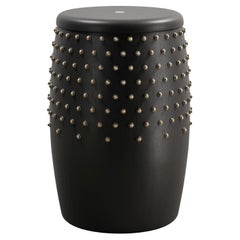
Sitiera Stool in Solid Wood, Olivo Thick Leather & Aged Bronze by Estudio Andean

Sitiera Stool in Solid Wood, Olivo Thick Leather & Aged Bronze by Estudio Andean

Located in Geneve, CH

Sitiera Stool in Solid Wood, Olivo Thick Leather & Aged Bronze by Estudio Andean Dimensions: D 34 x W 34 x H 50 cm. SH: 50 cm. Materials: Bronze, leather, and solid wood. Stool craf...

Category

2010s Ecuadorean Post-Modern Stools

Materials

Bronze

Sitiera Stool in Solid Wood with Aged Bronze Accents by Estudio Andean

Sitiera Stool in Solid Wood with Aged Bronze Accents by Estudio Andean

Located in Geneve, CH

Sitiera Stool in Solid Wood with Aged Bronze Accents by Estudio Andean Dimensions: D 34 x W 34 x H 50 cm. SH: 50 cm. Materials: Bronze and solid wood. Stool crafted from solid Seike...

Category

2010s Ecuadorean Post-Modern Stools

Materials

Bronze

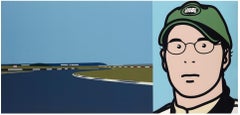
IMAGINE YOU ARE DRIVING (FAST) JACQUES

IMAGINE YOU ARE DRIVING (FAST) JACQUES

By Julian Opie

Located in Aventura, FL

Lambda print in colors, on Fuji color photographic paper dry-mounted to PVC (as issued). Hand signed and numbered in black marker on the reverse. Edition of 34/50. Published by Ala...

Category

Early 2000s Contemporary Figurative Prints

Materials

PVC, Photographic Paper, Lambda

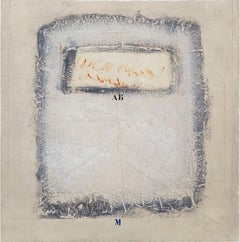
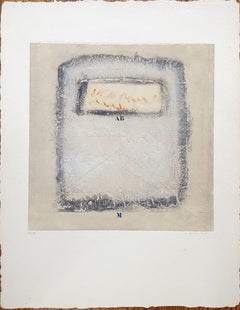
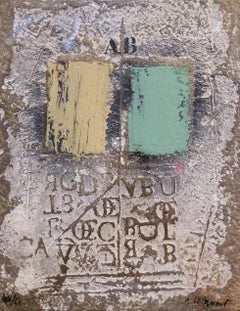
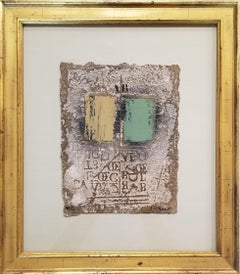
Espace - Ecriture (Space - Writing) /// French Contemporary Abstract Minimalism

Espace - Ecriture (Space - Writing) /// French Contemporary Abstract Minimalism

By James Coignard

Located in Saint Augustine, FL

Artist: James Coignard (French, 1925-2008) Title: "Espace - Ecriture (Space - Writing)" *Signed by Coignard in pencil lower right Year: 1983 Medium: Original Hand-Embellished Carboru...

Category

1980s Abstract Expressionist Abstract Prints

Materials

Handmade Paper, Engraving, Intaglio

Eduardo Chillida, Original Vintage Lithograph on cardboard, Framed

Eduardo Chillida, Original Vintage Lithograph on cardboard, Framed

By Eduardo Chillida

Located in Warszawa, Mazowieckie

Eduardo Chillida Lithograph on cardboard Number T 169/1000 The work is signed by the artist and individually numbered (pencil) Work dimensions 47/34 The work is framed Eduardo Chillida(1924 - 2002). He was a Spanish artist. He began his career in 1943, studying architecture at the University of Madrid, but in 1947 he took up drawing and sculpture. In 1948 he moved to Paris, then the world capital of art. Although he dropped out of college, his work betrays his architectural training, revealing an underlying sense of structural organization as well as material discipline, planning spatial relationships, and scaling elements. For years, the artist used materials that were the basis for his research on conceptual and metaphysical issues. Chillida's early efforts in stone and plaster oscillated between humans and the natural world. His return to the Spanish Basque country in 1951 initiated a change of vision, focusing more on the metamorphosis of space and the definition of spatial volume through form. Chillida soon abandoned the plaster he had used in his Paris works in favor of iron, then wood and steel. These materials represent Basque traditions in industry, architecture and agriculture, and recall the landscape and black light of the region. Chillida began using alabaster for its illuminated but veiled appearance, he used it in the sculpture How Deep is the Air (1996). Despite his use of a variety of media, Chillida's intentions for simplicity and balance never allowed the material to take on a form alien to its nature. He was consistently guided by the quality of space, density and rhythm. Major retrospectives of Chillida's graphic and sculptural works have been exhibited by the Museum of Fine Arts, Houston (1966), the Carnegie Institute, Pittsburgh (1979), the National Gallery of Art, Washington, D.C. (1979), the Guggenheim Museum (1980), the Palacio de Miramar, San Sebastián (1992), and Museo nacional centro de arte Reina Sofía, Madrid (1999). Chillida's monumental sculptures designed for urban and more remote spaces are permanently installed internationally and constitute a central aspect of his artistic production. Chillida has received numerous awards, including the Grand International Sculpture Prize at the Venice Biennale (1958), the Kandinsky Prize (1960), the Carnegie Prize for Sculpture (1964), the Andrew Mellon...

Category

1990s Spanish Mid-Century Modern Decorative Art

Materials

Paper

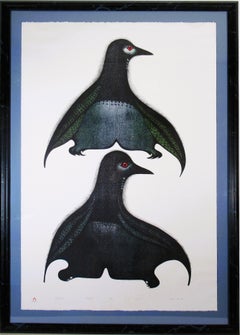
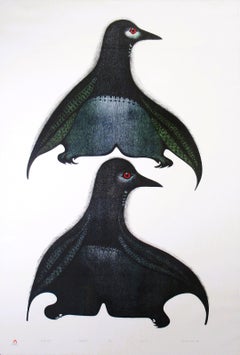
Young Loons, Very large original color lithograph

Young Loons, Very large original color lithograph

Located in San Francisco, CA

This artwork titled "Young Loons, 1990 is an original color lithograph by Canadian Inuit noted artist Pitaloosie Saila. 1942-2021. It is hand signed, titled, dated, located, described and numbered 34/50 in pencil by the artist. The subject size is 38.75 x 23.25 inches, sheet size is 44 x 30 inches, framed is 51.75 x 37.25 inches. Custom framed in a metal frame, with grey/blue backing. It is in excellent condition. About the artist: Pitaloosie was born in 1942 on the southwest coast of Baffin Island near what is now the community of Cape Dorset. She spent her childhood years in various hospitals in Quebec and Ontario for treatment of tuberculosis. She learnedEnglish during this time, and recalls the difficulty she experienced in relearning her native language upon her return to Baffin Island in 1957. She is now one of the few of her generation who speak both English and Inuktitut fluently. Pitaloosie began drawing in the early 1960’s, and quickly established herself as a versatile and intelligent graphic artist. Over the years, she has become a familiar presence in the Kinngait Studios, and her work has been included in annual print collections since 1968. Since the late 1960’s, Pitaloosie has made frequent trips to southern Canada to attend exhibitions and conferences. In 1967, she spent several weeks in Toronto while her husband, the well-known sculptor Pauta Saila, participated in an International Sculpture Symposium. Subsequently, she has visited Halifax, Toronto, Ottawa, Kansas City and Vermont. Her work has been featured in solo drawing exhibitions, and in 1977, Canada Post issued a stamp depicting her print, Fisherman’s Dream. Her 1985 lithograph entitled In the Hills represented the Northwest Territories in the centennial celebration of the National Parks of Canada. Amnesty International, the international human rights organization, selected a drawing by Pitaloosie entitled Mother and Child to use for their 1990 Christmas card. She was also one of nine featured artists in the acclaimed exhibition Isumavut: The Artistic Expression of Nine Cape Dorset Women, which opened at the Canadian Museum of Civilization in the fall of 1994 and continues to travel to other venues. Pitaloosie’s husband, Pauta, passed away in Cape Dorset in June of 2009 at the age of 93. In 2004, both she and Pauta were appointed members of the Royal Canadian Academy of the Arts, in recognition of their life’s work and contributions to Canadian art. Selected Exhibitions: • 2019 60/60, Feheley Fine Arts, Toronto • 2016 Pitaloosie Saila: A Print Retrospective, Feheley Fine Arts, Toronto • Toronto • 2003 The Inuit 2004 Sanaasimasiatok/Fine Works: Sculpture from Cape Dorset, Feheley Fine Arts, Icon: Selections from Private Collections, Feheley Fine Arts, Toronto • 1996-1997 Pitaloosie & Pauta, McMichael Canadian Art Collection, Kleinburg, ON • 1994 – 1995 Isumavut: The Artistic Expression of Nine Cape Dorset Women, Canadian Museum of History, Gatineau, QC • 1993 – 1994 Contemporary Inuit Drawings, Muscarelle Museum of Art, College of William and Mary, Williamsburg, VA • 1991 – 1992 In Cape Dorset We Do It This Way: Three Decades of Inuit Printmaking, McMichael Canadian Art Collection, Kleinburg, ON • 1989 – 1991 Kenojuak Ashevak...

Category

Late 20th Century Other Art Style Animal Prints

Materials

Lithograph

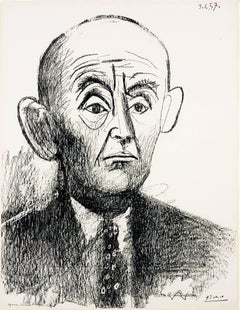
Portrait de D. H. Kahnweiler I

Portrait de D. H. Kahnweiler I

By Pablo Picasso

Located in Fairlawn, OH

Portrait de D. H. Kahnweiler I Lithograph, 1957 Estate Signature Stamp lower right Provenance: Picasso Estate Marina Picasso, her stamp on reverse Annotated in ...

Category

1950s French School Portrait Prints

Materials

Lithograph

La foule, Paroles peintes I, Robert Jacobson

La foule, Paroles peintes I, Robert Jacobson

Located in Southampton, NY

Etching on vélin Johannot d’Arches paper. Inscription: Unsigned and unnumbered, as issued. Good condition. Notes: From the album, Paroles peintes I, 1962. Published by Éditions O. La...

Category

1960s Modern Landscape Prints

Materials

Etching

Landscape XI
Landscape XI

Landscape XI

Located in San Francisco, CA

This artwork titled "Landscape XI' c.2000 is an original color etching with aquatint by Hungarian/American artist Theodora Varnay Jones, b.1942. It is hand signed, titled and numbered 18/50 in pencil by the artist. The image (plate mark) size is 14.75 x 17.65 inches, framed size is 28.25 x 30 inches. Custom framed in a silver and brown patina frame, with white matting. It is in excellent condition. About the artist: Theodora Varnay Jones, printmaker, sculptor, installation and digital artist, lecturer, and teacher, was born in Budapest, Hungary on 26 February 1942. She graduated from the Hámán Kató Leány Gimnázium before beginning her studies at the Academy of Fine Arts, Budapest where she earned her B.F.A. and, in 1971, her M.F.A. She moved to the United States in the early 1970s and married Monty Jones on 9 September 1972 in Reno. On 27 September 1984 she became a naturalized citizen of the United States. Her creativity seems unlimited and her work has been featured in exhibitions too numerous to enumerate. She is a member of the KALA Art Gallery in Berkeley, California and teaches classes there. SOLO EXHIBITIONS 2018 "Dialectics:angles of cognition, in the orbit of photography" Don Soker Gallery, San Francisco, CA 2016 "Fugue" Don Soker Gallery, San Francisco, CA 2015 "Resonances" Stanford Art Spaces, Stanford University, CA "Appearances" Lena & Roselli Galeria, Budapest, Hungary 2011 "Theodora Varnay Jones: Prints & Drawings: Selected Archival Work” Baczek Gallery, Berkeley, CA 09/10 "Manifold", (survey) ICA, San Jose, CA 2009 "Reflections", (survey) Don Soker Gallery, San Francisco, CA 2008 "Translucent Phenomena", Fresno Art Museum, Fresno, CA 2007 "Structures" Don Soker Gallery, San Francisco, CA 2005 "Theodora Varnay Jones", Galerie Reinfeld, Bremen, G e r m a n y "Undercurrents", Don Soker Gallery, San Francisco, CA 2003 "Theodora Varnay Jones", Gallery Hirawata, Fujisawa, Kanagawa, J a p a n "Theodora Varnay Jones", Gallery Naufu, Gifu City, J a p a n "Dialectica", Don Soker Gallery, San Francisco, CA 2001 "Transparentia", Don Soker Gallery, San Francisco, CA " Theodora Varnay Jones", Galerie Reinfeld, Bremen, G e r m a n y "Mixed Media Works", Shasta College Art Gallery, Redding, CA SFMOMA Artists Gallery, San Francisco, CA 2000 " Microcosmos" invited to represent the US, Schleswig-Holstein Music Festival, Bad Segeberg, G e r m a n y "Microcosmos" Kieler Kloster, Kiel, G e r m a n y 1999 Don Soker Gallery, San Francisco, CA 1998 Don Soker Gallery, San Francisco, CA 1997 Plaza Gallery, Tokyo, J a p a n 1996 "Theodora Varnay Jones" (survey), Vasarely Museum, Budapest, H u n g a r y 1995 Don Soker Gallery, San Francisco, CA "Theodora Varnay Jones", Shirakawa Gallery, Kyoto, J a p a n 1994 Collectors Gallery, The Oakland Museum, CA 1993 Don Soker Gallery, San Francisco, CA 1992 "Theodora Varnay Jones", Concourse Gallery, Bank of America World Headquarters, San Francisco, CA "Theodora Varnay Jones", Shirakawa Gallery, Kyoto, J a p a n "Theodora Varnay Jones", Chicashige Gallery, Okayama, J a p a n 1991 Collectors Gallery, The Oakland Museum, CA 1990 Don Soker Gallery, San Francisco, CA "Theodora Varnay Jones", Art Forum Yanaka, Tokyo, J a p a n Tamura Gallery, Tokyo, J a p a n Gallery 88, Sendai, J a p a n Heian Gallery, Kyoto, J a p a n 1989 Richard Hanson Fine Arts, Fresno, CA 1988 Don Soker Gallery, San Francisco, CA 1985 "Theodora Varnay Jones", Taller Galleria Fort, Cadaques, S p a i n 1984 Rorick Gallery, San Francisco, CA 1978 "Theodora Varnay Jones", Richmond Art Center, Richmond, CA TWO AND THRE PERSON EXHIBITIONS 2010 "Interdepencia/Interdependence; Theodora Varnay Jones, Francesca Pastine and Marta Sanchez-Vasquez" Consulate General of Mexico, San Francisco, CA 2007 "Theodora Varnay Jones and Tom Bills", Pacifica Center for the Arts, CA 2004 "Between"; Theodora Varnay Jones and Dee Hibbert-Jones Memorial Union Art Gallery, UC Davis 2002 "Theodora Varnay Jones and Lee Imonen", Campbell Hall Gallery, Western Oregon University 2001 "Traces" ; Theodora Varnay Jones, Christel Dillbohner and Mary Ijichi, Palo Alto Art Center, CA 2000 "Theodora Varnay Jones and Hoh Yin Ping", Kassenarztliche Vereinigung, Bremen, G e r m a n y 1988 "Theodora Varnay Jones and Kazuko Watanabe", Hastings College of the Law, San Francisco, CA 1985 "From a Different Perspective"; Theodora Varnay Jones and Peter Baczek, The Art Corridor, Menlo Park, CA 1981 "Theodora Varnay Jones and Vicki Ann Scuri", Rorick Gallery, San Francisco, CA SELECTED GROUP EXHIBITIONS 2021 "50th Anniversary Survey Exhibition" Don Soker Gallery at Carriage House Annex, San Francisco, CA "Art in the Time of Corona" NUMU New Museum Los Gatos, CA 2020 "Echoes of Bauhaus Photography Cast Long Shadows" curated by Hanna Regev, Ruth's Table Gallery, San Francisco, CA 2019 "Hardly Strictly Mini" Bolinas Art Museum, CA "The Artists' Annual" Kala Art Institute Gallery, Berkeley, CA "Annual Members Exhibition" Berkeley Art Center, CA 2018 "Surprise: New Acquisitions" The Janet Turner...

Category

21st Century and Contemporary Abstract Expressionist Abstract Prints

Materials

Etching, Aquatint

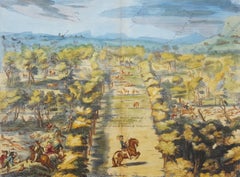
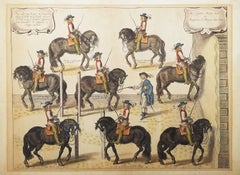
Welbeck Park Belongs to the Marquis of Newcastle /// Equestrian Horse Old Master

Welbeck Park Belongs to the Marquis of Newcastle /// Equestrian Horse Old Master

By William Cavendish

Located in Saint Augustine, FL

Artist: William Cavendish (English, 1593-1676) Title: "Welbeck Park Belongs to the Marquis of Newcastle" (Plate 38, page 263) Portfolio: Methode et Invention Nouvelle de Dresser Les ...

Category

1730s Old Masters Landscape Prints

Materials

Watercolor, Laid Paper, Engraving, Etching, Intaglio

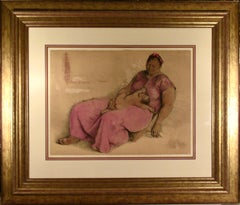
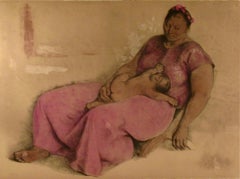
"Madre Juchiteca" Large original color lithograph.

"Madre Juchiteca" Large original color lithograph.

By Francisco Zúñiga

Located in San Francisco, CA

This artwork titled "Madre Juchiteca" 1973 is an original colors lithograph on Arches paper by renown Costa Rican/Mexican artist Francisco Zuniga, 1912-1998. It is hand signed, dated...

Category

Late 20th Century Realist Figurative Prints

Materials

Lithograph

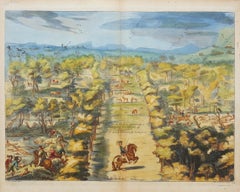
Captain Mazin Rides, and the Marquis Gives the Lesson /// Equestrian Horse Art

Captain Mazin Rides, and the Marquis Gives the Lesson /// Equestrian Horse Art

By William Cavendish

Located in Saint Augustine, FL

Artist: William Cavendish (English, 1593-1676) Title: "Captain Mazin Rides, and the Marquis Gives the Lesson" (Plate 17, page 76) Portfolio: Methode et Invention Nouvelle de Dresser ...

Category

1730s Old Masters Animal Prints

Materials

Watercolor, Laid Paper, Engraving, Etching, Intaglio

"Silvia" Large original color lithograph

"Silvia" Large original color lithograph

By Francisco Zúñiga

Located in San Francisco, CA

This artwork titled "Silvia" 1980 is an original colors lithograph on Wove paper by renown Costa Rican/Mexican artist Francisco Zuniga, 1912-1998. It is hand signed, dated and number...

Category

Late 20th Century Realist Figurative Prints

Materials

Lithograph

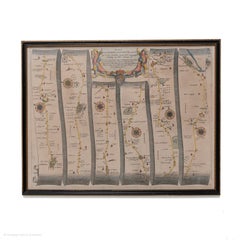
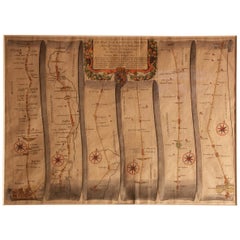
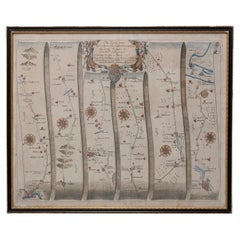
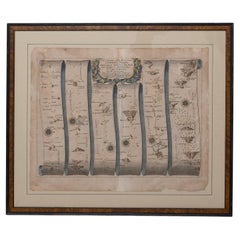
Road Map No43 London to Kings Lynn, Royston to Downham, John Ogilby, Britannia

Road Map No43 London to Kings Lynn, Royston to Downham, John Ogilby, Britannia

By John Ogilby

Located in BUNGAY, SUFFOLK

John Ogilby (British 1600-1676) Cosmographer and Geographick Printer to Charles II. A road map from Britannia, 1675/6. The road from London to Kings Lynn, showing Royston to Downham. In oak and gilded frame. In a remarkable life John Ogilby pursued, several careers, each ending in misfortune, and yet he always emerged undeterred, to carry on. His modern reputation is based on his final career, started in his sixty-sixth year, as a publisher of maps and geographical accounts. Ogilby was born outside Dundee, in 1600, the son of a Scottish gentleman...

Category

Antique Late 17th Century British Charles II Maps

Materials

Paper

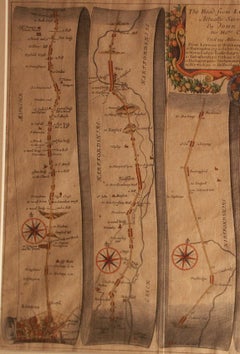
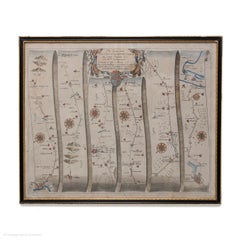
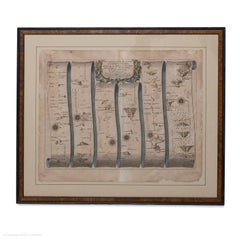
Road Map, John Ogilby, No 54, London, Yarmouth, Britannia

Road Map, John Ogilby, No 54, London, Yarmouth, Britannia

By John Ogilby

Located in BUNGAY, SUFFOLK

The Road from London to Yarmouth com. Norfolk. By John Ogilby, His Majesties Cosmographer. Containing 122 miles, 5 furlongs. No 54. From Standard in Co...

Category

Antique 1670s English Baroque Maps

Materials

Paper

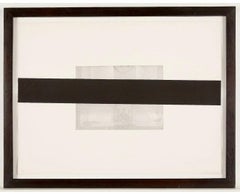
Large Contemporary Annette Lemieux Photo Etching Aquatint Censor Abstract Print

Large Contemporary Annette Lemieux Photo Etching Aquatint Censor Abstract Print

By Annette Lemieux

Located in Surfside, FL

Annette Lemieux (American, 1957-) Date: 1994 Medium: photogravure, aquatint (photo etching) and stencil Hand signed and dated lower right. Editioned lower left. Dimensions: Sheet: 22...

Category

1990s Conceptual Abstract Prints

Materials

Etching, Aquatint, Photogravure

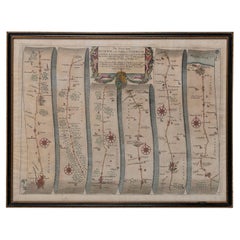
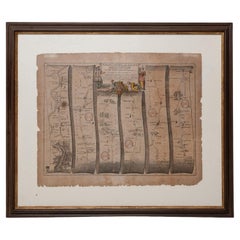
Road Map Britannia 1675/6 No 5 Road London to Barwick, London Stilton Grey Frame

Road Map Britannia 1675/6 No 5 Road London to Barwick, London Stilton Grey Frame

By John Ogilby

Located in BUNGAY, SUFFOLK

John Ogilby (British 1600-1676) cosmographer and geographick printer to Charles II. A road map from Britannia, 1675/6. No 5, The road from London to Barwick: London to Stilton In a grey painted and gilded frame. In a remarkable life John Ogilby pursued, several careers, each ending in misfortune, and yet he always emerged undeterred, to carry on. His modern reputation is based on his final career, started in his sixty-sixth year, as a publisher of maps and geographical accounts. Ogilby was born outside Dundee, in 1600, the son of a Scottish gentleman. While he was still a child, the family moved to London. When the elder Ogilby was imprisoned for debt, the young John invested his savings in a lottery, won a minor prize, and settled his father's debts. Unfortunately, not enough money was left to secure John a good apprenticeship; instead, he was apprenticed to a dance master. Ogilby was soon dancing in masques at court but, one day, while executing a particularly ambitious leap, he landed badly. The accident left him with a permanent limp, and ended his dancing career. However, he had come to the attention of Thomas Wentworth, later Earl of Strafford, Charles I's most senior minister. Ever one to exploit his contacts, Ogilby became a dance instructor in Strafford's household. When Strafford was sent to Ireland, Ogilby accompanied him as Deputy-Master of the Kings Revels, and then Master of Revels. In Dublin, he built the New Theatre, in St. Werburgh Street, which prospered at first, but the Irish Rebellion, in 1641, cost Ogilby his fortune, which he estimated at £2,000, and almost his life. After brief service as a soldier, he returned to England, survived shipwreck on the way, and arrived back penniless. On his return, Ogilby turned his attention to the Latin classics, as a translator and publisher. His first faltering attempt, in 1649, was a translation of the works of Virgil, but after his marriage to a wealthy widow the same year, his publishing activities received a considerable boost. One means by which Ogilby financed these volumes was by subscription, securing advance payments from his patrons, in return for including their name and coats-of-arms on the plates of illustrations. Another approach was to secure a patron, preferably in the court circle. Ogilby's first patron was Strafford, who found out too late that all leading ministers are dispensable when Charles I assented to his execution in 1641. As he re-established himself, Ogilby sought a new patron, the King himself. In 1661, Ogilby was approached to write poetry for Charles II's coronation procession; he later published 'The Relation of His Majesties Entertainment Passing Through the City of London', and a much enlarged edition the following year, which included a Fine set of plates depicting the procession. Royal favour was bestowed in 1674 when John Ogilby received the title of 'His Majesty's Cosmographer and Geographick Printer' with a salary of £13.6s.8d per annum. In 1665, Ogilby left London to avoid the Plague then ravaging the capital. The following year, in the Great Fire of London, Ogilby claimed that he lost his entire stock of books valued at some £3,000, as well as his shop and house, leaving him worth just £5. As he sought to restore his fortunes, Ogilby was already looking in new directions. The initial opportunity he seized on was the reconstruction of London's burnt-out centre. He secured appointment as a "sworn viewer", whose duty was to establish the property boundaries as they existed before the Fire. Ogilby was assisted in the project by his step-grandson, William Morgan, and by a number of professional surveyors. The result was an outstanding plan of London, on a scale of 100 feet to an inch, on 20 sheets, although it was not printed until after Ogilby's death. Ogilby then turned his attention to publishing geographical descriptions of the wider-world. In 1667, he issued 'An Embassy from the East India Company of the United Provinces to the Grand Tartar Cham, Emperor of China.' Buoyed by the response to this volume, Ogilby conceived an ambitious project, a multi-volume description of the world. The volumes were joint collaborations, in conjunction with the Dutch publisher Jacob van Meurs. 'Africa', published in 1670, was the least original of the three, both in terms of the text, maps and illustrations. In a similar vein, he issued the 'Atlas Japannensis' (1670), the 'Atlas Chinensis' (1671), and 'Asia' (1673). In 1671, Ogilby published the 'America', translated from Arnold Montanus' Dutch text. The 'America' is certainly the most original, and most important, of Ogilby's various geographical volumes, and its influence and popularity was immediate. With its completion, Ogilby turned to a project nearer his heart, the description of Britain. Ogilby originally intended to devote one volume to Britain, but as the project evolved, he became more ambitious, as revealed in a prospectus issued in about 1672: "This having oblig'd our Author to take new Measures ... to compleat within the space of two Years a Work ... considering the Actual survey of the Kingdom, the Delineation and Dimensuration of the Roads, the Prospects and Ground plots of Cities, with other Ornamentals ... into six fair volumes. The Four first comprehending the historical and geographical description of England, with the County-Maps truly and actually survey'd. ... The fifth containing an Ichnographical and Historical Description of all the Principal Road-ways in England and Wales, in two hundred copper sculptures, after a new and exquisite method. The sixth containing a New and Accurate Description of the famous City of London, with the perfect Ichnography thereof ..." In the proposals, Ogilby emphasised the scale of the undertaking; no-one before him had attempted such a vast project. He estimated the total costs would be £20,000, a staggering amount. The cost of the complete set of six volumes was to be £34. At that time, Wenceslas Hollar...

Category

Antique Late 17th Century British Charles II Maps

Materials

Paper

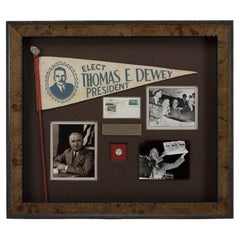
Thomas Dewey & Harry Truman 1948 Presidential Election Campaign Collage

Thomas Dewey & Harry Truman 1948 Presidential Election Campaign Collage

Located in Colorado Springs, CO

Presented is a unique commemorative collage, celebrating the 1948 U.S. presidential election between Harry Truman and Thomas Dewey. This one-of-a-kind collage features a Harry Truman signed...

Category

Vintage 1940s American Mid-Century Modern Political and Patriotic Memora...

Materials

Metal

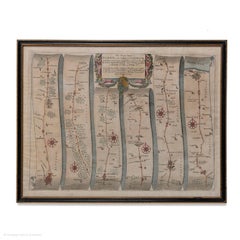
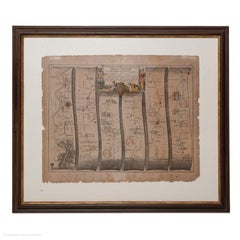
Road Map John Ogilby No 75 Kings Lyn Harwich, Britannia Framed Wallhanging

Road Map John Ogilby No 75 Kings Lyn Harwich, Britannia Framed Wallhanging

By John Ogilby

Located in BUNGAY, SUFFOLK

The Road from Kings Lyn Co Norfolk to Harwich Co Essex. By John Ogilby His Majesties Cosmographer. Containing 76 miles, 1 furlong. From Lyn to Swaffam, to Stanford, to Thetford, To Icksworth, to Stowmarket, to Ipswich and to Harwich including ye Ferry, No 75, inscribed in pencil 1698 Hand colored and floated in the original black and gold frame, c1961. Some creasing commensurate with age. The back of the frame inscribed May 1961. Provenance : Private Collection, acquired c1961, along with No 74 Ipswich to Norwich & No 54 London to Yarmouth. All in the original black and gold frames. Sheet width 45cm., 17 ¾”., height 34.5cm., 13 ½“ Frame width 50cm 19 ¾”., height 40cm., 15 ¾” Literature: In a remarkable life John Ogilby pursued, several careers, each ending in misfortune, and yet he always emerged undeterred, to carry on. His modern reputation is based on his final career, started in his sixty-sixth year, as a publisher of maps and geographical accounts. Ogilby was born outside Dundee, in 1600, the son of a Scottish gentleman. While he was still a child, the family moved to London. When the elder Ogilby was imprisoned for debt, the young John invested his savings in a lottery, won a minor prize, and settled his father's debts. Unfortunately, not enough money was left to secure John a good apprenticeship; instead, he was apprenticed to a dance master. Ogilby was soon dancing in masques at court but, one day, while executing a particularly ambitious leap, he landed badly. The accident left him with a permanent limp, and ended his dancing career. However, he had come to the attention of Thomas Wentworth, later Earl of Strafford, Charles I's most senior minister. Ever one to exploit his contacts, Ogilby became a dance instructor in Strafford's household. When Strafford was sent to Ireland, Ogilby accompanied him as Deputy-Master of the Kings Revels, and then Master of Revels. In Dublin, he built the New Theatre, in St. Werburgh Street, which prospered at first, but the Irish Rebellion, in 1641, cost Ogilby his fortune, which he estimated at £2,000, and almost his life. After brief service as a soldier, he returned to England, survived shipwreck on the way, and arrived back penniless. On his return, Ogilby turned his attention to the Latin classics, as a translator and publisher. His first faltering attempt, in 1649, was a translation of the works of Virgil, but after his marriage to a wealthy widow the same year, his publishing activities received a considerable boost. One means by which Ogilby financed these volumes was by subscription, securing advance payments from his patrons, in return for including their name and coats-of-arms on the plates of illustrations. Another approach was to secure a patron, preferably in the court circle. Ogilby's first patron was Strafford, who found out too late that all leading ministers are dispensable when Charles I assented to his execution in 1641. As he re-established himself, Ogilby sought a new patron, the King himself. In 1661, Ogilby was approached to write poetry for Charles II's coronation procession; he later published 'The Relation of His Majesties Entertainment Passing Through the City of London', and a much enlarged edition the following year, which included a Fine set of plates depicting the procession. Royal favour was bestowed in 1674 when John Ogilby received the title of 'His Majesty's Cosmographer and Geographick Printer' with a salary of £13.6s.8d per annum. In 1665, Ogilby left London to avoid the Plague then ravaging the capital. The following year, in the Great Fire of London, Ogilby claimed that he lost his entire stock of books valued at some £3,000, as well as his shop and house, leaving him worth just £5. As he sought to restore his fortunes, Ogilby was already looking in new directions. The initial opportunity he seized on was the reconstruction of London's burnt-out centre. He secured appointment as a 'sworn viewer', whose duty was to establish the property boundaries as they existed before the Fire. Ogilby was assisted in the project by his step-grandson, William Morgan...

Category

Antique 1670s European Baroque Maps

Materials

Paper

Map Road John Ogilby Britannia No 74 Ipswich to Norwich Cromer Framed

Map Road John Ogilby Britannia No 74 Ipswich to Norwich Cromer Framed

By John Ogilby

Located in BUNGAY, SUFFOLK

The Road from Ipswich com Suffolk to Norwich and thence to cromer on the sea coast com Norfolk. By John Ogilby, Esq, His Majesties Cosmographer. Containing...

Category

Antique 1670s English Baroque Maps

Materials

Paper

Road Map Britannia No 32 the Road from London to Barnstable John Ogilby Framed

Road Map Britannia No 32 the Road from London to Barnstable John Ogilby Framed

By John Ogilby

Located in BUNGAY, SUFFOLK

A road map from Britannia, by John Ogilby Esq., Cosmographer and Geographick Printer to Charles II. Containing 293 miles. No 32. From Standard in Cornhill London to Andover thence to Amesbury, to Shruton, to Warminster, to Maiden-Bradley, to Bruton, to Weston, to Ascot and to Bridgewater Hand coloured, some foxing and creasing, commensurate with age. Floated in a cream mount with a gilded linear border within a burr walnut, ebonised and gilded frame. Provenance : purchased as pair from a collector with no 15 London to St Davids. Framed as a pair. Measures: Black Linear Border around Map Length 44cm., 17 1/8" Height 36cm., 14". Full Sheet Length 51cm., 20" Height 39cm., 15 1/4" Frame Length 62cm., 24 1/2 " Height 52cm., 20 1/2" Literature: In a remarkable life John Ogilby pursued, several careers, each ending in misfortune, and yet he always emerged undeterred, to carry on. His modern reputation is based on his final career, started in his sixty-sixth year, as a publisher of maps and geographical accounts. Ogilby was born outside Dundee, in 1600, the son of a Scottish gentleman. While he was still a child, the family moved to London. When the elder Ogilby was imprisoned for debt, the young John invested his savings in a lottery, won a minor prize, and settled his father's debts. Unfortunately, not enough money was left to secure John a good apprenticeship; instead, he was apprenticed to a dance master. Ogilby was soon dancing in masques at court but, one day, while executing a particularly ambitious leap, he landed badly. The accident left him with a permanent limp, and ended his dancing career. However, he had come to the attention of Thomas Wentworth, later Earl of Strafford, Charles I's most senior minister. Ever one to exploit his contacts, Ogilby became a dance instructor in Strafford's household. When Strafford was sent to Ireland, Ogilby accompanied him as Deputy-Master of the Kings Revels, and then Master of Revels. In Dublin, he built the New Theatre, in St. Werburgh Street, which prospered at first, but the Irish Rebellion, in 1641, cost Ogilby his fortune, which he estimated at £2,000, and almost his life. After brief service as a soldier, he returned to England, survived shipwreck on the way, and arrived back penniless. On his return, Ogilby turned his attention to the Latin classics, as a translator and publisher. His first faltering attempt, in 1649, was a translation of the works of Virgil, but after his marriage to a wealthy widow the same year, his publishing activities received a considerable boost. One means by which Ogilby financed these volumes was by subscription, securing advance payments from his patrons, in return for including their name and coats-of-arms on the plates of illustrations. Another approach was to secure a patron, preferably in the court circle. Ogilby's first patron was Strafford, who found out too late that all leading ministers are dispensable when Charles I assented to his execution in 1641. As he re-established himself, Ogilby sought a new patron, the King himself. In 1661, Ogilby was approached to write poetry for Charles II's coronation procession; he later published 'The Relation of His Majesties Entertainment Passing Through the City of London', and a much enlarged edition the following year, which included a Fine set of plates depicting the procession. Royal favour was bestowed in 1674 when John Ogilby received the title of 'His Majesty's Cosmographer and Geographick Printer' with a salary of £13.6s.8d per annum. In 1665, Ogilby left London to avoid the Plague then ravaging the capital. The following year, in the Great Fire of London, Ogilby claimed that he lost his entire stock of books valued at some £3,000, as well as his shop and house, leaving him worth just £5. As he sought to restore his fortunes, Ogilby was already looking in new directions. The initial opportunity he seized on was the reconstruction of London's burnt-out centre. He secured appointment as a 'sworn viewer', whose duty was to establish the property boundaries as they existed before the Fire. Ogilby was assisted in the project by his step-grandson, William Morgan...

Category

Antique Late 17th Century English Charles II Maps

Materials

Paper

Road Map Britannia No 15 London to St Davids John Ogilby Brown Gilt Frame

Road Map Britannia No 15 London to St Davids John Ogilby Brown Gilt Frame

By John Ogilby

Located in BUNGAY, SUFFOLK

The continuation of the road from London to St Davids, commencing at Abingdon Com Berks and extending to Monmouth By John Ogilby Esq, His Majesties Cosmographer. From Abingdon to Farringdon, to Lechlade, to Fairford, to Barnsley to Gloucester showing Monmouth as the destination. A road map from Britannia, 1675/6. No 15. Hand coloured and floated on a cream mount within a brown painted and gilded ogee frame. Some foxing and creasing, uneven edge of sheet, all commensurate with age Provenance : purchased as pair from a collector with no 25 London to Lands End. Framed as a pair. Sheet width 46.5cm., 18 ¼ ”., height 37.5cm., 14 ¾ “ Frame width 66.5cm., 26”., height 56cm., 22 ” In a remarkable life John Ogilby pursued, several careers, each ending in misfortune, and yet he always emerged undeterred, to carry on. His modern reputation is based on his final career, started in his sixty-sixth year, as a publisher of maps and geographical accounts. Ogilby was born outside Dundee, in 1600, the son of a Scottish gentleman. While he was still a child, the family moved to London. When the elder Ogilby was imprisoned for debt, the young John invested his savings in a lottery, won a minor prize, and settled his father's debts. Unfortunately, not enough money was left to secure John a good apprenticeship; instead, he was apprenticed to a dance master. Ogilby was soon dancing in masques at court but, one day, while executing a particularly ambitious leap, he landed badly. The accident left him with a permanent limp, and ended his dancing career. However, he had come to the attention of Thomas Wentworth, later Earl of Strafford, Charles I's most senior minister. Ever one to exploit his contacts, Ogilby became a dance instructor in Strafford's household. When Strafford was sent to Ireland, Ogilby accompanied him as Deputy-Master of the Kings Revels, and then Master of Revels. In Dublin, he built the New Theatre, in St. Werburgh Street, which prospered at first, but the Irish Rebellion, in 1641, cost Ogilby his fortune, which he estimated at £2,000, and almost his life. After brief service as a soldier, he returned to England, survived shipwreck on the way, and arrived back penniless. On his return, Ogilby turned his attention to the Latin classics, as a translator and publisher. His first faltering attempt, in 1649, was a translation of the works of Virgil, but after his marriage to a wealthy widow the same year, his publishing activities received a considerable boost. One means by which Ogilby financed these volumes was by subscription, securing advance payments from his patrons, in return for including their name and coats-of-arms on the plates of illustrations. Another approach was to secure a patron, preferably in the court circle. Ogilby's first patron was Strafford, who found out too late that all leading ministers are dispensable when Charles I assented to his execution in 1641. As he re-established himself, Ogilby sought a new patron, the King himself. In 1661, Ogilby was approached to write poetry for Charles II's coronation procession; he later published 'The Relation of His Majesties Entertainment Passing Through the City of London', and a much enlarged edition the following year, which included a fine set of plates depicting the procession. Royal favour was bestowed in 1674 when John Ogilby received the title of 'His Majesty's Cosmographer and Geographick Printer' with a salary of £13.6s.8d per annum. In 1665, Ogilby left London to avoid the Plague then ravaging the capital. The following year, in the Great Fire of London, Ogilby claimed that he lost his entire stock of books valued at some £3,000, as well as his shop and house, leaving him worth just £5. As he sought to restore his fortunes, Ogilby was already looking in new directions. The initial opportunity he seized on was the reconstruction of London's burnt-out centre. He secured appointment as a "sworn viewer", whose duty was to establish the property boundaries as they existed before the Fire. Ogilby was assisted in the project by his step-grandson, William Morgan...

Category

Antique Late 17th Century British Charles II Maps

Materials

Paper

Road Map Britannia No 25 London to the Lands End, John Ogilby Brown Gilded Frame

Road Map Britannia No 25 London to the Lands End, John Ogilby Brown Gilded Frame

By John Ogilby

Located in BUNGAY, SUFFOLK

The road from London to the lands end. Commencing at the Standard in Cornhill and extending to Senan in Cornwall. By John Ogilby His Majesties Cosmographer. A road map from Britannia, 1675/6. No 25. Continuing 308 miles, 3 furlongs. London Southwark to Brentford, to Hampton Court, to Hounslow, to Windsor, to Cobham, to Farnham, to Basingstoke to Winchester The handcoloured sheet free floated. In a brown painted and gilded, ogee moulded frame. Some foxing and creasing, uneven edge of sheet, all commensurate with age Provenance : purchased as pair from a collector with no 15 London to St David's. Framed as a pair. Sheet width 48cm., 19 ”., height 38cm., 15 “ Frame width 66.5cm., 26”., height 56cm., 22 ” In a remarkable life John Ogilby pursued, several careers, each ending in misfortune, and yet he always emerged undeterred, to carry on. His modern reputation is based on his final career, started i Black Linear Border around Map Length 44cm., 17 1/8" Height 32cm., 12 1/2" Full Sheet Length 58cm., 22 3/4" Height 38cm., 15" Frame Length 66cm., 26"., Height 56cm., 22" In a remarkable life John Ogilby pursued, several careers, each ending in misfortune, and yet he always emerged undeterred, to carry on. His modern reputation is based on his final career, started in his sixty-sixth year, as a publisher of maps and geographical accounts. Ogilby was born outside Dundee, in 1600, the son of a Scottish gentleman. While he was still a child, the family moved to London. When the elder Ogilby was imprisoned for debt, the young John invested his savings in a lottery, won a minor prize, and settled his father's debts. Unfortunately, not enough money was left to secure John a good apprenticeship; instead, he was apprenticed to a dance master. Ogilby was soon dancing in masques at court but, one day, while executing a particularly ambitious leap, he landed badly. The accident left him with a permanent limp, and ended his dancing career. However, he had come to the attention of Thomas Wentworth, later Earl of Strafford, Charles I's most senior minister. Ever one to exploit his contacts, Ogilby became a dance instructor in Strafford's household. When Strafford was sent to Ireland, Ogilby accompanied him as Deputy-Master of the Kings Revels, and then Master of Revels. In Dublin, he built the New Theatre, in St. Werburgh Street, which prospered at first, but the Irish Rebellion, in 1641, cost Ogilby his fortune, which he estimated at £2,000, and almost his life. After brief service as a soldier, he returned to England, survived shipwreck on the way, and arrived back penniless. On his return, Ogilby turned his attention to the Latin classics, as a translator and publisher. His first faltering attempt, in 1649, was a translation of the works of Virgil, but after his marriage to a wealthy widow the same year, his publishing activities received a considerable boost. One means by which Ogilby financed these volumes was by subscription, securing advance payments from his patrons, in return for including their name and coats-of-arms on the plates of illustrations. Another approach was to secure a patron, preferably in the court circle. Ogilby's first patron was Strafford, who found out too late that all leading ministers are dispensable when Charles I assented to his execution in 1641. As he re-established himself, Ogilby sought a new patron, the King himself. In 1661, Ogilby was approached to write poetry for Charles II's coronation procession; he later published 'The Relation of His Majesties Entertainment Passing Through the City of London', and a much enlarged edition the following year, which included a fine set of plates depicting the procession. Royal favour was bestowed in 1674 when John Ogilby received the title of 'His Majesty's Cosmographer and Geographick Printer' with a salary of £13.6s.8d per annum. In 1665, Ogilby left London to avoid the Plague then ravaging the capital. The following year, in the Great Fire of London, Ogilby claimed that he lost his entire stock of books valued at some £3,000, as well as his shop and house, leaving him worth just £5. As he sought to restore his fortunes, Ogilby was already looking in new directions. The initial opportunity he seized on was the reconstruction of London's burnt-out centre. He secured appointment as a "sworn viewer", whose duty was to establish the property boundaries as they existed before the Fire. Ogilby was assisted in the project by his step-grandson, William Morgan...

Category

Antique Late 17th Century British Charles II Maps

Materials

Paper

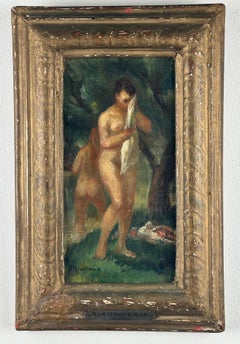
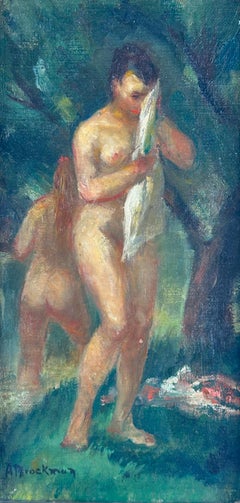
Female Bather (Nude Women)

Female Bather (Nude Women)

Located in Wilton Manors, FL

Ann Brockman (1895–1943) was an American artist who achieved success as a figurative painter following a successful career as an illustrator. Born in California, she spent her childhood in the American Far West and, upon marrying the artist William C. McNulty, relocated to Manhattan at the age of 18 in 1914. She took classes at the Art Students League where her teachers included two realist artists of the Ashcan School, George Luks and John Sloan. Her career as an illustrator began in 1919 with cover art for four issues of a fiction monthly called Live Stories. She continued providing cover art and illustrations for popular magazines and books until 1930 when she transitioned from illustrator to professional artist. From that year until her death in 1943, she took part regularly in group and solo exhibitions, receiving a growing amount of critical recognition and praise. In 1939 she told an interviewer that making money as an illustrator was so easy that it "almost spoiled [her] chances of ever being an artist."[1] In reviewing a solo exhibition of her work in 1939, the artist and critic A.Z Kruse wrote: "She paints and composes with a thorough understanding of form and without the slightest hesitancy about anatomical structure. Add to this a magnificent sense of proportion, and impeccable feeling for color and an unmistakable knowledge of what it takes to balance the elements of good pictorial composition and you have a typical Ann Brockman canvas."[2] Early life and training Brockman was born in Northern California in 1895 and spent much of her youth in nearby Oregon, Washington, and Utah.[1][3] She met the artist William C. McNulty in Seattle where he was employed as an editorial cartoonist. They married in March 1914 and promptly moved to Manhattan where he worked as a freelance illustrator.[4][5] At the time of their marriage, Brockman was 18 years old.[6] Over the next few years, her career generally followed that path that her husband had previously taken. His art training had been at the Art Students League beginning in 1908; she began her training there after moving to New York in 1914.[1] After an early career as an editorial cartoonist, he freelanced as a magazine and book illustrator beginning in 1914; she began her career as a magazine and book illustrator in 1919.[7] He embarked on a teaching career in the early 1930s and not long after, she began giving art instruction.[8][9] While they both adhered to the realist tradition in art, their usual subjects were different. His prominently depicted urban cityscapes in the social realist whereas hers generally focused on rural landscapes. He was best known for his etchings and she for her oils and watercolors.[8][10] Brockman returned to the Art Students League in 1926 to take individual instruction for a month at a time from George Luks and John Sloan.[1] Despite their help, one critic said McNulty's "sympathetic encouragement and guidance" was more important to her development as a professional artist.[11] Career in art In the course of her career as illustrator, Brockman would sometimes paint portraits of celebrities before drawing them, as for example in 1923 when she painted the French actress Andrée Lafayette who had traveled to New York to play title role in a film called Trilby.[12] She would also sometimes accept commissions to make portrait paintings and in 1929 painted two Scottish terriers on one such commission.[13] During this time, she also produced landscapes. In 1924 she displayed a New England village street scene painting in the Second Annual Exhibition of Paintings, Watercolors, and Drawings in the J. Wanamaker Gallery of Modern Decorative Art.[14] Available sources show no further exhibitions until in 1930 a critic for the Boston Globe described one of her portraits as "well done" in a review of a Rockport Art Association exhibition held that summer.[15] Between 1931 and her death in 1943, Brockman participated in over thirty group exhibitions and five solos.[note 1] Her paintings appeared in shows of the artists' associations to which she belonged, including the Rockport Art Association, Salons of America, Society of Independent Artists, and National Association of Women Painters and Sculptors.[17][19]Between 1932 and 1935, her paintings appeared frequently in New York's Macbeth Gallery.[20][23][25][27] She won an award for a painting she showed at the Art Institute of Chicago in 1940.[41] In 1942, the Whitney Museum bought one of the paintings she showed in its Biennial of that year.[10] Critical praise for her work steadily increased during the decade that ended with her untimely death in 1943. In 1932, her painting called "The Camera Man" was called "a clever piece of illustration."[21] Three years later, a painting called "Small Town" gave a critic "the impression of freshness, honesty, and skill".[29] In 1938, a critic described her "Folly Cove" as "masterful" and said "Pigeon Hill Picnic" was "sustained by excellence of execution".[48] At that time, Howard Devree of the New York Times saw "evidence of gathering powers" in her work and wrote "she imparts a dramatic feeling to landscape. She even manages this time to do trees touched by Autumn tints without calendar effect, which is no small praise."[51] Three years later, a Times critic reported Brockman had "set herself a new high" in the watercolors she presented,[52] and another critic said the gallery where she was showing had not "for some time" shown "so outstanding a solo exhibitor as Ann Brockman."[2] Shortly before her death, a critic for Art News maintained that she was "one of America's most talented women painters".[46] After she had died, a critic said Brockman's paintings "displayed real power", adding that she was "highly rated among the nation's professional artists" and was known to give "aid and encouragement, always with a smile," both artists and to her students.[10] in reviewing the memorial exhibition at the Kraushaar Galleries held in 1945, reviewers wrote about the strength and vibrancy of her personality, the quality of her painting ("every bit as good, possibly better than people had thought"),[53] called her "one of the best of our twentieth century women painters", and credited "her sense of the vividness of life" as a contributor to "the unusual breadth that is so characteristic of her work.[11] One noted that her work was "widely recognized throughout the country" and could be found in the collections of prominent museums, including the Metropolitan Museum of Art, the Whitney Museum of American Art, and the Art Institute of Chicago.[54] Writing in the Times, Devree wrote, "even those who had followed the steady growth of this artist for more than a decade, each successive show being at once an evidence of new achievement and an augury of still better work to come, may well be surprised at the combined impact of the selected paintings in the present showing,"[55] and writing in the Brooklyn Daily Eagle, A.Z Kruse said she had made "extraorginary accomplishments", painted with "inordinate distinction" showing a "lyrical majesty," and possessed "a keen esthetic sense which did not deviate from truth."[54] Artistic style (1) Ann Brockman, undated drawing, black chalk on paper, 18 x 22 inches (2) Ann Brockman, High School Picnic, about 1935, oil on canvas, 34 1/4 x 44 1/4 inches (3) Ann Brockman, untitled landscape, about 1943, watercolor and pencil on paper, 15 1/4 x 22 1/2 inches (4) Ann Brockman, North Coast, undated watercolor, 21 1/2 x 30 inches (5) Ann Brockman, On the Beach, 1942, watercolor on paper, 16 1/2 x 20 inches (6) Ann Brockman, Lot's Wife, 1942, oil on canvas, 46 x 35 inches (7) Ann Brockman, New York Harbor, 1934, watercolor on paper, 13 1/2 x 19 1/4 inches (8) Ann Brockman, Youth, 1942, oil on board, 13 1/2 x 11 1/2 inches Brockman was a figurative painter whose main subjects were rural landscapes and small-town and coastal scenes. She worked in oils and watercolors, becoming better known for the latter late in her career. Most of her paintings were relatively small. Although she made figure pieces infrequently, the nudes and circus and Biblical scenes she painted were seen to be among her best works. In 1938, Howard Devree wrote: "Her gray-day marines and coast scenes are familiar to gallery goers and are favorites with her fellow artists. Her figure pieces have attained a sculptural quality without losing warmth or taking on stiffness. One spirited circus incident of equestriennes about to enter the big tent compares not unfavorably with many of the similar pictures by a long line of painters who have been fascinated by the theme. She imparts a dramatic feeling to landscape. She even manages this time to do trees touched by Autumn tints without calendar effect, which is no small praise."[51] Similarly, a critic for Art Digest wrote that year: "Fluently and virilely painted, [her] canvases suggest a close affinity between nature and humans. The artist takes her subjects out in the open where they may picnic or bathe with space and air about them. A fast tempo is felt in the compositions of restless horses and nimble entertainers busily alert for the coming performance. Miss Brockman is also interested in portraying frightened groups of people, hurrying to safety or standing half-clad in the lowering storm light."[56] Her palette ranged from vivid colors in bright sunlight to somber ones in the overcast skies of stormy weather. Of the former, one critic spoke of the rich colors and "sun-drenched rocks" of her coastal scenes and another of her "summery landscapes of coves and picnics."[11][50] Of the latter, Howard Devree said she "painted so many moody Maine coast vignettes of lowering skies and uneasy seas that artists have been heard to refer to an effect as 'an Ann Brockman day'".[57] Brockman's handling of Biblical subjects can be seen in the oil called "Lot's Wife", shown above, Image No. 6. Her watercolor called "On the Beach" and her oil portrait called "Youth" may both indicate the "sculptural quality" that Devree said was typical of her figure pieces (Image No. 8, above). An example of Brockman's bright palette in a typical summer theme is the oil painting called "High School Picnic" shown above, Image No. 2. Next to it is a painting, an untitled landscape of about 1943 whose medium, watercolor on paper, shows off the sunny palette she often used (Image No. 3). Among the darkest of her works was an untitled 1942 drawing she made in black chalk (shown above, Image No. 1). In a book called Drawings by American Artists (1947), the artist and art editor Norman Kent noted that this study influenced her painting through its use of "forms" that were "elastic" and suggested "color". He said its "massing of dark and light" created "a definite mood" that was "impressionistic" and had "the strength of a man's work".[58] Brockman's undated watercolor called "North Coast" (shown above, Image No. 4) is an example of the paintings to which Kent referred. Illustrator (9) Ann Brockman, cover, March 12, 1917, Every Week magazine (10) Illustration of an article, "The Taking of a Salient" by Henry Russell...

Category

1930s American Impressionist Nude Paintings

Materials

Oil

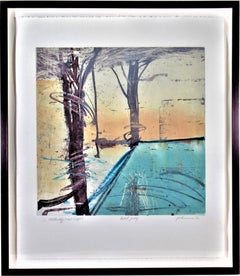
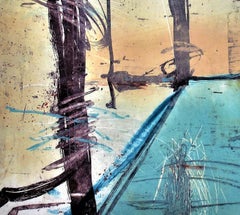
Walking View, Left
Walking View, Left

Walking View, Left

By Ron Pokrasso

Located in San Francisco, CA

This artwork titled "Walking View, Left" 1990 is a color etching with aquatint by Santa Fe artist Ron Pokrasso, b.1951. It is hand signed, titled dated and inscribed artist proof in pencil by the artist. The image (plate mark) is 17.5 x 17.5 inches, framed size is 28.5 x 24.75 inches. It is custom framed in a mahogany frame. It is in excellent condition. About the artist: Ron Pokrasso has been an exhibiting artist, printmaker and educator for more than 40 years. He received his MFA degree from Pratt Institute in 1975 and has had over 50 solo exhibitions and has participated in more than 175 group shows. His work is in public, private, and corporate collections throughout the U.S. and abroad and is represented by several galleries nationwide as well as being featured in numerous books. For 11 years Pokrasso owned and directed Graphics Workshop (gifted to The College of Santa Fe in 1993). He is an originator of the printmaking event “Monothon” and has been an ardent supporter of arts programs for youth. His teaching experience includes universities, museums, public schools and private workshops, as well as Artist Residencies in the U.S., Scotland, Ireland and Italy. In 2000 Ron Pokrasso received the Mayor’s Recognition Award For Visual Arts citing his artistic and educational contribution to the city of Santa Fe. Currently Ron Pokrasso operates the Galisteo Street Studio in Santa Fe, NM offering workshops and assisted sessions for artists in addition to creating and exhibiting his artworks. SOLO EXHIBITIONS 202056Trees and Music, Mentors, Friends and Family: Remarque Print Studio, Albuquerque, NM 2019 Santa Fe Studio Tour: Galisteo Street Studio, Santa Fe, NM 2018 Santa Fe Studio Tour: Galisteo Street Studio, Santa Fe, NM 123456Some Recent Works On Paper: Remarque Print Studio, Albuquerque, NM 2016 Emptying Drawers and Clearing Racks: Timberwick Studios, Santa Fe, NM 2015 Fun With Music and Art: Joseph Gierek Fine Art, Tulsa, OK 2014 Color Breaking Barriers: The SF Gallery, San Francisco, CA 123456Transferring Ink 3: Janice Griffiths Gallery, Fallbrook, CA 2011 Ron Pokrasso and Colleagues: Quad Gallery, Riverside, CA 2010 Zane Bennett Gallery, Santa Fe, NM 123456Recurrence of Memory: Center for Contemporary Printmaking, Norwalk, CT 2009 New Works: Craighead Green Gallery, Dallas, TX 2007 Denise Roberge Gallery, Palm Desert, CA 123456Lynne Fine Art, Scottsdale, AZ 2006 Lynne Fine Art, Scottsdale, AZ 2005 Deloney Newkirk Gallery, Santa Fe, NM 123456Denise Roberge Gallery, Palm Desert, CA 2004 Deloney Newkirk Gallery, Santa Fe, NM 123456Riverside Art Museum, Riverside, CA 123456Brevard Museum of Art and Science, Melbourne, FL 123456Denise Roberge Gallery, Palm Desert, CA 2003 Galerie Municipale/ C.I.M., Chamaliers, France 123456Deloney Newkirk Gallery, Santa Fe, NM 123456Arts Exclusive Gallery, Simsbury, CT 123456Denise Roberge Gallery, Palm Desert, CA 2002 Los Milagros Print Studio, Oklahoma City, OK 123456Deloney Newkirk Gallery, Santa Fe, NM 2001 Deloney Newkirk Gallery, Santa Fe, NM 2000 Deloney Newkirk Gallery, Santa Fe, NM 1999 Famous for His Trees: Deloney Newkirk Gallery, Santa Fe, NM 1998 Patricia Carlisle Fine Art, Santa Fe, NM 123456Art Thomas Gallery, Charleston, SC 1997 Patricia Carlisle Fine Art, Santa Fe, NM 1996 In the Eyes of the Beholder: Waxlander Gallery, Santa Fe, NM 1995 Works on Paper: Arts Exclusive Gallery, Simsbury, CT 123456Waxlander Gallery, Santa Fe, NM 1994 Amos Joseph Fine Art, Santa Fe, NM 123456Works on Paper: Franz Bader Gallery, Washington, DC 1993 Amos Joseph Fine Art, Santa Fe, NM 1992 New Monotypes: Franz Bader Gallery, Washington, DC 123456Fantasy, Art & Baseball: Barclay Simpson Gallery, Lafayette, CA 1991 Works on Paper: Wenniger Graphics, Boston, MA 123456Franz Bader Gallery, Washington, DC 123456Reynolds Gallery, Westmont College, Santa Barbara, CA 1990 Works on Paper: White Gallery, Tbilisi, Georgia, USSR 123456Recent Work: Franz Bader Gallery, Washington, DC 1989 Recent Work: Riverside Art Museum, Riverside, CA 123456Founders Gallery, Guilford College, Greensboro, NC 123456Recent Prints: Wenniger Graphics, Provincetown, MA 123456Recent Work: Franz Bader Gallery, Washington, DC 1988 Barclay Simpson Gallery, Lafayette, CA 198813Recent Prints: Wenniger Graphics, Boston, MA 1987 Recent Monotypes: Franz Bader Gallery, Washington, DC 1986 Fresh Start II, ‘86: Beverly Gordon Gallery, Dallas, TX 1985 New Work: Sena Plaza Gallery, Santa Fe, NM 1975 MFA Thesis Exhibition: Higgins Hall Gallery, Pratt Institute, Brooklyn, NY Group Exhibitions 202034Masked, Veiled and Unveiled: A Sea (In The Desert) Gallery, Santa Fe, NM 201956Breakfast At Harry’s: Are We There Yet? FOMA, Santa Fe, NM 123456Solar Impressions: Southampton Art Center, Southampton, NY 123456Exquisite Corpse: Community Gallery, Santa Fe, NM 2017 East Meets West: Gildea Contemporary, Key West, FL 2016 Recent Work; Three person show: Mill Contemporary, Santa Fe, NM 123456Men In Aprons: Pacific Northwest College Of Art, SGC conference, Portland, OR 123456Visual Arts Faculty: Parks Exhibition Center, Idyllwild, CA 2015 20th Retrospective: Center For Contemporary Printmaking, Norwalk, CT 123456The Mask Of The Artist: The SF Gallery, San Francisco, CA 123456Arizona Aqueous XXIV: Tubac Center Of The Arts, Tubac, AZ 2014 Monotypes And More: Pippin Contemporary, Santa Fe, NM 123456Premier Exhibition: The SF Gallery, San Francisco, CA 2013 Revisiting: Ten Years of the Visiting Artist Series at ASLD, Carson Gallery, Denver, CO 123456Visual Arts Faculty: Parks Exhibition Center, Idyllwild, CA 2012 Mentors and Makers: Rochester Contemporary Art Center, Rochester, NY 123456Beasts Big and Small from the Scripps Collection: Scripps College, Claremont, CA 123456Art Of The Book 4: Artist Union Gallery, Ventura, CA 123456One Square Foot Of Humor: Zane Bennett Contemporary, Santa Fe, NM 123456Michele Jamison and Friends: Stephen Archdeacon Gallery, Palm Springs, CA 2011 Aberdeen Artists Printmaking Invitational Exhibition, Aberdeen, Scotland 123456Contemporary Monotypes: Glasgow Print studio, Glasgow, Scotland 123456Visiting Artists: Bancroft Gallery, South Shore Art Center, Cohasset, MA 123456The Process of Art- Faculty Exhibition: Sedona Art Center, Sedona, AZ 123456Beyond Abstraction: Center For Emerging Visual Artists, Philadelphia, PA: J&J World Headquarters 12345678Gallery, New Brunswick, NJ 123456Artists Portraying Artists: Windsor Whip Works Art Center & Gallery, Windsor, NY 123456Going Solar: St Louis Artists’ Guild, St Louis, MO 2010 2010 Great Impressions- The Print Club of Rochester Turns 80: Memorial Art Gallery, Rochester, NY 123456Visual Arts Faculty, Parks Exhibition Center, Idyllwild, CA 123456September Special- Arts Exclusive Gallery, Simsbury, CT 2009 Comfort Food: Jennie Cooley Gallery, Santa Fe, NM 123456Vision Shift: Santa Fe Art Institute, Santa Fe, NM 2008 Process/ Image/ Print: O’Sullivan Art Gallery, Regis University, Denver, CO 123456September Special: Arts exclusive Gallery, Simsbury, CT 123456Visual Arts Faculty, Parks Exhibition Center, Idyllwild, CA 123456Interludes: South Shore Art Center, Cohasset, MA 123456Ink’d: dba256 Gallery, Pomona, CA 123456Craighead Green gallery, Dallas, TX 2007 Art Department Founders Exhibit: College of Santa Fe Gallery, Santa Fe, NM 123456From Barbizon to Santa Fe-Argos Etchings and Paintings, Santa Fe, NM 2006 Gallery Hop 2006: Joseph Gierek Fine Art, Tulsa, OK 123456Pressed: Riverside Art Museum, Riverside, CA 123456Faculty Artists Exhibition: Parks Exhibition Center, Idyllwild, CA 200556Summer Connections: Visiting Artists: Bancroft Gallery, Cohasset, MA 123456September Special: Arts Exclusive Gallery, Simsbury, CT 123456Solarplate Revolution: Taller Boricua Gallery, New York, NY 123456Solarplate Evolution: Cape Cod Community College, North Barnstable, MA 200456Solarplate Revolution: Gray Gallery, Quincy, IL; Center For Contemporary Printmaking, Norwalk, CT; 12345678Emory & Henry College, Emory, VA 123456Monothon 18: College of Santa Fe, Santa Fe, NM 200356Artists Choose Artists: East Central University, Ada, OK 123456Monothon 17: College of Santa Fe, Santa Fe, NM 123456Craighead Green Gallery, Dallas, TX 123456New Mexico Printmakers: Santa Fe Art Institute, Santa Fe, NM 1234566th World Triennale of Small Prints: Chamlieres, France 123456Printsafe: Warringah Printmakers Studio, Manly Vale, Australia 123456Solarplate Revolution: Southern Graphics Council, Boston, MA; Whitney Art Works, Greenport, NY; BCB 12345678Art, Hudson, NY 200256Northern New Mexico Printmakers: Foothills Art Center, Golden, CO 123456The Magnificent Subject: Wyeth Hurd Gallery, Santa Fe, NM 123456Monothon 16: Site Santa Fe, Santa Fe, NM 123456September Special: Arts Exclusive Gallery, Simsbury, CT 200156Jewish Artists on the Edge: Yeshiva University Museum, New York, NY 123456Monothon 15: Site Santa Fe, Santa Fe, NM 2000565th World Triennale of Small Prints: Chamalieres, France 123456Jewish Artists on the Edge: Marion Art Center, Santa Fe, NM 123456A Show With Heart: Joyce Robins Gallery, Santa Fe, NM 123456Monothon 14: College of Santa Fe, Santa Fe, NM 123456Seventh Annual Cup Show: Segretto Contemporary Art, Santa Fe, NM 199956Craighead Green Gallery, Dallas, TX 123456William Havu Gallery, Denver, CO 123456Deloney Newkirk Gallery, Santa Fe, NM 123456Monothon 13: Site Santa Fe, Santa Fe, NM 123456Bridging the Milleniums: Deloney Newkirk Gallery, Santa Fe, NM 199856Alumni Invitational: Tower Fine Arts Gallery, Brockport, NY 123456101 Cups – 101 Artists: Karen Ruhlen Gallery, Santa Fe, NM 123456Intimacies – A Collection of Small Works: Patricia Carlisle Fine Art, Santa Fe, NM 123456Hands In – The Cookie Jar Show: Select Art Gallery, Sedona, AZ 123456Monothon ’98: Riverside Art Museum, Riverside, CA 123456Collage = Reality: Gallery Zipp, Glorieta, NM 123456Magnificent Subject IV: Turner Carroll Gallery, Santa Fe, NM 123456Love Art – A Public Display of Affection: Patricia Carlisle Fine Art, Santa Fe, NM 123456Monothon 12: Site Santa Fe, Santa Fe, NM 199756Duo – Ron Adams...

Category

Late 20th Century American Modern Abstract Prints

Materials

Etching

Skowhegan-Wesserunsett, signed, framed oil painting by protege of Hans Hofmann

Skowhegan-Wesserunsett, signed, framed oil painting by protege of Hans Hofmann

By Paul Resika

Located in New York, NY

Paul Resika Skowhegan-Wesserunsett, 1976 Oil on board painting: Abstract Expressionist landscape Signed 'Resika' lower left, also signed, titled and dated on the reverse; verso also ...

Category

1970s Abstract Expressionist Landscape Paintings

Materials

Oil, Board

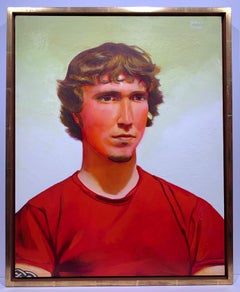
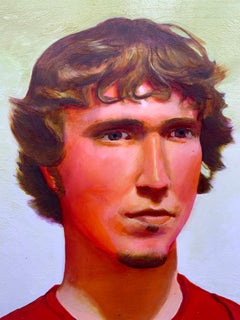
Influence of Red (male portrait)

Influence of Red (male portrait)

By Gilbert Lewis

Located in Wilton Manors, FL

Gilbert Lewis (b.1945). Influence of Red (male portrait), ca. 1990s. Oil on masonite panel, 16 x 20 inches. Signed upper right. Excellent condition. Measures 18 x 22 inches in custom gold leaf float frame. Original gallery labels affixed on verso. Provenance: estate of the artist. Artist statement: Figurative art is a vital active process. The image has its own meaning; not storytelling, not just a picture of a face or a flower. Neither is it simply an exercise in the arrangement of shapes or colors. I want to translate my immediate impression into paint to present the image of an outstretched branch of flowers or a face – direct and simple. My art reflects human concerns expressed symbolically, through fantasy and in a more concrete manner in the process of making the representation itself. Art is my response to the image, the end result of an active process of exploration of the limits of the paint on paper within the confines of representation. The painting of a face is not just a face. My feelings are expressed through these images. My paintings speak to anyone in touch with their own humanity; to anyone else my art may be dismissed as “to personal”. Biography: Gilbert Braddy Lewis born September 25, 1945 in Hampton, Va. Son of David Blake Lewis (born in Atlanta, Ga.) and Gladys Louise Braddy [Lewis] (of Sanford, Fl.); brother of David Blake Lewis (Jr.) and Linda Lewis [Hunter]. The family resides at 3 South Linden Street, Hampton, Va. 1953 until 1962 “I studied from the age of seven, in Virginia, with two well-known Tidewater artists, Jean Craig and the late Allan Jones. The teaching methods of carefully observed studies from nature in charcoal or tempra paint, derived, of course, from the original French academic model, conveyed its impact on my early development; however, my eye and consciousness were mostly activated by the reproductions on the studio wall of works by Botticelli, Da Vinci, and Michelangelo.” Gilbert Lewis in Contemporary Philadelphia Artists: A Juried Exhibition, (Philadelphia Museum of Art 2000), p. 145 1963-68 Studies at Pennsylvania Academy of the Fine Arts with Franklin Watkins, Hobson Pittman, Morris Blackburn, and Walter Stuempfig. While a student at PAFA he shares apartment [261 South 21st Street] with PAFA students, Jody Pinto and Barbara Sosson. In 1967 he receives PAFA’s: Bergman Prize in Painting; M. Herbert Syme Prize; and Samuel Cresson Memorial Travelling Scholarship. The latter award enables Lewis to travel to Europe during the summer of 1967 where he visits museums. “In 1967, after having seen the Italian master’s work while on scholarship from the Pennsylvania Academy, I was to realize my great influences and to discover the earlier Sienese masters whose clarity and energy still move me.” Gilbert Lewis in Contemporary Philadelphia Artists: A Juried Exhibition, (Philadelphia Museum of Art 2000), p. 145 1968 Horizontal painting [of an interior with a seated woman and cat by a large window] reproduced in black and white in school catalog for Pennsylvania Academy of the Fine Arts 1968-1969, p. 24. Other students whose works are reproduced include Clayton Anderson, Barkley...

Category

1990s Realist Portrait Paintings

Materials

Masonite, Oil

Large Contemporary Annette Lemieux Photo Etching Aquatint Censor Abstract Print

Large Contemporary Annette Lemieux Photo Etching Aquatint Censor Abstract Print

By Annette Lemieux

Located in Surfside, FL

Annette Lemieux (American, 1957-) Date: 1994 Medium: photogravure, aquatint (photo etching) and stencil Hand signed and dated lower right. Editioned lower left. Dimensions: Sheet: 22...

Category

1990s Conceptual Abstract Prints
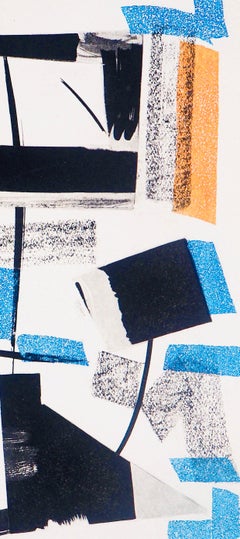
Materials

Etching, Aquatint, Photogravure

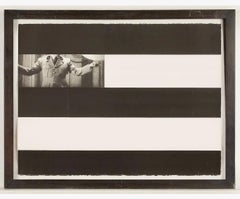
Large Contemporary Annette Lemieux Photo Etching Aquatint Censor Abstract Print

Large Contemporary Annette Lemieux Photo Etching Aquatint Censor Abstract Print

By Annette Lemieux

Located in Surfside, FL

Annette Lemieux (American, 1957-) Date: 1994 Medium: photogravure, aquatint (photo etching) and stencil Hand signed and dated lower right. Editioned lower left. Dimensions: Sheet: 22...

Category

1990s Conceptual Abstract Prints
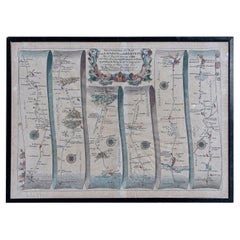
Materials

Etching, Aquatint, Photogravure

Large Contemporary Annette Lemieux Photo Etching Aquatint Censor Abstract Print

Large Contemporary Annette Lemieux Photo Etching Aquatint Censor Abstract Print

By Annette Lemieux

Located in Surfside, FL

Annette Lemieux (American, 1957-) Date: 1994 Medium: photogravure, aquatint (photo etching) and stencil Hand signed and dated lower right. Editioned lower left. Dimensions: Sheet: 22...

Category

1990s Conceptual Abstract Prints
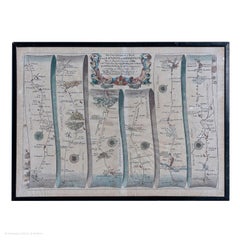
Materials

Etching, Aquatint, Photogravure

Large Contemporary Annette Lemieux Photo Etching Aquatint Censor Abstract Print

Large Contemporary Annette Lemieux Photo Etching Aquatint Censor Abstract Print

By Annette Lemieux

Located in Surfside, FL

Annette Lemieux (American, 1957-) Date: 1994 Medium: photogravure, aquatint (photo etching) and stencil Hand signed and dated lower right. Editioned lower left. Dimensions: Sheet: 22...

Category

1990s Conceptual Abstract Prints
Materials

Etching, Aquatint, Photogravure

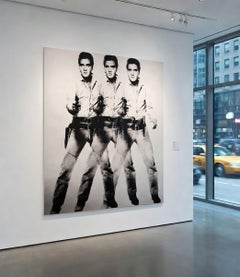
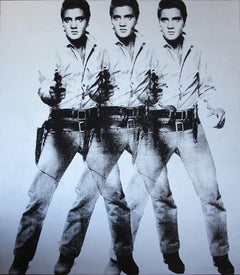
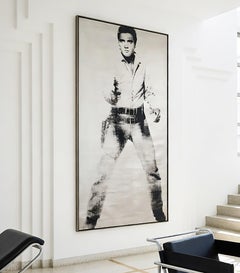
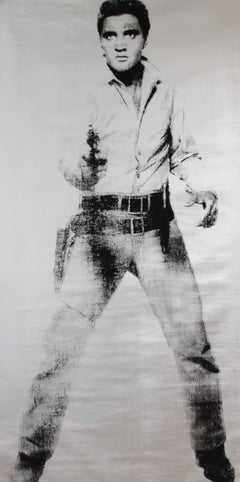
"Triple Elvis" Denied Andy Warhol Silver Black Pop Art Painting by Charles Lutz

"Triple Elvis" Denied Andy Warhol Silver Black Pop Art Painting by Charles Lutz

By Charles Lutz

Located in Brooklyn, NY

"Triple Elvis" (Denied) Silkscreen Painting by Charles Lutz Silkscreen and silver enamel paint on canvas with Artist's Denied stamp of the Andy Warhol Art Authentication Board. 82 x 72" inches 2010 This important example was shown alongside works by Warhol in a two-person show "Warhol Revisited (Charles Lutz / Andy Warhol)" at UAB Abroms-Engel Institute for the Visual Arts in 2024. Lutz's 2007 ''Warhol Denied'' series gained international attention by calling into question the importance of originality or lack thereof in the work of Andy Warhol. The authentication/denial process of the [[Andy Warhol Art Authentication Board]] was used to create value by submitting recreations of Warhol works for judgment with the full intention for the works to be formally marked "DENIED". The final product of the conceptual project being "officially denied" "Warhol" paintings authored by Lutz. Based on the full-length Elvis Presley paintings by Pop Artist Andy Warhol in 1964, this is likely one of his most iconic images, next to Campbell's Soup Cans and portraits of Jackie Kennedy, Marilyn Monroe, Liz Taylor, and Marlon Brando. This is the rarest of the Elvis works from the series, as Lutz sourced a vintage roll of 1960's primed artist linen which was used for this one Elvis. The silkscreen, like Warhol's embraced imperfections, like the slight double image printing of the Elvis image. Lutz received his BFA in Painting and Art History from Pratt Institute and studied Human Dissection and Anatomy at Columbia University, New York. Lutz's work deals with perceptions and value structures, specifically the idea of the transference of values. Lutz's most recently presented an installation of new sculptures dealing with consumerism at Frank Lloyd Wright's Fallingwater House in 2022. Lutz's 2007 Warhol Denied series received international attention calling into question the importance of originality in a work of art. The valuation process (authentication or denial) of the Andy Warhol Art Authentication Board was used by the artist to create value by submitting recreations of Warhol works for judgment, with the full intention for the works to be formally marked "DENIED" of their authenticity. The final product of this conceptual project is "Officially DENIED" "Warhol" paintings authored by Lutz. Later in 2013, Lutz went on to do one of his largest public installations to date. At the 100th Anniversary of Marcel Duchamp's groundbreaking and controversial Armory Show, Lutz was asked by the curator of Armory Focus: USA and former Director of The Andy Warhol Museum, Eric Shiner to create a site-specific installation representing the US. The installation "Babel" (based on Pieter Bruegel's famous painting) consisted of 1500 cardboard replicas of Warhol's Brillo Box (Stockholm Type) stacked 20 ft tall. All 1500 boxes were then given to the public freely, debasing the Brillo Box as an art commodity by removing its value, in addition to debasing its willing consumers. Elvis was "the greatest cultural force in the Twentieth Century. He introduced the beat to everything, and he changed everything - music, language, clothes, it's a whole new social revolution." Leonard Bernstein in: Exh. Cat., Boston, The Institute of Contemporary Art and traveling, Elvis + Marilyn 2 x Immortal, 1994-97, p. 9. Andy Warhol "quite simply changed how we all see the world around us." Kynaston McShine in: Exh. Cat., New York, Museum of Modern Art (and traveling), Andy Warhol: Retrospective, 1996, p. 13. In the summer of 1963 Elvis Presley was just twenty-eight years old but already a legend of his time. During the preceding seven years - since Heartbreak Hotel became the biggest-selling record of 1956 - he had recorded seventeen number-one singles and seven number-one albums; starred in eleven films, countless national TV appearances, tours, and live performances; earned tens of millions of dollars; and was instantly recognized across the globe. The undisputed King of Rock and Roll, Elvis was the biggest star alive: a cultural phenomenon of mythic proportions apparently no longer confined to the man alone. As the eminent composer Leonard Bernstein put it, Elvis was "the greatest cultural force in the Twentieth Century. He introduced the beat to everything, and he changed everything - music, language, clothes, it's a whole new social revolution." (Exh. Cat., Boston, The Institute of Contemporary Art (and traveling), Elvis + Marilyn 2 x Immortal, 1994, p. 9). In the summer of 1963 Andy Warhol was thirty-four years old and transforming the parameters of visual culture in America. The focus of his signature silkscreen was leveled at subjects he brilliantly perceived as the most important concerns of day to day contemporary life. By appropriating the visual vernacular of consumer culture and multiplying readymade images gleaned from newspapers, magazines and advertising, he turned a mirror onto the contradictions behind quotidian existence. Above all else he was obsessed with themes of celebrity and death, executing intensely multifaceted and complex works in series that continue to resound with universal relevance. His unprecedented practice re-presented how society viewed itself, simultaneously reinforcing and radically undermining the collective psychology of popular culture. He epitomized the tide of change that swept through the 1960s and, as Kynaston McShine has concisely stated, "He quite simply changed how we all see the world around us." (Exh. Cat., New York, Museum of Modern Art (and traveling), Andy Warhol: Retrospective, 1996, p. 13). Thus in the summer of 1963 there could not have been a more perfect alignment of artist and subject than Warhol and Elvis. Perhaps the most famous depiction of the biggest superstar by the original superstar artist, Double Elvis is a historic paradigm of Pop Art from a breath-taking moment in Art History. With devastating immediacy and efficiency, Warhol's canvas seduces our view with a stunning aesthetic and confronts our experience with a sophisticated array of thematic content. Not only is there all of Elvis, man and legend, but we are also presented with the specter of death, staring at us down the barrel of a gun; and the lone cowboy, confronting the great frontier and the American dream. The spray painted silver screen denotes the glamour and glory of cinema, the artificiality of fantasy, and the idea of a mirror that reveals our own reality back to us. At the same time, Warhol's replication of Elvis' image as a double stands as metaphor for the means and effects of mass-media and its inherent potential to manipulate and condition. These thematic strata function in simultaneous concert to deliver a work of phenomenal conceptual brilliance. The portrait of a man, the portrait of a country, and the portrait of a time, Double Elvis is an indisputable icon for our age. The source image was a publicity still for the movie Flaming Star, starring Presley as the character Pacer Burton and directed by Don Siegel in 1960. The film was originally intended as a vehicle for Marlon Brando and produced by David Weisbart, who had made James Dean's Rebel Without a Cause in 1955. It was the first of two Twentieth Century Fox productions Presley was contracted to by his manager Colonel Tom Parker, determined to make the singer a movie star. For the compulsive movie-fan Warhol, the sheer power of Elvis wielding a revolver as the reluctant gunslinger presented the zenith of subject matter: ultimate celebrity invested with the ultimate power to issue death. Warhol's Elvis is physically larger than life and wears the expression that catapulted him into a million hearts: inexplicably and all at once fearful and resolute; vulnerable and predatory; innocent and explicit. It is the look of David Halberstam's observation that "Elvis Presley was an American original, the rebel as mother's boy, alternately sweet and sullen, ready on demand to be either respectable or rebellious." (Exh. Cat., Boston, Op. Cit.). Indeed, amidst Warhol's art there is only one other subject whose character so ethereally defies categorization and who so acutely conflated total fame with the inevitability of mortality. In Warhol's work, only Elvis and Marilyn harness a pictorial magnetism of mythic proportions. With Marilyn Monroe, whom Warhol depicted immediately after her premature death in August 1962, he discovered a memento mori to unite the obsessions driving his career: glamour, beauty, fame, and death. As a star of the silver screen and the definitive international sex symbol, Marilyn epitomized the unattainable essence of superstardom that Warhol craved. Just as there was no question in 1963, there remains still none today that the male equivalent to Marilyn is Elvis. However, despite his famous 1968 adage, "If you want to know all about Andy Warhol, just look at the surface of my paintings" Warhol's fascination held purpose far beyond mere idolization. As Rainer Crone explained in 1970, Warhol was interested in movie stars above all else because they were "people who could justifiably be seen as the nearest thing to representatives of mass culture." (Rainer Crone, Andy Warhol, New York, 1970, p. 22). Warhol was singularly drawn to the idols of Elvis and Marilyn, as he was to Marlon Brando and Liz Taylor, because he implicitly understood the concurrence between the projection of their image and the projection of their brand. Some years after the present work he wrote, "In the early days of film, fans used to idolize a whole star - they would take one star and love everything about that star...So you should always have a product that's not just 'you.' An actress should count up her plays and movies and a model should count up her photographs and a writer should count up his words and an artist should count up his pictures so you always know exactly what you're worth, and you don't get stuck thinking your product is you and your fame, and your aura." (Andy Warhol, The Philosophy of Andy Warhol (From A to B and Back Again), San Diego, New York and London, 1977, p. 86). The film stars of the late 1950s and early 1960s that most obsessed Warhol embodied tectonic shifts in wider cultural and societal values. In 1971 John Coplans argued that Warhol was transfixed by the subject of Elvis, and to a lesser degree by Marlon Brando and James Dean, because they were "authentically creative, and not merely products of Hollywood's fantasy or commercialism. All three had originative lives, and therefore are strong personalities; all three raised - at one level or another - important questions as to the quality of life in America and the nature of its freedoms. Implicit in their attitude is a condemnation of society and its ways; they project an image of the necessity for the individual to search for his own future, not passively, but aggressively, with commitment and passion." (John Coplans, "Andy Warhol and Elvis Presley," Studio International, vol. 181, no. 930, February 1971, pp. 51-52). However, while Warhol unquestionably adored these idols as transformative heralds, the suggestion that his paintings of Elvis...

Category

21st Century and Contemporary Pop Art Figurative Paintings

Materials

Enamel

"Elvis", Denied Andy Warhol Silver & Black Pop Art Painting by Charles Lutz

"Elvis", Denied Andy Warhol Silver & Black Pop Art Painting by Charles Lutz

By Charles Lutz

Located in Brooklyn, NY

Elvis, Metallic Silver and Black Full Length Silkscreen Painting by Charles Lutz Silkscreen and silver enamel painted on vintage 1960's era linen with Artist's Denied stamp of the Andy Warhol Art Authentication Board. 82" x 40" inches 2010 Lutz's 2007 ''Warhol Denied'' series gained international attention by calling into question the importance of originality or lack thereof in the work of Andy Warhol. The authentication/denial process of the [[Andy Warhol Art Authentication Board]] was used to create value by submitting recreations of Warhol works for judgment with the full intention for the works to be formally marked "DENIED". The final product of the conceptual project being "officially denied" "Warhol" paintings authored by Lutz. Based on the full-length Elvis Presley paintings by Pop Artist Andy Warhol in 1964, this is likely one of his most iconic images, next to Campbell's Soup Cans and portraits of Jackie Kennedy, Marilyn Monroe, Liz Taylor, and Marlon Brando. This is the rarest of the Elvis works from the series, as Lutz sourced a vintage roll of 1960's primed artist linen which was used for this one Elvis. The silkscreen, like Warhol's embraced imperfections, like the slight double image printing of the Elvis image. Lutz received his BFA in Painting and Art History from Pratt Institute and studied Human Dissection and Anatomy at Columbia University, New York. Lutz's work deals with perceptions and value structures, specifically the idea of the transference of values. Lutz's most recently presented an installation of new sculptures dealing with consumerism at Frank Lloyd Wright's Fallingwater House in 2022. Lutz's 2007 Warhol Denied series received international attention calling into question the importance of originality in a work of art. The valuation process (authentication or denial) of the Andy Warhol Art Authentication Board was used by the artist to create value by submitting recreations of Warhol works for judgment, with the full intention for the works to be formally marked "DENIED" of their authenticity. The final product of this conceptual project is "Officially DENIED" "Warhol" paintings authored by Lutz. Later in 2013, Lutz went on to do one of his largest public installations to date. At the 100th Anniversary of Marcel Duchamp's groundbreaking and controversial Armory Show, Lutz was asked by the curator of Armory Focus: USA and former Director of The Andy Warhol Museum, Eric Shiner to create a site-specific installation representing the US. The installation "Babel" (based on Pieter Bruegel's famous painting) consisted of 1500 cardboard replicas of Warhol's Brillo Box (Stockholm Type) stacked 20 ft tall. All 1500 boxes were then given to the public freely, debasing the Brillo Box as an art commodity by removing its value, in addition to debasing its willing consumers. Elvis was "the greatest cultural force in the Twentieth Century. He introduced the beat to everything, and he changed everything - music, language, clothes, it's a whole new social revolution." Leonard Bernstein in: Exh. Cat., Boston, The Institute of Contemporary Art and traveling, Elvis + Marilyn 2 x Immortal, 1994-97, p. 9. Andy Warhol "quite simply changed how we all see the world around us." Kynaston McShine in: Exh. Cat., New York, Museum of Modern Art (and traveling), Andy Warhol: Retrospective, 1996, p. 13. In the summer of 1963 Elvis Presley was just twenty-eight years old but already a legend of his time. During the preceding seven years - since Heartbreak Hotel became the biggest-selling record of 1956 - he had recorded seventeen number-one singles and seven number-one albums; starred in eleven films, countless national TV appearances, tours, and live performances; earned tens of millions of dollars; and was instantly recognized across the globe. The undisputed King of Rock and Roll, Elvis was the biggest star alive: a cultural phenomenon of mythic proportions apparently no longer confined to the man alone. As the eminent composer Leonard Bernstein put it, Elvis was "the greatest cultural force in the Twentieth Century. He introduced the beat to everything, and he changed everything - music, language, clothes, it's a whole new social revolution." (Exh. Cat., Boston, The Institute of Contemporary Art (and traveling), Elvis + Marilyn 2 x Immortal, 1994, p. 9). In the summer of 1963 Andy Warhol was thirty-four years old and transforming the parameters of visual culture in America. The focus of his signature silkscreen was leveled at subjects he brilliantly perceived as the most important concerns of day to day contemporary life. By appropriating the visual vernacular of consumer culture and multiplying readymade images gleaned from newspapers, magazines and advertising, he turned a mirror onto the contradictions behind quotidian existence. Above all else he was obsessed with themes of celebrity and death, executing intensely multifaceted and complex works in series that continue to resound with universal relevance. His unprecedented practice re-presented how society viewed itself, simultaneously reinforcing and radically undermining the collective psychology of popular culture. He epitomized the tide of change that swept through the 1960s and, as Kynaston McShine has concisely stated, "He quite simply changed how we all see the world around us." (Exh. Cat., New York, Museum of Modern Art (and traveling), Andy Warhol: Retrospective, 1996, p. 13). Thus in the summer of 1963 there could not have been a more perfect alignment of artist and subject than Warhol and Elvis. Perhaps the most famous depiction of the biggest superstar by the original superstar artist, Double Elvis is a historic paradigm of Pop Art from a breath-taking moment in Art History. With devastating immediacy and efficiency, Warhol's canvas seduces our view with a stunning aesthetic and confronts our experience with a sophisticated array of thematic content. Not only is there all of Elvis, man and legend, but we are also presented with the specter of death, staring at us down the barrel of a gun; and the lone cowboy, confronting the great frontier and the American dream. The spray painted silver screen denotes the glamour and glory of cinema, the artificiality of fantasy, and the idea of a mirror that reveals our own reality back to us. At the same time, Warhol's replication of Elvis' image as a double stands as metaphor for the means and effects of mass-media and its inherent potential to manipulate and condition. These thematic strata function in simultaneous concert to deliver a work of phenomenal conceptual brilliance. The portrait of a man, the portrait of a country, and the portrait of a time, Double Elvis is an indisputable icon for our age. The source image was a publicity still for the movie Flaming Star, starring Presley as the character Pacer Burton and directed by Don Siegel in 1960. The film was originally intended as a vehicle for Marlon Brando and produced by David Weisbart, who had made James Dean's Rebel Without a Cause in 1955. It was the first of two Twentieth Century Fox productions Presley was contracted to by his manager Colonel Tom Parker, determined to make the singer a movie star. For the compulsive movie-fan Warhol, the sheer power of Elvis wielding a revolver as the reluctant gunslinger presented the zenith of subject matter: ultimate celebrity invested with the ultimate power to issue death. Warhol's Elvis is physically larger than life and wears the expression that catapulted him into a million hearts: inexplicably and all at once fearful and resolute; vulnerable and predatory; innocent and explicit. It is the look of David Halberstam's observation that "Elvis Presley was an American original, the rebel as mother's boy, alternately sweet and sullen, ready on demand to be either respectable or rebellious." (Exh. Cat., Boston, Op. Cit.). Indeed, amidst Warhol's art there is only one other subject whose character so ethereally defies categorization and who so acutely conflated total fame with the inevitability of mortality. In Warhol's work, only Elvis and Marilyn harness a pictorial magnetism of mythic proportions. With Marilyn Monroe, whom Warhol depicted immediately after her premature death in August 1962, he discovered a memento mori to unite the obsessions driving his career: glamour, beauty, fame, and death. As a star of the silver screen and the definitive international sex symbol, Marilyn epitomized the unattainable essence of superstardom that Warhol craved. Just as there was no question in 1963, there remains still none today that the male equivalent to Marilyn is Elvis. However, despite his famous 1968 adage, "If you want to know all about Andy Warhol, just look at the surface of my paintings" Warhol's fascination held purpose far beyond mere idolization. As Rainer Crone explained in 1970, Warhol was interested in movie stars above all else because they were "people who could justifiably be seen as the nearest thing to representatives of mass culture." (Rainer Crone, Andy Warhol, New York, 1970, p. 22). Warhol was singularly drawn to the idols of Elvis and Marilyn, as he was to Marlon Brando and Liz Taylor, because he implicitly understood the concurrence between the projection of their image and the projection of their brand. Some years after the present work he wrote, "In the early days of film, fans used to idolize a whole star - they would take one star and love everything about that star...So you should always have a product that's not just 'you.' An actress should count up her plays and movies and a model should count up her photographs and a writer should count up his words and an artist should count up his pictures so you always know exactly what you're worth, and you don't get stuck thinking your product is you and your fame, and your aura." (Andy Warhol, The Philosophy of Andy Warhol (From A to B and Back Again), San Diego, New York and London, 1977, p. 86). The film stars of the late 1950s and early 1960s that most obsessed Warhol embodied tectonic shifts in wider cultural and societal values. In 1971 John Coplans argued that Warhol was transfixed by the subject of Elvis, and to a lesser degree by Marlon Brando and James Dean, because they were "authentically creative, and not merely products of Hollywood's fantasy or commercialism. All three had originative lives, and therefore are strong personalities; all three raised - at one level or another - important questions as to the quality of life in America and the nature of its freedoms. Implicit in their attitude is a condemnation of society and its ways; they project an image of the necessity for the individual to search for his own future, not passively, but aggressively, with commitment and passion." (John Coplans, "Andy Warhol and Elvis Presley," Studio International, vol. 181, no. 930, February 1971, pp. 51-52). However, while Warhol unquestionably adored these idols as transformative heralds, the suggestion that his paintings of Elvis are uncritical of a generated public image issued for mass consumption fails to appreciate the acuity of his specific re-presentation of the King. As with Marilyn, Liz and Marlon, Warhol instinctively understood the Elvis brand as an industrialized construct, designed for mass consumption like a Coca-Cola bottle or Campbell's Soup Can, and radically revealed it as a precisely composed non-reality. Of course Elvis offered Warhol the biggest brand of all, and he accentuates this by choosing a manifestly contrived version of Elvis-the-film-star, rather than the raw genius of Elvis as performing Rock n' Roll pioneer. A few months prior to the present work he had silkscreened Elvis' brooding visage in a small cycle of works based on a simple headshot, including Red Elvis, but the absence of context in these works minimizes the critical potency that is so present in Double Elvis. With Double Elvis we are confronted by a figure so familiar to us, yet playing a role relating to violence and death that is entirely at odds with the associations entrenched with the singer's renowned love songs. Although we may think this version of Elvis makes sense, it is the overwhelming power of the totemic cipher of the Elvis legend that means we might not even question why he is pointing a gun rather than a guitar. Thus Warhol interrogates the limits of the popular visual vernacular, posing vital questions of collective perception and cognition in contemporary society. The notion that this self-determinedly iconic painting shows an artificial paradigm is compounded by Warhol's enlistment of a reflective metallic surface, a treatment he reserved for his most important portraits of Elvis, Marilyn, Marlon and Liz. Here the synthetic chemical silver paint becomes allegory for the manufacture of the Elvis product, and directly anticipates the artist's 1968 statement: "Everything is sort of artificial. I don't know where the artificial stops and the real starts. The artificial fascinates me, the bright and shiny..." (Artist quoted in Exh. Cat., Stockholm, Moderna Museet and traveling, Andy Warhol, 1968, n.p.). At the same time, the shiny silver paint of Double Elvis unquestionably denotes the glamour of the silver screen and the attractive fantasies of cinema. At exactly this time in the summer of 1963 Warhol bought his first movie camera and produced his first films such as Sleep, Kiss and Tarzan and Jane Regained. Although the absence of plot or narrative convention in these movies was a purposely anti-Hollywood gesture, the unattainability of classic movie stardom still held profound allure and resonance for Warhol. He remained a celebrity and film fanatic, and it was exactly this addiction that so qualifies his sensational critique of the industry machinations behind the stars he adored. Double Elvis was executed less than eighteen months after he had created 32 Campbell's Soup Cans for his immortal show at the Ferus Gallery, Los Angeles in July and August 1962, and which is famously housed in the Museum of Modern Art, New York. In the intervening period he had produced the series Dollar Bills, Coca-Cola Bottles, Suicides, Disasters, and Silver Electric Chairs, all in addition to the portrait cycles of Marilyn and Liz. This explosive outpouring of astonishing artistic invention stands as definitive testament to Warhol's aptitude to seize the most potent images of his time. He recognized that not only the product itself, but also the means of consumption - in this case society's abandoned deification of Elvis - was symptomatic of a new mode of existence. As Heiner Bastian has precisely summated: "the aura of utterly affirmative idolization already stands as a stereotype of a 'consumer-goods style' expression of an American way of life and of the mass-media culture of a nation." (Exh. Cat., Berlin, Neue Nationalgalerie (and traveling), Andy Warhol: Retrospective, 2001, p. 28). For Warhol, the act of image replication and multiplication anaesthetized the effect of the subject, and while he had undermined the potency of wealth in 200 One Dollar Bills, and cheated the terror of death by electric chair in Silver Disaster # 6, the proliferation of Elvis here emasculates a prefabricated version of character authenticity. Here the cinematic quality of variety within unity is apparent in the degrees to which Presley's arm and gun become less visible to the left of the canvas. The sense of movement is further enhanced by a sense of receding depth as the viewer is presented with the ghost like repetition of the figure in the left of the canvas, a 'jump effect' in the screening process that would be replicated in the multiple Elvis paintings. The seriality of the image heightens the sense of a moving image, displayed for us like the unwinding of a reel of film. Elvis was central to Warhol's legendary solo exhibition organized by Irving Blum at the Ferus Gallery in the Fall of 1963 - the show having been conceived around the Elvis paintings since at least May of that year. A well-known installation photograph shows the present work prominently presented among the constant reel of canvases, designed to fill the space as a filmic diorama. While the Elvis canvases...

Category

21st Century and Contemporary Pop Art Figurative Paintings

Materials

Enamel

'Kate Bush Drama'  SIGNED, LIMITED EDITION

'Kate Bush Drama' SIGNED, LIMITED EDITION

By Gered Mankowitz

Located in London, GB

'Kate Bush Drama' SIGNED, LIMITED EDITION 1978 by Gered Mankowitz Silver gelatin print - signed and numbered and stamped on the face of the print in the border below the image. Iconic and luscious close up shot of the legendary British pop singer, song writer and performer Kate Bush. Taken in London in 1978 at the height of her fame and success, by legendary Rock & Music photographer, Gered Mankowitz. GERED MANKOWITZ BIOGRAPHY: Gered Mankowitz was born in London, England, on 3rd August 1946. The first of four sons of the late author, playwright and film writer Wolf Mankowitz and his wife, the Jungian psychotherapist Ann Mankowitz. After an education of sorts at several London co-educational “progressive” schools, he left at 15, avoiding all exams and completed his education devoid of any formal qualifications. Having displayed a natural ‘eye’ for photography whilst on a school trip to Holland and having been inspired to take up photography by the actor Peter Sellers, his photographs were seen by the legendary photographer Tom Blau, who offered Gered an apprenticeship at his famous photo agency, Camera Press Ltd., in London. Over a period of several months Gered worked in all the various departments that made up Camera Press, finally moving to the studio and going on various assignments in and around London. In 1962, Gered went to Barbados with his family and began taking photographs professionally, producing a range of work from architectural studies for the island’s top architect to the first Boeing 707 landing at Bridgetown airport for British West Indian Airways. On returning to London, Gered was offered a chance to go to Paris for the collections, working for the fashion photographer Alec Murray. In spite of the glamour and exciting atmosphere, it was clear that this particular area of work was not for him, and on returning to London he went to work for the ‘show-biz’ portraitist, Jeff Vickers. Gered had already photographed the Bristol Old Vic production of the American musical play “Fiorello” and his photos had been used for the front of theatre display when the show transferred to London’s Piccadilly Theatre. This made him the youngest photographer to have his pictures used in this way; so working for Jeff Vickers gave him an opportunity to develop his ‘show-biz’ contacts and to broaden his experience in the studio, taking portraits of many actors and other personalities. During 1963, Gered met and photographed the singing duo Chad and Jeremy, who had just signed with Ember records. One of these photos was used as the cover of the duo’s first album, “Yesterday’s Gone”, and Gered found himself working in the music industry at a time when it desperately needed new, mould breaking images. He began to work with a new generation of producers like John Barry, Shel Talmy and Chris Blackwell photographing artists who were of his own age group and who felt at ease with him in a way that had not been possible with other photographers. At the end of 1963 Gered opened his first studio, at 9 Masons Yard in the heart of London’s West End. On one side was the infamous disco “The Scotch of St.James”, hangout of the pop glitterati of the time, and on the other the art gallery “Indica”, partly financed by The Beatles and where John Lennon met Yoko Ono. Within a few months Gered had already begun to make a name for himself, and he was approached to photograph Marianne Faithful, who had just had a big hit with “As Tears Go By”. Working closely with Marianne he got to know her manager and producer Andrew Loog Oldham. In early 1965, Oldham asked him to photograph the Rolling Stones, who he also managed and produced. This was a major turning point in Gered’s career, because from this first session came the cover for “Out of Our Heads” (U.S. title “December’s Children”), and as a result he was asked by the Stones to go to America with them on their record breaking 1965 autumn tour. During this 9 week (48 city) tour of the U.S. Gered photographed the Stones on stage and off, and got particularly close to Keith and Charlie. There were many adventures as Gered found himself on the road with the greatest Rock band in the world at the peak of their original success. Gered continued working with the Stones as their ‘official’ photographer, producing photos for albums (“Between the Buttons”; “Got Live If You Want It”; “Big Hits”; and several others), press and publicity, taken at home, in the recording studio, on stage and behind the scenes until 1967, when the band broke off with their manager, Oldham. Through the 60’s, Gered continued in the music world working with Oldham at his famous Immediate label, and with many other major artists including Jimi Hendrix, Free, Traffic, The Yardbirds, The Small Faces and Soft Machine. In to the 70’s with Slade, Gary Glitter, Suzi Quatro, Sweet, Elton John, Kate Bush, Eurythmics, ABC, Duran Duran and many others. During this period, Gered also worked in other areas of photography, including advertising, book covers and a brief spell taking ‘stills’ on movies, including several months in Sardinia with Elizabeth Taylor and Richard Burton on the ill-fated movie “Boom”. In 1982 Gered had a major exhibition of his work at London’s famous Photographers’ Gallery. This was seen by over 16,000 people, a record for the gallery at the time, and it then toured the U.K. for over 2 years. This exhibition was the first in the U.K. to focus on the world of music and was a pathfinder in this genre. In 1984 a book based on this exhibition, called “Hit Parade”, was published in the U.K. and U.S.A. Also in 1984 a book of Gered’s Rolling Stones photographs, called “Satisfaction”, was published. Both books were very well received, and as a result there began the growing interest in the Gered Mankowitz archive. For over 22 years Gered was based at his North London studio, a converted Victorian chapel, taking prize-winning photos for the advertising industry. He has also been a regular contributor to several major publications, and still works in the music business, photographing bands and singers for album covers and magazines. He contributes regularly to The Sunday Times Magazine and Mojo magazine as well as shooting sessions with musical artists such as Oasis, Verve, Catatonia, Kula Shaker, Embrace, The Buena Vista Social Club, Snow patrol, The Bravery, Dukes Spirit as well as many others. Prints of Gered’s work are purchased in galleries throughout the World including London, Manchester, Glasgow, Berlin, Amsterdam, New York, Washington DC, Los Angeles, San Francisco, Hawaii, Hong Kong, Dubai and Tokyo. In 1991 Gered teamed up with the designer David Costa to form Ink Icon Ltd. and to produce a series of limited edition silkscreen prints based on his archive. The first subject in this major project was Jimi Hendrix, and the result was so successful that it was chosen to become the flagship image for the world wide Jimi Hendrix Exhibition. It was also used as the cover for the Polygram Int. C.D. package, entitled The Ultimate Experience, which has gone on to sell well over 2 million copies. In 1993 they created three new images of Hendrix for the worldwide re-release of the great musicians’ albums. Their next project was to produce a set of 4 silk screen images for The Rolling Stones’ Voodoo Lounge tour, and in 1999 they produced Red Cage, a new Stones silk screen to celebrate the band’s continuing Bridges to Babylon tour. Ink Icon teamed up with top California based fine art publisher FrontLine Graphics Inc to produce a set of 6 limited edition, fine art litho prints that they launched in New York at ArtExpo in March 2000. In September and November 1992 Gered had a great success with his exhibition called ENTERTAINERS at the Cromwell and Ward Gallery in Dean Street, London, and in May and June 1993 the exhibition was at the City Museum in Portsmouth as part of the City’s Arts and Music Festival. In April 1994 the exhibition was enlarged to over 100 images for a four-week stay at the prestigious Gallerie Rose in Hamburg, Germany’s Rock’n’Roll city, and then on to Birmingham and Perpignan. In March 1995 Genesis Books published a limited edition (1750 copies only) book of Gered’s Rolling Stones photographs entitled Masons Yard To Primrose Hill and in July 1995 there was an exhibition based on the book at The Govinda Gallery in Washington DC. This book sold out within a few months and recently copies were changing hands for 850 GBP, over 7 times its original price! In early 1999 Genesis published a further book called I-Contact, which contains Gered’s entire black & white Rolling Stones archive of over 3000 images reproduced as 12 x 16 contact sheets. I-Contact also sold out very quickly and currently you would be lucky to find a used copy for less than 1000 GBP! In November 1998 there was a second one-man exhibit at Govinda in Washington DC, and in December/January 1999 there was a show at Magidson Fine Arts in Madison Avenue, New York City. During this prestigious show the gallery was visited by Tommy Hilfiger who purchased prints of the entire show, becoming in one purchase, Gered’s single biggest collector in the United States. Subsequently Tommy has used many of Gered’s prints to decorate his flagship stores, as well as his personal offices in New York. Gered’s famous photo of Hendrix also graced the cover of the Hilfiger sponsored Vanity Fair Rock Icons supplement in their December 1999 issue. Gered had several images in the Icons of Pop exhibition originally at The National Portrait Gallery in London. In March 1999 Gered went to Tokyo to open his first show in Japan, which then toured to three other Japanese cities. From February 2000 several of Gered’s works are on permanent exhibit in San Francisco at the San Francisco Art Exchange, where they have become some of the galleries most consistent sellers. At the end of 2000 Gered had his first major show in The Netherlands at the highly respected Torch Gallery, and in July/August 2001 over 35 prints of his work from the 60’s were seen in Lucerne, Switzerland as part of an International Blues Festival. In December 2001/January 2002 Gered teamed up with the legendary Beatles photographer Robert Freeman and presented a 64 image show in Hong Kong which was a huge success and went on to the Tres Hombres Gallery at the Hotel Tylosand in Halmstad, near Stockholm, Sweden for the whole of Summer 2002. The show was then exhibited in San Francisco in December 2002 through until the end of January 2003. This extraordinary collection that captures the 60’s so brilliantly continued to tour throughout 2004/5. From May 31st 2002 Gered participated in a major exhibition of photographs of Jimi Hendrix at the Audi Forum in Piccadilly Central London, which he also helped to curate and his images of Jimi were used within one of the first interactive television commercials produced for the Audi TT at the same time. Gered published a new book of his Rolling Stones photographs in September 2002 with Vision On Publishers which was launched with an all new Rolling Stones exhibit at the Proud Camden Gallery. This same show was then presented in Hamburg as part of Universal Music’s launch of the re-issued Rolling Stones catalogue of CD’s. With the sponsorship of HP this exhibition toured the UK and was also shown in galleries in Paris and Milan during the latter part of 2004. In June of 2003 together with his partner David Costa, Gered launched a Jimi Hendrix limited edition Fender Stratocaster guitar...
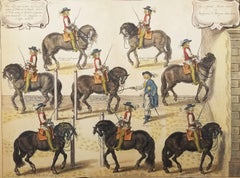
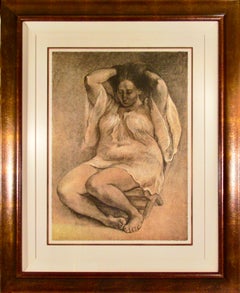
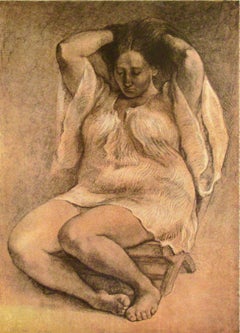
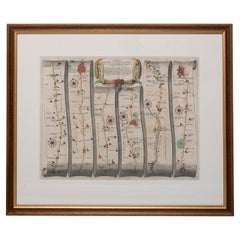
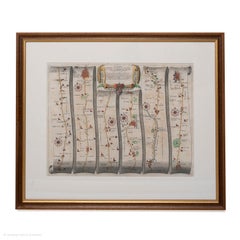
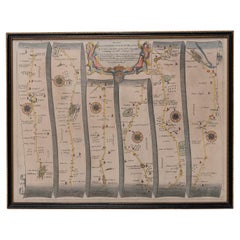
Category

1970s Modern Black and White Photography

Materials

Silver Gelatin

'Kate Bush Drama'  SIGNED, LIMITED EDITION

'Kate Bush Drama' SIGNED, LIMITED EDITION

By Gered Mankowitz

Located in London, GB

'Kate Bush Drama' SIGNED, LIMITED EDITION 1978 by Gered Mankowitz Silver gelatin print - signed and numbered and stamped on the face of the print in the border below the image. ...

Category

1970s Modern Black and White Photography

Materials

Silver Gelatin

'Kate Bush Drama'  SIGNED, LIMITED EDITION

'Kate Bush Drama' SIGNED, LIMITED EDITION

By Gered Mankowitz

Located in London, GB

'Kate Bush Drama' SIGNED, LIMITED EDITION 1978 by Gered Mankowitz Silver gelatin print - signed and numbered and stamped on the face of the print in the border below the image. ...

Category

1970s Modern Black and White Photography

Materials

Silver Gelatin

'Kate Bush Lionheart'  SIGNED, LIMITED EDITION

'Kate Bush Lionheart' SIGNED, LIMITED EDITION

By Gered Mankowitz

Located in London, GB

'Kate Lionheart' SIGNED, LIMITED EDITION 1978 by Gered Mankowitz C print - signed and numbered and stamped on the face of the print in the border below the image. Iconic and lu...

Category

1970s Modern Black and White Photography

Materials

C Print

'Kate Redhead'  SIGNED, LIMITED EDITION

'Kate Redhead' SIGNED, LIMITED EDITION

By Gered Mankowitz

Located in London, GB

'Kate Redhead' SIGNED, LIMITED EDITION 1978 by Gered Mankowitz C print - signed and numbered and stamped on the face of the print in the border below the image. Iconic and lusc...

Category

1970s Modern Black and White Photography

Materials

C Print

'Kate Bush Drama'  SIGNED, LIMITED EDITION

'Kate Bush Drama' SIGNED, LIMITED EDITION

By Gered Mankowitz

Located in London, GB

'Kate Bush Drama' SIGNED, LIMITED EDITION 1978 by Gered Mankowitz Silver gelatin print - signed and numbered and stamped on the face of the print in the border below the image. ...

Category

1970s Modern Black and White Photography

Materials

Silver Gelatin