276 results for "weapons"

to
17
49
57
32
47
91
Overall Width
to
Overall Height
to
12
12
58
194
1
3
5
1
9
4
17
2
76
57
29
12
12
11
10
3
2
1
118
96
62
127
61
58
57
30
24
23
19
17
13
12
11
10
9
7
7
6
6
5
5
219
158
153
139
77
46
16
6
4
3
70
58
193
67
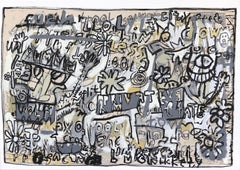
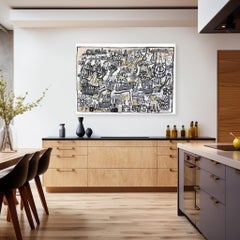
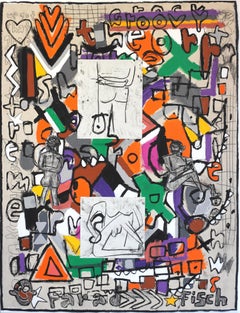
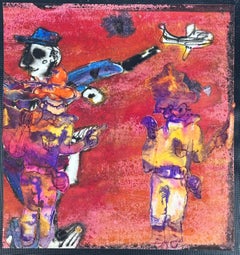
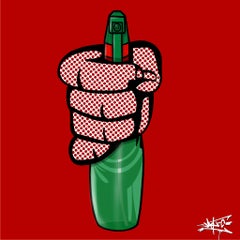
Weapon of Choice, Street Art, Pop Art, spray bottle, corona

Weapon of Choice, Street Art, Pop Art, spray bottle, corona

By Jay-C

Located in München, BY

Edition 5 A hand with a spray bottle JAY-C – the pseudonym of this innovative young artist known for his subversive use of familiar figures and symbols. ...

Category

2010s Street Art Abstract Paintings

Materials

Mixed Media, Pigment, Archival Pigment

Knowledge is the ultimate weapon, Painting, Acrylic on Canvas

Knowledge is the ultimate weapon, Painting, Acrylic on Canvas

Located in Yardley, PA

This new series aims to raise awareness about the interaction between people, social networks and technology in general. The main idea of this series is to capture the characters wit...

Category

21st Century and Contemporary Pop Art Paintings

Materials

Acrylic

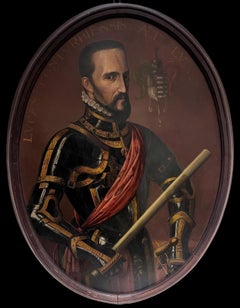
Huge Antique Oil Painting Portrait Fernando Álvarez de Toledo 3rd Duke of Alba

Huge Antique Oil Painting Portrait Fernando Álvarez de Toledo 3rd Duke of Alba

Located in Cirencester, Gloucestershire

Spanish School, early 20th century Portrait of Fernando Álvarez de Toledo, the 3rd Duke of Alba (1507-1582). after the 16th century painting by Anthonis Mors oil on panel, framed f...

Category

Early 20th Century Old Masters Portrait Paintings

Materials

Oil

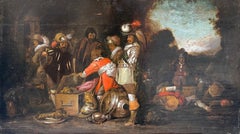
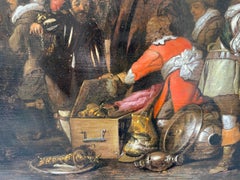
Dutch Military Scene – Circle of Duyster, Soldiers Dividing War Spoils, c.1700

Dutch Military Scene – Circle of Duyster, Soldiers Dividing War Spoils, c.1700

Located in Firenze, IT

Division of the Spoils in a Military Encampment Entourage of Willem Cornelisz. Duyster (Amsterdam 1599 – 1635) Not signed. Dutch school, late 17th – early 18th century Oil on oak pa...

Category

18th Century and Earlier Dutch School Figurative Paintings

Materials

Oak, Oil, Wood Panel

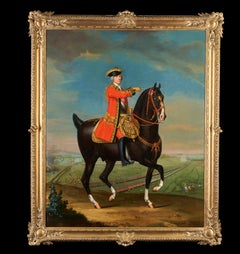
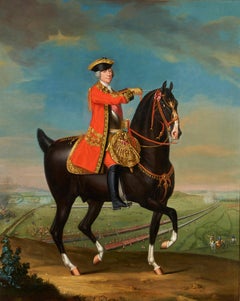
An equestrian portrait of Field Marshal Sir John Ligonier, 1st Earl of Ligonier

An equestrian portrait of Field Marshal Sir John Ligonier, 1st Earl of Ligonier

By David Morier

Located in Stoke, Hampshire

David Morier (c.1705–1770 London) An equestrian portrait of Field Marshal Sir John Ligonier, 1st Earl of Ligonier (1680–1770) Oil on canvas Canvas size - 40 x 50 in Framed size - 48 ...

Category

18th Century Old Masters Portrait Paintings

Materials

Oil

MYTHOLOGICAL SCENE- Italian School - Oil on canvas Painting.

MYTHOLOGICAL SCENE- Italian School - Oil on canvas Painting.

By Alfonso Pragliola

Located in Napoli, IT

MYTHOLOGICAL SCENE Italian oil on canvas painting cm.100x100, Alfonso Pragliola Italia 2010 In this oil on canvas, the painter makes his own personal and modern interpretation of Ant...

Category

2010s Modern Figurative Paintings

Materials

Canvas, Oil

Battle Masturzo Lansdscape 17th Century Paint Oil on canvas Old master

Battle Masturzo Lansdscape 17th Century Paint Oil on canvas Old master

Located in Riva del Garda, IT

Marzio Masturzo (Active in Naples and Rome in the second half of the 17th century) Attributable Battle between Christian and Turkish cavalry Oil on canvas 78 x 144 cm - 99 x ...

Category

17th Century Old Masters Landscape Paintings

Materials

Oil

Tennis Player
Tennis Player

Tennis Player

By Elisabeth Sabala

Located in Lake Worth Beach, FL

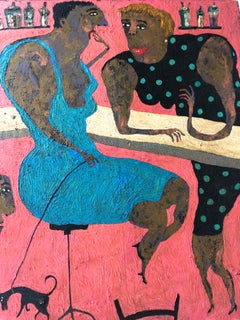
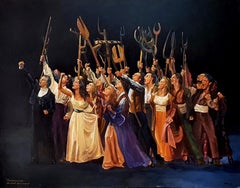
Tennis Player heavy oil impasto on canvas framed. Elisabeth Sabala Abelló (Barcelona, 1956). She studied industrial design at the School of Arts and Crafts in Barcelona ​and has a degree in Fine Arts, a specialty in painting, from the Central University of the same city. Sabala is a convinced figurative who has given all the prominence of her work to the representation of the human being in its most trivial aspects. At a time when the artistic landscape extols abstract and conceptual art focused on the great universal themes, Sabala continues to focus on the small defects that bring us closer to the collective and the human. The artistic progression of Sabala takes place, at first, from a bleak period to another vitalist and, later, from the representation of isolated characters (In the super, Reading the stories of​ the paintings) to the recreation of great concentrations of its peculiar individuals characterized in an endless number of situations (The Great Dance, The Girls of the Choir). Sabala's work is vital and touching, as well as scathing and satirical: it confronts its characters in the most varied situations, capturing, at the same time, the viewer's attention with an unusual juxtaposition of colors that do not seek chromatic harmony, but expression and movement through matter. In 1980 she won the first prize of a painting of the City of Castelldefels, and the following year she debuted individually in the Caixa Catalunya room, in Barcelona. In 1984, she was selected for the XXIII Joan Miró Drawing Prize, taking part in a traveling exhibition in Japan. He won the first prize of the International Painting Competition of Pollença (Mallorca) in 1985, and the following year he took part in a collective held at the Martano gallery in Turin. That same year of 1986 she obtained the Scholarship of Plastic Arts of the Generalitat de Catalunya. Sabala continues to hold personal shows in Barcelona, ​​Mallorca, Madrid, and Italy, and in 1989 she debuted in New York with an individual exhibition held at the Scott Alan Gallery. Since then she will reiterate his presence both in that city and in Paris, Berlin, Monaco, Amsterdam, Los Angeles, Mexico City, Hong Kong, etc. His works have been present at Interactive, ARCO, Art Forum, Art Jonction and New Art, as well as in various Spanish museums. • Studies: Fine Arts, University of Barcelona • Industrial Design, School of Arts and Crafts, Barcelona Main exhibitions Spain: • Barcelona: ◦ Arcs & Cracks​, 1990, 1992, Anna Benach 1993, Helena Ramos 1993 ◦ Maria Jose Castellvi 1996, 1997, 1999, 2001 “a wedding is a wedding” + Performance “Ella” ◦ 2004, 2006 “Fashion satisfaction” + Performance ◦ 2008 “Women's weapons” • Girona: ◦ Helena Ramos 1990, 1991, 1993, 1995 ◦ Cyprus Art...

Category

1980s Surrealist Figurative Paintings

Materials

Cotton Canvas, Oil

Battle Cavalry Landscape Calza Paint 17/18th Century Oil on canvas Old master

Battle Cavalry Landscape Calza Paint 17/18th Century Oil on canvas Old master

Located in Riva del Garda, IT

Antonio Calza (Verona, 1653 – Verona 1725) Battle between Christian and Turkish cavalry Oil on canvas 47 x 85 cm In frame 66 x 105 cm Here we see a fierce battle between Ch...

Category

17th Century Old Masters Paintings

Materials

Oil

"Triple Elvis" Denied Andy Warhol Silver Black Pop Art Painting by Charles Lutz

"Triple Elvis" Denied Andy Warhol Silver Black Pop Art Painting by Charles Lutz

By Charles Lutz

Located in Brooklyn, NY

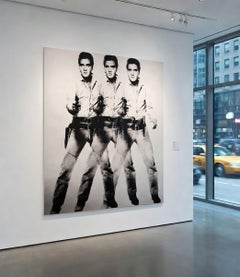
"Triple Elvis" (Denied) Silkscreen Painting by Charles Lutz Silkscreen and silver enamel paint on canvas with Artist's Denied stamp of the Andy Warhol Art Authentication Board. 82 x 72" inches 2010 This important example was shown alongside works by Warhol in a two-person show "Warhol Revisited (Charles Lutz / Andy Warhol)" at UAB Abroms-Engel Institute for the Visual Arts in 2024. Lutz's 2007 ''Warhol Denied'' series gained international attention by calling into question the importance of originality or lack thereof in the work of Andy Warhol. The authentication/denial process of the [[Andy Warhol Art Authentication Board]] was used to create value by submitting recreations of Warhol works for judgment with the full intention for the works to be formally marked "DENIED". The final product of the conceptual project being "officially denied" "Warhol" paintings authored by Lutz. Based on the full-length Elvis Presley paintings by Pop Artist Andy Warhol in 1964, this is likely one of his most iconic images, next to Campbell's Soup Cans and portraits of Jackie Kennedy, Marilyn Monroe, Liz Taylor, and Marlon Brando. This is the rarest of the Elvis works from the series, as Lutz sourced a vintage roll of 1960's primed artist linen which was used for this one Elvis. The silkscreen, like Warhol's embraced imperfections, like the slight double image printing of the Elvis image. Lutz received his BFA in Painting and Art History from Pratt Institute and studied Human Dissection and Anatomy at Columbia University, New York. Lutz's work deals with perceptions and value structures, specifically the idea of the transference of values. Lutz's most recently presented an installation of new sculptures dealing with consumerism at Frank Lloyd Wright's Fallingwater House in 2022. Lutz's 2007 Warhol Denied series received international attention calling into question the importance of originality in a work of art. The valuation process (authentication or denial) of the Andy Warhol Art Authentication Board was used by the artist to create value by submitting recreations of Warhol works for judgment, with the full intention for the works to be formally marked "DENIED" of their authenticity. The final product of this conceptual project is "Officially DENIED" "Warhol" paintings authored by Lutz. Later in 2013, Lutz went on to do one of his largest public installations to date. At the 100th Anniversary of Marcel Duchamp's groundbreaking and controversial Armory Show, Lutz was asked by the curator of Armory Focus: USA and former Director of The Andy Warhol Museum, Eric Shiner to create a site-specific installation representing the US. The installation "Babel" (based on Pieter Bruegel's famous painting) consisted of 1500 cardboard replicas of Warhol's Brillo Box (Stockholm Type) stacked 20 ft tall. All 1500 boxes were then given to the public freely, debasing the Brillo Box as an art commodity by removing its value, in addition to debasing its willing consumers. Elvis was "the greatest cultural force in the Twentieth Century. He introduced the beat to everything, and he changed everything - music, language, clothes, it's a whole new social revolution." Leonard Bernstein in: Exh. Cat., Boston, The Institute of Contemporary Art and traveling, Elvis + Marilyn 2 x Immortal, 1994-97, p. 9. Andy Warhol "quite simply changed how we all see the world around us." Kynaston McShine in: Exh. Cat., New York, Museum of Modern Art (and traveling), Andy Warhol: Retrospective, 1996, p. 13. In the summer of 1963 Elvis Presley was just twenty-eight years old but already a legend of his time. During the preceding seven years - since Heartbreak Hotel became the biggest-selling record of 1956 - he had recorded seventeen number-one singles and seven number-one albums; starred in eleven films, countless national TV appearances, tours, and live performances; earned tens of millions of dollars; and was instantly recognized across the globe. The undisputed King of Rock and Roll, Elvis was the biggest star alive: a cultural phenomenon of mythic proportions apparently no longer confined to the man alone. As the eminent composer Leonard Bernstein put it, Elvis was "the greatest cultural force in the Twentieth Century. He introduced the beat to everything, and he changed everything - music, language, clothes, it's a whole new social revolution." (Exh. Cat., Boston, The Institute of Contemporary Art (and traveling), Elvis + Marilyn 2 x Immortal, 1994, p. 9). In the summer of 1963 Andy Warhol was thirty-four years old and transforming the parameters of visual culture in America. The focus of his signature silkscreen was leveled at subjects he brilliantly perceived as the most important concerns of day to day contemporary life. By appropriating the visual vernacular of consumer culture and multiplying readymade images gleaned from newspapers, magazines and advertising, he turned a mirror onto the contradictions behind quotidian existence. Above all else he was obsessed with themes of celebrity and death, executing intensely multifaceted and complex works in series that continue to resound with universal relevance. His unprecedented practice re-presented how society viewed itself, simultaneously reinforcing and radically undermining the collective psychology of popular culture. He epitomized the tide of change that swept through the 1960s and, as Kynaston McShine has concisely stated, "He quite simply changed how we all see the world around us." (Exh. Cat., New York, Museum of Modern Art (and traveling), Andy Warhol: Retrospective, 1996, p. 13). Thus in the summer of 1963 there could not have been a more perfect alignment of artist and subject than Warhol and Elvis. Perhaps the most famous depiction of the biggest superstar by the original superstar artist, Double Elvis is a historic paradigm of Pop Art from a breath-taking moment in Art History. With devastating immediacy and efficiency, Warhol's canvas seduces our view with a stunning aesthetic and confronts our experience with a sophisticated array of thematic content. Not only is there all of Elvis, man and legend, but we are also presented with the specter of death, staring at us down the barrel of a gun; and the lone cowboy, confronting the great frontier and the American dream. The spray painted silver screen denotes the glamour and glory of cinema, the artificiality of fantasy, and the idea of a mirror that reveals our own reality back to us. At the same time, Warhol's replication of Elvis' image as a double stands as metaphor for the means and effects of mass-media and its inherent potential to manipulate and condition. These thematic strata function in simultaneous concert to deliver a work of phenomenal conceptual brilliance. The portrait of a man, the portrait of a country, and the portrait of a time, Double Elvis is an indisputable icon for our age. The source image was a publicity still for the movie Flaming Star, starring Presley as the character Pacer Burton and directed by Don Siegel in 1960. The film was originally intended as a vehicle for Marlon Brando and produced by David Weisbart, who had made James Dean's Rebel Without a Cause in 1955. It was the first of two Twentieth Century Fox productions Presley was contracted to by his manager Colonel Tom Parker, determined to make the singer a movie star. For the compulsive movie-fan Warhol, the sheer power of Elvis wielding a revolver as the reluctant gunslinger presented the zenith of subject matter: ultimate celebrity invested with the ultimate power to issue death. Warhol's Elvis is physically larger than life and wears the expression that catapulted him into a million hearts: inexplicably and all at once fearful and resolute; vulnerable and predatory; innocent and explicit. It is the look of David Halberstam's observation that "Elvis Presley was an American original, the rebel as mother's boy, alternately sweet and sullen, ready on demand to be either respectable or rebellious." (Exh. Cat., Boston, Op. Cit.). Indeed, amidst Warhol's art there is only one other subject whose character so ethereally defies categorization and who so acutely conflated total fame with the inevitability of mortality. In Warhol's work, only Elvis and Marilyn harness a pictorial magnetism of mythic proportions. With Marilyn Monroe, whom Warhol depicted immediately after her premature death in August 1962, he discovered a memento mori to unite the obsessions driving his career: glamour, beauty, fame, and death. As a star of the silver screen and the definitive international sex symbol, Marilyn epitomized the unattainable essence of superstardom that Warhol craved. Just as there was no question in 1963, there remains still none today that the male equivalent to Marilyn is Elvis. However, despite his famous 1968 adage, "If you want to know all about Andy Warhol, just look at the surface of my paintings" Warhol's fascination held purpose far beyond mere idolization. As Rainer Crone explained in 1970, Warhol was interested in movie stars above all else because they were "people who could justifiably be seen as the nearest thing to representatives of mass culture." (Rainer Crone, Andy Warhol, New York, 1970, p. 22). Warhol was singularly drawn to the idols of Elvis and Marilyn, as he was to Marlon Brando and Liz Taylor, because he implicitly understood the concurrence between the projection of their image and the projection of their brand. Some years after the present work he wrote, "In the early days of film, fans used to idolize a whole star - they would take one star and love everything about that star...So you should always have a product that's not just 'you.' An actress should count up her plays and movies and a model should count up her photographs and a writer should count up his words and an artist should count up his pictures so you always know exactly what you're worth, and you don't get stuck thinking your product is you and your fame, and your aura." (Andy Warhol, The Philosophy of Andy Warhol (From A to B and Back Again), San Diego, New York and London, 1977, p. 86). The film stars of the late 1950s and early 1960s that most obsessed Warhol embodied tectonic shifts in wider cultural and societal values. In 1971 John Coplans argued that Warhol was transfixed by the subject of Elvis, and to a lesser degree by Marlon Brando and James Dean, because they were "authentically creative, and not merely products of Hollywood's fantasy or commercialism. All three had originative lives, and therefore are strong personalities; all three raised - at one level or another - important questions as to the quality of life in America and the nature of its freedoms. Implicit in their attitude is a condemnation of society and its ways; they project an image of the necessity for the individual to search for his own future, not passively, but aggressively, with commitment and passion." (John Coplans, "Andy Warhol and Elvis Presley," Studio International, vol. 181, no. 930, February 1971, pp. 51-52). However, while Warhol unquestionably adored these idols as transformative heralds, the suggestion that his paintings of Elvis...

Category

21st Century and Contemporary Pop Art Figurative Paintings

Materials

Enamel

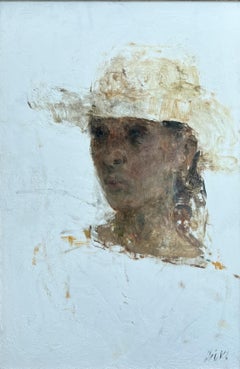
"Study at Jan and John's" (2025) Original Abstract Portrait Oil Painting

"Study at Jan and John's" (2025) Original Abstract Portrait Oil Painting

By Ron Hicks

Located in Denver, CO

Ron Hicks' (US based) "Study at Jan and John's" (2025) is an original, handmade oil painting that depicts a lightly abstracted portrait of a woman against a pale white background. T...

Category

2010s Abstract Impressionist Portrait Paintings

Materials

Oil, Wood Panel

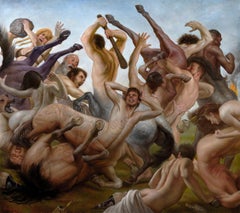
The Battle of the Lapiths and Centaurs - Monumental Mythological Oil Painting

The Battle of the Lapiths and Centaurs - Monumental Mythological Oil Painting

By Bruno Surdo

Located in Chicago, IL

The battle depicted here takes place between the Lapiths and the Centaurs at the wedding In this mythological battle between Lapiths and Centaurs, Surdo directly engages the lineage ...

Category

21st Century and Contemporary Contemporary Figurative Paintings

Materials

Oil, Canvas

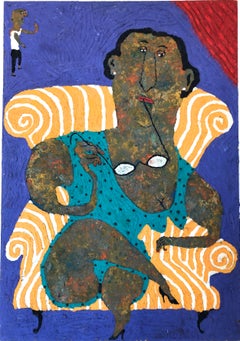
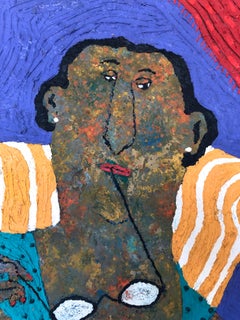
Woman In The Chair
Woman In The Chair

Woman In The Chair

By Elisabeth Sabala

Located in Lake Worth Beach, FL

Woman in the chair, heavy oil impasto on canvas framed. Elisabeth Sabala Abelló (Barcelona, 1956). She studied industrial design at the School of Arts and Crafts in Barcelona ​​and has a degree in Fine Arts, a specialty in painting, from the Central University of the same city. Sabala is a convinced figurative who has given all the prominence of her work to the representation of the human being in its most trivial aspects. At a time when the artistic landscape extols abstract and conceptual art focused on the great universal themes, Sabala continues to focus on the small defects that bring us closer to the collective and the human. The artistic progression of Sabala takes place, at first, from a bleak period to another vitalist and, later, from the representation of isolated characters (In the super, Reading the stories of the paintings) to the recreation of great concentrations of its peculiar individuals characterized in an endless number of situations (The Great Dance, The Girls of the Choir). Sabala's work is vital and touching, as well as scathing and satirical: it confronts its characters in the most varied situations, capturing, at the same time, the viewer's attention with an unusual juxtaposition of colors that do not seek chromatic harmony, but expression and movement through matter. In 1980 he won the first prize of a painting of the City of Castelldefels, and the following year he debuted individually in the Caixa Catalunya room, in Barcelona. In 1984, she was selected for the XXIII Joan Miró Drawing Prize, taking part in a traveling exhibition in Japan. Sabala won the first prize in the International Painting Competition of Pollença (Mallorca) in 1985, and the following year she took part in a collective held at the Martano gallery in Turin. That same year of 1986 she obtained the Scholarship of Plastic Arts of the Generalitat de Catalunya. He continues to hold personal shows in Barcelona, ​​Mallorca, Madrid, and Italy, and in 1989 he debuted in New York with an individual exhibition held at the Scott Alan Gallery. Since then she will reiterate his presence both in that city and in Paris, Berlin, Monaco, Amsterdam, Los Angeles, Mexico City, Hong Kong, etc. His works have been present at Interactive, ARCO, Art Forum, Art Jonction and New Art, as well as in various Spanish museums. • Studies: Fine Arts, University of Barcelona • Industrial Design, School of Arts and Crafts, Barcelona Main exhibitions Spain: • Barcelona: ◦ Arcs & Cracks, 1990, 1992, Anna Benach 1993, Helena Ramos 1993 ◦ Maria Jose Castellvi 1996, 1997, 1999, 2001 “a wedding is a wedding” + Performance “Ella” ◦ 2004, 2006 “Fashion satisfaction” + Performance ◦ 2008 “Women's weapons” • Girona: ◦ Helena Ramos 1990, 1991, 1993, 1995 ◦ Cyprus Art...

Category

1980s Surrealist Figurative Paintings

Materials

Cotton Canvas, Oil

"Odd Woman In" Oil Painting

"Odd Woman In" Oil Painting

By Ron Hicks

Located in Denver, CO

Ron Hick's (US based) "Odd Woman In" is an original, handmade oil painting that depicts an impasto rendering of a female model with dark hair and an abstracted background. Ron Hick'...

Category

2010s Impressionist Portrait Paintings

Materials

Oil, Panel

Jeremy, Painting, Oil on Canvas

Jeremy, Painting, Oil on Canvas

By Norman Lerner

Located in Yardley, PA

This is a portrait of Jeremy Meeks fashioned after his mug shot that went viral after he was booked by the Stockton, CA police on a weapons charge. He probably would have been a succ...

Category

2010s Contemporary Paintings

Materials

Oil

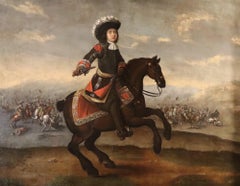
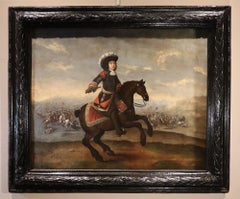
Portrait Battle Horse Van Der Meulen Paint 17/18th Century Oil on canvas

Portrait Battle Horse Van Der Meulen Paint 17/18th Century Oil on canvas

Located in Riva del Garda, IT

Circle of Adam Frans van der Meulen (Brussels 1632 – Paris 1690) Equestrian portrait with battle scene in the background Oil on canvas? 81 x 103 cm.?In frame 105 x 124 cm. ...

Category

17th Century Old Masters Portrait Paintings

Materials

Oil Pastel

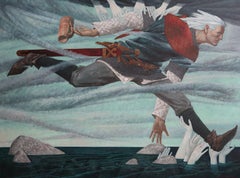
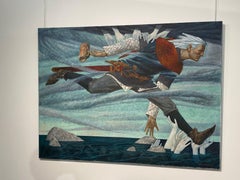
With Confidence- 21st Century  Contemporary Mythology painting of a Running Man

With Confidence- 21st Century Contemporary Mythology painting of a Running Man

By Nikita Mogilevtsev

Located in Nuenen, Noord Brabant

This painting is made by Nikita Mogilevtsev. Nikita Mogilevtsev, born and raised in a very artistic family in St Petersburg has a special style of his own. With his mother and father both as prominent artists, it was almost impossible for him to follow in his footsteps. (When we met him at gallery...

Category

2010s Contemporary Figurative Paintings

Materials

Canvas, Oil

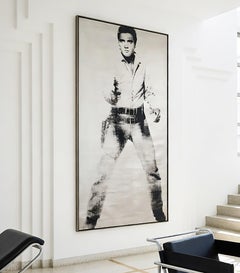
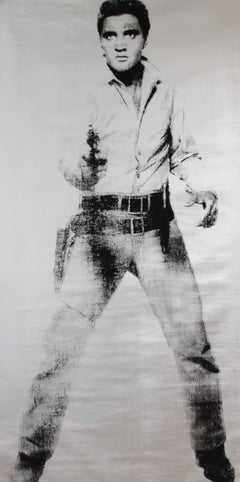
"Elvis", Denied Andy Warhol Silver & Black Pop Art Painting by Charles Lutz

"Elvis", Denied Andy Warhol Silver & Black Pop Art Painting by Charles Lutz

By Charles Lutz

Located in Brooklyn, NY

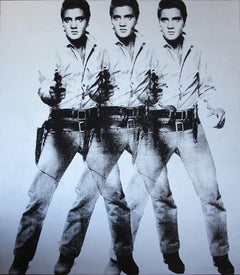
Elvis, Metallic Silver and Black Full Length Silkscreen Painting by Charles Lutz Silkscreen and silver enamel painted on vintage 1960's era linen with Artist's Denied stamp of the Andy Warhol Art Authentication Board. 82" x 40" inches 2010 Lutz's 2007 ''Warhol Denied'' series gained international attention by calling into question the importance of originality or lack thereof in the work of Andy Warhol. The authentication/denial process of the [[Andy Warhol Art Authentication Board]] was used to create value by submitting recreations of Warhol works for judgment with the full intention for the works to be formally marked "DENIED". The final product of the conceptual project being "officially denied" "Warhol" paintings authored by Lutz. Based on the full-length Elvis Presley paintings by Pop Artist Andy Warhol in 1964, this is likely one of his most iconic images, next to Campbell's Soup Cans and portraits of Jackie Kennedy, Marilyn Monroe, Liz Taylor, and Marlon Brando. This is the rarest of the Elvis works from the series, as Lutz sourced a vintage roll of 1960's primed artist linen which was used for this one Elvis. The silkscreen, like Warhol's embraced imperfections, like the slight double image printing of the Elvis image. Lutz received his BFA in Painting and Art History from Pratt Institute and studied Human Dissection and Anatomy at Columbia University, New York. Lutz's work deals with perceptions and value structures, specifically the idea of the transference of values. Lutz's most recently presented an installation of new sculptures dealing with consumerism at Frank Lloyd Wright's Fallingwater House in 2022. Lutz's 2007 Warhol Denied series received international attention calling into question the importance of originality in a work of art. The valuation process (authentication or denial) of the Andy Warhol Art Authentication Board was used by the artist to create value by submitting recreations of Warhol works for judgment, with the full intention for the works to be formally marked "DENIED" of their authenticity. The final product of this conceptual project is "Officially DENIED" "Warhol" paintings authored by Lutz. Later in 2013, Lutz went on to do one of his largest public installations to date. At the 100th Anniversary of Marcel Duchamp's groundbreaking and controversial Armory Show, Lutz was asked by the curator of Armory Focus: USA and former Director of The Andy Warhol Museum, Eric Shiner to create a site-specific installation representing the US. The installation "Babel" (based on Pieter Bruegel's famous painting) consisted of 1500 cardboard replicas of Warhol's Brillo Box (Stockholm Type) stacked 20 ft tall. All 1500 boxes were then given to the public freely, debasing the Brillo Box as an art commodity by removing its value, in addition to debasing its willing consumers. Elvis was "the greatest cultural force in the Twentieth Century. He introduced the beat to everything, and he changed everything - music, language, clothes, it's a whole new social revolution." Leonard Bernstein in: Exh. Cat., Boston, The Institute of Contemporary Art and traveling, Elvis + Marilyn 2 x Immortal, 1994-97, p. 9. Andy Warhol "quite simply changed how we all see the world around us." Kynaston McShine in: Exh. Cat., New York, Museum of Modern Art (and traveling), Andy Warhol: Retrospective, 1996, p. 13. In the summer of 1963 Elvis Presley was just twenty-eight years old but already a legend of his time. During the preceding seven years - since Heartbreak Hotel became the biggest-selling record of 1956 - he had recorded seventeen number-one singles and seven number-one albums; starred in eleven films, countless national TV appearances, tours, and live performances; earned tens of millions of dollars; and was instantly recognized across the globe. The undisputed King of Rock and Roll, Elvis was the biggest star alive: a cultural phenomenon of mythic proportions apparently no longer confined to the man alone. As the eminent composer Leonard Bernstein put it, Elvis was "the greatest cultural force in the Twentieth Century. He introduced the beat to everything, and he changed everything - music, language, clothes, it's a whole new social revolution." (Exh. Cat., Boston, The Institute of Contemporary Art (and traveling), Elvis + Marilyn 2 x Immortal, 1994, p. 9). In the summer of 1963 Andy Warhol was thirty-four years old and transforming the parameters of visual culture in America. The focus of his signature silkscreen was leveled at subjects he brilliantly perceived as the most important concerns of day to day contemporary life. By appropriating the visual vernacular of consumer culture and multiplying readymade images gleaned from newspapers, magazines and advertising, he turned a mirror onto the contradictions behind quotidian existence. Above all else he was obsessed with themes of celebrity and death, executing intensely multifaceted and complex works in series that continue to resound with universal relevance. His unprecedented practice re-presented how society viewed itself, simultaneously reinforcing and radically undermining the collective psychology of popular culture. He epitomized the tide of change that swept through the 1960s and, as Kynaston McShine has concisely stated, "He quite simply changed how we all see the world around us." (Exh. Cat., New York, Museum of Modern Art (and traveling), Andy Warhol: Retrospective, 1996, p. 13). Thus in the summer of 1963 there could not have been a more perfect alignment of artist and subject than Warhol and Elvis. Perhaps the most famous depiction of the biggest superstar by the original superstar artist, Double Elvis is a historic paradigm of Pop Art from a breath-taking moment in Art History. With devastating immediacy and efficiency, Warhol's canvas seduces our view with a stunning aesthetic and confronts our experience with a sophisticated array of thematic content. Not only is there all of Elvis, man and legend, but we are also presented with the specter of death, staring at us down the barrel of a gun; and the lone cowboy, confronting the great frontier and the American dream. The spray painted silver screen denotes the glamour and glory of cinema, the artificiality of fantasy, and the idea of a mirror that reveals our own reality back to us. At the same time, Warhol's replication of Elvis' image as a double stands as metaphor for the means and effects of mass-media and its inherent potential to manipulate and condition. These thematic strata function in simultaneous concert to deliver a work of phenomenal conceptual brilliance. The portrait of a man, the portrait of a country, and the portrait of a time, Double Elvis is an indisputable icon for our age. The source image was a publicity still for the movie Flaming Star, starring Presley as the character Pacer Burton and directed by Don Siegel in 1960. The film was originally intended as a vehicle for Marlon Brando and produced by David Weisbart, who had made James Dean's Rebel Without a Cause in 1955. It was the first of two Twentieth Century Fox productions Presley was contracted to by his manager Colonel Tom Parker, determined to make the singer a movie star. For the compulsive movie-fan Warhol, the sheer power of Elvis wielding a revolver as the reluctant gunslinger presented the zenith of subject matter: ultimate celebrity invested with the ultimate power to issue death. Warhol's Elvis is physically larger than life and wears the expression that catapulted him into a million hearts: inexplicably and all at once fearful and resolute; vulnerable and predatory; innocent and explicit. It is the look of David Halberstam's observation that "Elvis Presley was an American original, the rebel as mother's boy, alternately sweet and sullen, ready on demand to be either respectable or rebellious." (Exh. Cat., Boston, Op. Cit.). Indeed, amidst Warhol's art there is only one other subject whose character so ethereally defies categorization and who so acutely conflated total fame with the inevitability of mortality. In Warhol's work, only Elvis and Marilyn harness a pictorial magnetism of mythic proportions. With Marilyn Monroe, whom Warhol depicted immediately after her premature death in August 1962, he discovered a memento mori to unite the obsessions driving his career: glamour, beauty, fame, and death. As a star of the silver screen and the definitive international sex symbol, Marilyn epitomized the unattainable essence of superstardom that Warhol craved. Just as there was no question in 1963, there remains still none today that the male equivalent to Marilyn is Elvis. However, despite his famous 1968 adage, "If you want to know all about Andy Warhol, just look at the surface of my paintings" Warhol's fascination held purpose far beyond mere idolization. As Rainer Crone explained in 1970, Warhol was interested in movie stars above all else because they were "people who could justifiably be seen as the nearest thing to representatives of mass culture." (Rainer Crone, Andy Warhol, New York, 1970, p. 22). Warhol was singularly drawn to the idols of Elvis and Marilyn, as he was to Marlon Brando and Liz Taylor, because he implicitly understood the concurrence between the projection of their image and the projection of their brand. Some years after the present work he wrote, "In the early days of film, fans used to idolize a whole star - they would take one star and love everything about that star...So you should always have a product that's not just 'you.' An actress should count up her plays and movies and a model should count up her photographs and a writer should count up his words and an artist should count up his pictures so you always know exactly what you're worth, and you don't get stuck thinking your product is you and your fame, and your aura." (Andy Warhol, The Philosophy of Andy Warhol (From A to B and Back Again), San Diego, New York and London, 1977, p. 86). The film stars of the late 1950s and early 1960s that most obsessed Warhol embodied tectonic shifts in wider cultural and societal values. In 1971 John Coplans argued that Warhol was transfixed by the subject of Elvis, and to a lesser degree by Marlon Brando and James Dean, because they were "authentically creative, and not merely products of Hollywood's fantasy or commercialism. All three had originative lives, and therefore are strong personalities; all three raised - at one level or another - important questions as to the quality of life in America and the nature of its freedoms. Implicit in their attitude is a condemnation of society and its ways; they project an image of the necessity for the individual to search for his own future, not passively, but aggressively, with commitment and passion." (John Coplans, "Andy Warhol and Elvis Presley," Studio International, vol. 181, no. 930, February 1971, pp. 51-52). However, while Warhol unquestionably adored these idols as transformative heralds, the suggestion that his paintings of Elvis are uncritical of a generated public image issued for mass consumption fails to appreciate the acuity of his specific re-presentation of the King. As with Marilyn, Liz and Marlon, Warhol instinctively understood the Elvis brand as an industrialized construct, designed for mass consumption like a Coca-Cola bottle or Campbell's Soup Can, and radically revealed it as a precisely composed non-reality. Of course Elvis offered Warhol the biggest brand of all, and he accentuates this by choosing a manifestly contrived version of Elvis-the-film-star, rather than the raw genius of Elvis as performing Rock n' Roll pioneer. A few months prior to the present work he had silkscreened Elvis' brooding visage in a small cycle of works based on a simple headshot, including Red Elvis, but the absence of context in these works minimizes the critical potency that is so present in Double Elvis. With Double Elvis we are confronted by a figure so familiar to us, yet playing a role relating to violence and death that is entirely at odds with the associations entrenched with the singer's renowned love songs. Although we may think this version of Elvis makes sense, it is the overwhelming power of the totemic cipher of the Elvis legend that means we might not even question why he is pointing a gun rather than a guitar. Thus Warhol interrogates the limits of the popular visual vernacular, posing vital questions of collective perception and cognition in contemporary society. The notion that this self-determinedly iconic painting shows an artificial paradigm is compounded by Warhol's enlistment of a reflective metallic surface, a treatment he reserved for his most important portraits of Elvis, Marilyn, Marlon and Liz. Here the synthetic chemical silver paint becomes allegory for the manufacture of the Elvis product, and directly anticipates the artist's 1968 statement: "Everything is sort of artificial. I don't know where the artificial stops and the real starts. The artificial fascinates me, the bright and shiny..." (Artist quoted in Exh. Cat., Stockholm, Moderna Museet and traveling, Andy Warhol, 1968, n.p.). At the same time, the shiny silver paint of Double Elvis unquestionably denotes the glamour of the silver screen and the attractive fantasies of cinema. At exactly this time in the summer of 1963 Warhol bought his first movie camera and produced his first films such as Sleep, Kiss and Tarzan and Jane Regained. Although the absence of plot or narrative convention in these movies was a purposely anti-Hollywood gesture, the unattainability of classic movie stardom still held profound allure and resonance for Warhol. He remained a celebrity and film fanatic, and it was exactly this addiction that so qualifies his sensational critique of the industry machinations behind the stars he adored. Double Elvis was executed less than eighteen months after he had created 32 Campbell's Soup Cans for his immortal show at the Ferus Gallery, Los Angeles in July and August 1962, and which is famously housed in the Museum of Modern Art, New York. In the intervening period he had produced the series Dollar Bills, Coca-Cola Bottles, Suicides, Disasters, and Silver Electric Chairs, all in addition to the portrait cycles of Marilyn and Liz. This explosive outpouring of astonishing artistic invention stands as definitive testament to Warhol's aptitude to seize the most potent images of his time. He recognized that not only the product itself, but also the means of consumption - in this case society's abandoned deification of Elvis - was symptomatic of a new mode of existence. As Heiner Bastian has precisely summated: "the aura of utterly affirmative idolization already stands as a stereotype of a 'consumer-goods style' expression of an American way of life and of the mass-media culture of a nation." (Exh. Cat., Berlin, Neue Nationalgalerie (and traveling), Andy Warhol: Retrospective, 2001, p. 28). For Warhol, the act of image replication and multiplication anaesthetized the effect of the subject, and while he had undermined the potency of wealth in 200 One Dollar Bills, and cheated the terror of death by electric chair in Silver Disaster # 6, the proliferation of Elvis here emasculates a prefabricated version of character authenticity. Here the cinematic quality of variety within unity is apparent in the degrees to which Presley's arm and gun become less visible to the left of the canvas. The sense of movement is further enhanced by a sense of receding depth as the viewer is presented with the ghost like repetition of the figure in the left of the canvas, a 'jump effect' in the screening process that would be replicated in the multiple Elvis paintings. The seriality of the image heightens the sense of a moving image, displayed for us like the unwinding of a reel of film. Elvis was central to Warhol's legendary solo exhibition organized by Irving Blum at the Ferus Gallery in the Fall of 1963 - the show having been conceived around the Elvis paintings since at least May of that year. A well-known installation photograph shows the present work prominently presented among the constant reel of canvases, designed to fill the space as a filmic diorama. While the Elvis canvases...

Category

21st Century and Contemporary Pop Art Figurative Paintings
Materials

Enamel

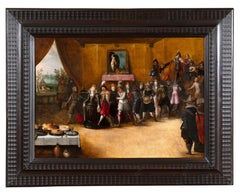
Attributed à H. Francken II, 17th c. Anwerp - The prodigal son among courtesans

Attributed à H. Francken II, 17th c. Anwerp - The prodigal son among courtesans

Located in PARIS, FR

The Prodigal Son Among Courtesans Attributed to Hieronymus Francken II (Antwerp 1578-1623) Early 17th century Antwerp school Oil on oak panel, Dimensions: H. 52.5 cm (20.67 in), W. 74 cm (29.14 in) Flemish-style moulded wood frame Frame: h. 78 cm (h. 30.70 in.), w. 100 cm (39.37 in.) This artwork is sold with a certificate of authenticity guaranteeing its origin, date of execution, and attribution to the artist. At first glance, this festive and joyful painting depicts a group of elegantly dressed people dancing to the sound of an orchestra in a richly decorated interior with a wide opening onto a rural exterior. However, the real theme is cleverly concealed by the painter and is only discernible through the artifice of a small scene in the background where we see a half-naked man, in the company of the pigs next to a makeshift shelter. In fact, beyond the pleasant and apparently superficial character of the painting, it is a subject taken from the parable of the prodigal son in the Gospel. The illustrated episode is the prodigal son among courtesans. Even if the viewer's attention is drawn to the central couple (prodigal son embracing a pretty courtesan) doing the dance steps, the artist takes care in a narrative approach of all the groups and ancillary scenes in order to create a rich and varied composition. Thus the musicians seated on a raised platform are depicted with great skill, their faces animated, their clothes abundantly varied. The theme of music, which has always been associated with that of sensuality and physical love, helps to exacerbate licentious pleasures. The merry company dances "Spanish pavane", a slow court dance from the sixteenth century, danced close to the ground by couples arranged in a procession, which was probably introduced to the south of the Netherlands around 1600 during the governance of Albrecht VII and the daughter of the King of Spain Isabella Clara Eugenia in Brussels. The interior of the house is also carefully elaborated, the embossed leather dyes on the walls, the middle sideboard (typical in Francken interiors), where the rich gold and silver crockery is placed in front of the painting "Andromeda chained to the rock and Perseus arriving to rescue her". The inclusion of a contemporary and probably extant pictorial work is also one of the characteristics of the Francken family, among them Frans Francken the Younger...

Category

Early 17th Century Old Masters Interior Paintings

Materials

Oak, Oil

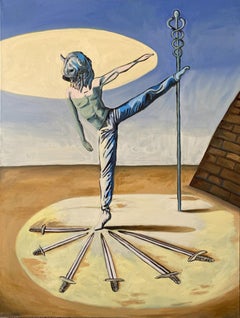
Six of Swords, Oil Painting

Six of Swords, Oil Painting

By Rachel Srinivasan

Located in San Francisco, CA

Artist Comments
Part of her series about the divinatory meanings of the swords tarot cards, artist Rachel Srinivasan paints a minotaur with blades and a caduceus. She feature...

Category

21st Century and Contemporary Surrealist More Art

Materials

Oil

Ulysses I - Figurative Painting, Warrior, Arrow, Blue, Red, Small Size

Ulysses I - Figurative Painting, Warrior, Arrow, Blue, Red, Small Size

By Alexandru Rădvan

Located in Baden-Baden, DE

Ulysses I, 2011 Acrylic on canvas (Signed on reverse) 7 9/10 H × 7 9/10 W in. 20 H × 20 W cm The artwork "Ulysses I" was part of the solo show “Epic”. This exhibition, as the artist...

Category

2010s Neo-Expressionist Figurative Paintings

Materials

Canvas, Acrylic

Wonder Valley (Sidewinder) - Polaroid, 21st Century, Contemporary

Wonder Valley (Sidewinder) - Polaroid, 21st Century, Contemporary

By Stefanie Schneider

Located in Morongo Valley, CA

Wonder Valley (Sidewinder) - 2005 Edition of 5, 156x125cm. Archival C-Print based on the Polaroid. Signature label and Certificate. Artist Inventory No. 3094. Not mounted. "...

Category

Early 2000s Contemporary Landscape Paintings

Materials

Archival Paper, Photographic Paper, C Print, Color, Polaroid

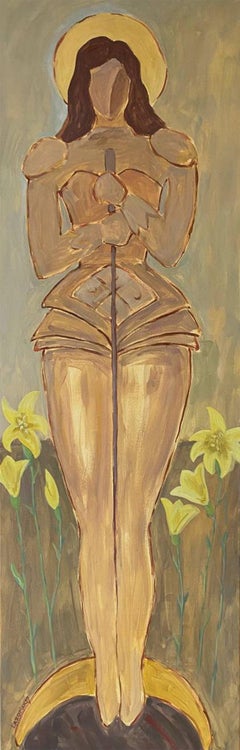
Warrior of Light
Warrior of Light

Warrior of Light

Located in Zofingen, AG

This painting symbolizes feminine strength and spirituality, focusing on the importance of protecting one's boundaries. In today’s world, where we are constantly influenced by extern...

Category

2010s Figurative Paintings

Materials

Canvas, Acrylic

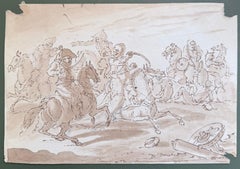
Fine English School Ink & Watercolor Chaotic Cavalry Battle Scene Riders Horses

Fine English School Ink & Watercolor Chaotic Cavalry Battle Scene Riders Horses

Located in Cirencester, Gloucestershire

1780's-1800 Fine English School Ink & Watercolor Chaotic Cavalry Battle Scene Riders Horses and Cannon Study Late 18th / Early 19th Century English School circa 1780–1800 ink drawing...

Category

Mid-20th Century English School Figurative Paintings

Materials

Ink, Watercolor

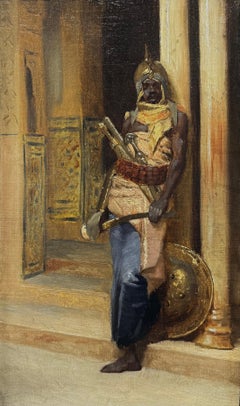
My Home is My Fortress

My Home is My Fortress

Located in Zofingen, AG

"Woman-Warrior of the modern world" series This work reveals the multilayered perception of a woman as both the protector and keeper of her world. As part of the series “The Woma...

Category

2010s Pop Art Figurative Paintings
Materials

Canvas, Acrylic

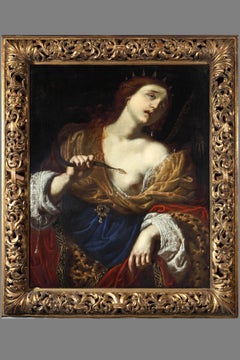
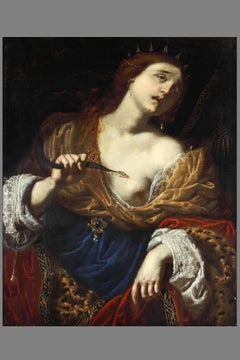
17th Century by Giovanni Domenico Ferrucci The Death of Cleopatra Oil on canvas

17th Century by Giovanni Domenico Ferrucci The Death of Cleopatra Oil on canvas

Located in Milano, Lombardia

Giovanni Domenico Ferrucci (Fiesole, Italy, 1619 – Lucca, Italy, post 1669) Title: The Death of Cleopatra Medium: Oil on canvas Dimensions: without frame 85 x 70.7 cm – with frame 10...

Category

17th Century Old Masters Figurative Paintings

Materials

Canvas, Oil

The Painter and His Muse

The Painter and His Muse

By Benjamin Eugène Fichel

Located in Wiscasett, ME

Oil on panel signed in the lower right corner and presented in a period frame measuring 21" x 18.5". Provenance: Private Collection Bradbury Art and Antiques, Wiscasset, ME Benj...

Category

19th Century Baroque Figurative Paintings

Materials

Oil

Okinawa, Typhoon of Steel by John Steven Dews

Okinawa, Typhoon of Steel by John Steven Dews

By John Steven Dews

Located in New Orleans, LA

John Steven Dews b. 1949 British Okinawa, Typhoon of Steel, 1st April 1945 Signed “J. Steven Dews” (lower right) Oil on canvas This powerful canvas by John Steven Dews captures t...

Category

20th Century Academic Landscape Paintings

Materials

Canvas, Oil

"Cerebral Seclusion" Oil Painting

"Cerebral Seclusion" Oil Painting

By Ron Hicks

Located in Denver, CO

Ron Hick's (US based) "Cerebral Seclusion" is an original, handmade oil painting that depicts an impasto rendering of a male figure with brown hair and an abstracted background. Ron...

Category

2010s Impressionist Portrait Paintings

Materials

Oil, Panel

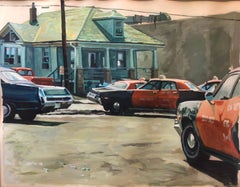
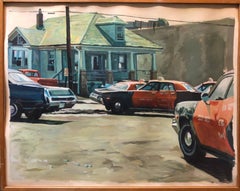
1980s Vintage American Street Scene Painting, Landscape with Taxi Cabs

1980s Vintage American Street Scene Painting, Landscape with Taxi Cabs

By Val Lewton

Located in Surfside, FL

Val Edwin Lewton (May 23, 1937 – April 24, 2015) was a painter and museum exhibition designer. As an artist, he created Realist acrylic paintings and watercolors of urban and suburba...

Category

1980s Photorealist Landscape Paintings

Materials

Acrylic, Archival Paper

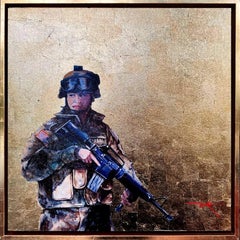
Impressionist Figurative Acrylic Painting, "Warrior Princess"

Impressionist Figurative Acrylic Painting, "Warrior Princess"

Located in San Diego, CA

When viewing the Warrior Princess, look at her gear and the weapon she holds as she surveys her surroundings while on patrol in Afghanistan. No “princess” here, but definitely, a war...

Category

2010s Impressionist Figurative Paintings

Materials

Gold Leaf

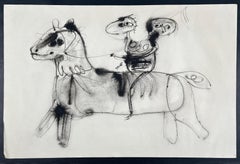
Looking back
Looking back

Looking back

By Erró

Located in Östermalm, Stockholms län

Artwork size: 81 x 119 cm. Frame size: 94 x 132 cm Free shipment worldwide. Acquired directly from the artist. Signed and dated on the verso. “I paint because painting is a private Utopia,” Erró writes of his art. The landscapes in Erró’s work are a constantly changing kaleidoscope of images, multivalent and mysterious, not infrequently controversial, bursting with life – and titillating, too! There is room in his pictures for both paradise and visions of fear. Erró is the alias of Gudmundur Gudmundsson, born on 19 July 1932 in Olafsvik, in north-western Iceland. Since Gudmundur first became enthralled by pictures of works of art in a catalogue from the Museum of Modern Art in New York at the tender age of ten, painting has been his passion and his mission in life. He was accepted into art school in Reykjavik as a 19-year old, subsequently complementing what he had learned there with further studies in Oslo. Erró travelled extensively in Spain, Italy, France and Germany in the 1950s, studying at the Florence Academy of Art in 1954 and at the School of Byzantine Mosaic Art in Ravenna in 1955. It was around this time that he began to exhibit his works, first and foremost in Paris, where he chose to make his home in 1958. During the 1960s he established contact with the Swedish museum director Pontus Hultén, who encouraged him and took him under his wing. Over the years Erró has taken part in hundreds of exhibitions and today his works are on show in museums all over the world, including the Centre Pompidou in Paris. Erró’s pictorial world is peopled by comic-strip characters and autocratic despots alike. Donald Duck with his Daisy, Chip & Dale, and other Walt Disney creations are unselfconsciously juxtaposed with Greek gods and madonnas. Elsewhere the German dictator Adolf Hitler stands shoulder to shoulder with his Iraqi counterpart Saddam Hussein...

Category

Early 2000s Pop Art Figurative Paintings
Materials

Canvas, Acrylic

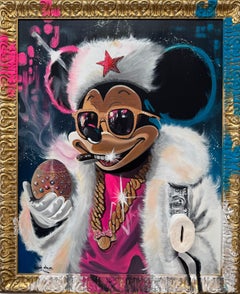
KING OF THE STREETZ “Once upon a time… I took over.”

KING OF THE STREETZ “Once upon a time… I took over.”

Located in West Hollywood, CA

In King of the Streetz, innocence gets iced out. The artist hijacks the familiar silhouette of Mickey Mouse and rebrands him as a streetwise hustler—chain heavy, cash in hand, and ga...

Category

21st Century and Contemporary Pop Art Portrait Paintings

Materials

Canvas, Mixed Media

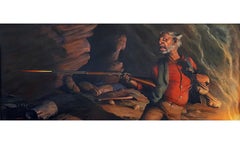
"Plastic Figure 4" Oil Painting

"Plastic Figure 4" Oil Painting

By Jason Walker

Located in Denver, CO

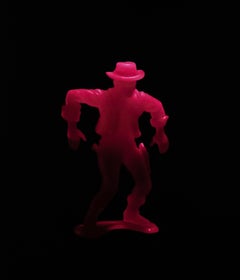
Jason Walker's (CAN based) "Plastic Figure 4" is an oil painting that depicts a lone pink plastic Cowboy figure toy drawing his weapon in the darkness. ...

Category

2010s Realist Still-life Paintings

Materials

Canvas, Oil

Early 17th Century by Carlo Bononi The triumph of David Oil on canvas

Early 17th Century by Carlo Bononi The triumph of David Oil on canvas

Located in Milano, Lombardia

Carlo Bononi (Ferrara, Italy, 1569 – 1632) Title: The triumph of David Medium: Oil on canvas Dimensions: without frame 41 x 28.5 cm – with frame 57 x 46 x 6 cm Not signed Provenance...

Category

Early 17th Century Old Masters Figurative Paintings

Materials

Canvas, Oil

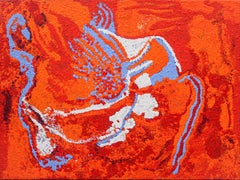
Braggart (beagle dog face cowboy shotgun americana vintage surreal oil painting)

Braggart (beagle dog face cowboy shotgun americana vintage surreal oil painting)

By Rudolf Kosow

Located in Quebec, Quebec

Rudolf Kosow's Braggart depicts a striking contrast between a colossal, melancholic dog and a diminutive cowboy figure. The dog's immense, expressive face dominates the canvas, its w...

Category

2010s Surrealist Figurative Paintings
Materials

Canvas, Oil

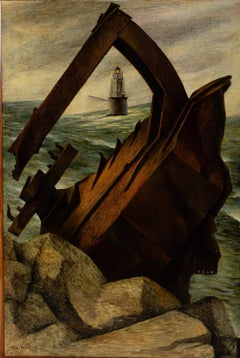
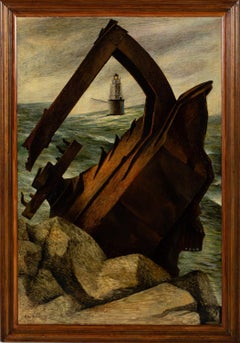
"Motion, " Victor Arnautoff, San Francisco Lighthouse, World's Fair WPA Painting

"Motion, " Victor Arnautoff, San Francisco Lighthouse, World's Fair WPA Painting

By Victor Michail Arnautoff

Located in New York, NY

Victor Mikhail Arnautoff (1896 - 1979) Motion (Mile Rocks Lighthouse), San Francisco, 1939 Oil and tempera on board 60 x 40 inches Signed lower left Provenance: The artist California School of Fine Arts (CFSA) John & Lynne Bolen Fine Arts, Huntington Beach, California Exhibited: New York, World's Fair, Exhibition of Contemporary American Art, 1939. San Francisco Museum of Art, 1962. Literature: American Art from the New York World's Fair 1939, Poughkeepsie, 1987, no. 11, p. 41, illustrated. Robert W. Cherny, Victor Arnautoff and the Politics of Art, Urbana, Illinois, 2017. The lighthouse in the distance is the Mile Rocks Lighthouse in San Francisco Bay, built in 1906 after many shipwrecks made the lighthouse necessary. In 1962 the lighthouse was reduced in size to make room for a helipad. Arnautoff was the son of a Russian Orthodox priest. He showed a talent for art from an early age and hoped to study art after graduating from the gymnasium in Mariupol. With the outbreak of World War I, he enrolled in the Yelizavetgrad Cavalry School. He went on to hold military leadership positions in the army of Nicholas II and the White Siberian army. With the defeat of the Whites in Siberia, he crossed into northeastern China and surrendered his weapons. Arnautoff remained in China for five years. He again tried to pursue art, but was impoverished and took a position training the cavalry of the warlord Zhang Zuolin. He met and married Lydia Blonsky and they had two sons, Michael and Vasily. In November 1925 Arnautoff went to San Francisco on a student visa to study at the California School of Fine Arts. There he studied sculpture with Edgar Walter and painting with several instructors. His wife and children joined him, and they all continued to Mexico in 1929, where, on Ralph Stackpole...

Category

1930s American Realist Landscape Paintings

Materials

Canvas, Oil, Tempera

Slava Ukraini – 18-04-22, Painting, Oil on Canvas

Slava Ukraini – 18-04-22, Painting, Oil on Canvas

By Corne Akkers

Located in Yardley, PA

Freedom above All The West has recently become familiar with the phrase ‘Slava Ukraini’. Obviously everyone who is a democrat and values freedom above all can support the meaning of this slogan. It seems as if the world has split into the good and the bad all of a sudden. The free world is pro and some rascalious countries keep supporting Russia’s goals. Strange how Europe and NATO can feel united more than ever whereas recently disunity was rife. Strong Ukrainian Women Vesna – 14-03-22 was my last oil with the Ukrainian theme. Somehow I felt the story for me to tell wasn’t finished yet. My reference graphite pencil drawing ‘Hold Your Horses – 04-01-22’ had the Scythians as theme. Strange why I chose to do an oil ‘Una in Aliam – 01-09-19’ covering the same topic three years back. In particular it tells of the legend of the Amazons. Legend has it they were Scythian warrior women on horseback. No great mind is needed to associate them with modern strong Ukrainian women rising up against the Russian agressor. And so I read the story of a woman from Kiev who bought a sniper rifle just to be able to defend her city and country. This painting is to honor those women and of course all freedom fighters in the Ukraine in general. New World Order There also was another reason to do another Ukrainian painting, to me an urgent one. Instead of fearfully waiting for whatever new world order will arise I decided to create one myself. This painting all makes sense to me. Ukrainian’s struggle is not theirs but ours too. A couple of days ago I commented on a post by Jerry Saltz. I stated law school was the best preparation for my work as an artist. Now I know why. Becoming a master in international law makes me mastering my artistic diction as well. I cannot ever be a soldier but I hold sound weapons in my hands: pencil and brush! Everything Gold The statues symbolize my view on art. I think they are beautiful and the pinnacle of aesthetics. One of them is Anton Gratz’s and the other ones I don’t know who made them. Makes me realize I maybe should start an art movement called ‘back to aesthetics’ by the way. The gold paint is a reference to the world famous Scythian gold...

Category

21st Century and Contemporary Surrealist Paintings

Materials

Oil

"Silent Street" Oil Painting

"Silent Street" Oil Painting

By Ron Hicks

Located in Denver, CO

Ron Hick's (US based) "Axiomatic Appeal" is an original, handmade oil painting that depicts an impasto rendering of a male figure with dark hair and an abstracted background. Ron Hi...

Category

2010s Impressionist Portrait Paintings

Materials

Oil, Panel

19th Century historical military oil painting of a roundhead soldier

19th Century historical military oil painting of a roundhead soldier

By Ernest Crofts

Located in Nr Broadway, Worcestershire

Ernest Crofts British, (1847-1911) On Guard Oil on panel, signed & dated (18)79 Image size: 9.25 inches x 6.75 inches Size including frame: 19.5 inches x 17 inches A wonderful historical painting of a roundhead soldier standing outside a fortress by Ernest Crofts. The soldier is depicted wearing a back and breast plate over a red and yellow sleeved jacket tied with a sash around his waist. On his head, he wears a felt hat with red and white feathers and holds a sword in his hand. He is shown standing at the moated entrance of a fortified stone building with a portcullis. Beyond the raised portcullis, a group of soldiers can be seen in the shadows. The soldier’s uniform is typical of Cromwell’s famous ‘Ironside’ cavalry and indicates he is an officer, who, in Cromwell’s time would have earned his place based on merit rather than social status. The English Civil...

Category

19th Century Victorian Figurative Paintings
Materials

Panel, Oil

Fantasy Battle, Painting, Acrylic on Canvas

Fantasy Battle, Painting, Acrylic on Canvas

By Daniel Loveday

Located in Yardley, PA

I'm having fun with my subject matter choices lately. The Dartmoor series I'm doing enabled me to get out of the house and visit beautiful locations. This painting takes me back to w...

Category

2010s Pop Art Paintings

Materials

Acrylic

Still-Life Armour Curtains Sculpture Tibaldi 17th Century Paint Oil on canvas

Still-Life Armour Curtains Sculpture Tibaldi 17th Century Paint Oil on canvas

Located in Riva del Garda, IT

Antonio Tibaldi (Rome, c. 1635 - post 1675) Workshop of Still Life with Armour, Curtains and Sculpture Oil on canvas 53 x 77 cm. - in frame 65 x 89 cm. Beautifully scenic painting ...

Category

17th Century Old Masters Paintings

Materials

Oil

Napoleon III Review Painting, Tempera on carton, Signed, 19th Century

Napoleon III Review Painting, Tempera on carton, Signed, 19th Century

By Jean Baptiste Édouard Detaille

Located in PARIS, FR

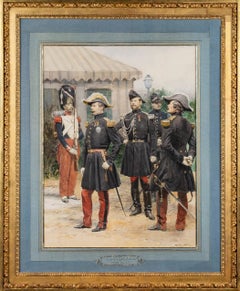
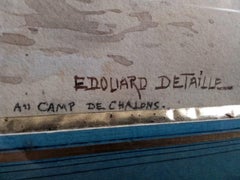
Conditions: Very good condition. In its original frame and glass. A similar composition, but less accomplished, is currently part of the collections of the Musée des Invalides. Signed at the bottom and dated. Complementary shipping worlwide by DHL, FEDEX. Description: This work of art, framed by a majestic golden frame, accurately depicts a group of soldiers in 19th-century uniforms. Every detail, from the golden buttons to the epaulettes, finely illustrates the military equipment of the time. Behind them stands a sober architectural structure, evoking a barracks or a guard post. The color palette, dominated by earthy tones and dark shades of blue, gives a solemn and dignified atmosphere to the scene. The disposition of the soldiers, turned towards the artist, with an attitude both alert and relaxed, captures a moment of daily military life. This painting, with its attention to detail and harmonious composition, transports the viewer into a bygone era, inviting reflection on history and military traditions. EDOUARD DETAILLE The emperor is accompanied by his aide-de-camp, Colonel Castelnau, and Marshal Canrobert. In a gilded wooden frame, under a Marie Louise blue background. Life and time Born in 1848 into a close-knit bourgeois family, Édouard Detaille, the eldest of eight children, displayed early talent in drawing. “He was a prodigy,” notes François Robichon. By the age of thirteen, he exhibited an astonishing surety of hand and a phenomenal sense of composition. His father, connected to Horace Vernet, encouraged him. At seventeen, after passing his baccalaureate, he entered Meissonier’s studio. This relationship, which developed into mutual affection, spared Detaille the academic detour through the École des Beaux-Arts. Rather than dictating an official art style, Meissonier, at the peak of his fame, traveled with his students, introducing them to the nuances of Titian, Rembrandt, and Rubens in Brussels and Lille. In 1867, the Paris of “free trade” dominated the world through the technological revolutions of the Universal Exhibition, and the amiable young man, striking in appearance, discovered the salon of Princess Mathilde and the theater of Dumas fils. He even approached the Empress, noting in his journals, “Not bad, the Empress.” This observation encapsulated Detaille: he had no doubts about his talent, cultivated panache, enjoyed the company of beautiful women, and aimed to conquer the circles of power without sacrificing his freedom. From childhood, he listened to his calling: “Before I could read, I could guess the subjects of battles, the names of famous generals, the weapons of officers and soldiers from the images I admired in the books of Norvins and Laurent de l'Ardèche.” He mingled with collectors and regularly attended military reviews on the Champs-Élysées. His first painting exhibited at the Salon in 1868, “La Halte de tambours,” was praised by critics who immediately recognized “a remarkable truth of observation and simplicity of effect.” The purchase of this work by Princess Mathilde, cousin of Emperor Louis-Napoleon, made Detaille, at twenty, an envied celebrity known to Sainte-Beuve, Théophile Gautier, the Goncourt brothers, and Flaubert. The young artist’s humanistic vision contrasted with the compositions of his predecessors, depicting soldiers in maneuvers, contemplative and resigned as war loomed. **The Combatant’s Vision** The Siege of Paris, where he nearly lost his life in 1870, and the deaths of two brothers in that defeat darkened his outlook. From 1871 onward, Detaille no longer concealed the cruelties of war: German riflemen mowed down by machine gun fire, cavalrymen and panicked horses caught in ambushes, fields plowed by shells strewn with dead animals. The unvarnished tragedy: “It is an absolute fact that no painter has ever rendered a battlefield covered with corpses as it is,” commented Jules Claretie. The fallen bodies still bear the appearance of life in their frozen rigidity. Detaille’s testimony of the devastating defeat and the catastrophic effects of the first total war in history was not a celebration of heroism but a lament, a “lesson in darkness.” “From war, once considered the supreme effort of human genius, we now see only melancholy and horrors,” judged one writer in response to his canvases. “Detaille experienced the reality of combat at a young age during a war that foreshadowed the two world conflicts of the 20th century,” explains François Robichon. With great realism, Detaille painted war from the perspective of the combatant. He introduced a humanity and a critical lucidity regarding the evolution of warfare. His works intensely captured the violence and firepower of new weapons like machine guns. Before he turned thirty, Detaille had become a chronicler of these painful years. He exhibited, as a critic noted, a “striking portrait of modern war” that both French civilians and soldiers had experienced firsthand. He embodied a youth humiliated and eager for revenge. Yet this scrupulous artist also remembered, in his expansive landscapes—from the chalky plateaus of Île-de-France to the Russian plains—the lessons of Corot and Courbet. Manet was not far off. “I wouldn’t want my art to be reduced to mere patriotic art,” he asserted. “A system I often employ and love is to first execute the landscape, very effective, very tight, based on nature…” Echoing Meissonier’s advice: “Always nature, always nature!” Detaille remained close to this father figure, constructing a grand townhouse next to his mentor’s studio at 129 boulevard Malesherbes at the age of 26, having purchased 425 m² of land from the Pereire brothers. He even chose the same architect as Meissonier: Paul Boesvilwald. A bachelor and incorrigible seducer, the painter welcomed his conquests, including Valtesse de la Bigne, amidst his collections, having built his studio in the courtyard. Diplomatic Actor As Detaille’s fame grew, his Malesherbes townhouse quickly became a gathering place for foreign princes, politicians, and heads of state, where Juliette Adam, Léon Gambetta’s muse, offered him valuable advice. The Prince of Wales, the future Edward VII, developed a genuine friendship with the painter. “This fervent patriot, friend of Déroulède, was extraordinarily open to the world,” recounts François Robichon. In just a few years, he gained considerable social, cultural, and international stature. Received at Windsor, at the English court, he was close to Tsar Alexander III and a great friend of Félix Faure. In this capacity, Detaille played a decisive role in the Entente Cordiale, signed in 1904 between England and France, and in the Franco-Russian alliance of 1894, thereby contributing to the Triple Entente among the three powers. An engaged witness of his time—associated with the birth of the “Ligue des Patriotes” alongside Alphonse de Neuville...

Category

Late 19th Century Academic Landscape Paintings

Materials

Gouache, Oil

[Bruce Sargeant (1898-1938)] Exercising En Plein Air

[Bruce Sargeant (1898-1938)] Exercising En Plein Air

By Mark Beard

Located in New York, NY

Oil on canvas Signed in red, u.r. $3250.00 + $200.00 framing This artwork is offered by ClampArt, located in New York City. “Bruce Sargeant is a mythic figure in the modern art mo...

Category

21st Century and Contemporary Realist Figurative Paintings
Materials

Canvas, Oil

Azrael., Painting, Oil on Canvas

Azrael., Painting, Oil on Canvas

By Igor Shulman

Located in Yardley, PA

If anyone else doesn't know who Azrael is, I'll explain. In Eastern mythology, he's the angel of death. I've imagined what the angel of death might look like today. Apparently he l...

Category

2010s Contemporary Paintings

Materials

Oil

The Painted Stallion

The Painted Stallion

By William Henry Dethlef Koerner

Located in Missouri, MO

The Painted Stallion William Henry Dethlef Koerner (German, American, 1878-1938) Oil on Panel Signed Lower Right Titled Verso 21.5 x 37 inches 26.5 x 42.5 inches with frame Written ...

Category

Early 20th Century American Modern Landscape Paintings

Materials

Oil, Panel

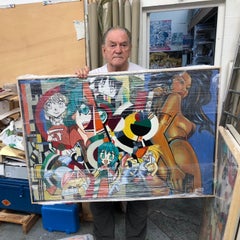
"The right to chose how to be..." Painting 57" x 38" inch by Tetiana Kalivoshko

"The right to chose how to be..." Painting 57" x 38" inch by Tetiana Kalivoshko

By Tetiana Kalivoshko

Located in Culver City, CA

"The right to chose how to be..." Painting 57" x 38" inch by Tetiana Kalivoshko Acrylic painting Tetiana Kalivoshko is an American-based Ukrainian artist who specializes in painti...

Category

21st Century and Contemporary Abstract Abstract Paintings

Materials

Acrylic, Canvas

Real and Imagined

Real and Imagined

By Adam Mysock

Located in New Orleans, LA

after: Pieter Bruegel the Elder’s The Blind Leading the Blind (1568), Akseli Gallen-Kallela’s Building (1903), and #17 Beast and the Beauty from Wally Wood’s, Bob Powell’s, and Norm Saunders’ Mars Attacks trading cards...

Category

2010s Contemporary Figurative Paintings
Materials

Acrylic, Panel

"What do u see here What could it be 1" Abstract Painting by Tetiana Kalivoshko

"What do u see here What could it be 1" Abstract Painting by Tetiana Kalivoshko

By Tetiana Kalivoshko

Located in Culver City, CA

"What do u see here What could it be 1" Abstract Painting by Tetiana Kalivoshko Acrylic painting Tetiana Kalivoshko is an American-based Ukrainian artist who specializes in painti...

Category

21st Century and Contemporary Abstract Abstract Paintings
Materials
Canvas, Acrylic