Questions & Answers
Our trusted network of 1stDibs sellers answer common questions
How do wood engravings differ from woodcuts?
1 Answer
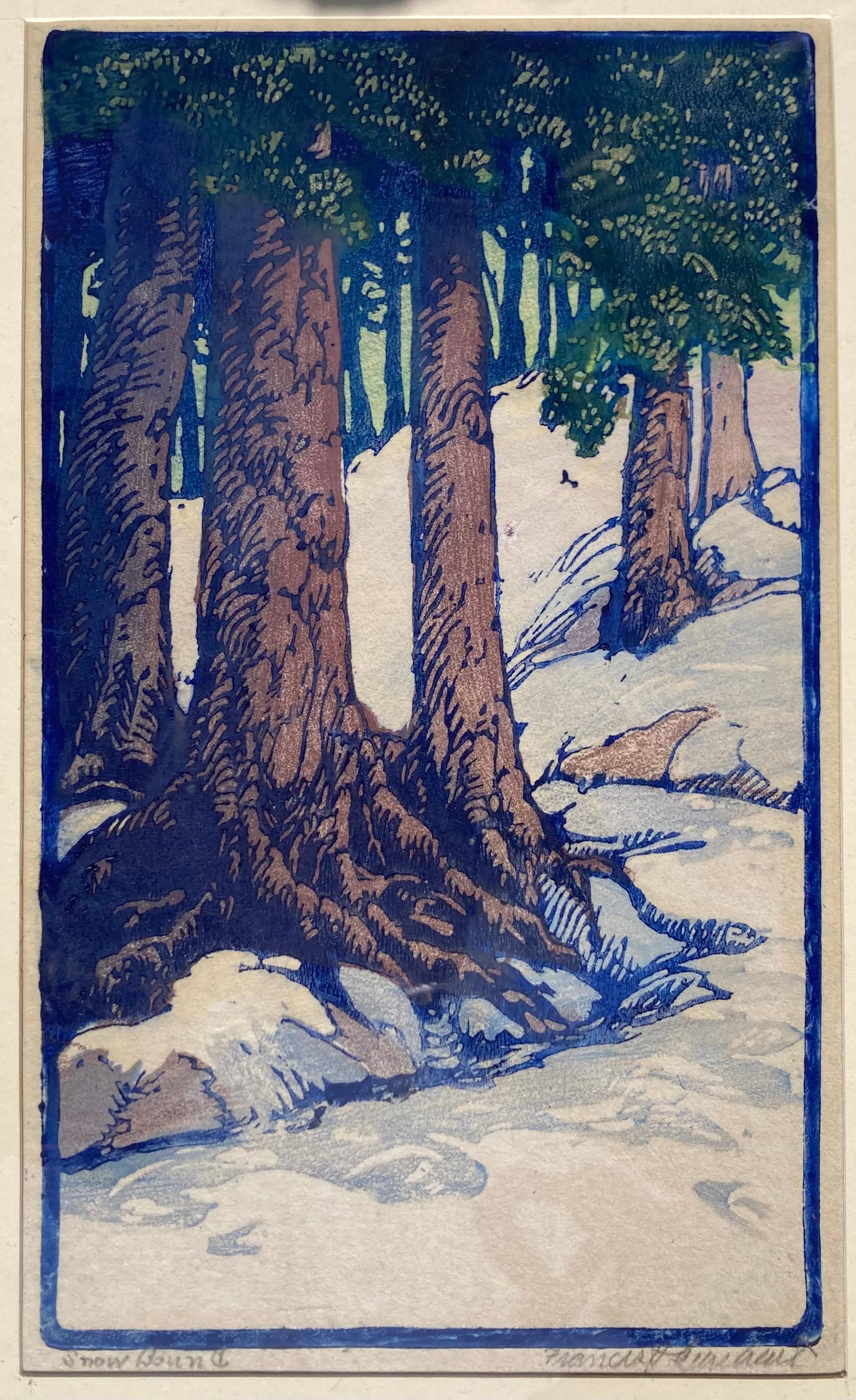
Wood engravings differ from woodcuts due to how the wood used to produce the printing plate is prepared. With a woodcut, an artisan saws the wood right along the grain so that they can easily carve into its surface with a knife-like tool. For wood engravings, an artisan uses end-grain wood. Because the wood is much harder, it must be worked with a special needle-like tool, allowing an artist to produce an image with a much higher degree of detail. On 1stDibs, explore a collection of woodcut prints.
1stDibs ExpertFebruary 21, 2024
Related Questions
- What is the difference between drypoint and engraving?1 Answer
- What is the difference between wood carving and sculpture?1 Answer
- What is a woodcut in art?1 Answer
- Where were woodcut prints invented?1 Answer
- What is the difference between a bevel and chamfer?1 Answer
Shop for Woodcut Prints and Multiples on 1stDibs
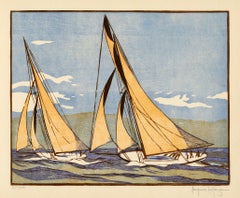
'The Start of the Race' — 1899 America's Cup, 1930s Color Woodcut
Located in Myrtle Beach, SC
Jacques La Grange, 'The Start of the Race, 1899', color woodcut, edition 500, 1934. Signed and numbered '21/500' in pencil. A fine impression, with fresh colors, on cream wove paper,...
Category
1930s American Modern Figurative Prints
Materials
Woodcut
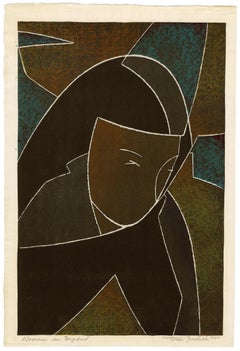
'Woman In Bagdad' — 1950s Japanese Sôsaku-hanga Signed Woodblock Print
Located in Myrtle Beach, SC
Toshi Yoshida, 'Woman In Bagdad', color woodblock print, 1954, edition not stated. Signed, dated, and titled, in pencil. A fine, richly-inked impression, with fresh colors, on cream-wove Japan paper; the full sheet with margins (1/2 to 7/8 inch); minor toning in the margins, otherwise in excellent condition. Self-carved, self-printed. Archivally sleeved, unmatted.
Image size 14 13/16 x 9 7/8 inches; sheet size 16 1/4 x 11 inches (oban tate-e).
Exhibited: 'Color in Relief: Wood Block Prints from Origins to Abstraction', Georgetown University Library, 2016.
Literature: Oliver Statler, Modern Japanese Prints: An Art Reborn, 1959, pp.168-169; Eugene M. Skibbe, Yoshida Toshi 1911-1999: Diversity, Change, and Continuity in the Yoshida Art Tradition, Andon 53, Society for Japanese Arts, 1996, pp. 5-14; Kendall H. Brown, Yoshida Toshi: The Nature of Tranquility, in, A Japanese Legacy: Four Generations of Yoshida Family Artists, The Minneapolis Institute of Arts, 2002, pp. 72-80; p. 91, no. 55
Exhibition: Japan & Beyond: The Yoshida Family Legacy in Japanese Woodblock Prints, curated by Kendall Brown and Quyen Le, The Ruth and Sherman Lee Institute for Japanese Art, Hanford, CA. February 3, 2004 - March 27, 2004.
Collections: Art Institute of Chicago, Clark Center for Japanese Art and Culture, Minneapolis Institute of Art, University of California Merced, University of Oregon (The Lavenberg Collection of Japanese Prints).
ABOUT THE ARTIST
Yoshida Toshi (1911-1995) began training at the age of 14 under his father, Yoshida Hiroshi, one of the most acclaimed artists of the Japanese 20th-century printmaking revival movement shin-hanga (’new prints’ created in the traditional collaborative system of Japanese printmaking). He studied from 1932 to 1935 at the Taiheiyo-Gakai (Pacific Painting Association), co-founded by his father.
Before the Pacific War, Toshi traveled widely with his father in Asia, Europe, Egypt, and the United States. Later he continued his worldwide travels, especially in Mexico, the United States, Canada, and Africa. Following his father’s death in 1950, Toshi began his very personal exploration of abstraction, joining the sôsaku-hanga movement (’creative prints’ wherein the artist is creator, carver, and printer). During this richly creative period (1954 to 1973), Toshi created over three hundred nonobjective designs.
In the early 1960s, Toshi returned to large-scale figurative work, concentrating on scenes of African wildlife in its natural habitat, and in 1984 he published the first of many illustrated children's books on African wildlife (Dobutsu Ehon Shirizu), which he continued to produce until the early 1990s.
In 1966 he published a book with the artist Yuki Rei...
Category
1960s Abstract Abstract Prints
Materials
Woodcut
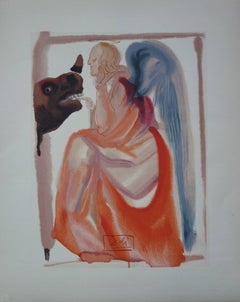
Paradise 6 - The Heaven of Mercury (Rhinoceros) - woodcut - 1963 (Field p 189)
Located in Paris, IDF
Salvador Dali (1904-1989)
Paradadise 6 - The Heaven of Mercury
From the Divine Comedy (Dante)
Woodcut in color
Signature printed in the plate
1960/63
On BFK Rives vellum 32,8 x 26,4...
Category
1960s Modern Figurative Prints
Materials
Woodcut
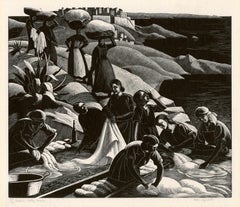
'Washing Clothes, Corsica' — 1st Edition, Modernist Signed Wood Engraving
Located in Myrtle Beach, SC
Clare Leighton, 'Washing Clothes, Corsica, 1934, wood engraving, edition 60, Boston Public Library 258. Signed, titled, and numbered '20/60' in pencil. A superb, richly-inked impress...
Category
1930s American Modern Figurative Prints
Materials
Woodcut
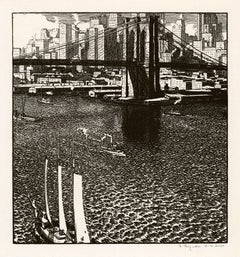
Brooklyn Bridge, NY — Early 20th Century Signed Modernist Wood Engraving
Located in Myrtle Beach, SC
Rudolph Ruzicka, 'Brooklyn Bridge, N. Y.', 1915, wood engraving, edition 35. Signed and annotated 'd. Sc. imp.' (designed, engraved, printed by the artist) in pencil. Numbered 14/35 ...
Category
1910s American Modern Landscape Prints
Materials
Woodcut
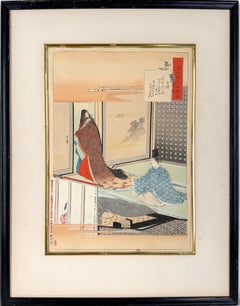
Wood Cut on Rice Paper "The Cicada Shell (Utsusemi)" by Gekko Ogata
Located in Soquel, CA
Wood Cut on Rice Paper "The Cicada Shell (Utsusemi)" by Gekko Ogata
Woodcut is a striking 1892 woodblock print by Meiji-era master Ogata Gekko (Japanese, 1859–1920). It references T...
Category
Late 19th Century Impressionist Figurative Prints
Materials
Printer's Ink, Rice Paper, Woodcut