Questions & Answers
Our trusted network of 1stDibs sellers answer common questions
What is the difference between drypoint and engraving?
1 Answer

The difference between drypoint and engraving is that these two types of prints involve different techniques. An engraving is a print made by incising lines into a metal plate with a sharp tool called a burin. After the image is drawn, the plate is inked, wiped clean, and then firmly pressed to paper so the ink remaining in the incised grooves is transferred. Considerable force is required to mark the metal, so the lines made by engraving tend to be stronger than those made through etching and characterized by gentle tapering. Light and shade have to be created through cross-hatching since the technique is line-based. Drypoint is similar to engraving in that an artist incises a metal plate with a sharp tool. As the metal is carved, metal shavings, also called the burr, build up in the grooves. But unlike with engraving, the burr is not cleaned away with drypoint, resulting in very soft, velvety lines. Since the burr slowly wears away with each printing, fewer impressions can be made, and the first impression tends to be stronger than the last, a characteristic that sets the technique apart from many other printing methods. Explore a selection of engravings and drypoint prints on 1stDibs.
1stDibs ExpertOctober 7, 2024
Related Questions
- How do wood engravings differ from woodcuts?1 Answer
- What is the difference between a bevel and chamfer?1 Answer
- What is the difference between a bracket and a corbel?1 Answer
- What is the difference between a buffet and a sideboard?1 Answer
- What is the difference between a bangle and a bracelet?1 Answer
Shop for Drypoint Prints and Multiples on 1stDibs
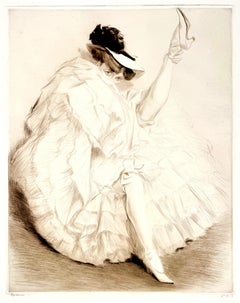
Mademoiselle Cyclone
Located in Middletown, NY
A wonderful, rare image by a pivotal 19th century Printmaker whose work serves as a bridge between social realism and the exuberant, often gritty glamour of Parisian cabaret culture....
Category
Early 20th Century French School Figurative Prints
Materials
Drypoint, Etching
Stag, Kate Boxer, original print
By Kate Boxer
Located in Deddington, GB
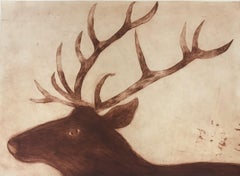
Paper sizes may vary. Stag is a limited edition drypoint etching by artist and printmaker, Kate Boxer. The warm tones of the work and delicate use of line highlights the magnificence...
Category
21st Century and Contemporary Minimalist Animal Prints
Materials
Drypoint
'Riders at Sundown' — Mid-Century Southwest Regionalist Signed Aquatint
By Gene Kloss
Located in Myrtle Beach, SC
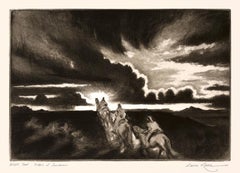
'Riders at Sundown', aquatint and drypoint, edition 75, 1953, Kloss 451. Signed, titled, and annotated 'Artist's Proof' in pencil. A superb, richly-inked, atmospheric impression, in ...
Category
1950s American Modern Landscape Prints
Materials
Drypoint, Aquatint
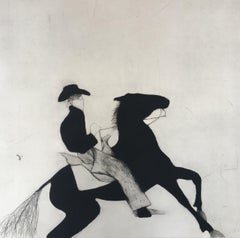
Cowboy, Kate Boxer, original print
By Kate Boxer
Located in Deddington, GB
Cowboy is a limited edition drypoint etching made with carborundum on paper by printmaker and artist, Kate Boxer. The classic black and white artwork is somewhat reminiscent of the o...
Category
21st Century and Contemporary Minimalist Animal Prints
Materials
Drypoint
Notre-Dame Cathedral from the Seine
Located in Middletown, NY
Etching with drypoint on cream wove paper, 7 x 8 3/4 inches (177 x 223 mm); sheet 10 1/2 x 11 3/4 inches (267 x 300 mm), full margins. Signed V. E. Chapel and numbered 62/250 in penc...
Category
Early 20th Century French School Landscape Prints
Materials
Etching, Drypoint

I Won't Eat You, original print, Kate Boxer
By Kate Boxer
Located in Deddington, GB
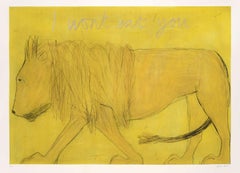
I Won't Eat You by Kate Boxer is a limited edition drypoint etching. This contemporary art print with gouache depicts a lion and is a humorous work of art by Kate Boxer. Kate Boxer m...
Category
2010s Contemporary Animal Prints
Materials
Drypoint