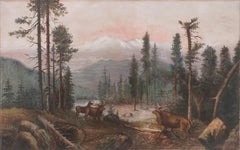
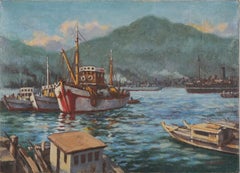
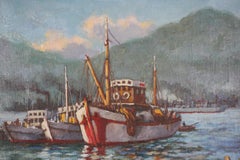
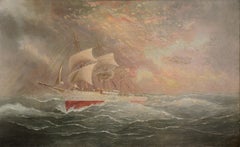
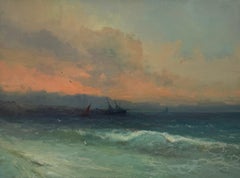
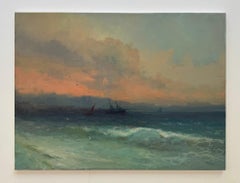
Turn of 20th Century Spanish-American War Coast Guard Cutter with Cannons Original Oil Painting
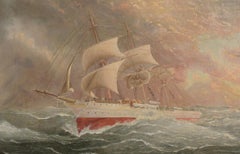
A fine example of maritime ship portraiture oil painting of a Coast Guard Cutter with cannons under sails during the Spanish American War by renowned Nautical British/American painter Captain William Lindsay Challoner (British/American 1852-1901), 1901. Auction values Luminous and striking painting with seaman unfurling sails heading into rough waters. Challoner served as captain of a naval vessel (Coast Guard Cutter) during the Spanish-American War. Here he is depicted on the deck of the ship while seamen scramble aloft on the rigging during a gale. The captain stands tall before the cannons at the ready to fend off intruders. His paintings are rare and highly prized by museums and Nautical collectors alike.
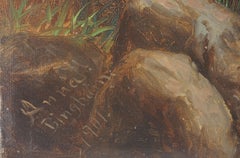
Signed: Lower right corner "W. Challoner"
Not framed
Dated: "1910"
Provenance: A local Monterey Bay area estate find.
Condition: Professionally restored (conservation report available)
Image size: 27.75"H x 47.38"W
William Lindsay Challoner lived the peripatetic life of a mariner, spending much of his time at sea, and in ports such as New Orleans and San Francisco, California. He was born in Bedminster, England, and attended the York Naval Academy. In 1880, Challoner married Mary Cadogan. That same year, the couple immigrated to Argentina and then New Orleans. They had one son, William Lindsay Challoner, Jr.
Lloyd’s Lists record Challoner as master aboard J.P. Macheca, a “Clipper Schooner” running bananas from Jamaica during the mid-1880s. The clipper also raced at the Southern Yacht Club in New Orleans. As is often the case, Challoner’s middle name is misspelled as “Lindsey” in J.P. Macheca & Co. records. He is also said to have served as captain for vessels in the Morgan Line.
Painting was at first an avocation for Challoner, but his draftsmanship and handling of paint suggest academic training. He may also have learned to make precise topographical drawings at the York Naval Academy. Many of his ship portraits are in the English tradition, notably followers of Samuel Walker, a leading English maritime artist in the 1850s. Like his Liverpool counterparts, Challoner used receding linear and atmospheric perspective to focus on the crisp portraits of specific ships. At their best, his canvases are highly finished, a style that imitates the Venetian tradition of topographical city views associated with Giovanni Antonio Canal, also known as Canaletto. However, Challoner’s restrained bravura paint handling also may bear witness to the influence of the French Impressionists.
Challoner seems to have arrived in New Orleans about 1880. He advertised in the press and exhibited at the Creole Art Gallery and Grunewald’s Music Store in New Orleans. In 1887, Challoner moved to San Francisco, where he exhibited his maritime scenes at the Mechanic’s Institute and became a U.S. citizen. He may have been back in New Orleans after 1891, and served as captain of a naval vessel during the Spanish-American War. His art clients tended to be men involved in the shipping industry—ship owners and commission merchants, along with professional clubs and maritime benevolent societies.
Challoner’s principal competition in New Orleans was August Norieri, a talented ship portraitist and painter of marines. While Norieri lived hand-to-mouth, Challoner drew a handsome salary working as a ship captain, presumably until shortly before his death at the age of 49. Securing the commission for painting the newly founded New Orleans Yacht Club suggests that Challoner was held in higher regard as an artist than Norieri. The two artists together met the market demand for ship portraiture and marine views in the port city, as had Edward Arnold and James Guy...
Category
Early 1900s American Impressionist Art by Medium: Linen
MaterialsLinen, Oil, Stretcher Bars