By Icilio Federico Joni
Located in Sutton Poyntz, Dorset
Icilio Federico Joni.
Italian ( b.1866 - d.1946 ).
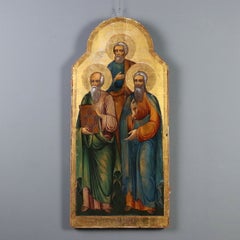
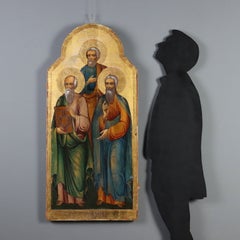
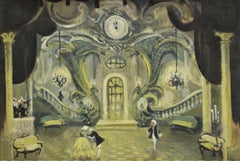
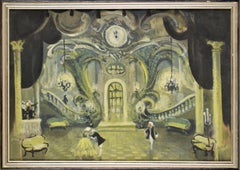
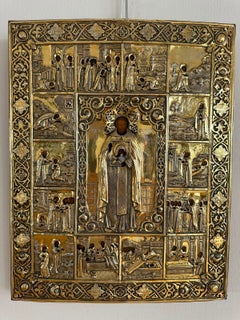
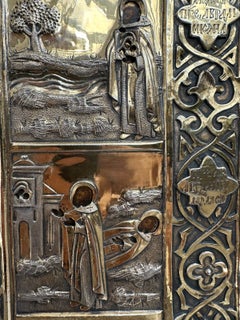
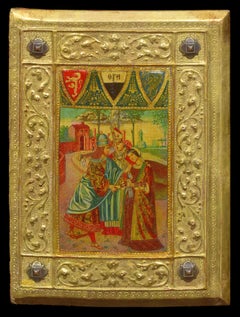
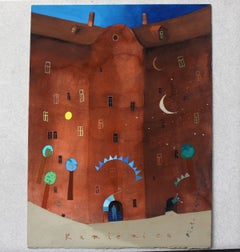
Painted Gesso, Gilt & Wood Tavolette Book Cover Binding In The Sienese Biccherna Aesthetic.
Book Cover size 11 inches x 8.1 inches ( 28cm x 20.5cm ).
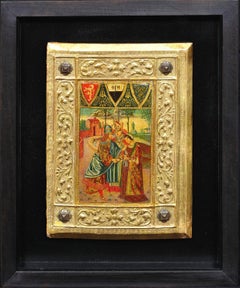
Frame size 16 inches x 13 inches ( 40.5cm x 33cm ).
Available for sale; this painted gesso and gilt “tavolette” wooden book cover in the Biccherna aesthetic is by Icilio Federico Joni.
The book cover is mounted and supplied in a contemporary black Tulip Wood frame (which is shown in these photographs) which is glazed with non-reflective Tru Vue UltraVue® UV70 glass. The wooden book cover is curved and float mounted giving a wonderful 3D depth to its presentation.
The gesso and painted surfaces have benefitted from professional restoration which was performed on our instruction, supervision and approval.
This antique book cover is in very good condition, commensurate with its age.
The frame presentation is new and in excellent condition. Combined, it wants for nothing and is supplied ready to hang and display.
The story of these panels and of their artist is fascinating, and begins in 13th century Siena:
The Biccherna was the person who held the position of Magistrate of Chancellery of Finance from the 13th to the 14th century for the republic and the city of Siena, in the Tuscany region of Italy. The records of that office were very important because Siena was one of the earliest and most significant banking centres in Italy, and indeed in Europe. It became the fashion to keep banking and taxation records of the region in large books with painted leather covers. These were originally made from wood and leather. In the competition to make these ever more prestigious the bindings and panels on the front and rear of the books were painted by the major artists of the day, such as Giovanni di Paolo. Many of these mainly secular covers are displayed in the Archives of the State of Siena located in the Palazzo Piccolmini.
The Gothic Revival of the 19th century occurred partly as a reaction against the progress of industrialisation in Europe generally. It was however greatly affected by the unification of Italy in the second half of the 19th century. This led to the closure and downsizing of many religious institutions, which resulted in the dispersal of thousands of works of art dating from the Middle Ages and early Renaissance. Many aristocratic and bourgeois families struggled to pay debts or simply to make ends meet and so they sold off their private collections and family heirlooms. There was then an influx of goods into the antiques market which provided a great deal of work for Italy’s restorers and craftsmen, since many of these pieces were in need of cleaning, repair and, in keeping with the interventionist tastes of the times, radical restoration, before they could be sold on, often to foreign buyers. These early Italian works became so fashionable that demand soon outstripped supply. This in turn gave rise to a new type of artist-craftsman capable of turning out from scratch increasingly convincing reproductions, imitations and out-and-out fakes.
Siena naturally became the epicentre of this thriving cottage industry because of the extraordinary continuity there in traditional craft skills. This technical expertise had been handed down from generation to generation, and it was perhaps inevitable that a number of artists with real talent, the flair of commerce and a genuine love and understanding of antique Sienese art should adapt their skills to these new market conditions. Among these artists were Igino Gottardi, Alceo Dossena, Fulvio Corsini, Umberto Giunti...
Category
Late 19th Century Renaissance Tempera More Art
MaterialsGesso, Oil, Tempera, Wood Panel