By Kyra Markham
Located in New York, NY
Kyra Markham
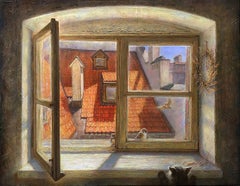
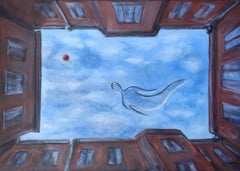
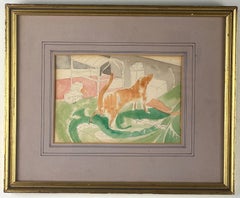
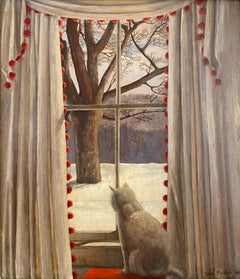
Looking Out the Window, Vermont, 1947
Signed and dated lower right
Oil on board
20 x 16 inches
Kyra Markham was an actress, figurative painter and printmaker. Markham was briefly married to the architect Frank Lloyd Wright, and five years later, married the scenographer David Stoner Gaither. She worked for the Federal Arts Project, creating works of social realism that documented American life in the 1930s. During World War II, her art was focused on the propaganda effort against the Nazis.
Markham was born Elaine Hyman in Chicago, Illinois. She studied drawing at the Chicago Art Institute from 1907 to 1909, and subsequently worked as a muralist and printmaker.
In addition to her work as an artist, Markham was an accomplished actress. She appeared with the Chicago Little Theater from 1909 to the 1920s, with the Provincetown Players from 1916, and in movies in Los Angeles. She lived with the author and playwright Theodore Dreiser in Greenwich Village from 1914-1916, helping him with his writing, editing, and typing. Through Dreiser she became acquainted with H.L Mencken, Edgar Lee Masters, and other writers. Due to Dreiser’s womanizing tendencies, Markham left him in 1916 and moved to Provincetown to escape his desperate pleas of reconciliation. While there, Markham continued acting alongside George Cram Cook, Susan Giaspell, and Eugene O’Neill, who founded the Provincetown Playhouse. During this early stage, Markham supported herself by making bookjackets and illustrations, and later working as an art director for film companies like Fox and Metro.
In 1922 she married the architect Lloyd Wright and briefly had Frank Lloyd Wright as a father-in-law. In 1927, she married David Gaither and collaborated with him on the set design for a children's play, The Forest Ring, staged at the Roerich Museum Theatre in 1930. Gaither encouraged Markham to pursue "her first love, painting." Markham returned to the Art Students League in New York City in 1930, where she studied with Alexander Abels. Before the stock market crash, Markham was a successful bathroom muralist. From the 1920s until the Depression she obtained commercial commissions from clubs and restaurants.
During the 1930s, Markham's artistic career began to gain momentum, regularly winning prizes for her lithographic work. In 1934, Markham organized her first solo exhibition in Ogunquit, Maine, featuring prints, murals and lithographs. Markham created works of social realism depicting street beggars, musicians, actors and scenes from department stores. In recognition of her work, Markham received the prestigious Mary S. Collins Prize at the Philadelphia Print Club's annual exhibition the following year for her lithograph Elin and Maria (1934). Markham sold work to the Whitney Museum of American Art, the Library of Congress and the Metropolitan Museum of Art. From 1935 to 1937, she worked in the Graphic Arts Division for the Federal Arts Project, a New Deal program designed to provide employment for artists during the Depression. The Hall of Inventions at the 1939 World's Fair in New York included 40 dioramas by Markham. During World War II she created propaganda satirizing the Nazis and promoting patriotism at home. In 1946 Markham and Gaither moved to an old farmhouse in Halifax, Vermont. Markham stopped making prints after moving to her remote Vermont farm...
Category
1940s American Modern Landscape Paintings