By Jean-Baptiste Wicar
Located in PARIS, FR
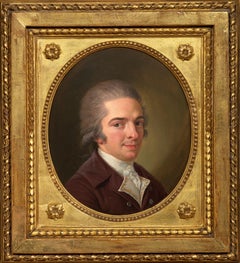
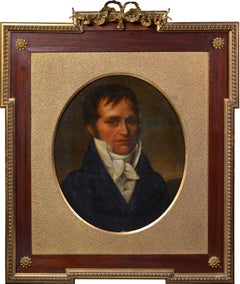
Mrs. Maria Teresa Caracciolo, art historian and specialist of the painter, confirmed after an inspection of the painting that she was in favour of its attribution to Wicar. From a stylistic point of view, we find in this painting the precise and meticulous style of the artist, although no preparatory drawing is known to date.
1. Jean-Baptiste Wicar, disciple and friend of David
Son of a carpenter in Lille, Jean-Baptiste Wicar was first a pupil at the free drawing school of his native town. At the age of 18 he was sent to the workshop of the engraver Jacques-Philippe Le Bas (1707 - 1783), and then admitted in 1781 to the workshop of the painter Jacques-Louis David (1748 - 1825). He accompanied his master to Rome and Florence in 1784-1785 and then stayed on his own in Italy from 1787 to 1793.
Back in Paris in 1793, he was appointed curator of the section of antiques at the Museum thanks to David. In 1795, Wicar left France for Italy. In 1797, during Bonaparte’s Italian Campaign, he was a member of the Commission in charge of seizing artworks to enrich the French national museums.
A member of the Saint-Luke Academy in Rome (from 1805), he was appointed director of the Royal Academy of Naples from 1806 to 1809, before settling permanently in Rome. In Italy Wicar achieved a real success, as the official portraitist of the Bonaparte family and as a history painter. The Resurrection of the Son of the Widow of Naïm (now in the Lille Museum of Fine Arts) is a perfect example of his large, impeccably executed compositions.
Finally, Wicar was a remarkable collector: his drawings of the masters of the Italian Renaissance are now in the Museum of Fine Arts in Lille, following the bequest he made to the Society of Sciences, Agriculture and Arts of Lille.
2. Description of the work
According to Maria Teresa Caracciolo : "one of the successes of Wicar's painted and drawn work is his portraits [...]. The artist gave 'the best of himself' in these artworks [...]; they are artworks of remarkable aesthetic quality, in which he shows himself to be both an excellent pupil of David and an autonomous artist in his own right".
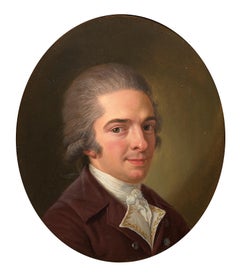
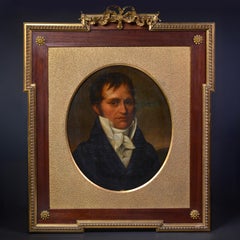
A young man is represented here in three-quarter view on a brown background from which he stands out. He is dressed with great elegance in a plum-coloured jacket with wide lapels. A white waistcoat...
Category
1780s Old Masters Mahogany Figurative Paintings


![[Bruce Sargeant (1898-1938)] Man with Ropes and Rings](https://a.1stdibscdn.com/mark-beard-paintings-bruce-sargeant-1898-1938-man-with-ropes-and-rings-for-sale/a_9323/a_34789511540921014664/Man_with_Ropes_and_Rings_artnet_master.jpg?width=240)