Anthony Van Dyck Art

Flemish, 1599-1641
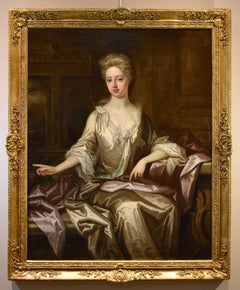
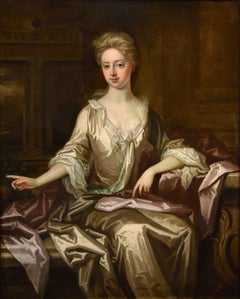
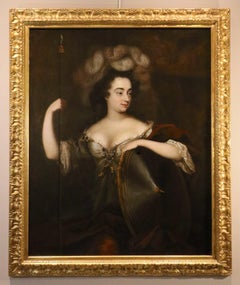
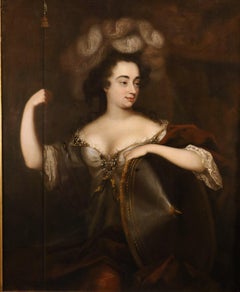
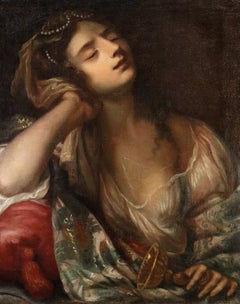
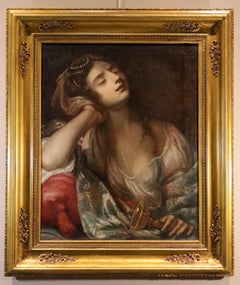
A three-quarter length portrait of Anne, Lady Russell, later Countess of, Attributed to Sir Anthony Van Dyck. Anne Carr, Lady Russell, an esteemed beauty was clearly a favourite of Sir Anthony Van Dyck. There are six portrait types of Lady Russell listed in Miller, et al. It is tempting to associate the current portrait with the three-quarter length in blue in the Egremont collection at Petworth House (Millar IV.22) because of the similarity of colouring. However, we believe that this picture represents a different portrait type, and most likely derives from a separate sitting. The comparison with the short three-quarter length belonging to the Tokyo Fuji Art Museum, Tokyo (Millar IV.23), is telling. The heads are essentially the same, though the pose and the colouring of the portraits are quite different. The Japanese painting features a rose-red gown and a fawn stole, possibly darker than in this painting. This comparison also illustrates Van Dyck's ability to develop different compositions from a single sitting. Dr. Malcolm Rogers CBE FSA believes this painting to be an unfinished work by the artist: "with, as you might expect, preparatory work by a member of his studio. Especially encouraging is the penumbra of thicker paint around the lady's head which is a recognised feature associated with the artist's ad vivum rendering of heads. My notes do not mention a similar penumbra in the Tokyo painting, though the painting is throughout of very high quality. There are one or two slight pentimenti in the silhouette of the figure of your painting and in the line of her stole, which at one point may have been intended to run over her right wrist. Close examination may reveal more. Some areas of the draperies, especially the linens are not fully realised, and, of course, the background is only roughed in. Millar suggests that the Tokyo painting with its loose gown and protective hands may indicate that the sitter is pregnant. The gown is similarly loose in [this] painting. If she is indeed pregnant this might suggest a date around 1638 or 1639, in which years the first two of her eleven children were born. I cannot explain why the painting was left unfinished, but it is, must be, a distinct possibility that this is the very portrait of Lady Bedford that remained in Van Dyck's studio at the time of his death (see C. Brown and N. Ramsay, 'Van Dyck's Collection: Some New Documents', Burlington Magazine, Vol. 132, pp. 704-9)." Dimensions: 53 1⁄8 in (H) x 43 1⁄4 in (W) Provenance: Picture probably listed in contents of van Dyck’s studio at time of death December 1641 (O. Millar, Van Dyck, A complete catalogue of the paintings, New Haven and London, 2004, under no. IV.23); The most Reverand Dean of Durham, possibly William Lake (1817-1897); Charles Sedelmeyer, 1906, as 'Sir Anthony van Dyck'; Colonel Edward F Simms of Kentucky; H. Kenneth Franzheim; Kenneth Franzheim II; Thence by descent to Sabrina Franzheim (current owner).
to
2
2
Overall Width
to
Overall Height
to
4
3
3
1
3
2
1
1
1
1
1
3
3
2
2
1
4
11,411
2,867
2,494
1,538
2
4
Artist: Anthony Van Dyck
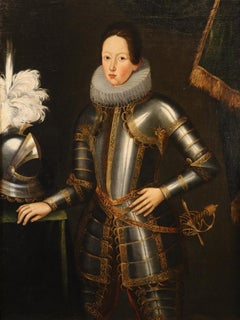
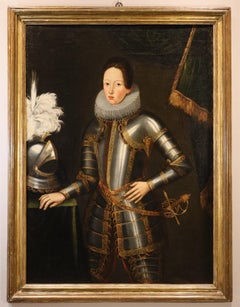
Portrait of a Royalist Officer in Armour with Horse & Groom c.1650–1665, Large

Portrait of a Royalist Officer in Armour with Horse & Groom c.1650–1665, Large

By Anthony van Dyck

Located in London, GB

Portrait of a Royalist Officer in Armour, with a Horse and Groom Beyond, c.1650–1665 Follower of Sir Anthony van Dyck (Anglo-Flemish School) (1599-1641) This commanding portrait bel...

Category

17th Century Old Masters Anthony Van Dyck Art

Materials

Canvas, Oil

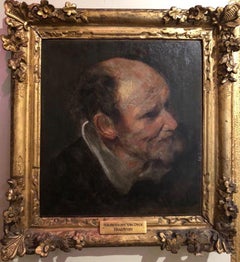
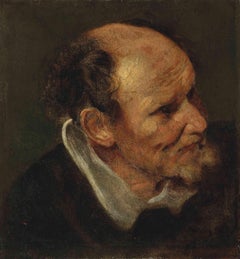
Sir Anthony Van Dyck 17th Century Oil Painting Study of a Head of a Man

Sir Anthony Van Dyck 17th Century Oil Painting Study of a Head of a Man

By Anthony van Dyck

Located in London, GB

Sir Anthony Van Dyck (1599-1641, Flemish) Study of a Head of Man Circa 1627-32, Van Dyck’s second Antwerp period Oil on paper, laid down on canvas Dimensions 15 x 14 inches (38.1 x 3...

Category

17th Century Old Masters Anthony Van Dyck Art

Materials

Oil
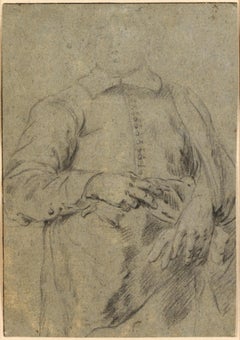
Portrait Study of a Standing Man, Chalk on Laid Paper, 17th Century

Portrait Study of a Standing Man, Chalk on Laid Paper, 17th Century

By Anthony van Dyck

Located in Paris, Île-de-France

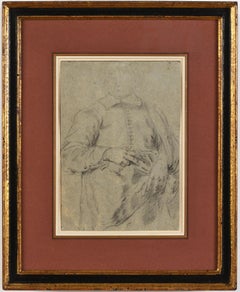
Anthonius VAN DYCK (1599–1641) A portrait study of a standing man Black and white chalk on bluish green paper, 25.4 × 17.5 cm Unsigned Provenance Collection Julius Samuel Held (1...

Category

17th Century Old Masters Anthony Van Dyck Art

Materials

Chalk, Laid Paper

Related Items
Portrait of an Old Bearded Man

Portrait of an Old Bearded Man

By Christian Wilhelm Ernst Dietrich

Located in Stockholm, SE

We are pleased to offer a captivating portrait, most likely painted in the late 18th century, attributed to an artist within the circle of Christian Wilhelm Ernst Dietrich. This oil ...

Category

Late 18th Century Old Masters Anthony Van Dyck Art

Materials

Oil, Wood Panel

French school, circa 1840, Portrait of a Gentleman, oil on wood, signed

French school, circa 1840, Portrait of a Gentleman, oil on wood, signed

Located in Paris, FR

French school, circa 1840, Portrait of a Gentleman, monogrammed D.L. on the lower right oil on wood panel 28.8 x 24,8 In a beautiful antique frame : 48 x 43.5 cm This gentleman’s...

Category

1840s Old Masters Anthony Van Dyck Art

Materials

Oil
18th Century portrait oil painting of a lady in an ermine trimmed cloak

18th Century portrait oil painting of a lady in an ermine trimmed cloak

By Sir Godfrey Kneller

Located in Nr Broadway, Worcestershire

Circle of Sir Godfrey Kneller Dutch, (1646-1723) Portrait of a Lady in an Ermine Trimmed Cloak Oil on canvas Image size: 26.5 inches x 22.5 inches Size including frame: 33.5 inches x 29.5 inches A well-executed half-length portrait of a lady painted in a feigned oval, circle of Sir Godfrey Kneller. The use of a feigned oval was a device used in portraiture to give a sense of depth and add an intimacy to the painting, drawing your attention to the sitter. The subject, posed without her wig in the undressed fashion of the day, wears a blue ermine trimmed blue cloak over a white silk robe...

Category

18th Century Old Masters Anthony Van Dyck Art

Materials

Canvas, Oil

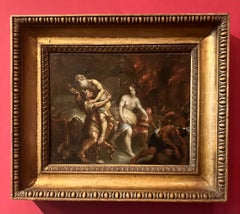
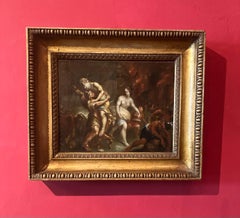
Aeneas Fleeing the Burning of Troy, 17th Century Flemish Oil on Canvas Painting

Aeneas Fleeing the Burning of Troy, 17th Century Flemish Oil on Canvas Painting

Located in Firenze, IT

This oil painting on canvas, created by an artist from the 17th Century Flemish School, depicts one of the most significant scenes from Greco-Roman mythology: Aeneas saving his famil...

Category

17th Century Dutch School Anthony Van Dyck Art

Materials

Canvas, Oil

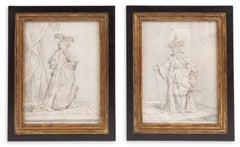
Costume drawings for ‘Ambassadeur de Siam’ and ‘La Sultana Reine’

Costume drawings for ‘Ambassadeur de Siam’ and ‘La Sultana Reine’

Located in Amsterdam, NL

Joseph-Marie Vien (1716-1809) ‘Ambassadeur de Siam’ and ‘La Sultana Reine’ Both titled lower centre, the drawing of the ambassador inscribed with colours intended for the prints, e...

Category

Mid-18th Century Old Masters Anthony Van Dyck Art

Materials

Paper, Pencil

Two royal portraits (the Duc d'Angoulême and the Duc de Berry) by H.P. Danloux

Two royal portraits (the Duc d'Angoulême and the Duc de Berry) by H.P. Danloux

Located in PARIS, FR

These two royal portraits are a major historical testimony to the stay of the Comte d'Artois (the future Charles X) and his family in Edinburgh in 1796-1797. Given by the sitters to Lord Adam Gordon, the Governor of Edinburgh, and kept by family descent to this day, these two portraits provide us with a vivid and spontaneous image of the Duc d’Angoulême and his brother the Duc de Berry. Danloux, who had emigrated to London a few years before, demonstrate his full assimilation of the art of British portrait painters in the brilliant execution of these portraits. 1. Henri-Pierre Danloux, a portraitist in the revolutionary turmoil Born in Paris in 1753, Henri-Pierre Danloux was first a pupil of the painter Nicolas-Bernard Lépicié (1735 - 1784) and then, in 1773, of Joseph-Marie Vien (1716 - 1809), whom he followed to Rome when, at the end of 1775, Vien became Director of the Académie de France. In Rome he became friends with the painter Jacques-Louis David (1748 - 1825). Returning to France around 1782, he settled in Lyon for a few years before returning to Paris in 1785. One of his first portraits was commissioned by the Baroness d'Etigny, the widow of the former Intendant of the Provinces of Gascony, Bearn and Navarre Antoine Mégret d'Etigny (1719 – 1767). He then became close to his two sons, Mégret de Sérilly and Mégret d'Etigny, who in turn became his patrons. In 1787, this close relationship with the d'Etigny family was further strengthened by his marriage to Antoinette de Saint-Redan, a relative of Madame d'Etigny. After his marriage, he left for Rome and did not return to France until 1789. It was during the winter of 1790-1791 that he painted one of his masterpieces, the portrait of Baron de Besenval. Set in a twilight atmosphere, this portrait of an aristocrat who knows that his death is imminent symbolizes the disappearance of an erudite and refined society which would be swept away by the French Revolution. The Jacobin excesses led Danloux to emigrate to England in 1792; many members of his family-in-law who remained in France were guillotined on 10 May 1794. Danloux enjoyed great success as a portrait painter in England before returning to France in 1801. During his stay in England, Danloux was deeply under the influence of English portraitists: his colors became warmer (as shown by the portrait of the Duc d'Angoulême that we are presenting), and his execution broader. 2. Description of the two portraits and biographical details of the sitters The Duc d'Angoulême (1775-1844) was the eldest son of the Comte d'Artois, the younger brother of King Louis XVI (the future King Charles X), and his wife Marie-Thérèse of Savoie. He is shown here, in the freshness of his youth, wearing the uniform of colonel-general of the "Angoulême-Dragons" regiment. He is wearing the blue cordon of the Order of the Holy Spirit, which was awarded to him in 1787, and two decorations: the Cross of Saint-Louis and the Maltese Cross, as he was also Grand Prior of the Order of Malta. Born on 16 August 1775 in Versailles, Louis-Antoine d'Artois followed his parents into emigration on 16 July 1789. In 1792, he joined the émigrés’ army led by the Prince de Condé. After his stay in Edinburgh (which will be further discussed), he went to the court of the future King Louis XVIII, who was in exile at the time, and in 1799 married his first cousin Marie-Thérèse Charlotte of France, the daughter of Louis XVI and the sole survivor of the royal family. The couple had no descendants. He became Dauphin of France in 1824, upon the accession to the throne of his father but played only a minor political role, preferring his military position as Grand Admiral. Enlisted in Spain on the side of Ferdinand VII, he returned home crowned with glory after his victory at Trocadero in 1823. He reigned for a very short time at the abdication of Charles X in 1830, before relinquishing his rights in favor of his nephew Henri d'Artois, the Duc de Bordeaux. He then followed his father into exile and died on 3 June 1844 in Gorizia (now in Italy). His younger brother, the Duc de Berry, is shown in the uniform of the noble cavalry of the émigrés’ Army. He is wearing the blue cordon of the Order of the Holy Spirit, awarded to him in May 1789, and the Cross of Saint-Louis (partly hidden by his blue cordon). Born on 24 January 1778 in Versailles, Charles-Ferdinand d'Artois also followed his parents into emigration and joined the émigrés’ army in 1792. After his stay in Edinburgh, he remained in Great Britain, where he had an affair with Amy Brown...

Category

1790s Old Masters Anthony Van Dyck Art

Materials

Canvas, Oil, Wood Panel

The Card Players by a Flemish 1600s Artist

The Card Players by a Flemish 1600s Artist

By Flemish School, 17th Century

Located in Stockholm, SE

Flemish 1600s School The Card Players oil on oak panel panel dimensions 22.5 x 20 cm frame included Provenance: From a Swedish private collection. Condition: Flat and stabl...

Category

17th Century Old Masters Anthony Van Dyck Art

Materials

Oak, Oil, Panel

Venetian School, late 15th century, Saint Paul the Apostle

Venetian School, late 15th century, Saint Paul the Apostle

Located in Stockholm, SE

Venetian School, late 15th century Saint Paul the Apostle oil on panel unframed 44.5 × 23.5 cm (17.5 × 9.3 in) framed 64 × 42 cm (25.2 × 16.5 in) No signature Provenance: Private ...

Category

15th Century and Earlier Old Masters Anthony Van Dyck Art

Materials

Oil, Wood Panel

Untitled - Blue Landscape With Trees, XX Century Figurative Oil Painting

Untitled - Blue Landscape With Trees, XX Century Figurative Oil Painting

Located in Hallein, AT

Alina Dobrowolska - artist from Gdańsk; graduated from the Academy of Fine Arts in Gdańsk at the Faculty of Painting. She took part in collective and individual exhibitions in Poland...

Category

1990s Contemporary Anthony Van Dyck Art

Materials

Canvas, Oil

18th Century German Old Master Portrait of an Elderly Bearded Man

18th Century German Old Master Portrait of an Elderly Bearded Man

By Christian Wilhelm Ernst Dietrich

Located in Stockholm, SE

Circle of Christian Wilhelm Ernst Dietrich (1712–1774) Germany Head of an Elderly Bearded Man oil on panel unframed 28 × 22.5 cm (11 × 8.9 in) framed 44.5 × 38.5 cm (17.5 × 15.2 in...

Category

Late 18th Century Old Masters Anthony Van Dyck Art

Materials

Oil, Wood Panel

17th Century portrait oil painting of a gentleman

17th Century portrait oil painting of a gentleman

By John Riley

Located in Nr Broadway, Worcestershire

Circle of John Riley British, (1646-1691) Portrait of a Gentleman Oil on canvas Image size: 29 inches x 24 inches Size including frame: 36 inches x 31 inch...

Category

17th Century Old Masters Anthony Van Dyck Art

Materials

Canvas, Oil

Previously Available Items
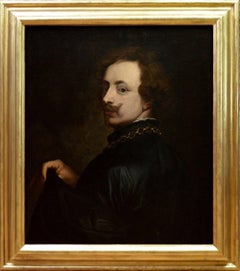
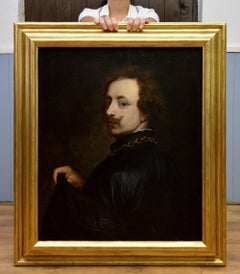
studio of Sir Anthony van Dyck - Self Portrait

studio of Sir Anthony van Dyck - Self Portrait

By Anthony van Dyck

Located in Gerrards Cross, GB

A fine 17th century oil on canvas portrait of the celebrated Flemish artist Sir Anthony van Dyck (1599-1651). With the exception Peter Paul Rubens...

Category

17th Century Old Masters Anthony Van Dyck Art

Materials

Oil
Anthony Van Dyck art for sale on 1stDibs.

Find a wide variety of authentic Anthony Van Dyck art available for sale on 1stDibs. You can also browse by medium to find art by Anthony Van Dyck in canvas, fabric, oil paint and more. Not every interior allows for large Anthony Van Dyck art, so small editions measuring 92 inches across are available. Customers who are interested in this artist might also find the work of Jan Frans van Bloemen (Orizzonte), Sir Godfrey Kneller, and Giovan Battista Viola. Anthony Van Dyck art prices can differ depending upon medium, time period and other attributes. On 1stDibs, the price for these items starts at $94,810 and tops out at $94,810, while the average work can sell for $94,810.

Artists Similar to Anthony Van Dyck

Questions About Anthony Van Dyck Art
  • 1stDibs ExpertOctober 30, 2024
    How much a van Dyck painting is worth varies based on its historical significance, condition and size. At a London auction in 2009, a self-portrait of the artist sold for $13.5 million. Sir Anthony van Dyck was a Flemish Baroque artist who became the leading court painter for Charles I of England. He is best known for his portraits of royalty and aristocracy, most notably Charles I and his family and associates. His style changed considerably between the countries he worked in, culminating in the relaxed elegance of his last English period. Van Dyck widely influenced English portrait painting for the next 150 years, and his influence extended into the modern period. If you own a van Dyck piece, use the services of a certified appraiser or knowledgeable art dealer to learn how much it may be worth. On 1stDibs, find a variety of Baroque art.